How to Write a Grant Proposal: Every Section, Step by Step
How to write a grant proposal, section by section: executive summary, statement of need, goals, methods, evaluation plan, budget, and the attachments funders expect.
Last updated: August 2026
A grant proposal is a structured argument: your organization understands a problem, has a credible plan to address it, can measure the results, and will spend the funder's money exactly as promised. Every section of the proposal exists to carry one part of that argument, and reviewers score each part separately.
This guide walks through the full document in the order reviewers read it. Each section below explains what the component has to accomplish, the mistakes that get proposals rejected, and links to a deeper guide with worked examples and a free template for that component.
Quick Answer: What Are the Sections of a Grant Proposal?
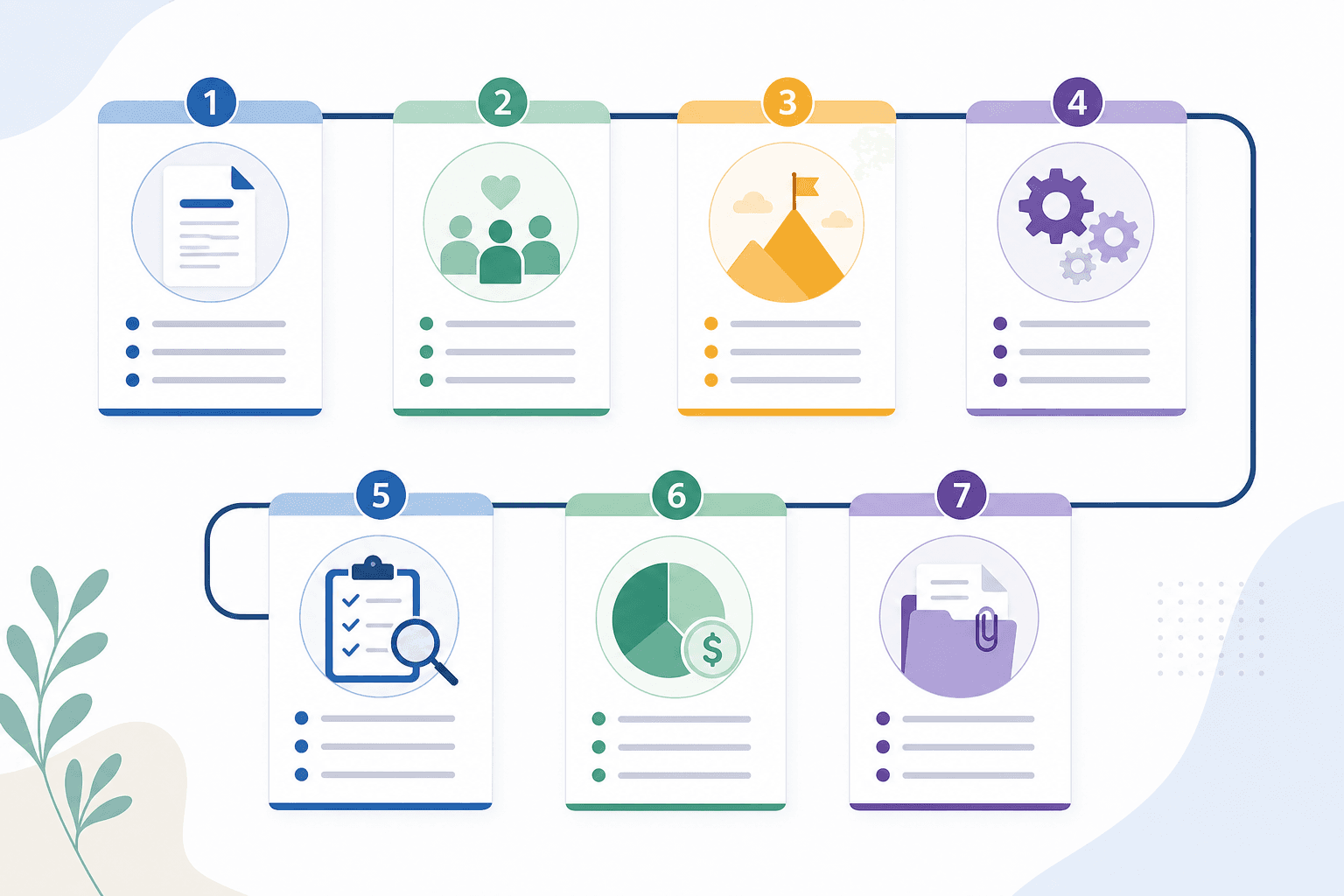
A complete grant proposal contains, in order:
- Cover letter (for foundations) or required federal forms
- Executive summary
- Statement of need
- Goals and objectives
- Program design and methods
- Evaluation plan
- Budget and budget narrative
- Organizational background
- Sustainability plan
- Attachments (501(c)(3) letter, board list, financials, letters of support)
Federal applications add sponsor-specific forms and formats set by the notice of funding opportunity (NOFO) on Grants.gov. Some funders also ask for a letter of intent before inviting a full proposal.
Every Section, With a Worked Example
Each component below links to a dedicated guide with examples you can adapt and a template you can download.
| Section | What it must do | Deep-dive guide |
|---|---|---|
| Letter of intent | Earn the invitation to apply | LOI example and template |
| Cover letter | Frame the ask in one page | Cover letter examples |
| Executive summary | Compress the whole argument | Executive summary examples |
| Statement of need | Prove the problem with data | Statement of need examples |
| Goals and objectives | Make outcomes measurable | SMART goals and objectives examples |
| Logic model | Map inputs to outcomes | Logic model template |
| Evaluation plan | Show how you'll know it worked | Evaluation plan examples |
| Budget | Account for every dollar | Budget template with examples |
| Full sample proposals | See everything assembled | Sample grant proposals and templates |
| Common mistakes | Avoid the usual rejections | Why proposals get rejected |
| First proposal ever? | Start with the basics | Beginner's guide to grant writing |
The grant narrative guide assembles these sections into one annotated draft.
Step 1: Qualify the Opportunity Before You Write Anything
The most expensive grant-writing mistake happens before the first sentence: writing for an opportunity you were never going to win. Before committing 20 to 100 hours, confirm four things.
Eligibility. Read the eligibility section of the guidelines twice. Funders reject ineligible applicants without review, no matter how strong the proposal.
Alignment. Your project has to advance the funder's stated priorities, not just survive contact with them. If you have to stretch the mission to fit, reviewers will notice the stretch.
Capacity. Can you actually deliver the project and its reporting requirements? Federal awards in particular carry administrative obligations under 2 CFR 200, the Uniform Guidance, that small teams routinely underestimate.
Competitiveness. Look at what the funder has actually funded, at what dollar level, in which geographies. Award histories are public for federal grants on USAspending.gov and, for foundations, in their IRS Form 990-PF filings.
This qualification step is the part of the process GrantCue automates: its AI fit scoring reads an opportunity against your organization's profile and shows the evidence for and against pursuing it, so the go/no-go decision takes minutes instead of a staff meeting.
If the funder turns out to be a business or an individual rather than a grantmaker, a donation proposal is the right document instead.
Step 2: The Letter of Intent (When One Is Required)
Many foundations screen with a one-to-two-page letter of intent (LOI) before inviting full proposals. The LOI is not a summary of a proposal you haven't written; it is a pitch built from the same argument — problem, plan, capacity, cost — at one-tenth the length.
Keep it to the funder's stated page limit, lead with alignment, and give one concrete number for the problem and one for the ask. The LOI guide has a full example and a template with the standard structure.
Step 3: The Executive Summary — Write It Last, Place It First
The executive summary is the most-read section of the proposal, and for skimming reviewers it may be the only one read closely. It compresses the entire argument into half a page: the problem, your solution, who benefits, what it costs, and why your organization is the one to do it.
Write it after every other section is final, so the numbers can't drift out of sync — a mismatch between the summary's budget figure and the budget page is one of the fastest credibility killers in grant review.
The executive summary guide breaks down three worked examples sentence by sentence. Note that a proposal executive summary is a different document from the executive summary of an annual report or business plan; if you need the organizational version, see the nonprofit executive summary guide.
Step 4: The Statement of Need — Prove the Problem
The statement of need has one job: establish, with evidence, that a specific problem exists at a specific scale in a specific place, and that the people affected can't wait. It is the emotional and evidentiary core of the proposal, and it is where reviewers first decide whether you actually know your community or are writing from a template.
Three rules separate funded need statements from rejected ones:
- Cite data, not adjectives. "Unemployment in the county is 9.4%, against a state average of 4.1%" beats "unemployment is devastating our community" every time. Census data, state agency reports, and your own intake numbers all work.
- Describe the need, not your lack of funding. The problem is in the community; your budget gap is not the funder's problem.
- Connect the need to your solution. Every statistic you cite should point at something your program design answers.
The statement of need guide includes annotated examples and the public data sources reviewers trust.
Step 5: Goals and Objectives — Make Success Measurable
Goals state the change you intend; objectives make it countable. The convention that satisfies nearly every reviewer is SMART objectives: specific, measurable, achievable, relevant, and time-bound.
Weak: "Improve food security for local families."
Fundable: "Provide 2,400 households with weekly groceries by June 30, 2027, reducing self-reported food insecurity among participants by 30% on the USDA six-item screener."
Two to four objectives per goal is the sweet spot. More than that and the evaluation plan becomes unmanageable — and reviewers know it. The goals and objectives guide has worked examples across program types.
Step 6: Program Design, Methods, and the Logic Model
The methods section explains what you will actually do: the activities, the sequence, the staffing, and the timeline. Reviewers read it for feasibility — does this team, at this budget, deliver these activities on this calendar?
The strongest methods sections are boring in the best way: month-by-month timelines, named roles with time allocations, and activity descriptions concrete enough to audit. Save the vision language for the need statement.
Many funders, and most federal agencies, also expect a logic model: a one-page table mapping inputs → activities → outputs → outcomes → impact. It is the fastest way for a reviewer to check that your objectives, activities, and evaluation measures actually connect. Build it with the logic model template before writing the methods narrative — it will expose gaps while they're still cheap to fix.
Funders also ask what happens when their money stops; a sustainability plan answers that question honestly.
Step 7: The Evaluation Plan — Show How You'll Know It Worked
Funders increasingly weight evaluation as heavily as program design, because it's how they justify their own spending. A complete evaluation plan answers four questions:
- What will you measure? Tie every measure to an objective.
- How will you collect it? Instruments, frequency, and who is responsible.
- What counts as success? State the thresholds in advance.
- What happens to the findings? Reporting to the funder, and course-correction internally.
Process measures (did you deliver the activities?) and outcome measures (did anything change?) both belong in the plan. The evaluation plan guide includes examples for both, plus the reporting-cadence table most federal programs expect.
Step 8: The Budget — Where Proposals Are Actually Won and Lost
Reviewers with program-officer experience often read the budget first, because it's where the real plan lives. A credible budget does three things:
- Matches the narrative exactly. Every activity in the methods section costs something; every line item traces to an activity.
- Shows the math. "Program coordinator, 0.5 FTE × $52,000 = $26,000" — not "$26,000, personnel."
- Handles indirect costs correctly. Federal awards let you apply a negotiated indirect cost rate or the de minimis rate under the Uniform Guidance; foundations set their own caps. Know which regime you're in before you build the spreadsheet.
The budget narrative walks the funder through each line in prose, justifying anything a reviewer might question. The budget template guide includes a formula-driven spreadsheet with a narrative sheet built in.
Most funders also expect a budget narrative explaining each line; write it with the budget, not after.
Step 9: Organizational Background, Sustainability, and Attachments
Organizational background answers "why you": your track record with similar programs, relevant staff qualifications, and financial health. Keep it to results, not history — funders care what you've delivered, not what year you incorporated.
Sustainability answers the question every funder asks about every program: what happens when our money ends? Diversified funding plans, earned-revenue components, and institutional commitments all work; "we will seek additional grants" alone does not.
Attachments are where compliant proposals die at the deadline: the IRS determination letter, board list, current operating budget, audited financials, and letters of support all have to be current and in the requested format. Build the attachment checklist the day you decide to apply, not the week it's due.
Partner commitments belong in letters of support, which carry weight when they name specific resources and dates.
Step 10: Review, Submit, and Track What Happens
Before submission, run the proposal past someone who hasn't worked on it, against the funder's own review criteria. The common mistakes guide catalogs the rejection reasons reviewers report most: ineligible requests, budget-narrative mismatches, missed formatting requirements, and generic boilerplate that ignores the funder's priorities.
For federal submissions, register early — SAM.gov registration and renewal can take weeks, and Grants.gov workspace setup has its own lead time. Submit at least 48 hours before the deadline; portal outages the final afternoon are a grant-writing tradition.
Then track the outcome either way. Rejected proposals with reviewer comments are the cheapest professional development available — request the comments, log them, and reuse the strongest sections. Teams that manage their proposals as a pipeline, with deadlines, owners, statuses, and next actions in one place, consistently outperform teams working from a spreadsheet and a shared drive. That pipeline layer — deadlines, tasks, team assignments, and document versions per opportunity — is what GrantCue's grant management features handle, alongside the discovery and fit-scoring that decide what enters the pipeline in the first place.
How Long Does a Grant Proposal Take to Write?
Plan on 15 to 25 working hours for a standard foundation proposal and 60 to 120 hours for a competitive federal application, spread over four to eight weeks. The variance is mostly in three places: how much of the need-statement data you already have, whether your budget model exists or has to be built, and how many attachment documents need updating.
First-timers should double those estimates and start with a smaller foundation ask — the beginner's guide covers how to scope a first proposal you can actually finish.
The grant proposal timeline guide has both documents: the backward-planned writing schedule and the project timeline that goes inside the proposal.
FAQ
What is the most important section of a grant proposal?
The statement of need, narrowly ahead of the budget. The need statement is where reviewers decide whether the problem is real and urgent; the budget is where they decide whether you can be trusted to solve it. A weak version of either loses proposals that are strong everywhere else.
What order should I write the sections in?
Qualify the opportunity, then write in this order: logic model, goals and objectives, methods, evaluation plan, budget, statement of need, organizational background, sustainability — and the executive summary last, once every number is final. You present them in the funder's required order, which is different from the order you write them.
How is a federal proposal different from a foundation proposal?
Federal proposals follow the NOFO's mandated structure, forms, and page limits exactly, are scored against published criteria by panels, and carry post-award compliance obligations under the Uniform Guidance. Foundation proposals are shorter, less standardized, and more relationship-driven — but the underlying argument (problem, plan, measurement, cost) is identical. The sample proposals guide includes examples of both.
Can AI write my grant proposal?
AI is genuinely useful for first drafts of boilerplate sections, plain-language rewrites, and compressing a finished proposal into an executive summary. It cannot know your community data, your program design, or your funder's history — the parts that win. Use it to accelerate the writing, not to replace the argument. GrantCue's AI fit scoring sits earlier in the process: it evaluates whether an opportunity is worth writing for at all, and shows its evidence.