Grant Proposal Executive Summary: How to Write One, With 3 Templates
Download the free templateHow to write a grant proposal executive summary: what goes in it, how long it should be for each kind of funder, a five-sentence framework, three templates and a before-and-after rewrite.
In this article (18)
- Quick Answer: What Is a Grant Proposal Executive Summary?
- What Goes in a Grant Proposal Executive Summary
- The 5-Sentence Executive Summary Framework
- Example 1: Foundation Grant Executive Summary
- Example 2: Federal Grant Executive Summary
- Example 3: Executive Summary for a $25,000 Local Grant
- Executive Summary Format
- Executive Summary Templates by Proposal Type
- How Long Should a Grant Executive Summary Be?
- What To Change When the Summary Is Too Long
- Before and After: Rewriting a Weak Executive Summary
- What To Pull From the Full Proposal
- Make the Executive Summary Easy to Review
- Executive Summary Checklist
- Common Mistakes
- How This Fits Into the Full Grant Proposal
- FAQ
- Test the Summary on Someone Who Has Not Read the Proposal
A grant proposal executive summary is a short overview of your funding request. It explains the problem, your project, the amount requested, the people served, and the measurable results the funder can expect, so that someone who reads only this section understands the whole request.
If you are building the full application, use this guide alongside the complete grant proposal template. The executive summary previews the proposal; it never introduces ideas that do not appear anywhere else.
One scope note before the examples. This guide covers the executive summary section of a grant proposal. If you need a summary of the organization itself, for an annual report or a board packet, use this nonprofit executive summary example instead.
Quick Answer: What Is a Grant Proposal Executive Summary?
A grant proposal executive summary is a short overview, placed before the narrative, that states who is asking, how much and for how long, what the project does, whom it serves and where, the need it answers, the measurable results expected, and why the applicant can deliver. The funder's instructions set its length.
What Goes in a Grant Proposal Executive Summary
A grant proposal executive summary carries seven elements, each in a sentence or less. The table lists them in one workable order.
Good executive summaries are specific, short, and easy to scan. An executive summary only works if the proposal behind it holds up, and our section-by-section guide to writing a grant proposal covers the rest of the document.
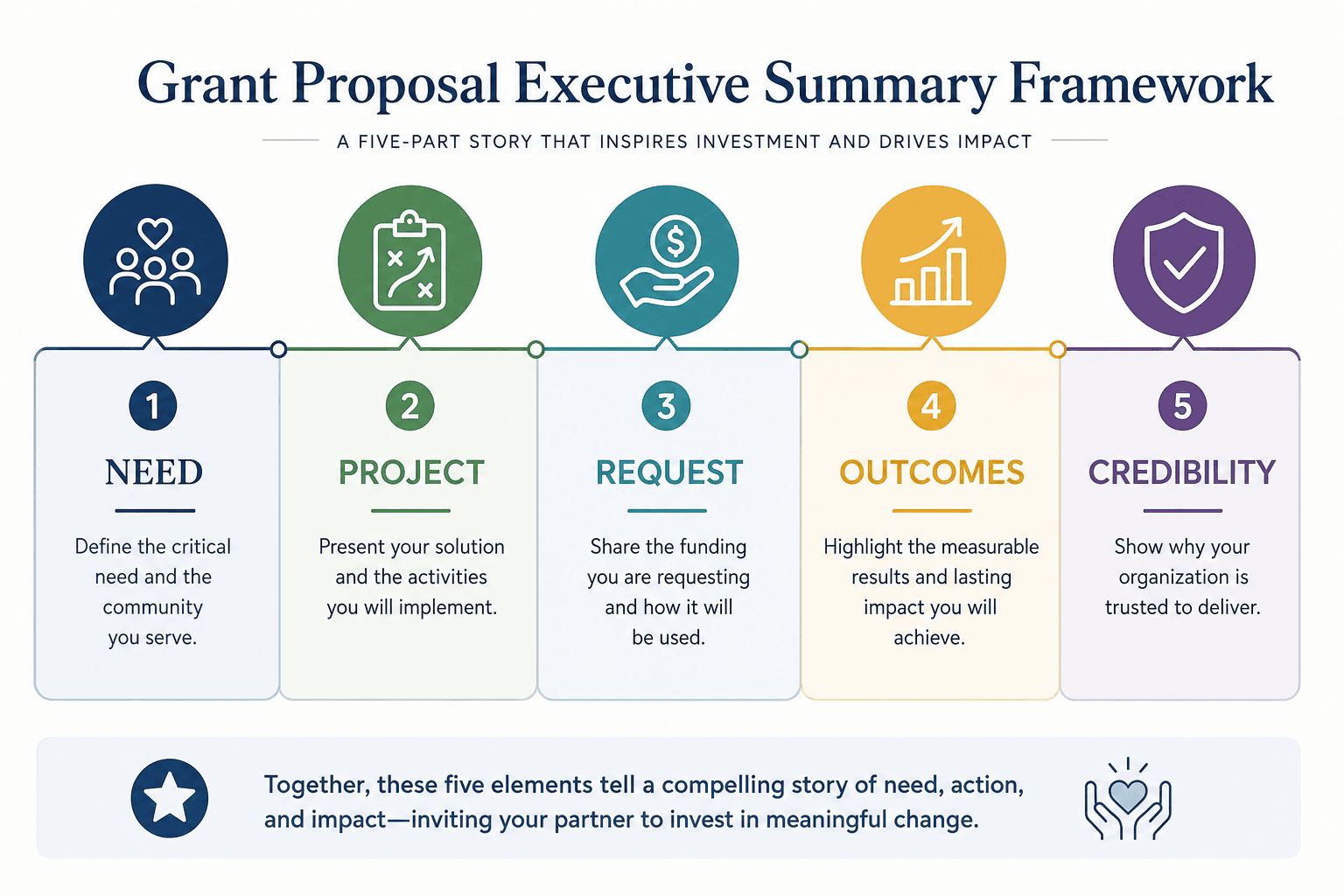
The 5-Sentence Executive Summary Framework
The five-sentence framework is a drafting order that puts one element in each sentence. Use it when you need to draft quickly:
- Need sentence: Identify the problem, who it affects, and where the need appears.
- Project sentence: Explain what your organization will do and why that response fits.
- Request sentence: State the funding amount and grant period.
- Outcome sentence: Name the measurable results.
- Credibility sentence: Show why your organization can deliver.
Template:
[Organization Name] requests [$Amount] from [Funder Name] to support [Project Name], a [program type] serving [population] in [location]. The project responds to [specific need/data point]. Grant funds will support [major activities or cost categories]. Over [time period], the program will [outputs and outcomes]. [Organization Name] is positioned to deliver this work because [brief credibility point].
This structure keeps the executive summary connected to the rest of the proposal. It gives the reader a direct answer to the question: what is the project, and why should it be funded?
Example 1: Foundation Grant Executive Summary
This example uses a composite applicant, Example Literacy Partners (composite), writing to a composite community foundation.
Example Literacy Partners requests $75,000 from the Example Valley Community Foundation to support the Family Literacy Bridge Project, a 12-month tutoring and caregiver engagement program serving 120 elementary students in two rural schools. District benchmark data shows that 43 percent of third-grade students in the target schools are reading below grade level, limiting their long-term academic success. Grant funds will support part-time reading tutors, bilingual family workshops, curriculum materials, transportation support, and evaluation activities. By the end of the grant period, at least 80 participating students will improve by one reading level or more, and 75 caregivers will complete at least three literacy workshops. Example Literacy Partners has delivered school-based youth programs for 14 years and will implement the project in partnership with the district's elementary leadership team.
Illustrative figures, not data from a real organization.
Why it works:
- It names the applicant, amount, project, and funder.
- It gives one clear data point.
- It connects grant funds to activities.
- It states measurable outcomes.
- It establishes credibility without becoming a full organization history.
Example 2: Federal Grant Executive Summary
This example uses the composite applicant Example Community Health Alliance (composite).
Example Community Health Alliance requests $350,000 over 24 months to expand mobile behavioral health screening and referral services for uninsured adults in three medically underserved counties. Local health needs assessment data shows that residents in the service area experience long wait times for behavioral health care, limited transportation options, and high rates of untreated anxiety and depression. Grant funds will support mobile clinic staffing, screening tools, referral coordination, telehealth equipment, and data reporting. The project will provide 2,400 screenings, connect at least 900 residents to follow-up services, and reduce average referral completion time from 45 days to 25 days. Example Community Health Alliance currently operates two mobile care units and has managed state and federal health grants for more than eight years.
Illustrative figures, not data from a real organization.
Why it works:
- It is more operational than promotional.
- It includes service area, population, and implementation capacity.
- It uses outputs and outcomes.
- It previews evaluation and reporting without overexplaining them.
If your federal proposal also needs a deeper compliance structure, connect this summary to your grant proposal evaluation plan and budget justification.
Example 3: Executive Summary for a $25,000 Local Grant
This example uses the composite applicant Example Youth Arts Collective (composite).
Example Youth Arts Collective requests $25,000 to launch Creative Fridays, a weekly arts and mentoring program for 60 middle school students in the harbor district. The project responds to a lack of safe, affordable after-school enrichment options for students whose families cannot pay for private programs. Funding will support teaching artists, art supplies, healthy snacks, student transportation, and a public exhibition of student work. During the 10-month project period, Creative Fridays will provide 30 after-school sessions, help at least 50 students complete a personal art portfolio, and increase participating students' sense of belonging as measured by a pre/post survey. Example Youth Arts Collective has served local youth for ten years and will deliver the program with support from a neighborhood community center.
Illustrative figures, not data from a real organization.
Why it works:
- It does not pretend to be larger than it is.
- It gives a clear program model.
- It includes practical costs.
- It names the community partner.
- It uses realistic outcomes for a smaller award.
Executive Summary Format

The executive summary format below is a five-part order to use when the funder does not specify one.
For most proposals, the executive summary should be one tight section, not a page of subheadings. If the funder allows a longer summary, use short paragraphs or bullets to improve scanability.
Executive Summary Templates by Proposal Type
Different applications call for different levels of detail. Use the version that matches the funder, then tailor it to the actual instructions.
Short Foundation Proposal Template
[Organization] requests [$Amount] to support [Project], a [brief program type] serving [population] in [location]. The project addresses [specific need] by providing [core activities]. During the grant period, [Organization] will [measurable output] and achieve [measurable outcome].
Use this version when the funder asks for a short proposal, a letter-style application, or a simple online form.
Standard Nonprofit Proposal Template
[Organization] requests [$Amount] from [Funder] for [Project Name]. The project will serve [population] in [location], where [need/data point]. Grant funds will support [major activities and cost categories]. Over [time period], the program will [outputs] and [outcomes]. [Organization] brings [experience/partnership/track record], making it well positioned to deliver and report on the project.
Use this version for most foundation proposals and local grant applications. It is long enough to include the major pieces but short enough to stay focused. The full set of sections it previews is laid out in the nonprofit grant proposal template.
Government Grant Summary Template
[Organization] requests [$Amount] over [project period] to implement [Project Name], a [program model] serving [eligible population/geography]. The project responds to [need/data source] and aligns with [program priority or statutory purpose]. Funds will support [allowable cost categories]. The project will produce [outputs] and [outcomes], measured through [evaluation method]. [Organization] has [relevant compliance, fiscal, or program experience].
Use this version when the funder cares about eligibility, compliance, allowable costs, data collection, and formal reporting.
How Long Should a Grant Executive Summary Be?
A grant executive summary is as long as the funder's instructions allow, and no longer; there is no standard word count that applies across funders. When the instructions set a page limit, a character limit on an online form field, or a word count, that limit is the length. When they set none, one paragraph built on the five-sentence framework is enough for most nonprofit requests, and one page is a sensible ceiling. The University of Kansas Community Tool Box describes the abstract or executive summary of a grant application as "typically less than one page" (Community Tool Box, Applying for Grants, read October 2026), and one university sponsored programs office says it "should, in general, be no more than one page though some abstracts are limited to a certain number of words" (Utah Valley University Office of Sponsored Programs, read October 2026).
The kind of document decides how much room the summary gets. Published guidance on letters of inquiry shows the range at the short end.
Sources for the table, each read September 2026: the Gordon and Betty Moore Foundation inquiry guideline, the Institute for Advanced Study LOI guidance, the Ahmanson Foundation letter of inquiry page, and an HRSA notice of funding opportunity (HRSA-24-002).
Do not make the executive summary long because the project is important. Make it long only if the funder asks for more detail. A summary written for a letter of inquiry also does double duty: the guide to a sample letter of intent shows how the same five elements open an LOI.
What To Change When the Summary Is Too Long
When the executive summary runs over the funder's limit, cut in this order:
- Remove background details that belong in the organization section.
- Reduce the need statement to one data point.
- Combine activities into one sentence.
- Keep only the strongest outcome.
- Remove adjectives that do not add evidence.
Do not cut the funding amount, target population, project activity, or outcome. Those are the pieces a reader needs to orient themselves.
Before and After: Rewriting a Weak Executive Summary
A weak executive summary is one a reader cannot act on: it asks for nothing specific and promises nothing checkable. The rewrite below takes a generic nonprofit summary through five fixes, one phrase at a time.
Weak version:
Our organization is seeking funding for an important program that will help children in our area. We have been serving the community for many years and care deeply about improving outcomes. With your support, we can expand our work and make a real difference for families.
Each weak phrase has a specific replacement.
Illustrative figures, not data from a real organization.
Stronger version:
Example Literacy Partners requests $75,000 to support the Family Literacy Bridge Project, a 12-month tutoring and caregiver engagement program serving 120 elementary students in two rural schools. District benchmark data shows that 43 percent of third-grade students in the target schools are reading below grade level. Grant funds will support part-time reading tutors, bilingual family workshops, curriculum materials, and evaluation activities. By the end of the grant period, at least 80 participating students will improve by one reading level or more. Example Literacy Partners has delivered school-based youth programs for 14 years.
Illustrative figures, not data from a real organization.
Why it works:
- It is concrete.
- It answers the basic questions: who, how much, for what, for whom, and with what result.
- It previews the need, activities, budget, and outcomes.
- It can be verified in the rest of the proposal.
The rewrite also drops "care deeply," which tells the funder nothing it can score. Commitment shows in the numbers and the track record, not in the adjectives.
What To Pull From the Full Proposal
The executive summary should not be written in isolation. Pull each detail from the section of the full proposal that already holds it:
If your need statement is still fuzzy, pause and improve it using this statement of need example. If the request amount is not clear, build the numbers with a grant proposal budget template before finalizing the summary.
A complete annotated grant narrative example shows what the full document looks like before you compress it.
Make the Executive Summary Easy to Review
An executive summary is easy to review when the request, project, need, and outcomes are clear without the reader hunting through the full proposal.
For this section, use:
- The exact project name.
- The exact organization name.
- The exact funding amount.
- The target population and geography.
- The grant period.
- One measurable output.
- One measurable outcome.
- One concise credibility statement.
Avoid:
- "This project" when the project name has not been stated.
- "Our community" without naming the place or population.
- "Many people" instead of a number or defined group.
- "Better outcomes" without naming the outcome.
Example of vague language:
This program will help many families access support and improve their lives.
Clear reviewer-friendly language:
The Family Literacy Bridge Project will serve 120 elementary students in two rural schools and help at least 80 participating students improve by one reading level or more by the end of the 12-month grant period.
Illustrative figures, not data from a real organization.
This version is easier to evaluate, summarize, and reuse in reports.
Executive Summary Checklist
Before submitting, confirm the summary includes:
- Organization name.
- Project name.
- Funding amount.
- Grant period.
- Target population.
- Location.
- One clear need or data point.
- Main activities.
- Measurable outcomes.
- One credibility point.
- No unsupported claims.
- No jargon that only your team understands.
Common Mistakes
Each of these five mistakes has a one-line fix.
Mistake 1: Opening With a Mission Statement
Your mission matters, but the first sentence should usually identify the request and project. A reader needs to know what is being asked before why it matters.
Better:
Example Literacy Partners requests $75,000 to support the Family Literacy Bridge Project.
Illustrative figures, not data from a real organization.
Mistake 2: Making the Need Too Broad
Avoid broad claims like "students are struggling" or "families need support." Use one specific data point and one specific population.
Better:
District benchmark data shows that 43 percent of third-grade students in the two target schools are reading below grade level.
Illustrative figures, not data from a real organization.
Mistake 3: Hiding the Funding Request
Do not make the reader search for the amount. Put it in the first sentence or first paragraph.
Mistake 4: Listing Activities Without Outcomes
Activities explain what you will do. Outcomes explain what will change. A strong summary includes both.
Mistake 5: Promising Too Much
Executive summaries get weaker when they overpromise. Use outcomes your team can reasonably measure and deliver.
How This Fits Into the Full Grant Proposal
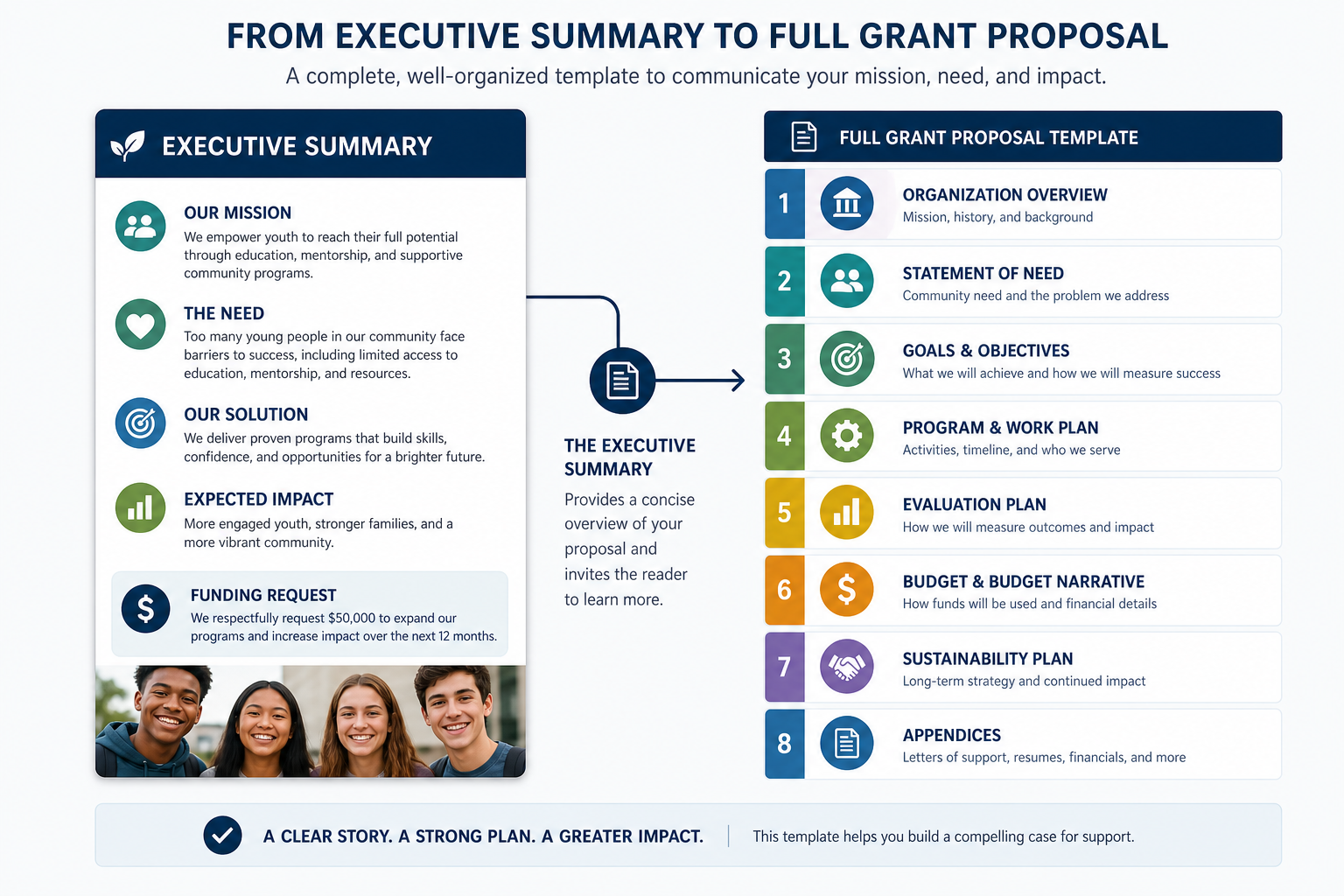
The executive summary is the front door to the full proposal. It connects directly to the narrative, the need statement, the goals and objectives, the evaluation plan, the budget, and the sustainability plan. If a detail appears in the executive summary, the full proposal should support it. If the full proposal includes a major point that does not appear in the summary, decide whether the summary needs a revision.
GrantCue includes AI writing tools for proposal sections from its Essentials plan, and the proposal assistant starts on the Team plan (GrantCue pricing page, October 2026). Whatever produces the first draft of an executive summary, check every figure in it against the budget and the narrative before it goes out; the GrantCue features page describes the writing tools.
FAQ
What Is an Executive Summary in a Grant Proposal?
An executive summary in a grant proposal is a concise overview of the grant request, placed before the narrative. It names the applicant, the need, the project, the funding amount and grant period, the target population, and the expected outcomes, so a reader who sees only this section understands what is being asked and why.
Is an Executive Summary the Same as an Abstract?
Not always. Some funders use the terms interchangeably, while an abstract may be shorter and more technical, written for a research or federal audience. Always follow the funder's label and instructions, including any word or character limit on the section, and write to the section name the funder uses.
Should the Executive Summary Include the Budget?
Yes. Include the total amount requested and the grant period, and, when useful, the major cost categories the grant will support. Keep line items in the budget itself. The figure in the summary must match the total on the budget form exactly, so update the summary whenever the budget changes.
Should I Write the Executive Summary First or Last?
Draft it early to clarify the proposal, but revise it last, after the need, activities, outcomes, budget, and evaluation plan are final. A summary drafted first works as a plan for the narrative; a summary revised last makes sure every figure and promise in it matches the sections behind it.
Can I Use Bullets in an Executive Summary?
Yes, if the funder allows them and they improve clarity. For narrative applications and online forms with a single text box, a short paragraph format is safer, because bullets may not display as intended. Where bullets are allowed, keep one element per bullet and the request in the first line.
Test the Summary on Someone Who Has Not Read the Proposal
After drafting your executive summary, check it against the full proposal so every sentence points to a section that supports it. Then ask someone who has not worked on the proposal to read only the summary. If they cannot explain the request amount, project, population, need, and expected result after one read, revise it before you upload the full application.