Sample Letter of Intent for a Nonprofit: LOI Templates That Lead to Full Proposals
Download the free templateA complete sample letter of intent for a nonprofit, fill-in LOI templates for foundation and corporate funders, when a funder means letter of inquiry, and how to follow up.
In this article (20)
- Quick Answer: What Does a Sample Letter of Intent for a Nonprofit Include?
- What Goes in a Grant LOI
- Grant LOI Template
- Sample Letter of Intent for a Nonprofit: A Complete One-Page Example
- Foundation Grant LOI Example
- Corporate Grant LOI Example
- Letter of Intent vs Letter of Inquiry: When a Funder Asks for Which
- LOI vs Cover Letter
- Follow-Up Etiquette
- Common Mistakes
- How Funders Use Letters of Intent
- LOI Structure for a One-Page Request
- What To Include When Space Is Tight
- Mini Budget Language for an LOI
- LOI Review Checklist
- AI Prompt for a Letter of Intent
- How To Expand an LOI Into a Full Proposal
- LOI Fit Signals
- FAQ
- Keep the LOI and the Invitation Together
A letter of intent for a grant, often called an LOI or a letter of inquiry, is a short preliminary request that introduces your organization, project, funding need, and fit with the funder. For many foundations it is the first contact: one university's foundation relations office says the first contact with a foundation is often a brief one- to three-page letter of inquiry, which many foundations accept on a rolling basis (Northwestern University Foundation Relations, read September 2026).
Below are a fill-in template, a complete sample letter of intent for a nonprofit, and shorter foundation and corporate examples. If the LOI leads to an invitation, use the complete grant proposal template to build the full application.
Quick Answer: What Does a Sample Letter of Intent for a Nonprofit Include?
A sample letter of intent for a nonprofit shows a one- to three-page request asking a funder to invite a full proposal. It names the organization and amount, states the need, describes the project and expected results, ties them to the funder's priorities, and closes by asking for the next step.
What Goes in a Grant LOI
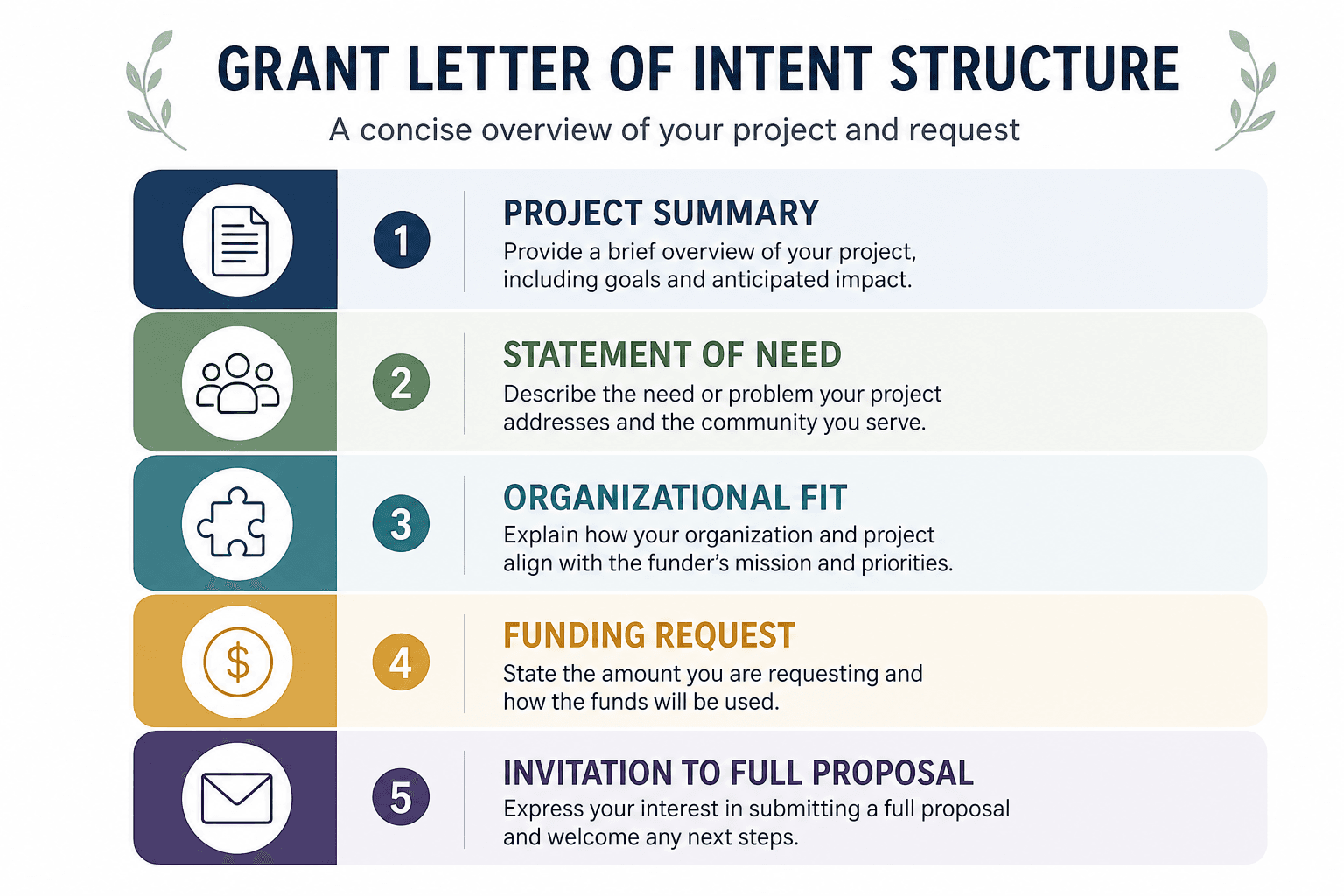
A grant LOI has seven short sections, each doing one job.
A letter of intent is the short version of a case you will make in full later. See how to write a grant proposal for the complete document.
Grant LOI Template
Dear [Program officer's name],
[Organization Name] is writing to inquire about support for [Project Name], a [brief program description] serving [population] in [location]. We are seeking [$Amount] to support [major activities].
[Brief paragraph about the need and why it matters.]
[Brief paragraph about the project, outcomes, and organizational fit.]
We would welcome the opportunity to submit a full proposal if this request aligns with your current priorities. Thank you for considering this inquiry.
Sincerely,
[Name]
Sample Letter of Intent for a Nonprofit: A Complete One-Page Example
The sample below is a complete one-page letter of intent from a composite nonprofit, Example Family Center (composite), to a composite community foundation. It shows every element of a foundation LOI in one workable order for a funder that gives no questions of its own.
[Date]
[Program officer's name]
[Title], Example Valley Community Foundation
[Street address]
[City, state, ZIP]
Re: Letter of intent, Family Stability Navigation Project, request of $50,000
Dear [Program officer's name],
Example Family Center requests an invitation to submit a full proposal for $50,000 over 12 months to support the Family Stability Navigation Project. The project fits the foundation's stated interest in preventing housing instability for low-income families in North Valley County.
Last year the center received 214 household requests for help with housing, benefits and transportation. Our current staff can handle emergency intake, but many families wait more than 30 days for follow-up.
The project adds a part-time family navigator, evening appointment hours and transportation assistance. Over the 12-month grant period it will serve 120 households. At least 90 will complete a stability plan, and at least 70 will resolve one documented housing, benefits or transportation barrier.
The total project cost is $92,000. Our request covers the navigator's salary and the transportation fund; county funds and individual donations cover the rest.
Example Family Center has provided family services in North Valley County for 11 years, and our case managers already work alongside the county housing office. We would welcome the chance to send a full proposal and can provide our budget, most recent Form 990 and board list at your request.
Sincerely,
[Name]
[Title], Example Family Center
[Phone] | [Email] | EIN [number]
Illustrative figures, not data from a real organization.
Each paragraph does one job: request and fit, need, project and results, money, then capacity and close. When a funder lists required items, as one foundation does with a 1 to 3 page limit plus the organization's IRS-recognized name, EIN, current-year operating budget and top five recent grants (The Ahmanson Foundation, read September 2026), follow its list in place of this order.
Foundation Grant LOI Example
This shorter example uses the composite applicant Example Literacy Partners (composite).
Dear [Program officer's name],
Example Literacy Partners is writing to inquire about a $75,000 grant to support the Family Literacy Bridge Project, a 12-month tutoring and caregiver engagement program serving 120 elementary students in two rural schools.
District benchmark data shows that 43 percent of third-grade students in the target schools are reading below grade level, and families report that transportation and work schedules keep children from tutoring after school.
The Family Literacy Bridge Project will provide after-school tutoring, bilingual caregiver workshops, curriculum materials, transportation support, and evaluation activities. By the end of the grant period, at least 80 participating students will improve by one reading level or more, and 75 caregivers will complete at least three literacy workshops.
Example Literacy Partners has delivered school-based youth programs for 14 years and will implement this project in partnership with district elementary leadership. We would welcome the opportunity to submit a full proposal if this request aligns with the foundation's early learning priorities.
Sincerely,
Illustrative figures, not data from a real organization.
Corporate Grant LOI Example
This example uses the composite applicant Example Youth Arts Collective (composite).
Dear Community Investment Team,
Example Youth Arts Collective is writing to inquire about support for Creative Fridays, a weekly arts and mentoring program for middle school students in the harbor district. We are seeking $25,000 to support teaching artists, student transportation, materials, and a public exhibition of student work.
Students in the harbor district have limited access to safe, affordable after-school enrichment. The community center's current youth programs operate at capacity, and school staff report a need for structured activities between dismissal and caregiver pickup.
Creative Fridays will provide 30 after-school sessions for 60 students during the school year. Participants will complete personal art portfolios, build positive peer relationships, and share their work at a community exhibition. The project aligns with your company's focus on youth opportunity, creativity, and neighborhood investment.
We would be grateful for guidance on whether this project is a fit for your current grant cycle.
Illustrative figures, not data from a real organization.

Letter of Intent vs Letter of Inquiry: When a Funder Asks for Which
Foundations often use "letter of intent" and "letter of inquiry" for the same screening letter, both abbreviated LOI. In federal grants, a letter of intent is often only a notice that you plan to apply.
NSF shows the federal sense. It states that "An LOI is not a binding document," yet "Failure to submit a required LOI identified in a program solicitation will result in a full proposal not being accepted or returned without review" (NSF PAPPG 24-1, effective May 20, 2024).
The format, the length and whether the letter is reviewed come from the funder's guidelines, not from the name.
LOI vs Cover Letter
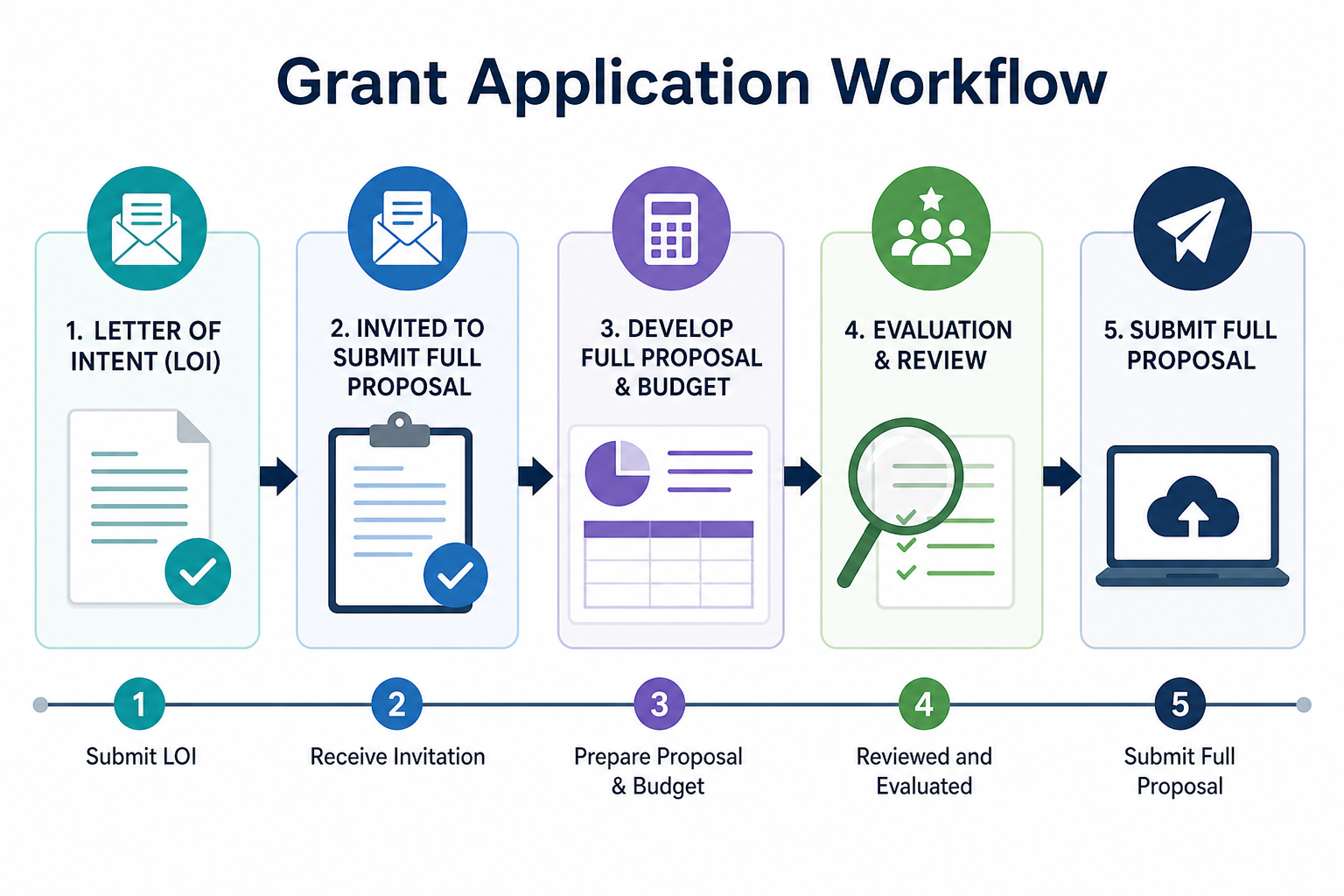
An LOI comes before a full proposal; a cover letter travels with one.
If you are submitting a full proposal package, use the grant proposal cover letter example. If the funder asks for a summary inside the application, use the grant proposal executive summary example.
One more document gets confused with both: a letter of support is written by a partner vouching for you, not by your organization.
Follow-Up Etiquette
After sending an LOI:
- Follow the funder's stated timeline.
- Do not call repeatedly.
- If no timeline is given, wait a few weeks before one brief follow-up.
- Keep follow-up messages short and respectful.
- If declined, ask whether feedback is available, and do not count on it: across funders that surveyed their declined applicants, "only about 50 percent of those declined applicants receive any sort of feedback from the foundation" (Center for Effective Philanthropy, 2016).
Common Mistakes
Three mistakes to avoid:
Mistake 1: Writing the Full Proposal Too Early
An LOI is a screening document. Keep it focused. Save the full detail for the invited application.
Mistake 2: Being Vague About the Request
Include a requested amount or expected range unless the funder says not to.
Mistake 3: Ignoring Fit
The LOI should clearly connect the project to the funder's stated priorities.
How Funders Use Letters of Intent
Funders use letters of intent to decide whether a project is aligned before the nonprofit writes a full proposal. Candid lists letters of inquiry, from which a foundation invites full applications, among the routes that even foundations closed to unsolicited proposals can leave open (Candid, October 2025).
An LOI should answer the funder's screening questions:
- Is the applicant eligible?
- Does the project fit the funder's priorities?
- Is the request amount in range?
- Does the organization appear capable?
- Is the project clear enough to invite a full proposal?
It does not need every attachment or budget line, only enough for the funder to make the next decision.
LOI Structure for a One-Page Request
Use this order when the funder does not provide questions:
- Opening request: organization, amount, project, purpose.
- Fit: why the project aligns with the funder.
- Need: specific problem and population.
- Project: core activities and grant period.
- Results: expected outputs or outcomes.
- Capacity: why the organization can deliver.
- Close: invitation for next step.
Address the letter to the named funder contact, not a generic title.
What To Include When Space Is Tight
When the LOI limit is a page or less, prioritize:
Do not hide the request amount. Funders need to know the scale of the ask.
A first-year organization with no past grants to list should say so in one sentence, one of the points in how first-year nonprofits can approach funders.
Mini Budget Language for an LOI
Some LOIs ask for a short budget summary rather than a full budget. Use a sentence like:
"The total project cost is $125,000. The organization requests $50,000 from the foundation to support part-time program staffing, participant transportation, materials, and evaluation. The remaining project cost will be supported through county funding, individual donations, and in-kind partner space."
Illustrative figures, not data from a real organization.
LOI Review Checklist
Before sending:
- Confirm the funder accepts LOIs.
- Follow the required format or portal instructions.
- State the request amount.
- Show direct fit with funder priorities.
- Keep the project scope realistic.
- Avoid attachments unless requested.
- Include contact information.
- Save the submitted LOI in the grant record.
- Add follow-up and invitation deadlines to the grant calendar.
AI Prompt for a Letter of Intent
Draft a grant letter of intent using only the facts below.
Keep it concise and funder-facing.
Do not create new program details, outcomes, or budget sources.

Funder priority:
[Priority]

Organization:
[Name, mission, credibility]

Request:
[Amount]

Project:
[Name, activities, timeline]

Need:
[Population, geography, data]

Expected results:
[Outputs or outcomes]

Fit:
[Why this funder]
Ask for a second version under the word limit, and check every figure before sending.
How To Expand an LOI Into a Full Proposal
If the funder invites a full proposal, use the LOI as the promise you must keep. Expand each part without changing the core request:
If the proposal changes significantly after the LOI, explain the change or contact the funder before submitting. For a private foundation, the foundation grant proposal template sets out what each invited section usually asks for, and a first-time grant writing guide covers the rest of the process.
LOI Fit Signals
Small signals show a funder that you have done your homework: its priority in plain language, a named population and place, a request inside its usual range, and a project that fits the proposed period. An LOI that could go to any foundation is not doing its job.
Checking whether a foundation takes applications at all comes before any of that. A private foundation that "only makes contributions to preselected charitable organizations and does not accept unsolicited requests for funds" says so on its Form 990-PF (IRS, 2025 Form 990-PF). GrantCue's public foundation directory covers more than 10,000 private foundations built from those filings and can be filtered to foundations that indicate they accept applications (grantcue.com, October 2026), which narrows an LOI list before you write a word.
FAQ
How Long Should a Grant LOI Be?
A grant LOI is often one to three pages: one university's foundation relations office says the first contact with a foundation is often a brief one- to three-page letter of inquiry (Northwestern University Foundation Relations, read September 2026). Some funders ask for less, such as a short email inquiry, and any word, character or page limit the funder gives always wins.
Is a Letter of Intent Binding?
No. A letter of intent is a request or a notice, not a contract. NSF states that "An LOI is not a binding document," though a required federal LOI must still be filed on time for the full proposal to be accepted (NSF PAPPG 24-1, effective May 20, 2024). A foundation LOI only commits you to a consistent full proposal.
Should an LOI Include a Budget?
Include the requested amount, the grant period, a brief use of funds, and the total project cost if your request covers only part of it. Add a budget table only if the funder asks for one, and keep the amount the same in the full proposal unless you explain the change.
What Is the Difference Between a Letter of Intent and a Letter of Inquiry?
For many foundations there is none: both are short screening letters that ask to be invited to submit a full proposal. In federal grants, a letter of intent is often only a notice that you plan to apply; CDMRP, a federal medical research program, states that for its letters of intent "There is no review and selection process" (CDMRP, How to Apply, updated July 2, 2026).
Keep the LOI and the Invitation Together
If the funder invites a full proposal, save the invitation with the LOI you sent, note the proposal deadline in the grant calendar the same day, and build the application section by section from the letter. Expand each part of the LOI into full detail without changing the core request or the promise you made.