Why Do Grant Applications Get Rejected? 10 Common Mistakes and Fixes
Why grant applications get rejected: ten common, fixable mistakes and the fix for each, why good proposals still lose, and how to learn from a rejection before the next submission.

In this article (7)
Why do grant applications get rejected? Sometimes the proposal was weak, sometimes it was a strong proposal sent to the wrong funder, and sometimes there was not enough money for every good application. The first two can be fixed before you submit; the third can only be planned around.
Funders' own data points the same way. In one foundation's 2025 applicant survey, declined applicants were most often told their request "Doesn't fit Foundation priorities/guidelines, with explanation as to why" (36 percent), followed by "Not enough funds/too many good proposals" (23 percent) (Center for Effective Philanthropy and William Penn Foundation, 2025 survey). The ten mistakes below are the fixable part.
Quick Answer: Why Do Grant Applications Get Rejected?
Grant applications get rejected when the proposal does not fit the funder, or when it does not outscore the competition for the money available. The fixable causes are a wrong-fit funder, a weak need statement, vague objectives, an unexplained budget, missed instructions, missing attachments, and a late or rushed submission.

Why Grant Proposals Get Rejected: Common Mistakes at a Glance
The common mistakes that get grant proposals rejected fall into three groups: choosing the wrong funder, writing sections a reviewer cannot score, and failing the funder's instructions. Each has a fix you can apply before the next submission.
Ten Common Grant Proposal Mistakes and How to Fix Them
Each of the ten is preventable before submission.
Mistake 1: Applying to the Wrong Funder
Applying to a funder whose priorities do not match the project wastes the whole application, however well it is written. Signs you are applying to the wrong funder:
- Their priority areas do not match your project, even if the program title sounds similar.
- They have never funded organizations like yours in size, sector or geography.
- Their typical grant is far smaller than your request.
- The notice or guidelines exclude your type of work.
The fix is to verify alignment before you write a word. Read the funder's guidelines, review its past grantees, and check a private foundation's Form 990-PF: one box there says whether it "only makes contributions to preselected charitable organizations and does not accept unsolicited requests for funds," and the items below it state where applications go, any deadlines and any restrictions on awards (IRS Form 990-PF, 2025). Funders see this mistake often: one of the two reasons funders most frequently give for not providing decline feedback is that many applications are far outside their mission even when the guidelines are clear (Center for Effective Philanthropy, 2016). Our complete guide to writing a grant proposal covers the rest of the structure.
Mistake 2: Weak Need Statement
A need statement fails when it is all data with no people in it, or all story with no evidence that the problem is wider than one case.
The fix is to pair one local data point with one concrete case and connect both to the population the project serves. For examples and a fill-in template, see our statement of need guide.
Mistake 3: Vague or Unmeasurable Objectives
"We will improve outcomes for community residents" tells a reviewer nothing: which outcomes, which residents, by how much, by when? One commenter diagnosed rejections as "no crystal clear outcomes that are linked confidently to the org's capacity and track record" (Reddit thread 1vf8jxw, read September 2026).
The fix is to write every objective so it can be checked: specific, measurable, achievable, relevant and time-bound. Our goals and objectives guide gives worked examples.

Mistake 4: Unrealistic or Unexplained Budgets
Budget problems come in four kinds:
- Round numbers everywhere, such as $5,000 and $10,000 lines with no calculation behind them.
- Math errors, where the line items do not add up to the total.
- No justification, so nobody can see how a figure was reached.
- A budget and narrative that disagree, such as a training program with no line for trainers.
Budgets are scored. One published federal merit review weighting gives the budget 15 percent of the total (Bureau of Justice Assistance, FY2025 COSSUP). The fix is to show your math for every line, have someone else check the totals, and make sure every major activity in the narrative has budget support; a grant proposal budget template shows the layout.
Mistake 5: Ignoring Funder Guidelines
Ignoring the funder's guidelines can end an application before anyone reads it. The Office of Justice Programs screens applications against basic minimum requirements first, and those that fail "will neither proceed to technical review nor receive further consideration" (DOJ Office of Justice Programs, grant application resource guide, page modified September 22, 2026). Common misses:
- Wrong font or margin size.
- Exceeding page limits.
- Missing required sections or attachments.
- Submitting after the deadline.
- Not answering the specific questions the funder asked.
The fix is to build a compliance checklist from the funder's guidelines before you start writing, and check every item before you submit. A grant proposal review checklist is a starting point.
Mistake 6: Missing Letters of Support
Many proposals require letters from partner organizations, community stakeholders or public officials, as independent proof that the project is needed and the partnerships are real. A letter that arrives after the deadline usually cannot be added.
The fix is to ask partners as soon as you decide to apply, give them talking points or a draft, and follow up well before the deadline. The guide to letters of support for grants has wording partners can adapt.
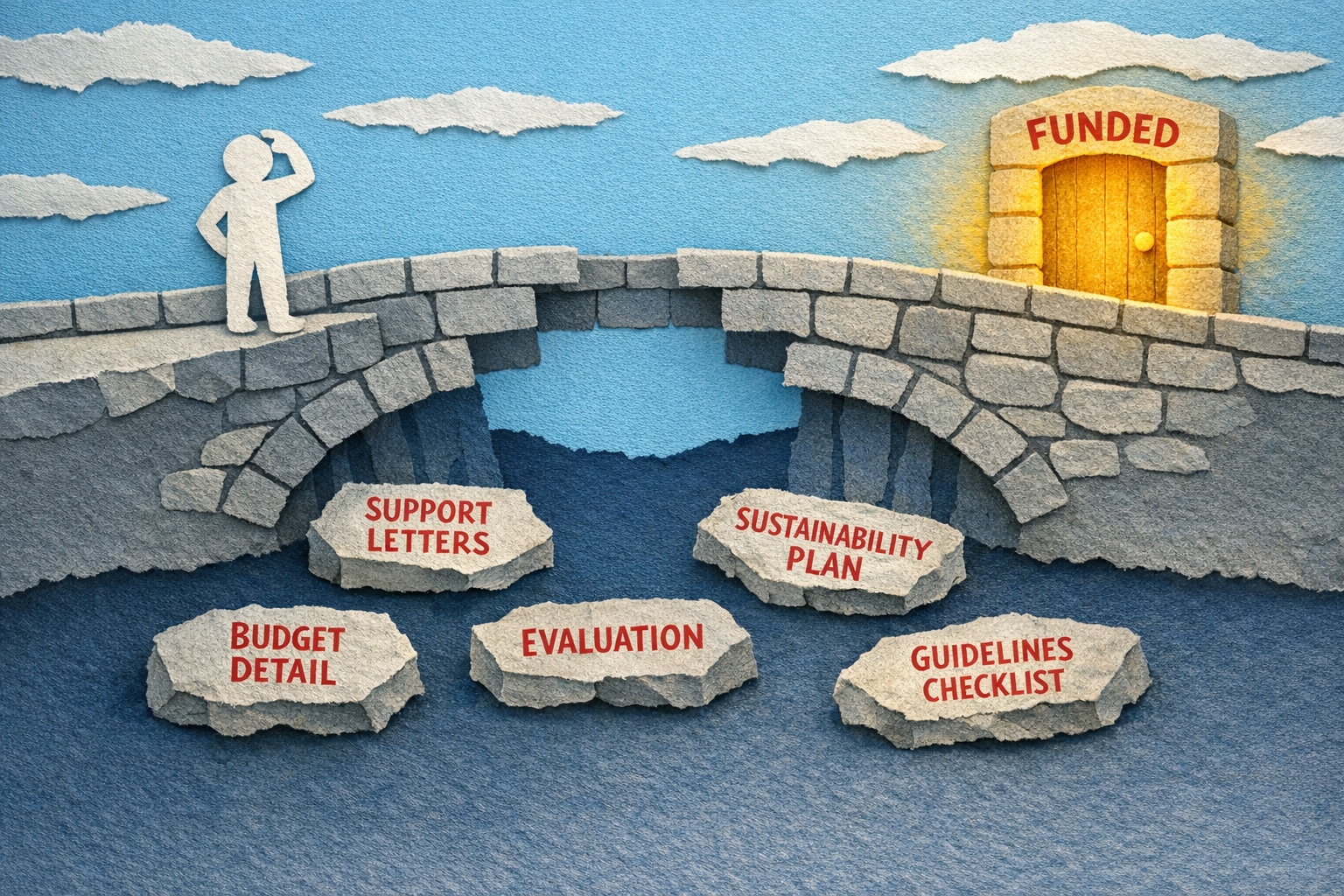
Mistake 7: No Sustainability Plan
A proposal that skips sustainability, or offers only "we will seek additional funding," leaves the funder guessing what happens when its money ends.
The fix is to name specific sources with amounts and decision dates, partners' signed commitments, and the capacity that stays regardless; the guide to what funders look for in a sustainability plan has two worked examples.
Mistake 8: Jargon Overload
Dense jargon makes a reviewer work harder to understand the project, and a reviewer who cannot follow a section cannot score it well.
The fix is to write for an intelligent reader outside your field: define a term or replace it with plain language, and read the proposal aloud.
Mistake 9: Last-Minute Submissions
Submitting on deadline day leaves no time to fix an upload error, a rejected file format or a validation failure. Federal agencies say so directly: NIH recommends "submitting at least two days before the due date" (NIH, How to Submit, Track, and View Your Application, updated September 2024), and HRSA's best practice is to "apply at least three calendar days before the deadline stated in the NOFO" (HRSA Application Guide, September 2025).
The fix is to set your own internal deadline days ahead of the funder's and treat it as the real one. For foundation portals, submit a day early and use the remaining time to check what went in.
Mistake 10: No Evaluation Plan
Leaving out the evaluation plan leaves points on the table where a funder scores it. One published HRSA rubric gives "Evaluative Measures" 15 of its 100 points (HRSA notice of funding opportunity HRSA-24-002, FY2024).
The fix is to state, at minimum, what you will measure, how you will collect the data, who is responsible, and when you will report. It does not need to be elaborate for a small grant; the grant proposal evaluation plan guide shows how much detail fits each size of request.
Why Good Grant Proposals Get Rejected
Good grant proposals get rejected because a score is not the only thing a funder weighs, and because there is less money than there are strong applications. A well-written proposal can lose on fit, on funds, or on the funder's other priorities.
- Funds run out. NIH reported that the success rate of research project grant applications fell to 13.0 percent in FY2025, from 18.5 percent in FY2024 (NIH Extramural Nexus, March 2026).
- Scores are advisory. The Office of Justice Programs states that reviewers' scores and any resulting recommendations "are advisory only," and it also weighs geographic coverage, strategic priorities, available funding, past performance and budget reasonableness (DOJ Office of Justice Programs, page modified September 22, 2026).
- Thresholds cut close calls. The National Institute of Justice sets a numerical score threshold to decide which applications go on to collaborative review (National Institute of Justice, February 2024).
One grantseeker described being "0 for 10 on recent grant applications... it feels like we are shouting into the void" (Reddit thread 1w5jaaq, read September 2026), and commenters in that thread answered that the organization was not yet ready to apply for most grants. A string of losses like that calls for a grant readiness checklist as much as a better draft.
How to Learn From Rejection
A rejection is useful information if you collect it. Work through it in this order:
- Request reviewer feedback. NSF sends declined PIs the reviews and the panel summary (NSF PAPPG 24-1), and NIH program officials discuss the outcome of review after you receive your summary statement (NIH, Understand Staff Roles). Foundations vary: across funders that surveyed declined applicants, "only about 50 percent of those declined applicants receive any sort of feedback from the foundation" (Center for Effective Philanthropy, 2016).
- Look for patterns. If three reviewers flagged your evaluation plan, treat that as a finding, not an opinion.
- Get an outside read. The Unfunded List's volunteer evaluators review proposals that were submitted and not funded and send a written feedback report, for a one-time $100 fee on a first submission (The Unfunded List, read September 2026).
- Revise and resubmit where the funder allows it, or take the revised proposal to a better-fitting funder.
- Log the funder, the feedback and what you changed.
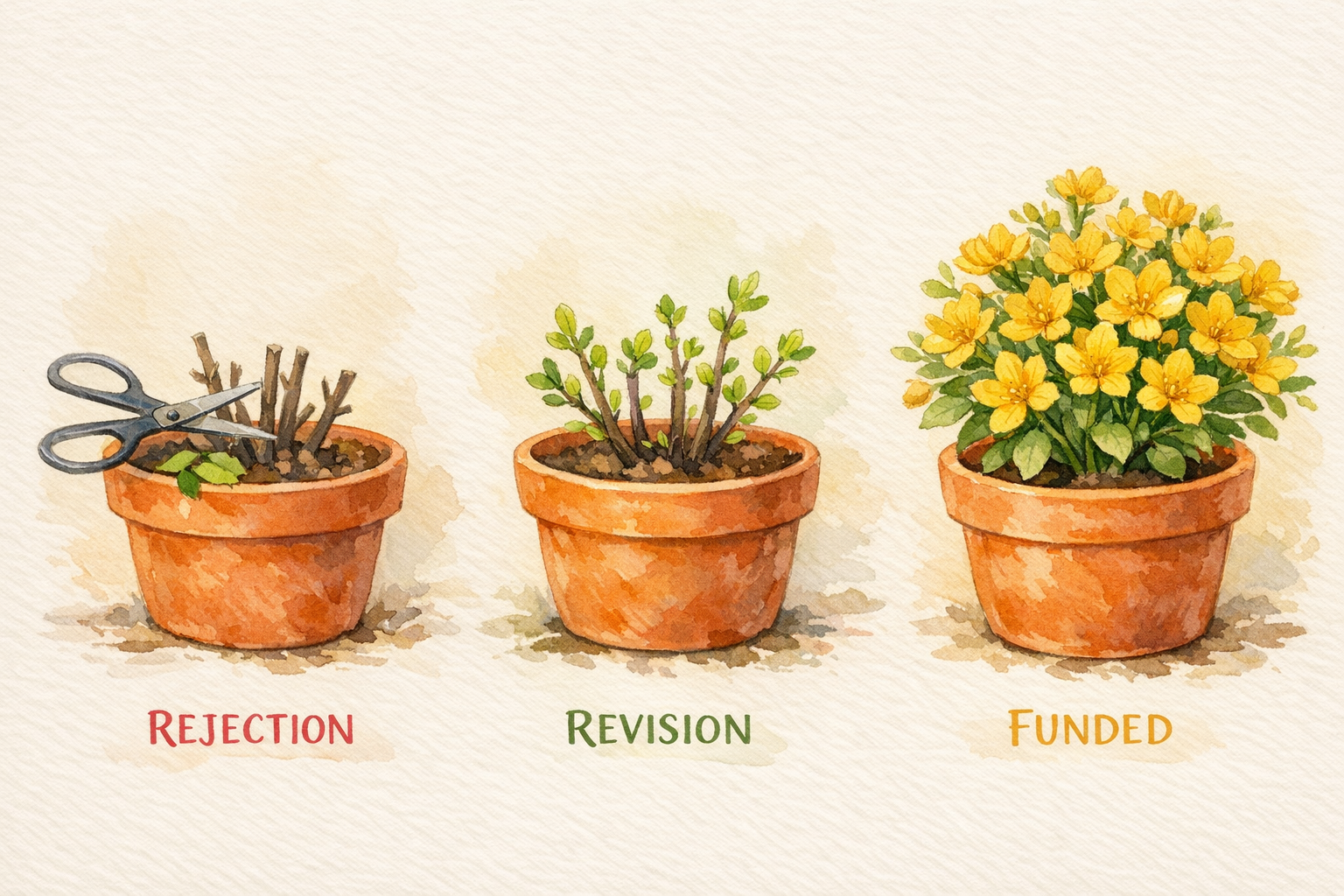
When the feedback has to be requested, how to ask a funder why you were rejected gives the timing, a short email to send and the questions most likely to get an answer.
The first mistake on the list is a funder choice. GrantCue's fit scores, which are on every plan including Free, rate how closely an opportunity matches your organization's profile before anyone writes a word, and its public foundation directory can be filtered to foundations that indicate they accept applications (grantcue.com, October 2026). Start a discovery search with fit in view, then read the funder's own guidelines before you commit.
FAQ
What Is the Most Common Reason Grant Applications Are Rejected?
Poor fit with the funder is the reason funders give most often in the data available. In one foundation's 2025 applicant survey, the most common reason declined applicants received was that the request did not fit the foundation's priorities or guidelines (36 percent), ahead of not enough funds or too many good proposals (23 percent) (Center for Effective Philanthropy and William Penn Foundation, 2025 survey).
Why Do Good Grant Proposals Get Rejected?
Because funding is limited and scores are not the only factor. NIH's research project grant success rate was 13.0 percent in FY2025 (NIH, March 2026), so many strong applications lose. Some agencies also weigh geographic coverage, strategic priorities and available funding beyond reviewers' scores, which the Office of Justice Programs calls "advisory only."
Do Funders Tell You Why Your Grant Was Rejected?
Some do and many do not. Federal agencies such as NSF release reviews and panel summaries to declined applicants, while across foundations that surveyed their declined applicants only about 50 percent of those applicants received any feedback (Center for Effective Philanthropy, 2016). Asking politely is reasonable; expecting a detailed answer is not.
Should You Resubmit a Rejected Grant Proposal?
Resubmit when the feedback points to fixable problems and the funder still fits; move on when the rejection was about fit. Read the funder's rules first, since some limit resubmissions. Revise the sections reviewers flagged, keep a log of what changed, and consider an outside read before you send it again.
What Are the Most Common Grant Proposal Mistakes?
This guide covers ten: applying to the wrong funder, a weak need statement, vague objectives, an unexplained budget, ignored guidelines, missing letters of support, no sustainability plan, jargon, a last-minute submission and no evaluation plan. Each can be caught before submission by checking the draft against the funder's guidelines.
Check Your Next Proposal Against the Ten Mistakes
Before your next submission, run the draft against the table at the top of this page: funder fit, need, objectives, budget, guidelines, letters, sustainability, plain language, timing and evaluation. Fix every row that fails, then set an internal deadline days ahead of the funder's. For the full section-by-section structure, use the complete grant proposal template guide.