Grant Narrative Example and Template: The Section-by-Section Skeleton With an Annotated Sample
A grant narrative guide with a full annotated example, the seven-part skeleton reviewers expect, a way to map funder review criteria, and rules for cutting to a page limit.

Last updated: September 2026
A grant narrative is the written part of a grant application that explains the problem, the people affected, what you will do, how you will measure it, and why your organization can deliver. The forms and the budget carry your data. Neither one argues for anything, and that job belongs to the narrative.
What follows is the skeleton most funders expect, a worked example with reviewer notes, and a cutting order for when the draft runs long. Pair it with the complete grant proposal template if you are assembling the whole application.
Quick Answer: What Is a Grant Narrative?
A grant narrative is the prose section of a grant application that makes the case for funding. It usually covers need, target population, goals and objectives, methods and activities, evaluation, organizational capacity, and sustainability. Federal applicants submit it through the Project Narrative Attachment Form on Grants.gov, separately from the budget narrative.
What a Grant Narrative Is
A grant narrative is the document a reviewer reads to decide whether a project deserves money. It handles the questions the forms cannot: why this problem, why this approach, why your organization, and why now.
Grants.gov publishes a Project Narrative Attachment Form that holds a mandatory project narrative file, and a separate Budget Narrative Attachment Form for the budget justification (Grants.gov forms repository, verified August 9, 2026). Agencies also have to tell you how to build it. 2 CFR Part 200, Appendix I requires every federal notice of funding opportunity to give applicants the "instructions needed to develop the narrative portions of the application," including "any requirements for its order, format, or required headings" (eCFR, Appendix I to Part 200, paragraph (b)(4)(i)(I), verified August 9, 2026).
Foundations use the same document under other names: project description, program narrative, proposal narrative, or simply the proposal. Only the label changes. What a reviewer wants inside it varies far less than the names suggest.
Grant Narrative vs Grant Proposal vs Budget Narrative
The grant proposal is the entire submission. Inside it, the grant narrative is the prose section, and the budget narrative is a separate document that explains the dollar figures. People swap the three terms in conversation and then lose points for it on the application.
| Term | What it is | What it contains | Typical form or file |
|---|---|---|---|
| Grant proposal | The complete application package | Forms, narrative, budget, budget narrative, attachments, certifications | Full submission in Grants.gov, a foundation portal, or email |
| Grant narrative (project narrative) | The prose case for funding | Need, population, goals, methods, evaluation, capacity, sustainability | Project Narrative Attachment Form, or a single uploaded document |
| Budget narrative (budget justification) | The explanation behind each cost | Salary calculations, unit costs, indirect cost basis, match and in-kind detail | Budget Narrative Attachment Form, or a spreadsheet plus memo |
When you cannot tell where a paragraph belongs, ask whether a reviewer could score it without opening a spreadsheet. If they could, it goes in the narrative. If the paragraph exists to defend a line item, it belongs in the grant budget narrative.

The Grant Narrative Skeleton, Section by Section
The standard grant narrative skeleton runs in this order: statement of need, target population, goals and objectives, methods and activities, evaluation, organizational capacity, sustainability. Most funder templates are a renaming or a reordering of those seven parts.
| Section | Question it answers | Evidence it needs |
|---|---|---|
| Statement of need | What problem exists and where | Local data, program records, a service gap |
| Target population | Who will be served and how they are reached | Counts, eligibility criteria, referral sources |
| Goals and objectives | What will change and by how much | Baselines, targets, dates, measurement method |
| Methods and activities | What the project actually does | Workflow, staffing, dosage, timeline |
| Evaluation | How you will know it worked | Instruments, intervals, data owner |
| Organizational capacity | Why you can deliver this | Prior-year volume, credentials, systems |
| Sustainability | What happens after the grant | Committed amounts, sources, end dates |
Statement of need
Name a specific problem, the place it happens, and the people it happens to, and back each claim with evidence a reviewer can verify. Lead with local data or your own service records. National context can follow, if it adds anything. Finish by naming the gap the project fills. That is the sentence the rest of the narrative answers. Worked models are in these statement of need examples.
Target population
Define who is eligible, how many people you will serve, and how they actually reach the program. Reviewers want the referral path; a demographic profile without one reads like a wish. State the eligibility rule first, then name the referral sources and say who does the screening.
Goals and objectives
The goal is the condition you want to change. Objectives are the measurable steps toward it, each with a number, a population, a deadline, and a method for measuring it. Two to four is usually enough for a one-year project; past that the evaluation section becomes unmanageable. Worked sets are in these grant proposal goals and objectives examples.
Methods and activities
Describe what staff will do, in what order, and at what volume. Name the workflow, the roles, the frequency, and the caseload. If a reviewer cannot sketch your program on a napkin from this section, it is not specific enough to justify the budget attached to it.
Evaluation
Name the measures, the instruments, the collection intervals, and the person responsible for each one. Keep outputs and outcomes apart. Every outcome needs a baseline, even if that baseline is just the intake-day score. Templates are in this grant proposal evaluation plan guide.
Organizational capacity
Prove you can run the project by citing prior volume, relevant credentials, and systems already in place. Use last year's numbers instead of adjectives, because a count is checkable and "experienced" is not. If a required capability is new to you, say so and explain how you are covering it.
Sustainability
Explain what happens to the work when the grant period ends. Every continuation commitment needs an amount, a source, and an end date. A general pledge to diversify funding is not a commitment, and reviewers have read that one a thousand times.
Those seven sections sit inside a larger package of forms and attachments, mapped out in the full nonprofit grant proposal.
A Complete Grant Narrative Example With Reviewer Notes
A complete grant narrative moves from need to objectives to methods to evaluation to capacity, and each section hands the next one its evidence. Everything below is fictional: Willow Creek Community Partners, Marden County, and every figure were invented for illustration, so replace all of it with your own verified numbers. The request is $85,000 for one year.
Need and target population
Marden County has 9,400 residents age 65 and older, and 61 percent own the home they live in. Willow Creek Community Partners screened 214 of those households in 2025 and found at least one immediate fall hazard in 148 of them: no bathroom grab bars, unsecured stair rails, missing exterior handrails, or dim interior lighting. The repairs themselves are inexpensive; access is the barrier. Both licensed contractors in the county decline jobs under $1,500, and 71 percent of screened households reported annual income below $32,000. Sixteen households on the 2025 waitlist moved into assisted living within eight months of screening, and family members named home safety as a factor in nine of those moves.
Reviewer note: The section names a place, a population, a count, and a barrier before it names the program. The waitlist and follow-up data come from the applicant's own records, which outweigh a national fall-risk figure here.
Goals and objectives
Goal: older homeowners in Marden County stay safely in their own homes.
Objective 1: Complete home safety assessments for 180 owner-occupied households headed by a resident age 65 or older between October 1, 2026 and September 30, 2027.
Objective 2: Install grab bars, stair rails, exterior handrails, or task lighting in 120 of those households within 45 days of assessment.
Objective 3: Reduce self-reported difficulty with bathing, stair use, and entry access by 30 percentage points among served households, measured by a matched pre and post survey at 90 days.
Reviewer note: Every objective carries a number, a population, a deadline, and a measurement method. Objective 3 names the instrument and the interval, so the evaluation section has something specific to build on.
Methods and activities
The home safety program runs a four-step cycle. A trained assessor completes a 40-item in-home safety walkthrough and records findings in a shared checklist. A repair coordinator prices the work, confirms it falls under the program's $900 per-household materials cap, and schedules the job. A two-person crew, one licensed carpenter and one trained technician, completes the installation. The assessor returns at 90 days for the follow-up survey and a second walkthrough.
Referrals come from three channels already in place: the county Area Agency on Aging, the regional hospital's discharge planners, and the two senior centers Willow Creek staffs. The program holds 40 slots for discharge referrals, whose households have the shortest window before a return to the emergency department. Households needing work above the cap are referred to the county weatherization program, and the coordinator records whether that referral was completed.
Reviewer note: A reviewer can picture the workflow and count the staff. The cap, the reserved slots, and the referral path show the applicant planned for households that do not fit the program.
Evaluation
Willow Creek will track three measures. Output: assessments and installations completed, pulled monthly from the repair database. Outcome: change in the matched pre and post difficulty survey at 90 days, administered by the assessor. Longer-term: housing status at 12 months, collected by phone for every household served. The baseline for the survey is the assessment-day score, so each household is its own comparison. The program director reviews measures monthly and reports to the board quarterly.
Reviewer note: The plan names the instrument, the interval, and the owner. It also names a baseline, which is the piece most evaluation sections leave out.
Capacity and sustainability
Willow Creek has run minor home repair in Marden County since 2019 and completed 96 installations in 2025 with a two-person crew. The program director holds the county residential contractor license. Three continuation sources are already in place: the Area Agency on Aging has committed $18,000 in annual referral-based funding through 2028, the county allocates $25,000 of its housing rehabilitation set-aside each year, and the 2026 spring appeal raised $31,000 for repair materials. Grant funds would cover the assessor position and the higher materials cap, the two limits on volume today.
Reviewer note: Capacity is proved with a prior-year number rather than an adjective. The sustainability paragraph names amounts, sources, and end dates instead of promising future fundraising.
Using Data and Story Together
Numbers show that the problem is real at scale, and a short story shows that it is real for one person. Use both, but keep the proportion honest. A handful of checkable figures per section and one illustrative passage is plenty, and the passage should never outrun the evidence around it. Four sentences is the usual ceiling: who, what barrier, what consequence, and how that experience lines up with the data. Use composite examples and strip identifying details.
Anchor every number to a source even when the funder does not ask for citations. Keep an internal note of the dataset, the year, and the report behind each claim, because the question tends to arrive at a site visit rather than in the application.
Matching the Funder's Language and Review Criteria
Write the narrative in the funder's vocabulary and in the funder's order. Reviewers score against a published rubric, not against whatever structure you find most logical, and federal agencies are required to publish theirs. 2 CFR Part 200, Appendix I directs the review information section of every notice of funding opportunity to give "a clear description of each criterion and sub-criterion used" and, when criteria differ in weight, "the relative percentages, weights, or other means used to distinguish between them" (eCFR, Appendix I to Part 200, paragraph (b)(6)(ii)(A), verified August 9, 2026).
The big federal science agencies publish that structure down to the heading text.
| Funder | Published structure | What it means for the narrative |
|---|---|---|
| NSF | The Project Description must contain a separate section labeled "Broader Impacts," with that heading on its own line (PAPPG 24-1, verified August 9, 2026) | Use the exact heading text, not a synonym |
| NIH | Research Strategy uses three headers in order: Significance, Innovation, Approach (NIH advice on application sections, verified August 9, 2026) | Match the order the reviewer expects to scroll through |
| NIH peer review | For application due dates on or after January 25, 2025, most research project grants are assessed on three factors: Importance of the Research, Rigor and Feasibility, Expertise and Resources (NIH Simplified Peer Review Framework, verified August 9, 2026) | Give each factor its own clearly labeled paragraph |
Build a two-column map before you draft: each scored criterion on the left, the narrative section that answers it on the right. A criterion with a blank cell beside it is a point you are giving away. Sections that answer nothing on the list are the first to cut when the draft runs long.

Word-Limit Discipline and What To Cut First
Cut in a fixed order: organizational history first, duplicated national data second, restatements third, and evidence last, if ever. Page limits are enforced by the submission system, and funder instructions override every general rule, including the ones here.
NIH limits the Specific Aims attachment to one page and the Research Strategy to 12 pages for R01 applications, or 6 pages for R03 and R21 applications, while stating plainly that notice of funding opportunity instructions always supersede the general guide (NIH page limits, page last updated June 22, 2026, verified August 9, 2026). NSF caps the Project Description at 15 pages, and charts, graphs, maps, and photographs all count against that limit (PAPPG 24-1, verified August 9, 2026). Foundation portals often cap narratives by character count rather than page count, and those counters usually include spaces.
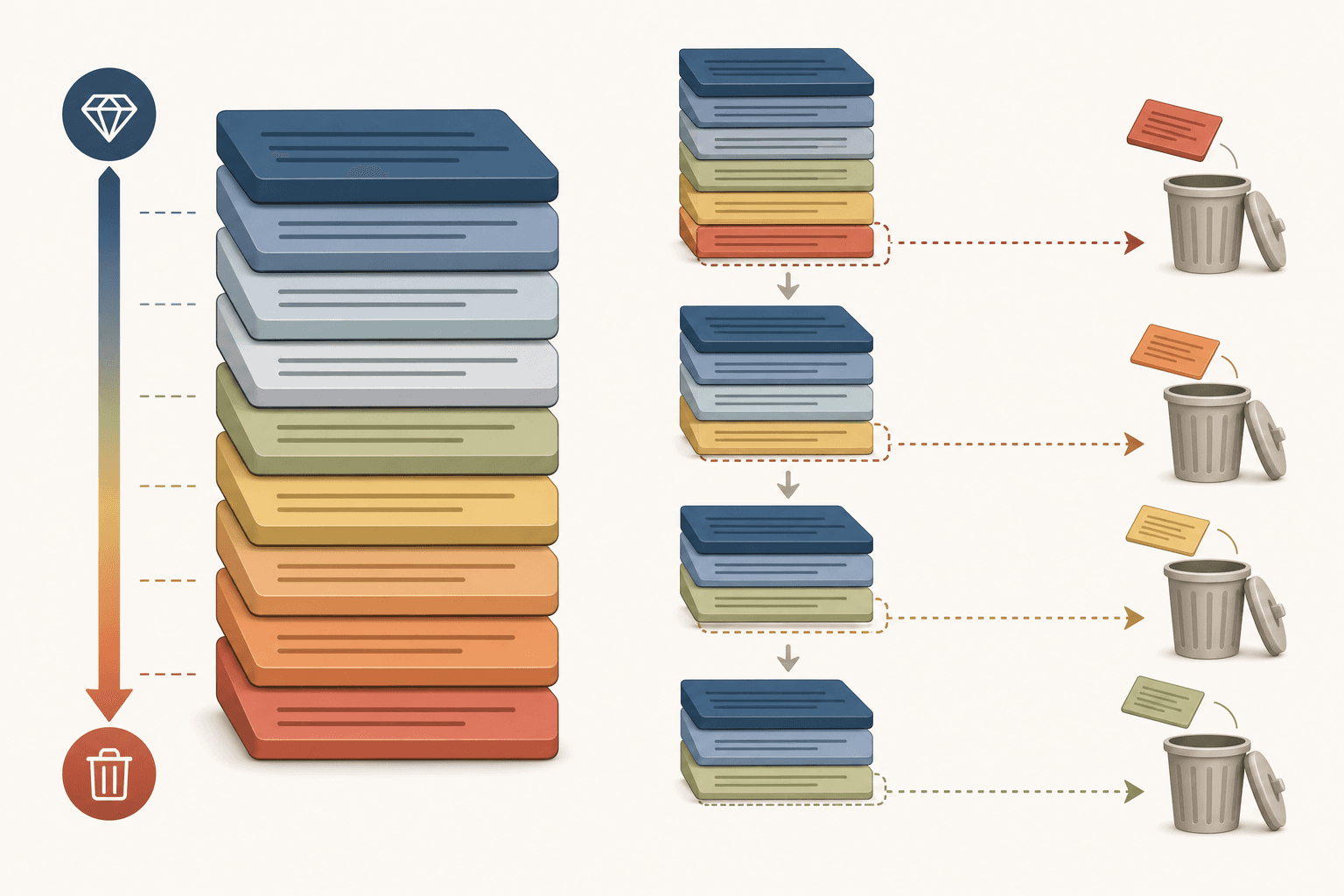
| Cut order | What to remove | Why it goes first |
|---|---|---|
| 1 | Founding history and mission language | The forms and attachments already carry your organization profile |
| 2 | National statistics that repeat a local number | The local number is the one that scores |
| 3 | Restatements of the need in later sections | Reviewers read the sections in order |
| 4 | Activity descriptions duplicated in the work plan table | Keep the table, delete the prose version |
| 5 | Qualifiers and intensifiers | "Significantly improved" costs words and adds nothing checkable |
| 6 | Partner background paragraphs | Move them to the letters of support |
Protect four things while cutting: baseline numbers, the measurable objectives, the evaluation instrument and interval, and any statement the notice requires verbatim, such as cost-sharing language. NIH's General Grant Writing Tips page recommends sentences of 20 words or fewer, active voice, and paragraphs of five to seven sentences (NIH, verified August 9, 2026). Tightening sentences across a whole draft frees more room than deleting any single paragraph, and it costs you no content.
Common Grant Narrative Mistakes
Opening with the organization instead of the problem
A first paragraph about your founding year tells a reviewer nothing about the project they are being asked to fund. Open with the problem, the place, and the people. Your history belongs later, in the capacity section.
Objectives that cannot be measured
"Improve community wellbeing" gives the evaluation section nothing to work with. Every objective needs a number, a population, a deadline, and a measurement method.
A methods section a reviewer cannot picture
If the section lists services without frequency, dosage, staffing, or sequence, a reviewer has no way to judge whether the budget is reasonable. Describe the workflow instead.
A narrative and budget that disagree
If the narrative describes two staff positions and the budget funds one, the reviewer stops trusting both documents. Reconcile them before submission.
FAQ
Grant narrative meaning: what does the term include?
A grant narrative is the written, non-numeric portion of a grant application that explains the problem, the plan, and the organization behind it. It excludes the forms, the budget spreadsheet, and the attachments. Some funders call the same document the project narrative, the program narrative, or the project description.
How long should a grant narrative be?
Follow the funder's stated limit, which always overrides general advice. Federal research applications are capped in pages, such as NIH's 12-page Research Strategy for R01 applications and NSF's 15-page Project Description. Foundation narratives are usually far shorter, and small local grants may allow only a page or two.
What is the difference between a grant narrative and a budget narrative?
The grant narrative argues that the project should happen. The budget narrative explains why each requested dollar is necessary and how it was calculated. On Grants.gov they are attached through two different forms and are usually reviewed by different people.
Can the same grant narrative be reused for another funder?
The program facts can be reused. The framing, headings, emphasis, and length almost never survive intact, because each funder scores against its own published criteria. Keep reusable blocks in a proposal library and rewrite the connective sections for each application.
Who should write the grant narrative?
One person should own the draft so the voice stays consistent. Program staff supply activity detail, finance confirms the narrative matches the budget, and leadership reviews the capacity and sustainability claims. Assign one reviewer to score the draft against the funder's criteria before submission.
Next Step
Pull the notice of funding opportunity on your desk, list its scored criteria in one column, and name the narrative section that answers each one beside it. Any blank row is the section to draft first. When the narrative is done, check it against the nonprofit grant proposal template so the budget and attachments describe the same project.