Sustainability Plan for a Grant Proposal: What Funders Look For, With 2 Examples
Download the free templateWhat funders look for in the sustainability plan of a grant proposal, with the four dimensions to cover, weak and strong wording, two complete worked examples and a fill-in template.

In this article (12)
- Quick Answer: What Do Funders Look For in a Sustainability Plan?
- What Funders Look For in a Sustainability Plan
- Sustainability in a Grant Proposal Rarely Means Environmental Sustainability
- The Four Dimensions of a Grant Sustainability Plan
- Weak Versus Strong Sustainability Plans: Examples Side by Side
- Sample Sustainability Plan for Grant Proposal: Direct-Service Nonprofit
- Sustainability Plan Example: Research and Capacity-Building Project
- Sustainability Plan Template With Fill-In Prompts
- How to Write a Sustainability Plan When You Do Not Know If the Program Will Continue
- How Sustainability Connects to the Evaluation Plan and Logic Model
- FAQ
- Rewrite Your Last Sustainability Paragraph
A sustainability plan for a grant proposal is the section explaining how the funded work continues after the money stops. It is short and usually written last, and the sustainability plan funders look for is a specific one: named sources, dates and commitments, not a promise to keep trying.
If the application is still in draft, start with how to write a grant proposal and return once the budget exists.
Quick Answer: What Do Funders Look For in a Sustainability Plan?
What funders look for in a sustainability plan is evidence the work continues after the grant: what continues and at what scale, named funding sources with amounts and decision dates, partners with signed commitments, and the skills, protocols and data that remain if funding stops. Unnamed "diversified funding" answers none of it.
What Funders Look For in a Sustainability Plan
Funders look for proof that the benefit outlasts their payment, because a grant is a time-limited purchase and most grants pay for a defined program. Candid's readiness guidance notes that most grants, especially first-time grants, are restricted to program expenses, and that general operating or unrestricted grants "are largely the exception, rather than the rule" (Candid, March 2024). Multiyear money is scarcer still: in Exponent Philanthropy's 2025 report, 37 percent of participating lean funders made multiyear project-specific grants, 28 percent multiyear general operating support and 13 percent multiyear capacity-building grants (Exponent Philanthropy, 2025).
So the question behind the section is who pays, and for what, once this award ends. A plan that answers it shows four things:
- A continuation scope: which activities carry on, at what service level, and which stop.
- Money with names on it: each source, the amount, the decision date and whether you have applied.
- Commitments in writing: a memorandum of understanding, a board resolution or an adopted budget line, not a letter of support that commits nobody.
- What stays regardless: trained staff, written protocols, adopted referral pathways and public data.
Federal criteria ask for the same evidence. Among the optional factors the Department of Education may use to judge the quality of a project design is the extent to which the applicant "has the resources to operate the project beyond the project period, including a multiyear financial and operating model and accompanying plan; the demonstrated commitment of any partners" (34 CFR 75.210(c)(2)(xxii), eCFR, current as of October 2026).
A notice can also put points on the section. HRSA's Small Health Care Provider Quality Improvement Program notice, which closed on August 6, 2026, scored sustainability under its Impact criterion, worth 15 of 100 points, told applicants to "Propose a plan for project sustainability after the period of federal funding ends" and to "Discuss challenges that you will likely encounter in sustaining the program," and required a final sustainability report in Year 4 of the award (HRSA notice of funding opportunity HRSA-26-046, 2026).
Some funders build that commitment into eligibility. One community foundation's capacity-building program requires the applicant to contribute 10 to 25 percent of the project cost and to supply a board-chair letter confirming the project was approved at an officially called board meeting (The Community Foundation, Harrisonburg and Rockingham, May 2026). Relationships matter too: across three Reddit threads, commenters said a proposal shouldn't be the first time a funder hears about your organization (Reddit threads 1vf8jxw, 1r8eviy and 1pzk4ub, read September 2026), and that holds for the funder you are counting on for year four.
Sustainability in a Grant Proposal Rarely Means Environmental Sustainability
In a grant proposal, sustainability means continuation of the program after the funding period, not environmental impact. That everyday meaning is what trips up first-time applicants.
Programmatic sustainability is the continuation of specific services or activities after a funding source ends. Federal selection criteria use the word that way: the Department of Education's general selection criteria include "the extent to which the proposed project demonstrates that it is designed to build capacity and yield sustainable results that will extend beyond the project period" (34 CFR 75.210(c)(2)(x), eCFR, current as of October 2026). Exceptions exist: an environmental funder may want the literal meaning, and some research programs use the word for keeping shared infrastructure running. One NSF cyberinfrastructure solicitation, for example, included a "Transition to Sustainability" class of awards for groups "who would like to execute a well-defined sustainability plan" for existing infrastructure (NSF solicitation 22-632, posted September 19, 2022). Search the funding announcement for the word and write to the meaning around each use.
The Four Dimensions of a Grant Sustainability Plan
A complete grant sustainability plan covers all four dimensions below. Weak plans cover only the first, and usually cover it badly.
Financial sustainability is the piece most applicants attempt, and amounts and dates are what make it credible. One caution if the plan relies on fees charged during a federal award: fees for services the award supports are program income. When the award names no method, the deduction method applies, under which "Program income is deducted from the total allowable costs, reducing the overall total amount of the Federal award"; the addition method is the default only for institutions of higher education and nonprofit research institutions (2 CFR 200.1 and 200.307(b), eCFR, current as of October 2026). Income earned after the period of performance carries no federal requirement unless the agency's regulations or the award terms set one (2 CFR 200.307(c), eCFR, current as of October 2026). Settle that before building a fee model into your grant proposal budget.
The other three dimensions reward honesty. A plan in which four of nine activities continue at 60 percent of grant-period volume can be checked; a paragraph where everything keeps running unchanged cannot.

Financial sustainability is easier to argue when the organization can point to a working nonprofit funding model with more than one revenue stream behind the program.
Weak Versus Strong Sustainability Plans: Examples Side by Side
Strong sustainability plans are seldom longer than weak ones, just more specific. Common weak sentences, rewritten:
Illustrative figures, not data from a real organization.
Sample Sustainability Plan for Grant Proposal: Direct-Service Nonprofit
The organization below, Example Literacy Partners (composite), is invented, and its numbers show the level of detail a checkable plan needs.
Scenario: a community literacy nonprofit requesting $190,000 over two years for after-school tutoring at four elementary schools.
Sustainability Plan
Programmatic continuation. Two of the four school sites will continue past the award period, the two largest, where the district has committed classroom space and supervision at no cost. Service level is 2 sessions per week per site, down from 4, serving roughly 60 students a year against 140 during the grant. The other two sites continue only if the funding gap described under Financial continuation is closed.
Financial continuation. Annual operating cost of the two-site model is $58,000, against $95,000 during the grant. The school district funds a comparable reading program at $22,000 a year and its cycle closes each February, so we will apply in Year 2, before the award ends. The board designated $18,000 from our annual campaign for tutoring, and a family foundation that has funded us twice will be asked to renew at $15,000. Those total $55,000 against a $58,000 need, leaving $3,000 from reserves.
Partnership continuation. Both continuing schools signed memoranda of understanding covering space, on-site supervision, and student referral for the two years following the award.
Capacity continuation. By the end of the grant we will have 14 volunteer tutors trained in the program's structured literacy protocol and a written tutor handbook. Two staff will hold the trainer certification, so onboarding no longer depends on a paid external trainer, removing $6,400 a year from operating cost.
Illustrative figures, not data from a real organization.
The narrative never claims the whole program survives, and the funding decision date sits inside the grant period.
Sustainability Plan Example: Research and Capacity-Building Project
Research and capacity projects need a different argument. The product is knowledge or an institutional capability, not a recurring service, so the question is who maintains it and who pays.
Scenario: Example University Data Lab (composite) requests three years to build an open data resource for a specialty clinical field, plus training for early-career researchers.
Sustainability Plan
Knowledge continuation. The primary product is a curated dataset with a versioned schema and a public data dictionary, deposited in a discipline-appropriate repository with a persistent identifier at first publication. Deposit is a one-time $4,200 cost in Year 3, so access does not depend on our group continuing to exist.
Technical continuation. The pipeline is released under an open license with containerized builds and automated tests, so a third party can reproduce it without us. Post-award maintenance covers security patches and dependency updates only, at 0.05 FTE absorbed by the department's research computing group, which confirmed this in the attached letter.
Institutional continuation. The university library will host the documentation site and take over the domain at the end of Year 3. The training component becomes a standing one-credit graduate methods module approved by the curriculum committee.
Financial continuation for growth. Expanding the resource, as distinct from maintaining it, will be pursued through a Year 3 follow-on proposal to a program that funds research infrastructure. If that fails, the resource stays available at the maintenance level described here.
Illustrative figures, not data from a real organization.
That version separates maintenance from growth, and every commitment names a unit that signed something. Research funders may also set their own data-sharing or commercialization requirements, so check the notice for sections that overlap with this one.
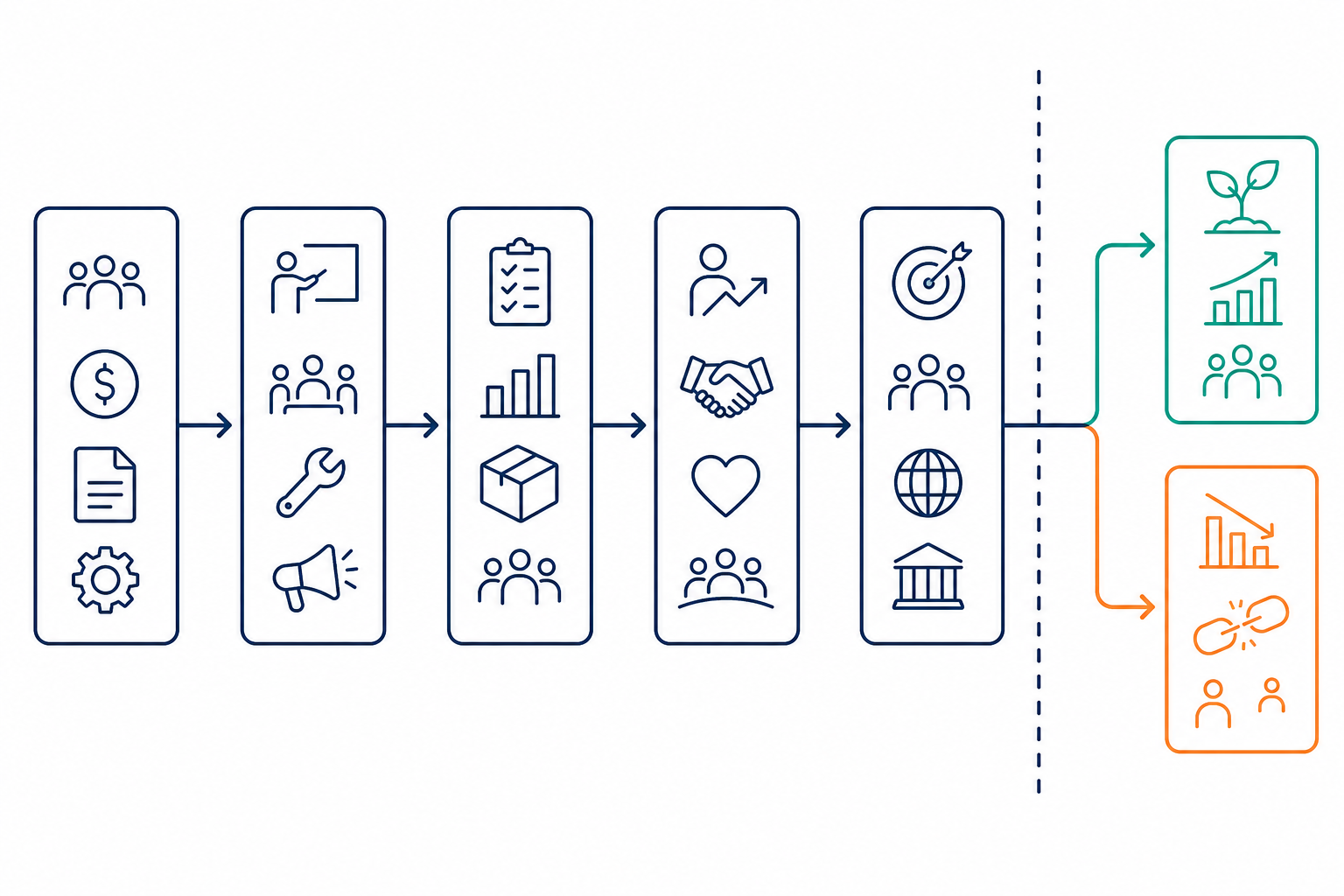
Sustainability Plan Template With Fill-In Prompts
Answer every bracketed prompt with something checkable. Delete any prompt the funder does not ask for.
Scope of continuation. After the period of performance ends, [number] of [number] activities will continue: [list by name]. Service level is [quantity per period], against [quantity per period] during the award. Activities that will end are [list], because [reason].
Financial plan. Annual operating cost of the continuing model is [$amount], against [$amount] during the award. For each source: [source], [$amount], decision date [month and year], status [applied / invited / in discussion]. Total identified is [$amount] against a need of [$amount], leaving [$gap], covered by [reserves / reduced scope].
Partnership commitments. [Partner] has committed to [contribution] through [date], documented in [MOU / board resolution / adopted budget line], attached as [attachment]. Repeat for each partner.
Capacity retained. By the end of the award we will hold [trained staff count and skill], [documented protocols], and [data, tools, or licenses]. These cut post-award operating cost by [$amount] a year because [reason].
Decision points and risks. The main risk is [risk]. We will know by [date] whether [condition] is met. If it is not, [named fallback], which preserves [what survives] and ends [what stops].
How to Write a Sustainability Plan When You Do Not Know If the Program Will Continue
Write a decision plan in place of a promise. Name the threshold, the date the decision gets made, the person who makes it, and what happens under each outcome. Stated uncertainty can be planned around; vagueness written to sound like confidence cannot.
That paragraph needs four things.
- State the condition plainly: "Continuation depends on whether the county renews its human services contract in the March cycle."
- Give the decision a date and an owner: "The executive director and board finance committee decide in April of Year 2, six months before the award ends."
- Write both branches. The continuation branch gets scope and cost. The wind-down branch gets a legacy: who stays trained, which protocols remain in use, where the data lives.
- Say what you have already done. A meeting held, an application submitted, or a board vote scheduled reads differently from an intention.
This wording holds up when continuation is genuinely uncertain:
Continuation of the mobile screening component depends on one decision: whether the regional health authority includes community screening in its next contracting cycle. That determination is made in the authority's spring budget process, and we will know in April of Year 2. Our clinical director has met with the contracting lead twice and has been asked to submit first-year utilization data. If screening is included, the component continues at current volume under contract. If it is not, screening ends with the award, and two things remain at no cost: the referral pathway embedded in both clinics' intake workflow, and two staff credentialed in the protocol.
A no-cost extension does not solve this problem. Under 2 CFR 200.308(g)(2), a federal recipient may in some cases initiate a one-time extension of the period of performance by up to 12 months, with written notice at least 10 calendar days before the period ends, and that extension "may not be exercised for the sole purpose of using unobligated balances" (eCFR, current as of September 2026). An extension moves the end date. It does not answer the sustainability question.
How Sustainability Connects to the Evaluation Plan and Logic Model
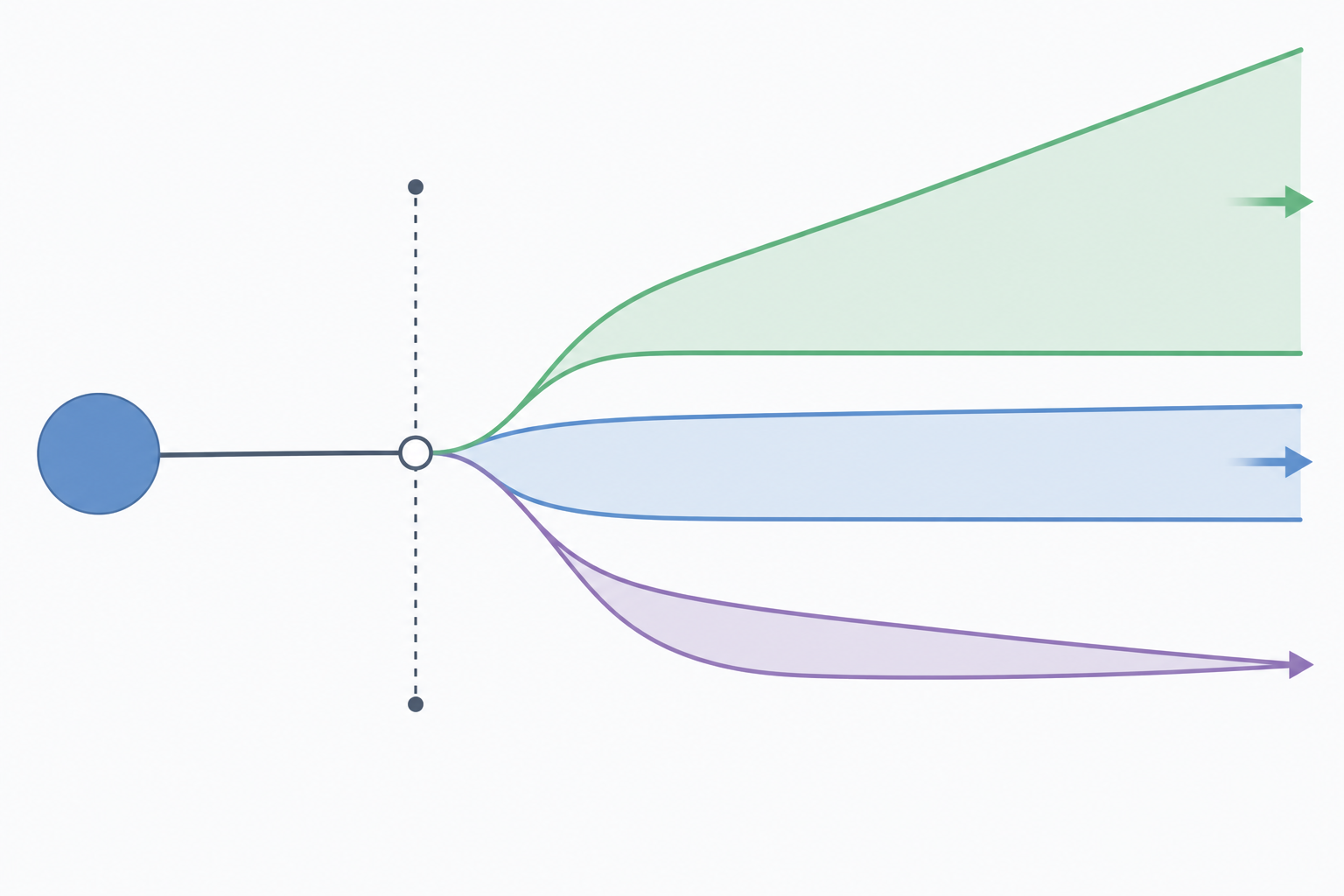
The sustainability plan is the column that comes after your logic model's outcomes, and the evaluation plan supplies the evidence that anything is worth continuing. Run the question down the chain of inputs, activities, outputs, and outcomes, asking which links survive without grant money. A logic model template for grants makes that mapping easy to check.
Outcome data from the award becomes the argument you take to whoever funds the next phase, so pick measures a county budget office or a review panel would accept. An evaluation plan producing only satisfaction surveys leaves you nothing to negotiate with in Year 3, and the grant proposal evaluation plan guide covers what funders expect from that section. Continuation targets written as SMART goals and objectives are checkable, so "the district absorbs the coordinator role by June 30 of Year 2" beats "we will work toward district adoption."
Sustainability comes back at closeout, when a final report asks what happened to the program. Keeping the narrative with the award record through the grant closeout checklist means answering from evidence, not memory.
Continuation funders are prospects like any other. GrantCue's public foundation directory covers more than 10,000 private foundations built from IRS 990-PF filings, with a filter for foundations that indicate they accept applications, and GrantCue's deadline tracking, simple email reminders and ICS calendar feed come with every plan, Free included (grantcue.com, October 2026), so the decision dates in a sustainability plan can sit on the same calendar as the reports due on the current award.
FAQ
What Is a Grant Sustainability Plan?
A grant sustainability plan is a proposal section describing how program activities, funding, partnerships, and organizational capacity will continue after the grant period ends. Funders use it to judge whether their investment produces lasting benefit, so it names sources, amounts, decision dates and signed commitments, and says plainly which activities will stop.
How Long Should a Sustainability Plan for a Grant Proposal Be?
Follow the funder's page or character limit, which always wins. When none is given, keep it in proportion to the rest of the narrative: a few tight paragraphs that cover the four dimensions are enough for most direct-service requests, and every sentence should carry a number, a date or a named source.
Does Sustainability in a Grant Proposal Mean Environmental Sustainability?
Usually no. In a grant proposal it means programmatic and financial continuation after funding ends. Environmental funders and some research infrastructure programs use the word differently, so search the funding announcement for the word and write to the meaning it uses there before you draft.
What Should a Sustainability Plan Say if the Program Will End?
Say so, and describe what remains. Trained staff, documented protocols, adopted referral pathways, and published data all count as durable results. A defined wind-down with a named legacy is more credible than an unsupported claim of continuation, and it answers the funder's question honestly.
Can I Write That We Will Apply for Another Grant?
Yes, if you name the program or funder, the submission date, and where that date falls relative to your award end. "We will pursue additional grant funding" carries no weight on its own; a named application due in Year 2, before the award ends, does. The guide to common grant proposal mistakes covers similar vague promises elsewhere in a proposal.
Rewrite Your Last Sustainability Paragraph
Pull up the last proposal you submitted and find the sustainability paragraph. Mark every sentence that has no number, no date, or no named source behind it. Rewrite those against the fill-in template, then check them against your evaluation measures. Keeping funding cycles and partner commitments in one place makes the next proposal easier to substantiate.