Statement of Need Example for Grants: Templates, Data Sources, and Reviewer-Ready Language
Download the free templateA guide to writing a grant proposal statement of need, with examples, data-source guidance, templates, and related proposal resources.
In this article (27)
- Quick Answer: What Should a Statement of Need Include?
- Statement of Need Template
- Example 1: Education Need Statement
- Example 2: Health Access Need Statement
- Example 3: Community Development Need Statement
- Best Data Sources for a Statement of Need
- Before and After Revision
- How the Need Statement Connects to the Rest of the Proposal
- Common Mistakes
- Mistake 1: Starting With Your Organization
- Mistake 2: Using National Data Only
- Mistake 3: Making the Problem Too Broad
- Mistake 4: Jumping to the Solution Too Soon
- How To Research a Strong Statement of Need
- Local Data Beats Generic Data
- Write the Problem, Not the Absence of Your Program
- How To Use Stories Without Manipulation
- Statement of Need Review Checklist
- AI Prompt for Drafting a Statement of Need
- Mini Needs Assessment Plan
- Source Notes for the Proposal File
- Read the Statement of Need Out Loud
- FAQ
- How long should a statement of need be?
- Can a statement of need include stories?
- What is the difference between a need statement and a needs assessment?
- Next Step
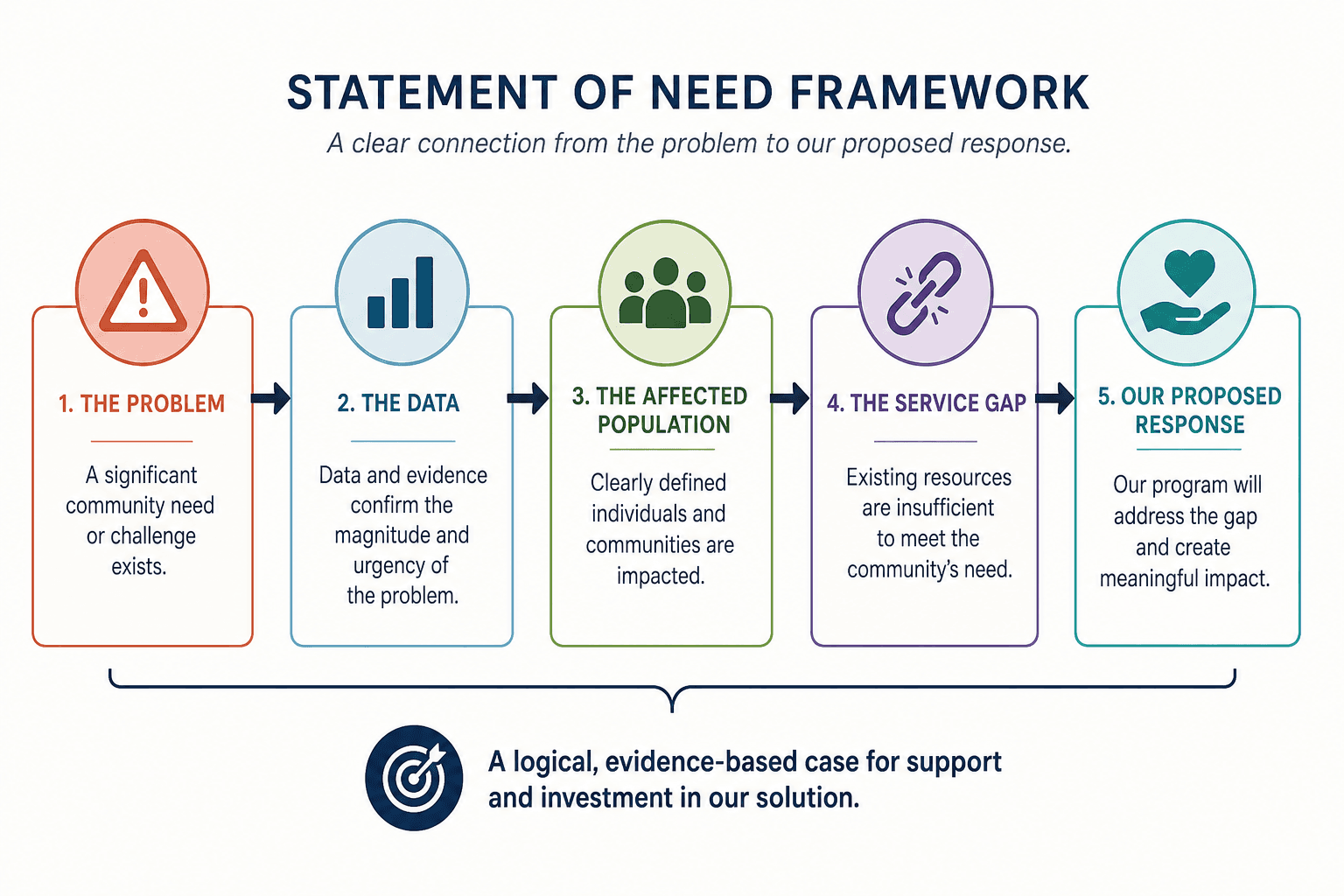
A statement of need explains the problem your grant project will address, who is affected, why the issue matters now, and what gap the proposed project will fill. A strong statement of need uses specific data, local context, and clear consequences. It should make the case that the project is necessary before you ask the funder to support your solution.
Use this statement-of-need guide with the complete grant proposal template. The need statement should directly support your goals, activities, evaluation plan, and budget.
Quick Answer: What Should a Statement of Need Include?
A statement of need is the section of a grant proposal that names the problem a project will address, who is affected, the data that shows the problem is real, the gap in current services, and the consequence of leaving it unaddressed. The section makes the case that the project is necessary before the proposal asks for funding.
The statement of need is one section of a longer document, and the complete grant proposal walkthrough shows where it sits and what has to agree with it.
Statement of Need Template
In [community/location], [population] faces [specific problem]. According to [source], [data point]. This issue affects [population] by [consequence]. Existing services are limited by [gap/barrier]. Without additional support, [likely outcome]. [Organization Name] will address this need through [brief project response].
This template works because it moves from evidence to urgency to solution. It does not start with the organization. It starts with the community problem.
Example 1: Education Need Statement
In the two partner elementary schools, students from low-income households are entering fourth grade with widening reading gaps. District benchmark data shows that 43 percent of third-grade students in the target schools are reading below grade level, compared with 27 percent statewide. Families report that transportation, work schedules, and the cost of private tutoring make it difficult to access academic support outside school hours. Without additional intervention, students who miss early literacy milestones are more likely to struggle across subjects and disengage from school. The Family Literacy Bridge Project addresses this need by pairing after-school tutoring with caregiver workshops that help families reinforce reading skills at home.
Why it works:
- It names the population and location.
- It uses a comparison data point.
- It explains barriers.
- It connects the need to the proposed intervention.
Example 2: Health Access Need Statement
Adults in the three-county service area face long delays accessing behavioral health screenings and referrals. The most recent community health needs assessment identifies behavioral health access as a top regional priority, and local providers report wait times of 30 to 60 days for non-crisis appointments. Transportation gaps make the problem worse for uninsured residents and residents in rural communities. Untreated anxiety, depression, and substance use concerns affect employment, family stability, and physical health. Mobile screening and referral coordination will help residents identify needs earlier and connect to appropriate services faster.
Why it works:
- It combines public data with provider context.
- It avoids overclaiming.
- It links the problem to a practical service model.
Example 3: Community Development Need Statement
The East Harbor neighborhood lacks safe, affordable after-school enrichment for middle school students. Families in the neighborhood have limited access to fee-based arts, sports, and mentoring programs, and the community center's current youth programs operate at capacity. Local school staff report that students need structured activities between school dismissal and evening caregiver pickup. Without additional youth programming, students have fewer opportunities for positive peer relationships, creative expression, and adult mentorship. Creative Fridays will fill this gap with weekly arts instruction, mentoring, and a public student showcase.

Best Data Sources for a Statement of Need
Use a mix of external and internal sources.
Do not overload the section with statistics. One strong local statistic is usually better than five broad national statistics.
Before and After Revision
Weak version:
Many families in our community are struggling, and children need more support. Our organization wants to help them succeed with after-school programming.
Stronger version:
In the East Harbor neighborhood, middle school students have limited access to safe, affordable after-school enrichment. The community center's existing youth programs are at capacity, and school staff report that students need structured activities between dismissal and caregiver pickup. Creative Fridays will respond by providing weekly arts instruction, mentoring, and a public showcase for 60 students during the school year.
The stronger version is more useful because it names the population, place, service gap, and proposed response.
How the Need Statement Connects to the Rest of the Proposal
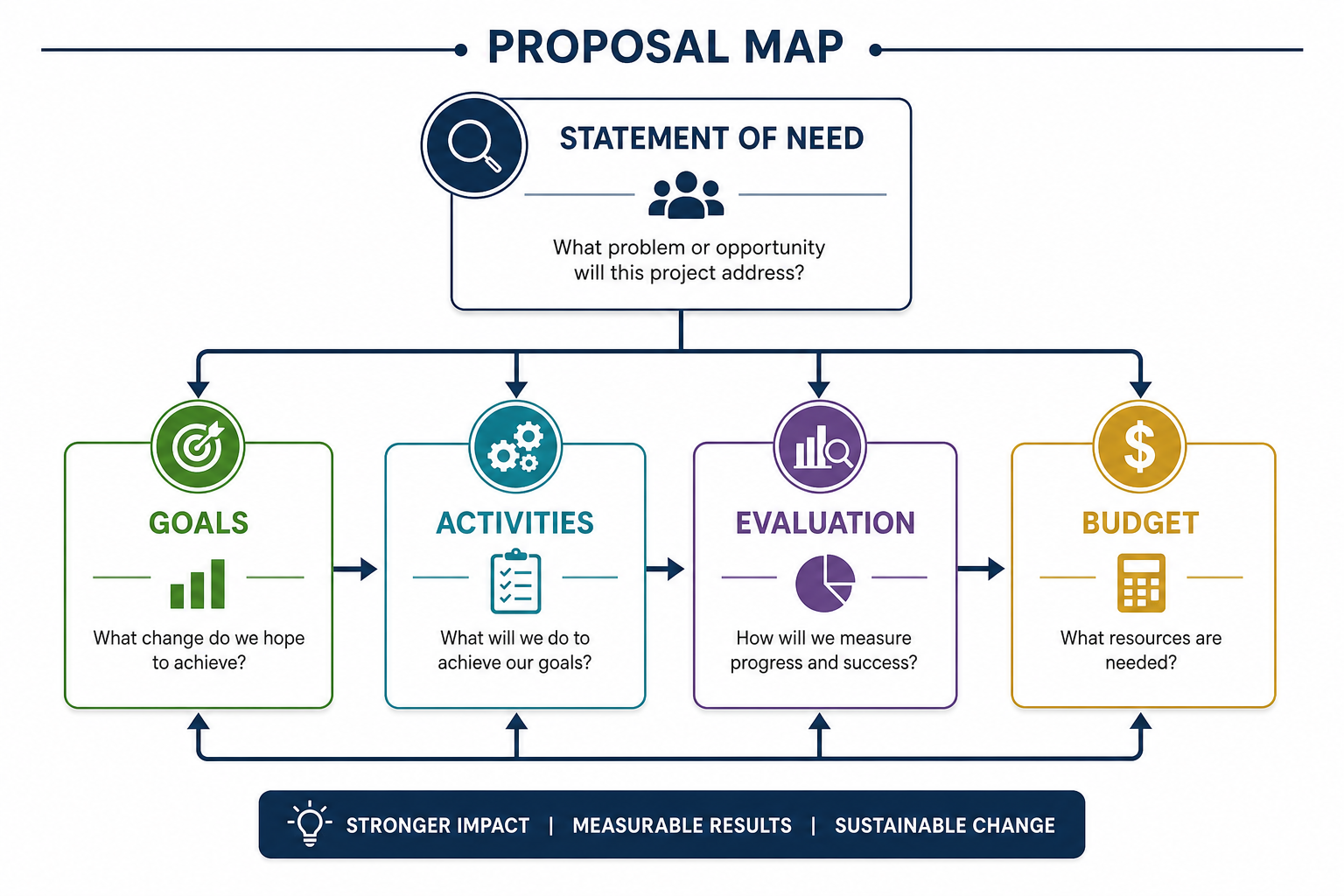
The need statement should not sit alone. In a full nonprofit grant proposal, it should drive the rest of the application:
After drafting the need statement, check that the grant proposal goals and objectives examples, grant proposal evaluation plan, and grant proposal budget template all respond to the same problem.
The need statement opens the grant narrative, the container that carries every section reviewers score.
Common Mistakes
Mistake 1: Starting With Your Organization
The need statement should focus on the community need first. Your organization background belongs elsewhere in the proposal.
Mistake 2: Using National Data Only
National data can provide context, but reviewers usually need local evidence. Use community, county, district, or program-level data whenever possible.
Mistake 3: Making the Problem Too Broad
Avoid broad statements like "poverty is a challenge" or "youth need support." Narrow the problem to the specific barrier your project can realistically address.
Mistake 4: Jumping to the Solution Too Soon
Explain the need before describing the program. A reviewer should understand why the project matters before reading how it works.
How To Research a Strong Statement of Need
A strong statement of need is built from several kinds of evidence. Do not rely on one dramatic statistic or one emotional story. Reviewers usually want to see that the organization understands the problem at the community level, has direct experience with the people affected, and can connect the proposed project to a real gap in service.
Use this research stack:
Candid's proposal guidance emphasizes reviewing and following funder requirements, making the proposal easy to read, and backing up the approach with evidence. NIH's general grant writing guidance gives the same reviewer-centered lesson in a federal context: make the application organized, specific, clear, and easy for reviewers to evaluate. A statement of need should do that work before the proposal ever describes activities.
Local Data Beats Generic Data
National data can help frame a problem, but local data is usually more persuasive. A proposal that says "childhood literacy is a national crisis" is less fundable than a proposal that says "43 percent of third-grade students in the two target schools are reading below grade level, compared with 28 percent countywide." The second version gives reviewers a defined population, a place, a comparison point, and a reason to believe the project is targeted.
Use national data only when it does one of three jobs:
- It explains why the local problem matters.
- It gives context when local data is incomplete.
- It connects the project to a larger public priority.
Then bring the paragraph back to the local service area. This structure answers the broad question and the specific local question in the same section: what is the problem, who is affected, where is it happening, and why does this project matter now? Cite the source for each data point.
Write the Problem, Not the Absence of Your Program
A common weak need statement says, "Our organization needs funding to expand our program." That is an organizational need, not a community need. The reviewer is not primarily funding your growth. The reviewer is funding a public, community, educational, health, cultural, or human service outcome.
Better structure:
- Name the community problem.
- Show who is affected.
- Use local evidence.
- Explain the service gap.
- Connect the gap to the proposed project.
Example:
Weak: "Our nonprofit needs $50,000 to hire a part-time case manager."
Stronger: "In the last fiscal year, 214 households contacted the agency for housing navigation, but 71 households waited more than 30 days for follow-up because current staff capacity is limited to emergency intake. The requested part-time case manager will reduce the follow-up wait time and help families complete rental assistance, document replacement, and referral steps before housing instability becomes homelessness."
The stronger version still supports the staff cost, but the problem is framed as a service gap affecting households.
How To Use Stories Without Manipulation
Stories can make a statement of need memorable, but they should be handled with care. Use composite or permission-based stories, avoid identifying details, and do not use participants as decoration. The story should clarify the data, not replace it.
Good story structure:
- One sentence on the person or household type.
- One sentence on the barrier.
- One sentence on the consequence.
- One sentence that connects the story back to the data.
Example:
"A caregiver in the program's listening session described taking two buses to reach a clinic appointment, then missing the appointment when the second bus was delayed. Her experience reflects a broader pattern: 38 percent of surveyed participants reported missing at least one health or benefits appointment in the past six months because of transportation barriers."
This gives the reviewer a human example and a measurable pattern.
Statement of Need Review Checklist
Before moving on to the project description, review the need statement against these questions:
- Does the section name a specific problem?
- Does it identify the population affected?
- Does it define the geography?
- Does it use current, credible evidence?
- Does it include local data where possible?
- Does it explain the consequences of inaction?
- Does it distinguish the community need from the organization's funding need?
- Does it connect naturally to the proposed project?
- Does it avoid exaggeration?
- Does it avoid unsupported claims?
If the answer to any question is no, revise before drafting the solution. A weak statement of need forces the rest of the proposal to work harder.
AI Prompt for Drafting a Statement of Need
Use AI only with verified source material:
Draft a grant proposal statement of need using only the facts below.
Do not invent statistics, citations, names, or program outcomes.
Write for a nonprofit funder reviewing community need.

Population:
[Who is affected]

Geography:
[Service area]

Local data:
[Data point, source, year]

Program data:
[Waitlist, service count, survey result, or outcome]

Service gap:
[What is missing or insufficient]

Consequence if not funded:
[What happens without intervention]

Proposed project connection:
[How the project responds]
After the draft, ask the AI to list unsupported claims. That second output is often more useful than the first draft because it shows what needs human research.
Mini Needs Assessment Plan
If the statement of need feels thin, run a small needs assessment before writing. This does not have to be a months-long research project. For many nonprofit proposals, a focused two-week process can produce better evidence than guessing.
Use this plan:
- Review the funder's priority language and scoring criteria.
- Pull two to four current local data points.
- Review your organization's service records for the last 12 to 24 months.
- Ask one or two partners whether they see the same problem.
- Collect three to five short participant or staff observations.
- Identify the gap between current services and the level of need.
- Decide which part of the problem the grant can realistically address.
The final statement of need should not include every note you collected. It should include the evidence that makes the strongest case for this project.
Source Notes for the Proposal File
Keep source notes even if the funder does not require citations. Source notes protect the organization during review, reporting, and renewal.
This habit also improves AI-assisted drafting. When source notes are available, the AI can be asked to organize evidence without inventing citations.
Read the Statement of Need Out Loud
Read the final section out loud and ask one question: would someone outside the organization understand the problem without extra explanation? If the answer is no, add context. If the section only makes sense to staff who already know the program, reviewers may miss the urgency. A strong need statement is specific enough to be credible and plain enough to be understood on the first read.
If the section feels persuasive only because the reader already likes your organization, revise again. The evidence should stand on its own, and a new reviewer should understand both the urgency and the limits of the proposed response.
FAQ
How long should a statement of need be?
Follow the funder's instructions. If no length is provided, a standard statement of need is often 500 to 900 words. A short proposal may need only 150 to 300 words.
Can a statement of need include stories?
Yes, but stories should support the data rather than replace it. Use a brief participant or community example to make the need concrete.
What is the difference between a need statement and a needs assessment?
A needs assessment is the research process used to identify a problem. A statement of need is the proposal section that summarizes the problem and evidence.
Next Step
Once the need statement is clear, use it to build out this sample grant proposal for a nonprofit organization. Every objective, activity, budget line, and evaluation measure should trace back to the need you described. When you reach the measurement section, the evaluation plan for a grant proposal guide shows how to turn the documented need into trackable outcomes.