Grant Proposal Goals and Objectives Examples: SMART Templates for Nonprofits
Download the free templateA guide to grant proposal goals and objectives, with SMART objective templates, examples by sector, and links to the full grant proposal template.
In this article (31)
- Quick Answer: Goal vs Objective vs Outcome
- SMART Objective Formula
- The Five Parts of a Measurable Objective
- Example Goal and Objectives: Education
- Example Goal and Objectives: Health Access
- Example Goal and Objectives: Workforce Development
- How Objectives Connect to Evaluation
- Weak vs Strong Objectives
- Common Mistakes
- Mistake 1: Confusing Activities With Outcomes
- Mistake 2: Writing Objectives Without a Baseline
- Mistake 3: Overpromising
- Mistake 4: Ignoring the Budget
- How To Build Objectives From the Statement of Need
- Baselines Make Objectives Credible
- Outputs, Outcomes, and Indicators
- Example Objective Sets by Grant Type
- How To Set Targets Without Overpromising
- Objective Review Checklist
- AI Prompt for Goals and Objectives
- Objective Bank by Measurement Type
- Where Goals and Objectives Fit in the Rest of the Proposal
- How Reviewers Read Objectives
- Tracking Objectives After the Award
- FAQ
- How many objectives should a grant proposal include?
- Are goals and outcomes the same thing?
- Should objectives include percentages or numbers?
- Where do goals and objectives go in a grant proposal?
- What is an example of a project objective?
- Next Step
Grant proposal goals describe the broad change your project intends to create. Objectives describe the measurable results you will achieve during the grant period. A strong proposal connects the statement of need to clear goals, SMART objectives, program activities, and an evaluation plan.
Use this guide with the complete grant proposal template so your objectives match the rest of the application.
Quick Answer: Goal vs Objective vs Outcome
Goals and objectives have to match both the need statement and the evaluation plan. The full proposal guide walks through how those sections connect.
Free download: SMART goals and objectives worksheet as Word .docx. No email address required.
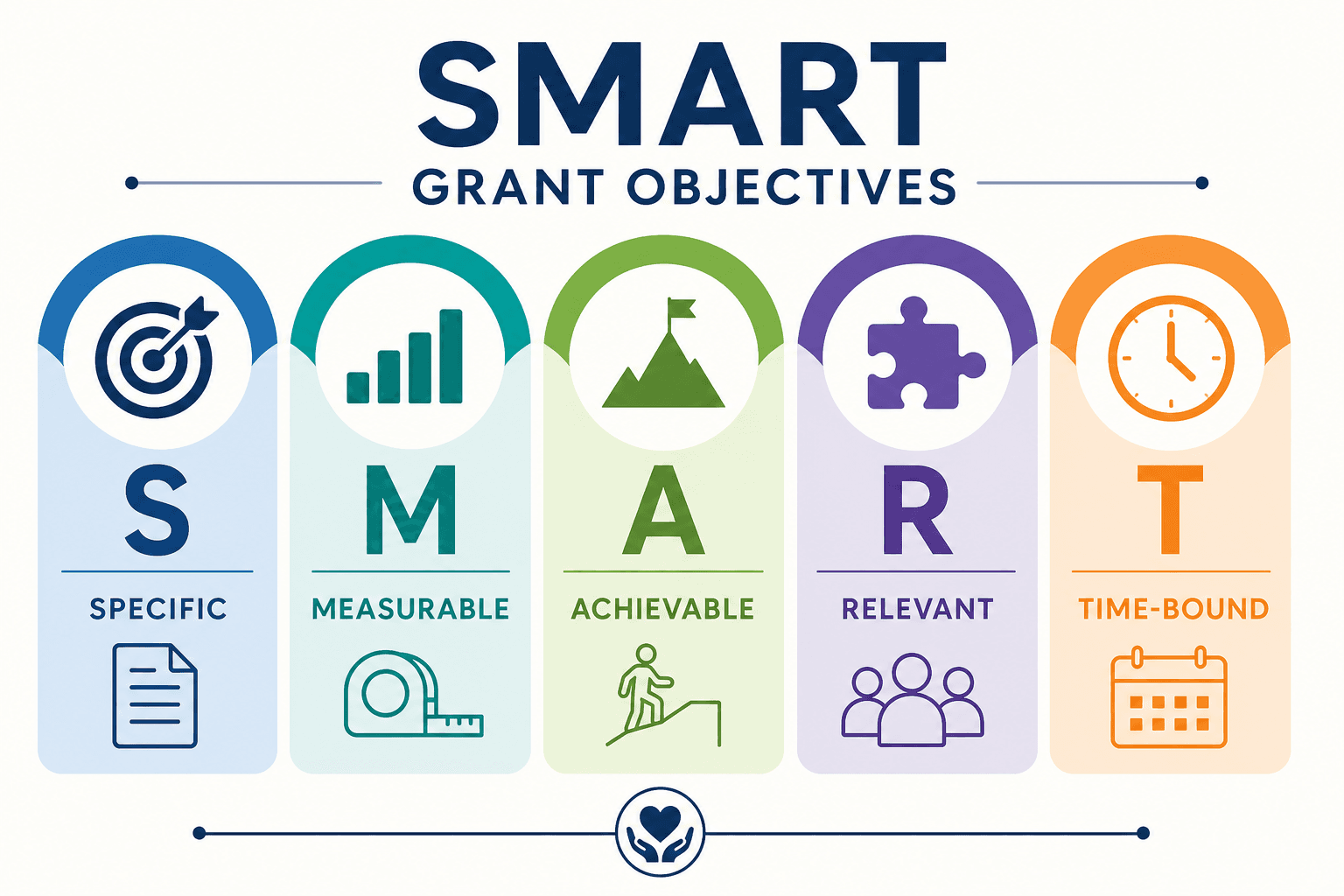
SMART Objective Formula
Use this formula:
By [date], [number or percent] of [target population] will [measurable change] as measured by [tool or data source].
Example:
By June 30, 2027, 70 percent of participating students will improve by at least one reading level as measured by district benchmark assessments.
This objective is strong because it includes a deadline, population, measurable change, and data source.
The Five Parts of a Measurable Objective
A measurable objective has five parts: an action verb, a population, a quantity, a method and a deadline. Draft the sentence, then check that each part is specific enough that a stranger could verify it. The fragments below are illustrative, not figures from a real award.
The quantity row causes the most trouble. Without a baseline, a reviewer cannot judge whether the target is ambitious or trivial. "Serve 1,200 households" reads differently once the reader learns you served 1,150 last year, so state the baseline in the objective or right after it.
Deadlines need to sit inside the period of performance, because you cannot report on an objective that lands three months after the grant ends. When the award start date is unknown, write relative deadlines: "within six months of award" beats a calendar date you will have to revise.
One test separates objectives from goals. Read the sentence and ask what evidence would settle whether it was achieved. If you cannot name the document or count that answers the question, you have written a goal, not an objective. If the sentence describes what your staff will do, it is an activity and belongs in the methods section.
Example Goal and Objectives: Education
Goal:
Improve grade-level literacy among elementary students in the two partner schools.
Objectives:
- Enroll 120 students reading below grade level by the end of month two.
- Provide at least 2,400 tutoring hours during the grant period.
- Help 70 percent of participating students improve by at least one reading level by June 30, 2027.
- Engage 75 caregivers in at least three family literacy workshops.
These objectives connect directly to a statement of need example focused on reading gaps and family support barriers.
Example Goal and Objectives: Health Access
Goal:
Increase early access to behavioral health screening and referral services for uninsured adults in rural communities.
Objectives:
- Provide 2,400 behavioral health screenings during the 24-month project period.
- Refer at least 900 residents to appropriate follow-up services.
- Reduce average referral completion time from 45 days to 25 days by the end of year two.
- Train 20 community partner staff on screening and referral protocols.
Example Goal and Objectives: Workforce Development
Goal:
Improve employment readiness and job placement for unemployed young adults.
Objectives:
- Enroll 150 young adults in workforce readiness programming.
- Help 120 participants complete job-readiness training.
- Place 75 participants in paid employment, internships, or apprenticeships.
- Increase participant job-search confidence by 30 percent as measured by pre/post surveys.
How Objectives Connect to Evaluation
Every objective should have a measurement plan. If you cannot measure it, revise it.
After drafting objectives, build the grant proposal evaluation plan around them. The evaluation plan should not introduce unrelated measures. It should prove whether the objectives were achieved.
Objectives that extend past the grant period belong in the sustainability plan for a grant proposal.
Weak vs Strong Objectives
Weak:
Increase student success.
Strong:
By June 30, 2027, 70 percent of participating students will improve by at least one reading level as measured by district benchmark assessments.
Weak:
Provide helpful services to families.
Strong:
By the end of the project period, 75 caregivers will attend at least three family literacy workshops and 60 percent will report increased confidence supporting reading at home.

The same tests apply outside grant writing; objectives in a nonprofit project proposal for a board or sponsor earn approval the same way, by naming a measurable change and a date.
Weak objectives usually fail for one of five reasons: no number, no baseline, no deadline, an activity in place of a result, or a measurement method the applicant does not have. Three more rewrites show the pattern, with illustrative numbers to replace with your own baselines.
Read each draft objective aloud with "and we will know because" attached to the end. If the sentence that follows names a document you already produce, the objective is sound. If it trails off, add the method clause.
Common Mistakes
Mistake 1: Confusing Activities With Outcomes
"Hold 10 workshops" is an output. "Caregivers increase confidence supporting reading at home" is an outcome. You usually need both.
Mistake 2: Writing Objectives Without a Baseline
If you want to show improvement, define the starting point or the tool you will use to measure change.
Mistake 3: Overpromising
Reviewers may distrust objectives that promise massive change in a short timeline. Choose ambitious but credible targets.
Mistake 4: Ignoring the Budget
Objectives should be achievable with the staffing and resources in the budget. If you promise 2,400 tutoring hours, the grant proposal budget template should include enough tutor time.
How To Build Objectives From the Statement of Need
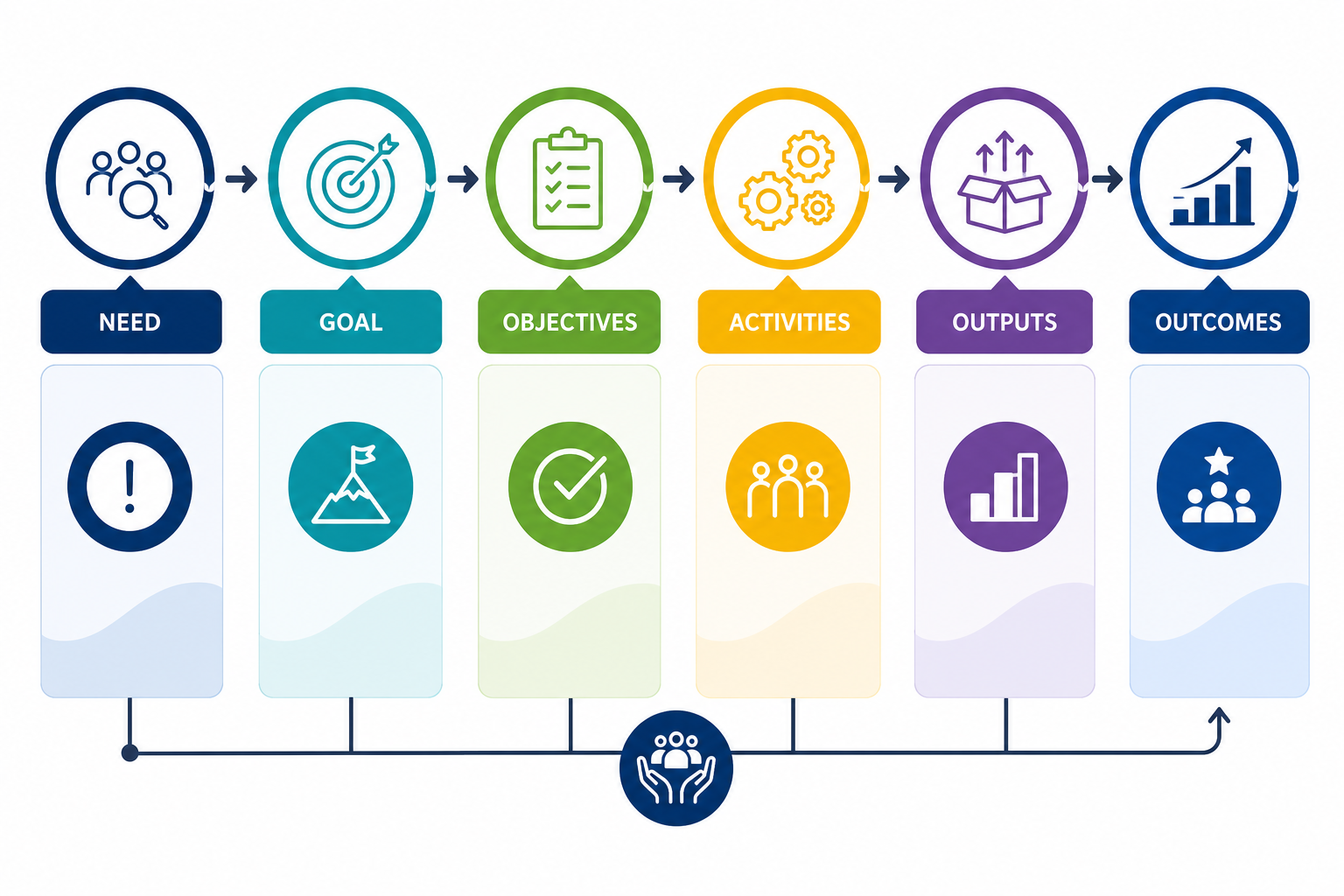
Good objectives are not invented after the proposal is written. They come from the statement of need, the project design, and the evaluation plan. Start by turning the problem into a change statement.
This connection matters for reviewers. NIH's writing guidance tells applicants to make goals realistic and clear, and to make the thought process easy to follow. That advice applies beyond research grants. A reviewer should be able to move from need to activity to objective to evaluation without guessing.
Where objectives sit inside the whole document is easiest to see in a worked grant narrative.
Baselines Make Objectives Credible
A baseline is the starting point. Without a baseline, a target may look arbitrary. If the organization currently serves 60 students per year, an objective to serve 300 students may require a strong staffing and partnership explanation. If the program currently has a 50 percent completion rate, an objective to reach 95 percent may look unrealistic unless the project changes the model.
Use one of these baseline types:
- Current program performance.
- Community data.
- Pilot project results.
- Prior grant results.
- Published benchmark from a similar intervention.
- Partner data.
Example:
"During the previous school year, 54 percent of participating students improved by at least one reading level. With the added tutor hours and caregiver workshops funded by this grant, the program will increase that figure to 70 percent by June 30, 2027."
That objective is stronger because it explains both the starting point and the reason the target might improve.
Outputs, Outcomes, and Indicators
Grant objectives often fail because they mix outputs and outcomes. Both are useful, but they answer different questions.
Most proposals need both output objectives and outcome objectives. Output objectives show the project is feasible. Outcome objectives show the project is worth funding. Both belong in the wider structure laid out in the full nonprofit grant proposal guide.
Example Objective Sets by Grant Type
Youth Program
Goal: Improve academic support for middle school students who are performing below grade level.
Objectives:
- Enroll 90 students referred by partner schools by October 15, 2026.
- Deliver at least 1,800 total tutoring hours during the school year.
- Increase math benchmark scores for at least 65 percent of participating students by May 31, 2027.
- Achieve caregiver participation in at least one family conference for 70 percent of enrolled students.
Food Security Program
Goal: Improve reliable access to healthy food for low-income households.
Objectives:
- Distribute 4,000 produce boxes to 500 unduplicated households during the grant period.
- Add two mobile pantry sites in neighborhoods identified by partner referral data.
- Increase the share of surveyed households reporting reliable weekly access to fresh produce from 42 percent at intake to 65 percent at follow-up.
Arts and Culture Program
Goal: Expand access to community arts education for rural youth.
Objectives:
- Provide 36 free after-school arts workshops across three community sites.
- Enroll at least 120 youth, with at least 60 percent from households qualifying for free or reduced-price lunch.
- Collect participant portfolios and post-program surveys showing that 80 percent of participants gained at least one new art technique or creative skill.
Environment Program
Goal: Improve water quality in a degraded urban creek segment.
Objectives:
- Plant 1,800 native riparian trees across 4 stream miles by November 2027, verified by GPS-logged planting records.
Housing Program
Goal: Reduce returns to homelessness among households exiting the shelter.
Objectives:
- Keep 85 of 100 households housed at the 12-month mark, verified through HMIS follow-up.
Illustrative figures, not data from a real organization.
How To Set Targets Without Overpromising
Targets should be ambitious enough to matter and realistic enough to believe. Use these questions:
- What did we achieve last year?
- What changes with this funding?
- What does the budget actually support?
- How much time do staff have?
- Are participants likely to stay engaged?
- What outside factors could affect results?
- What target would a reviewer consider credible?
If the project is new, consider using a pilot objective. For example, "By the end of the six-month pilot, the organization will test the intake process with 50 participants and use findings to refine the full-year service model." Pilot objectives are especially useful when the funder supports innovation or capacity building.
Objective Review Checklist
Before final submission, each objective should pass this test:
- It starts with an action verb.
- It names a population or unit.
- It includes a number, percent, or clear completion standard.
- It has a deadline.
- It can be measured with available data.
- It connects to the project activities.
- It is supported by the budget.
- It does not promise more than the team can deliver.
If an objective cannot be evaluated, rewrite it before writing the evaluation plan.
AI Prompt for Goals and Objectives
Create grant proposal goals and SMART objectives from the project facts below.
Use only the information provided.
Do not invent baselines, target numbers, or outcomes.
If a number is missing, mark it as [human input needed].

Statement of need:
[Need summary]

Project activities:
[Activities]

Population:
[Participants]

Grant period:
[Dates]

Available baseline data:
[Baseline]

Evaluation methods:
[Surveys, assessments, attendance, records]
The best AI output will identify missing baselines instead of filling them in with fake precision.
Objective Bank by Measurement Type
Use these examples as models, not as numbers to copy.
This bank helps writers avoid vague objectives like "increase awareness" or "provide support." If the objective cannot be measured, it probably needs a stronger verb, target, or data source.
Where Goals and Objectives Fit in the Rest of the Proposal
Goals and objectives sit between the need statement and the methods section, and what you write there determines what the rest of the application has to say. A number in an objective sets a target the budget has to fund, the workplan has to schedule, and the evaluation plan has to measure.
A logic model is a quick way to check that the pieces line up, because it forces inputs, activities, outputs and outcomes onto one page. The same check works in a plain table: one row per objective, then a column for the activity that produces it, a column for the instrument that measures it, and a column for the budget line that pays for it. Any empty cell is a question a reviewer can ask. Change a number anywhere along the chain and check every other place it appears, including attachments. Number your objectives and keep those numbers consistent across the narrative, the workplan and the budget justification, so the reader never has to reconcile two meanings of "objective 2.1" before scoring either.
How Reviewers Read Objectives
Reviewers often scan objectives before reading every paragraph. They use the objectives to understand whether the proposal is organized and whether the applicant knows what success looks like. Strong objectives make the application easier to score because they give reviewers a checklist.
Weak objectives create uncertainty. If the application promises to "empower families," a reviewer has to guess what will change. If the application promises that "75 caregivers will complete three workshops and 60 percent will report increased confidence using a reading strategy at home," the reviewer can see the scale, method, and intended result.
This distinction also makes the section easier to scan and reuse. Define goals, objectives, outputs, outcomes, baselines, indicators, and targets in plain language so reviewers can see exactly what the project promises.
One quick test before you submit: cover the project narrative and read only the objectives. A reviewer should still understand the intended scale and result. If the objectives could apply to almost any nonprofit program, they are too generic, so add the population, measure, target, and deadline. This catches vague wording before it reaches the funder and keeps the proposal aligned with the evaluation plan.
Tracking Objectives After the Award
Objectives written in a proposal become reporting obligations the day the award lands, so store them where the people writing reports will find them. By the second reporting period they are usually buried in whatever document the proposal was written in, and the person drafting the report is often not the person who wrote the objective.
That is a workflow problem. GrantCue tracks the awards those objectives belong to, so each reporting deadline carries a date and each report draft carries an owner. Browse open grant opportunities, add the ones you plan to pursue, then set a reminder at each reporting milestone. Keep your own copy of every funded set as well, since a block that scored well is a starting point for the next application.
FAQ
How many objectives should a grant proposal include?
Most proposals need three to five objectives. Very small grants may need one or two. Complex federal projects may need more.
Are goals and outcomes the same thing?
No. Goals are broad and directional. Outcomes are measurable changes that result from the project.
Should objectives include percentages or numbers?
Use both when possible. Percentages show proportional success, while numbers show scale.
Where do goals and objectives go in a grant proposal?
Directly after the statement of need and before the methods section, so the reader moves from the problem to the intended change to the plan for producing it. Some funders fold them into a project description instead, so check the funding opportunity instructions.
What is an example of a project objective?
"By June 30, 2027, move at least 70 of the 90 enrolled third graders up one or more reading levels on the district benchmark assessment." That sentence names the deadline, the population, the target, the change and the instrument that proves it.
Next Step
After writing objectives, return to the complete grant proposal template and confirm the activities, evaluation plan, and budget all support the same measurable results.