Nonprofit Executive Summary Example: Templates for Grants, Reports, and Funding Requests
Download the free templateA nonprofit executive summary guide with templates for grant proposals, organizational overviews, annual reports, and funder-ready summaries.
In this article (32)
- Quick Answer: What Should an Executive Summary for a Nonprofit Organization Include?
- Nonprofit Grant Executive Summary Example
- Nonprofit Organizational Executive Summary Example
- Nonprofit Executive Summary Template
- Grant Proposal vs Annual Report Summary
- How To Write a Strong Nonprofit Executive Summary
- 1. Name the Reader's Decision
- 2. Use Specific Numbers
- 3. Connect Need to Action
- 4. Keep It Short
- Common Mistakes
- Mistake 1: Starting With Too Much History
- Mistake 2: Using Generic Impact Language
- Mistake 3: Forgetting the Funding Request
- Mistake 4: Disconnecting From the Budget
- Where Nonprofits Use Executive Summaries
- Grant Executive Summary vs Organizational Summary
- Metrics That Make a Summary Stronger
- Before and After Example
- Make the summary easy to reuse
- Review Checklist
- AI Prompt for a Nonprofit Executive Summary
- Full Nonprofit Executive Summary Example
- Why This Example Works
- How To Shorten an Executive Summary
- Common Summary Lengths by Asset
- Align the Summary With the Full Document
- FAQ
- How long should a nonprofit executive summary be?
- What is the difference between a nonprofit executive summary and a mission statement?
- Should a nonprofit executive summary include financials?
- Next Step
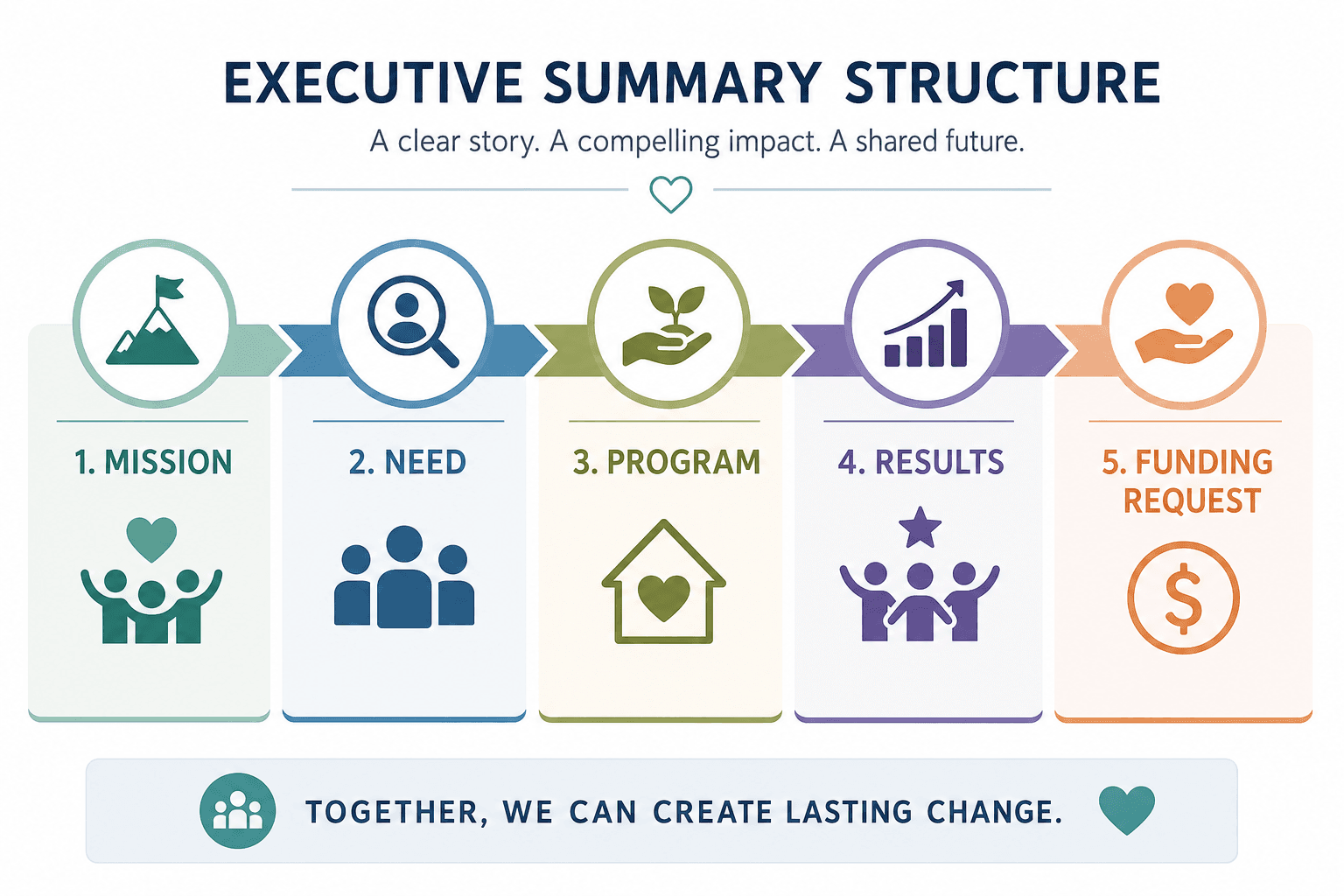
A nonprofit executive summary is a concise overview of your organization, project, funding request, or annual results. In a grant proposal, it should explain the need, project, request amount, and expected outcomes. In an organizational document, it may summarize mission, programs, impact, and financial position.
If you are writing specifically for a grant, use this nonprofit summary guide alongside the grant proposal executive summary example and the complete grant proposal template.
Quick Answer: What Should an Executive Summary for a Nonprofit Organization Include?
If you are drafting a whole application rather than just the summary, start with how to write a grant proposal.
Nonprofit Grant Executive Summary Example
Riverside Community Partners requests $75,000 to support the Family Literacy Bridge Project, a 12-month tutoring and caregiver engagement program serving 120 elementary students in two rural schools. District benchmark data shows that 43 percent of third-grade students in the target schools are reading below grade level. Grant funds will support part-time reading tutors, bilingual family workshops, curriculum materials, transportation support, and evaluation activities. By the end of the grant period, at least 80 participating students will improve by one reading level or more, and 75 caregivers will complete at least three literacy workshops. Riverside Community Partners has delivered school-based youth programs for 14 years and will implement the project with district partners.
This summary works because it includes the organization, amount, project, need, activities, outcomes, and credibility.
Nonprofit Organizational Executive Summary Example
Riverside Community Partners is a community-based nonprofit that helps children and families access academic support, family engagement programs, and basic stability services. In the past year, the organization served 1,850 residents through youth programs, family literacy workshops, food access partnerships, and school-based support. Program data shows that 78 percent of youth participants completed at least one full program cycle, and 82 percent of surveyed caregivers reported stronger connection to local support resources. The organization is expanding its school partnership model to reach more students in rural communities where transportation, tutoring costs, and limited after-school options create barriers for families.
Use this format for annual reports, board packets, donor packets, or strategic funding conversations.

Nonprofit Executive Summary Template
[Organization Name] is a [type of nonprofit] whose mission is [mission]. The organization serves [population] in [location] through [program areas]. In [time period], [Organization Name] achieved [key result]. The current priority is [project or strategic need]. Support will help [organization] [activities] and achieve [outcomes].
Grant Proposal vs Annual Report Summary
Do not use the same summary everywhere. The audience and decision should shape the content.
How To Write a Strong Nonprofit Executive Summary
1. Name the Reader's Decision
Are they deciding whether to fund, partner, donate, approve, or keep reading? The summary should make that decision easier.
2. Use Specific Numbers
Replace vague claims with numbers:
Weak:
We help many families each year.
Stronger:
In 2025, Riverside Community Partners served 1,850 residents through youth programs, family literacy workshops, and food access partnerships.
3. Connect Need to Action
The summary should show why your work is necessary and what you will do about it.
4. Keep It Short
Most nonprofit executive summaries should be 250 to 750 words. If the summary is longer than one page, it may no longer be a summary.
Common Mistakes
Mistake 1: Starting With Too Much History
A founding story can help, but it should not crowd out the current need and request.
Mistake 2: Using Generic Impact Language
Words like empower, transform, and uplift are not wrong, but they need evidence.
Mistake 3: Forgetting the Funding Request
If the summary is part of a proposal, state the amount clearly.
Mistake 4: Disconnecting From the Budget
If you mention activities in the summary, the grant proposal budget template should include the resources needed to deliver them.
Where Nonprofits Use Executive Summaries
A nonprofit executive summary can appear in several contexts, and each one needs a slightly different emphasis.
The mistake is reusing the same summary everywhere. A funder does not need the same executive summary as a board member reviewing a merger discussion or a donor reading an annual impact report.
Grant Executive Summary vs Organizational Summary
A grant executive summary is project-specific. An organizational executive summary is institution-specific.
Grant summary:
- Names one funding request.
- Focuses on one project or program.
- Connects need, activities, budget, and outcomes.
- Uses the funder's priorities as context.
Organizational summary:
- Describes the nonprofit's mission and role.
- Explains the service area and core programs.
- Summarizes track record and impact.
- May include financial or strategic priorities.
If the summary is for a grant, do not spend half the space on organizational history. If the summary is for a strategic plan, do not make it read like a project budget narrative. When the summary opens a funding request, build it straight from your full nonprofit grant proposal guide so the summary and the narrative stay consistent.
Metrics That Make a Summary Stronger
Specific metrics help reviewers understand the substance of the summary. Use numbers when they are current and relevant.
Examples:
- People served last year.
- Program completion rate.
- Waitlist count.
- Percentage of participants achieving an outcome.
- Geographic reach.
- Years of service.
- Partner count.
- Total project cost.
- Amount requested.
- Match or leveraged funding.
Do not use vanity metrics that do not support the decision. A social media follower count may matter for an outreach campaign, but it probably does not belong in a food security grant summary unless outreach reach is part of the project design.
Before and After Example
Weak:
"Our nonprofit has served the community for many years and is committed to making a difference. We provide important programs that help families succeed and request support to continue this work."
Stronger:
"North Valley Family Center requests $80,000 to expand its family navigation program for 240 low-income households in North Valley County. In 2025, 61 percent of households seeking rental assistance also needed help with document replacement, benefits applications, or transportation, but current staffing allowed only emergency intake. Grant funds will add a part-time navigator, extend evening appointment hours, and support transportation assistance. By the end of the 12-month grant period, at least 180 households will complete a stability plan and 120 will resolve at least one benefits, housing, or transportation barrier."
The stronger version names the organization, request, population, need, project, and outcomes. It is easier for a reviewer to score and easier for staff to reuse accurately.
Make the summary easy to reuse
Reusable writing is clear writing. Use:
- A direct first sentence.
- Specific entities and locations.
- A table when comparing uses or components.
- Short paragraphs.
- Consistent terminology.
- Explicit connection between request and outcome.
For a grant executive summary, use precise terms like funding request, project period, statement of need, measurable outcomes, and budget so a reviewer can match the summary to the rest of the proposal.
Review Checklist
Before sharing or submitting:
- Does the first sentence explain the purpose?
- Is the reader's decision obvious?
- Are the most important numbers included?
- Does the summary match the full document?
- Does it include the funding request if relevant?
- Does it avoid unsupported impact claims?
- Does it show why the organization is credible?
- Does it end with a clear next step or result?
AI Prompt for a Nonprofit Executive Summary
Draft a nonprofit executive summary for the use case below.
Use only the facts provided.
Do not invent outcomes, financials, partnerships, or history.

Use case:
[Grant proposal, annual report, strategic plan, board packet, case for support]

Reader decision:
[What the reader needs to decide]

Organization:
[Name, mission, service area, credibility]

Need or opportunity:
[Specific context]

Program or proposal:
[Activities, audience, timeline]

Numbers to include:
[People served, request amount, outcomes, budget, years]

Tone:
[Professional, concise, funder-facing, board-facing, donor-facing]
After drafting, compare every number against the source document. Executive summaries are short, so one wrong number stands out.
Full Nonprofit Executive Summary Example
River County Community Health is a 501(c)(3) nonprofit that provides preventive health education, benefits navigation, and referral support for low-income residents across River County. In 2025, the organization served 3,200 residents through community workshops, one-on-one navigation, and partnerships with clinics, schools, and housing agencies.
The organization is requesting $100,000 to expand its Community Health Navigator Program for a 12-month project period. Local intake data show that 46 percent of clients seeking health education also need help completing benefits applications, scheduling appointments, or arranging transportation. Current staff capacity limits follow-up support, leaving many residents with information but no practical path to care.
Grant funds will support two part-time navigators, bilingual outreach materials, transportation assistance, data tracking, and evaluation. The project will serve 500 residents, complete 350 benefits or referral action plans, and help at least 250 residents attend a health, benefits, or social service appointment. Results will be tracked through intake forms, appointment logs, participant follow-up surveys, and partner referral records.
River County Community Health is positioned to deliver this project because it has 18 years of community health experience, formal referral partnerships with four clinics, and a bilingual outreach team already working in the target neighborhoods. The requested funding will convert existing trust and education into measurable access to care.
Why This Example Works
The example works because it answers the reader's decision quickly:
- Who is applying?
- What do they do?
- How much are they requesting?
- What problem will the project address?
- What will the money pay for?
- How many people will benefit?
- How will results be measured?
- Why can this organization deliver?
It does not try to include the entire proposal. It gives enough information for a reviewer to understand the request and keep reading.
How To Shorten an Executive Summary
If the funder gives a tight word limit, cut in this order:
- Long founding history.
- Secondary programs not connected to the request.
- Repeated mission language.
- Extra adjectives.
- Detailed methods that belong in the project description.
- Full partner lists.
- Background data that is not essential to the decision.
Keep the request amount, project purpose, population, need, activities, and measurable results.
Common Summary Lengths by Asset
Length should follow the reader's need. A summary that is too short may hide important facts. A summary that is too long may bury the decision. When in doubt, lead with the decision the reader has to make and cut anything that does not support that decision.
Align the Summary With the Full Document
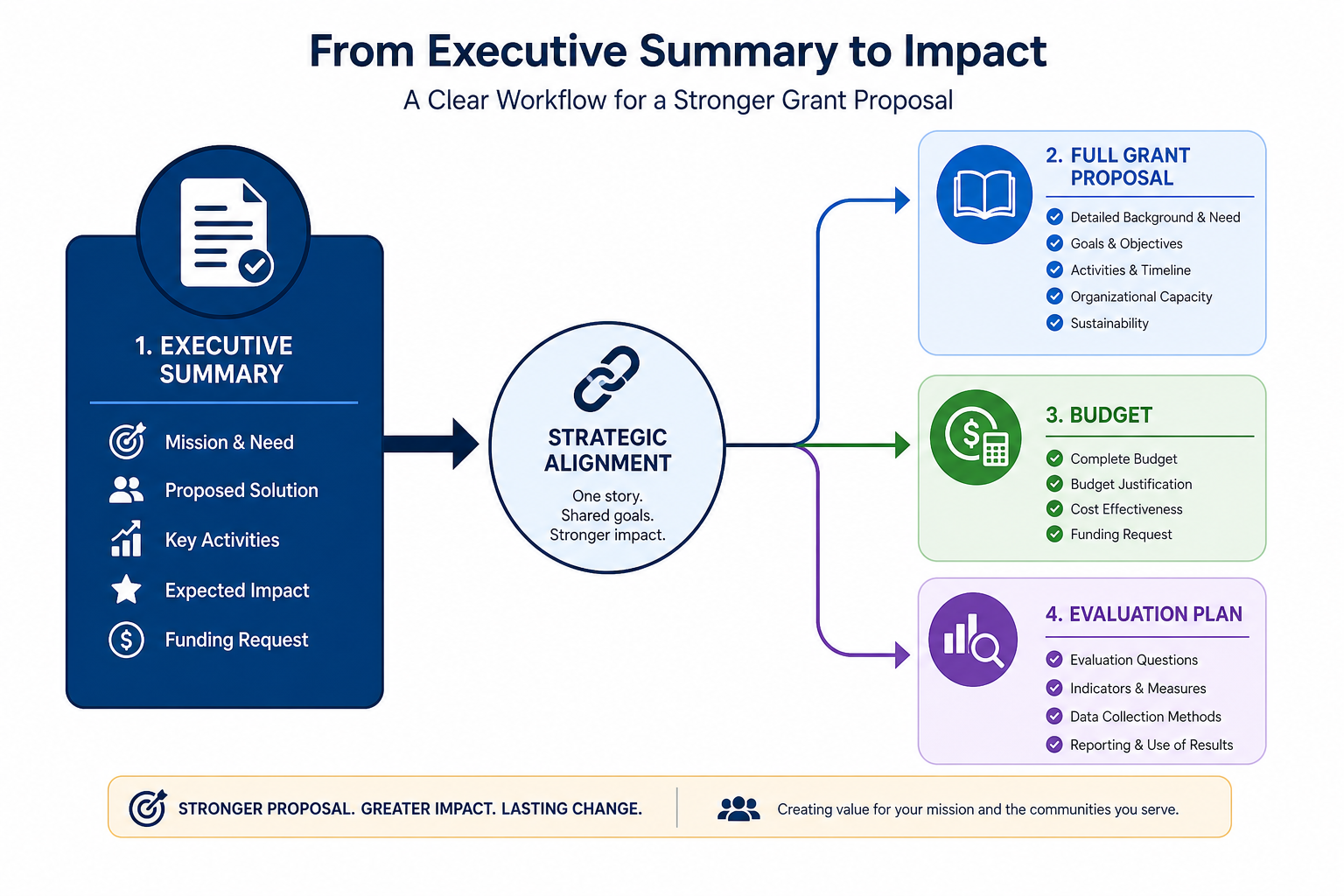
An executive summary should be written last, even though it appears first. After the full proposal, report, or plan is complete, compare the summary against the final document. Every major claim should be supported later, every number should match, and every promised result should appear in the project plan, budget, or evaluation section. If the summary is stronger than the underlying document, fix the document instead of overselling the summary.
This step matters most when several people contributed sections. The summary should sound like one coherent organizational position, not a patchwork of program, finance, and development notes, and it helps internal reviewers catch inconsistencies before the document leaves the organization.
FAQ
How long should a nonprofit executive summary be?
Most nonprofit executive summaries are 250 to 750 words. For a short grant application, the summary may be shorter.
What is the difference between a nonprofit executive summary and a mission statement?
A mission statement explains why the organization exists. An executive summary explains the organization, current need, proposed work, and results in context.
Should a nonprofit executive summary include financials?
Include financial details when relevant to the decision, such as a funding request, project budget, or stewardship summary.
Next Step
If this summary is for a grant, expand it into the step-by-step grant proposal walkthrough and make sure the proposal narrative supports every claim in the summary. Once the full document is final, keep the matching summary version with the proposal record so the next submission starts from an accurate draft.