What Is a Letter of Support? Definition, Examples, and Who Should Write One
A letter of support is a signed third-party endorsement of a grant project. Here is what belongs in one, who should write it, and a full example you can adapt.

Last updated: September 2026
A funder asks for letters of support, the deadline is nine days out, and nobody on your team has assembled one before. Two questions come first: what is a letter of support, and who should write yours? A letter of support is a short signed document from someone outside your organization that confirms your project is real and says why the writer backs it. Reviewers read them to settle something else entirely: does anyone besides the applicant believe this work will happen? Most of the job is in who you ask and how early you ask them.
Quick Answer: What Is a Letter of Support?
A letter of support is a signed statement from a third party that endorses a grant applicant's project and confirms the writer's stake in its success. It typically runs one page on the writer's letterhead, names the specific project and funder, describes the relationship, and states what the writer will contribute or vouch for.
Free download: Letter of support pack, four ready-to-adapt letters as Word .docx. No email address required.
What Is a Letter of Support in a Grant Application?
In a grant application, a letter of support is an attachment that corroborates the partnerships and community demand your narrative asserts. Reviewers treat it as evidence about the proposal rather than praise for the organization.
The writer is usually a partner agency director, a school principal, an elected official, or someone the program has served. Whoever signs it, the funder reads for one signal: a person with a reputation to protect put their name on this application.
Funders read a support letter as an endorsement rather than a pledge. That is the line between a letter of support and a letter of commitment, and blurring it weakens the whole attachment package. If a partner promises three staff days a month, that promise belongs in a commitment letter or a memorandum of understanding, not buried in an endorsement.
Wherever the funder files it, the letter should echo a claim you already made. If your statement of need says the county has one bilingual caseworker for a district of thousands, a letter from the agency employing that caseworker turns your assertion into corroboration. A letter that praises your organization in general terms without touching a single claim in the proposal adds paper and nothing else.
Asking a partner for a letter also forces a conversation about what each organization is actually agreeing to, and that conversation is better had before you submit than after you win. Our walkthrough on how to write a grant proposal puts partner outreach ahead of drafting for that reason.

Letter of Support vs. Letter of Commitment vs. Letter of Intent
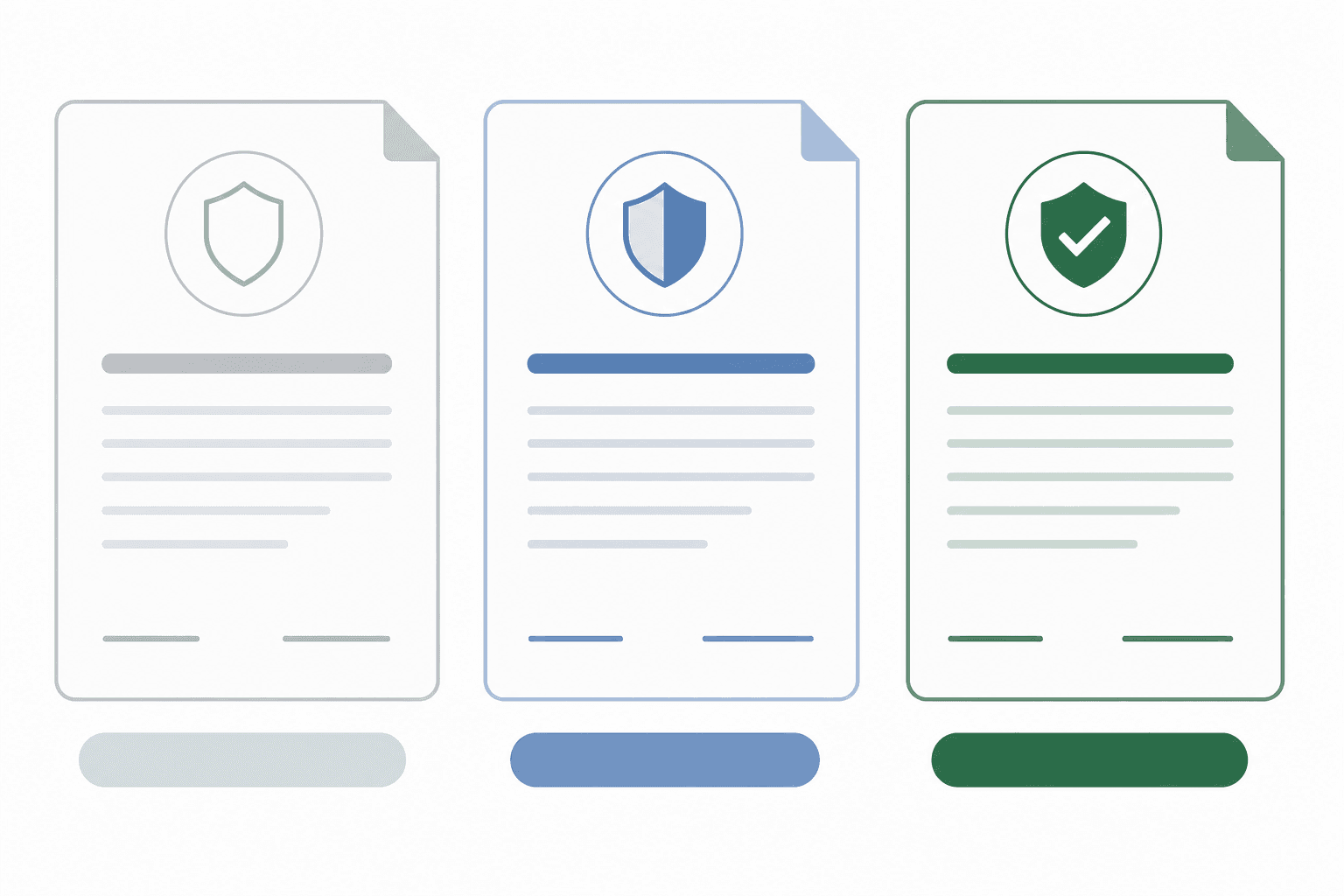
Funders use these terms inconsistently, so the announcement's instructions decide which document you need, not the label on it. What separates them is how much each one commits and who has the authority to sign.
| Document | What it says | Who signs it | How funders read it | Length we recommend |
|---|---|---|---|---|
| Letter of support | This project matters and I endorse the applicant | Partner, official, service recipient, community leader | An endorsement rather than a pledge of resources | 1 page |
| Letter of commitment | I will provide this named resource if the grant is awarded | An officer authorized to commit the resource | A binding pledge of the named resource, though the letter is not itself a contract | 1 page |
| Letter of intent | We intend to apply, and here is the project in brief | The applicant's executive director or principal investigator | A screening document that commits nobody to anything | 1 to 3 pages |
| Memorandum of understanding | Here are the responsibilities each party accepts | Both organizations | The closest thing to an agreement in the packet, though many are written as expressly non-binding | 2 or more pages |
Whether an MOU binds anyone turns on its terms and the law that governs it, not on the word at the top of the page. Nothing here is legal advice.
The letter of intent causes the most confusion, because it sits at the front of the process rather than in the attachment pile, and it travels from you to the funder rather than from a partner to the funder. When guidelines ask for an LOI before a full application, that is a screening step, and our letter of intent example and template covers what belongs in it.
One rule holds across all four. If the letter names a dollar figure or a headcount, the signer needs authority to commit it. A program coordinator can endorse. Only a director or officer can pledge.
When Funders Require a Letter of Support
A letter of support is required whenever the funding announcement lists it under required attachments, and it is worth including when optional if your project depends on partners you have named. Read those instructions before you ask anyone for anything, because they settle four things you cannot guess:
- Whether letters are required, optional, or prohibited, and whether the announcement caps how many you may attach.
- Whether they count against the narrative page limit.
- Whether they must be merged into one PDF or uploaded separately.
- Whether the review criteria award points for demonstrated partnership. If so, the letters are scored content.
Federal practice is not uniform, and the form set is what decides it. NIH applications that use the PHS 398 Research Plan Form have a dedicated Letters of Support attachment field, and NIH instructs applicants to "combine all letters of support into a single PDF file" and to "not place these letters in the Appendix" (NIH Application Guide, G.400 PHS 398 Research Plan Form, checked September 2026). That field belongs to the PHS form, not to the SF-424 (R&R) itself. The R&R Other Project Information form carries only a general Other Attachments field at item 12 (NIH Application Guide, G.220, checked September 2026).
Some programs refuse the letters outright. NSF's CAREER solicitation states that "letters of recommendation for the PI or other letters of support for the project are not permitted," and requires letters of collaboration in a prescribed single sentence, warning that "departure from this format may result in the proposal being returned without review" (NSF 20-525, CAREER solicitation, checked September 2026). Foundations vary just as widely, so read the attachment instructions for each one.
Our companion guide to letters of support for grants goes deeper on the funder-by-funder variations.
Certain project types make letters close to mandatory in practice:
| Project type | Why a letter matters | Best source |
|---|---|---|
| Multi-agency collaboration | Proves the partners agreed before you submitted | Each partner's executive director |
| School-based program | Confirms building access and staff release time | Principal or district administrator |
| Fiscally sponsored project | Confirms the sponsor accepts the funds and the reporting | Fiscal sponsor's finance officer |
| Program serving a specific population | Shows the community asked for this, not just the applicant | Participant, client, or resident group |
If your proposal claims a referral pipeline from another agency and no letter from that agency appears, a careful reviewer reads the pipeline as aspirational. Plan the attachments alongside the rest of the grant proposal rather than after it.
What Goes in a Support Letter for Grant Applications
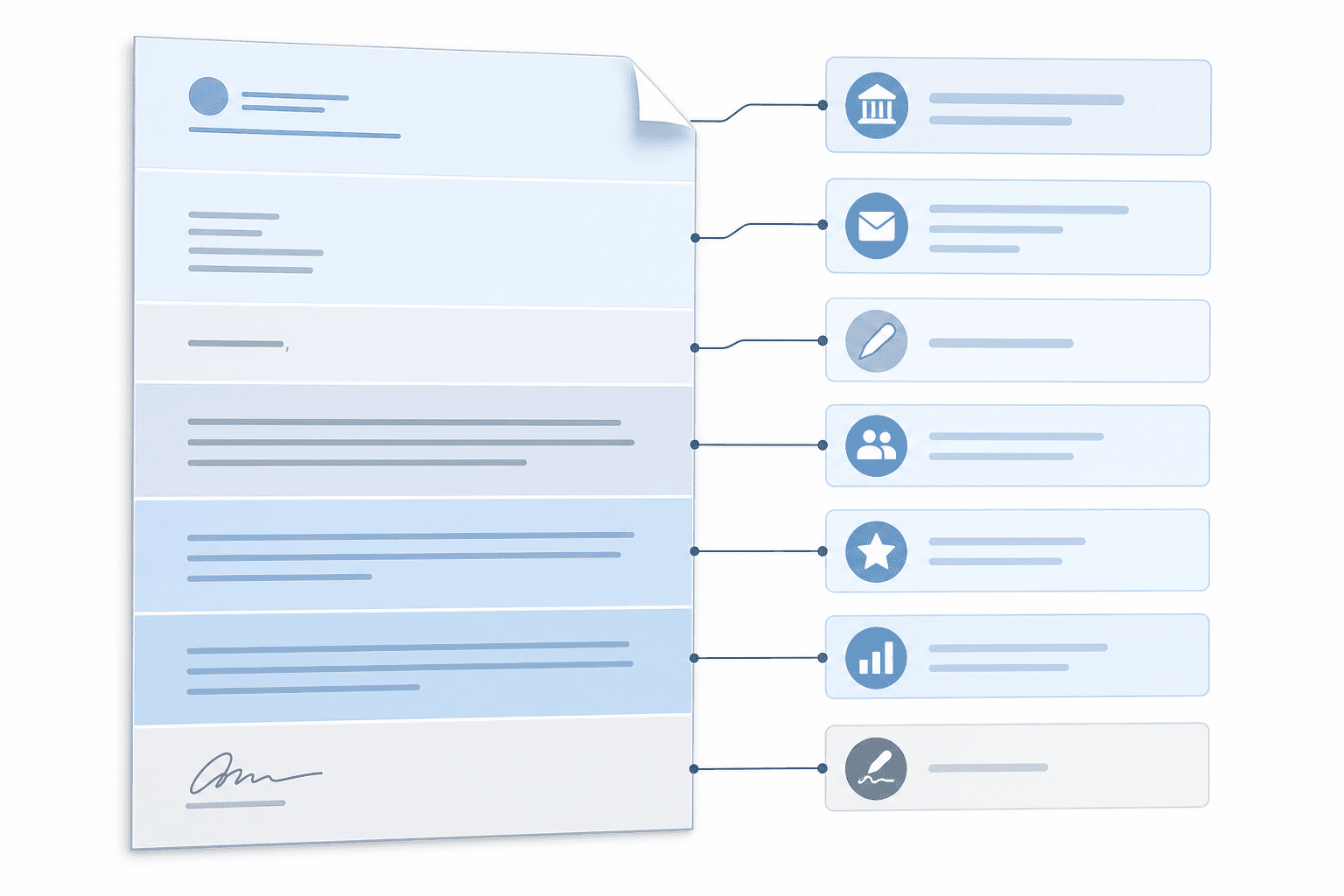
A support letter for a grant application runs seven parts on a single page, and only the relationship paragraph changes between a partner agency, an elected official, and an individual writing in a personal capacity.
| Part | What it does | Length |
|---|---|---|
| Letterhead and date | Establishes the writer is who they say they are | Header block |
| Address block | Names the funder, program officer, and opportunity title | 3 to 4 lines |
| Opening statement | Names the applicant, the project, and the specific grant | 1 to 2 sentences |
| Relationship | States how the writer knows the applicant and for how long | 2 to 3 sentences |
| Substantive endorsement | Gives one thing only this writer would know | 3 to 5 sentences |
| Contribution or role | Says what the writer will do if funded, or what they vouch for | 2 to 3 sentences |
| Signature block | Name, title, organization, direct contact | 4 to 5 lines |
The substantive endorsement separates a useful letter from a form letter. A school principal writing about an after-school literacy program should name the reading gap in their own building. A reviewer believes the relationship predates the application when the letter contains something only the writer could know.
Two formatting details get letters flagged: a missing date and a missing signature. A scanned signature is the safest default. Some funders accept a typed signature line and some do not, so check the attachment instructions.
Letter of Support Example
A letter of support example runs about four short paragraphs on partner letterhead: an opening that names the grant, the relationship, the endorsement, and the contribution. This one is composite, written for a $25,000 request from a small literacy nonprofit. Every name is a bracketed placeholder and no organization here is real.
[PARTNER ORGANIZATION LETTERHEAD]
[Date, within the current application cycle]
[Program Officer Name]
[Funder Name]
[Street Address]
[City, State ZIP]
RE: [Applicant Organization] application to the [Grant Program Name]
Dear [Program Officer Name],
I am writing in support of [Applicant Organization]'s application to the [Grant Program Name] for its [Project Name] tutoring initiative. [Partner Organization] serves the same neighborhood, and I have worked alongside [Applicant Organization]'s staff for the past four years.
Our after-school site enrolls roughly 90 students each fall, and last year we turned away families every month because we have no staff qualified to run reading intervention. Those families had nowhere else to go. [Applicant Organization] is the only group in this ZIP code running structured literacy tutoring, and their coordinator has already trained two of my volunteers on the assessment they use.
If this grant is awarded, [Partner Organization] will host the tutoring sessions in our community room three afternoons a week at no cost to the project, and our site director will refer eligible students from our waitlist. We have space for this and we want it here.
I would be glad to answer questions about our role. You can reach me directly at [phone] or [email].
Sincerely,
[Signature]
[Name], Executive Director
[Partner Organization]
The writer names four years of shared work, so the reviewer knows the partnership predates the deadline. The second paragraph does the heavy lifting: it supplies a fact the applicant could not credibly assert about itself. The offer is a room, three afternoons a week, at no cost. And the writer hands over a direct phone number, which is what people do when they expect to be called.
Here is the version that gets skimmed: "I am writing to support [Applicant Organization]. They do excellent work in our community and I fully endorse their application." Anyone could write that about any organization.
Who to Ask for a Letter of Support
Ask the people whose cooperation your project actually depends on, then fill the remaining slots with voices that prove community demand. Three strong letters beat eight generic ones.
| Who to ask | What their letter proves | Ask them when |
|---|---|---|
| Partner nonprofit or agency | The collaboration in your narrative is real | Your project names them as a partner |
| School or district administrator | You have building access and staff cooperation | You serve students during or after school |
| Elected official or municipal staff | The project has public-sector awareness | Your work touches public infrastructure or policy |
| Program participant or client | Demand comes from the community, not the org chart | The funder values lived experience |
| Fiscal sponsor | The financial pathway for the funds is settled | You lack your own 501(c)(3) status |
| Employer or workforce board | Job placements at the end of training are real | You run workforce or credentialing programs |
Give every writer a one-paragraph project summary, the exact grant program name, and the date you need the signed letter back. Offer a draft, and say plainly that you want it changed. A letter that returns identical to what you sent is a warning sign.
Ask at least three weeks out. Executives sign things slowly, and the person you need is often the one traveling.
Common Mistakes That Weaken a Letter of Support
The most common failure is sending every partner the same draft and getting back five near-identical letters. A reviewer reading them in sequence concludes the applicant wrote all of them. Watch for these:
- Wrong funder or program name. It happens constantly on letters recycled from a prior cycle, and reviewers notice.
- No date, or a date from a previous application cycle.
- Praise with no specifics. "Excellent work" and "vital services" carry no information.
- A resource promise from someone without authority to make it.
- A letter that arrives after you submit. Treat the submission deadline as the letter deadline, because a funder that accepts post-submission material at all will restrict what it takes.
- Exceeding a stated attachment limit. Some funders reject on that alone, before review.
- Contradicting the budget. If a letter says a partner donates space, the budget should show that space as in-kind, not as a rental line.
Budget contradictions catch teams often. A reviewer comparing attachments to the budget finds the mismatch, and it reads as carelessness across the whole application.
How to Track Letters of Support Across Multiple Applications
Each requested letter needs an owner and a due date set several days ahead of the application deadline. Letters fail on logistics far more often than on writing.
A team running six applications at once is chasing signatures from a dozen people who do not work for them, each on a different deadline. A spreadsheet handles that until someone forgets to update it. GrantCue handles this part: assign each letter request as a task with an owner and a due date, attached to the opportunity it belongs to. Browse open grant opportunities, add the ones you intend to pursue, then work the letter requests backward from each deadline.
Keep signed letters in your own records after the cycle closes. A partner who has already written for you once is a far easier ask the second time than someone approached cold.
FAQ
What is a letter of support?
A letter of support is a one-page attachment, written on the signer's letterhead, in which someone outside the applicant organization endorses a specific grant application. It names the project and the funding opportunity, explains how the writer knows the applicant, and says why the writer backs the work. Funders file it with the attachments rather than inside the narrative when the instructions call for it.
What is a support letter?
A support letter is the same document as a letter of support, and funders use the two terms interchangeably. If an announcement uses one term in the instructions and the other in the attachment checklist, it means the same file.
How do you write a letter of support?
Write it on letterhead, date it, and address it to the named program officer. The opening sentence should name the applicant, the project, and the grant program so a reviewer can file it without hunting. Then say how long you have known the applicant, in what capacity, and give one fact only you could supply. Close with what you will do if the grant lands, your title, and a direct phone number.
How long should a letter of support be?
One page. Three to four short paragraphs fits comfortably. Check the funding announcement, because some funders state an explicit page cap for attachments. A two-page letter reads as a writer who did not know what to cut.
Who should sign a letter of support for a grant?
The most senior person who can speak credibly about the relationship and who has authority over anything the letter promises. A program manager can endorse a partnership. Only someone with signing authority should sign a letter that commits space, staff time, or money.
Does a letter of support need to be on letterhead?
Yes, when the writer's organization has letterhead, because it carries the address and contact details that make the endorsement verifiable. Community members writing in a personal capacity can use plain paper, but should include a mailing address and a way to reach them.
Putting Letters of Support to Work
A reviewer who finds a specific, dated letter from a named partner reads the rest of the package more generously. Get the specifics right and the partnerships in your narrative stop being claims. Send five copies of the same paragraph and you have spent partner goodwill for nothing.
Read the attachment instructions first, then list the people whose cooperation your project genuinely requires and ask them three weeks out. The rest of the application answers to the same discipline, and the walkthrough on how to write a grant proposal covers it end to end.