Sample Grant Proposal for a Nonprofit Organization: Template and Annotated Example
A complete grant proposal template for nonprofits, with a full sample structure, section-by-section examples, budget and evaluation guidance, and links to detailed templates for every major proposal component.
Last updated: July 2026
A grant proposal template is a reusable structure for turning a funder's
requirements into a clear, reviewable case for support. Most nonprofit grant
proposals include an executive summary, statement of need, goals and objectives,
program design, evaluation plan, budget, sustainability plan, organization
background, and attachments. The exact order should always follow the funder's
instructions.
This guide contains a complete sample grant proposal for a nonprofit organization, annotated with reviewer notes that explain what each section has to prove, plus a reusable template and links to deeper guides for every major section.
Quick Answer: What Should a Grant Proposal Include?
A complete grant proposal usually includes:
| Section | What It Proves | Detailed Guide |
|---|---|---|
| Executive summary | The project is clear, urgent, and fundable | Grant proposal executive summary example |
| Statement of need | The problem is real, specific, and backed by evidence | Statement of need example |
| Goals and objectives | The project has measurable outcomes | Grant proposal goals and objectives examples |
| Program design | The plan is realistic and aligned with the need | This guide |
| Evaluation plan | The team can measure progress and results | Grant proposal evaluation plan |
| Budget and budget narrative | The funding request is reasonable and justified | Grant proposal budget template |
| Cover letter or LOI | The request is framed professionally | Grant proposal cover letter example |
If you are building your first proposal, start with this complete grant proposal
template, then use the section-level guides above to strengthen the parts that
reviewers score most heavily.
These samples cover one section at a time. For the full arc from problem statement to budget, see how to write a grant proposal from start to finish.
How To Use This Grant Proposal Template

Do not treat a template as a form to fill out mechanically. A strong proposal is
more than a collection of sections. It is a chain of logic:
- The community has a specific need.
- Your organization is positioned to address it.
- The proposed project is realistic.
- The outcomes are measurable.
- The budget directly supports the work.
- The funder's investment will produce a clear public or community benefit.
Before writing, collect these inputs:
| Input | Why It Matters |
|---|---|
| Funder guidelines | The funder's required sections, word limits, scoring criteria, and attachments override any generic template. |
| Program description | You need a clear intervention, service model, timeline, and staffing plan. |
| Need data | Reviewers expect evidence as well as a moving story. |
| Organization history | Funders want proof that the applicant can manage the award. |
| Budget assumptions | Every line item should connect to a project activity. |
| Evaluation metrics | Outcomes should be measurable before the project begins. |
| Required attachments | Missing documents can sink an otherwise strong proposal. |
The best time to use this template is after you have read the funding
opportunity but before you start drafting. Map the funder's prompts to the
sections below, delete what the funder does not ask for, and add any special
requirements.
One caution: never submit the template headings if the funder gives different
required headings. In that case, keep the substance of this template but rename
and reorder sections to match the application portal. Reviewers score what the
funder asked for, not what a generic template prefers. The safest workflow is to
create a two-column outline: funder prompt on the left, matching proposal content
on the right.
Proposal Planning Timeline
If the deadline is more than 30 days away, build the proposal in phases instead
of trying to write everything at once.
| Timeline | Work To Complete |
|---|---|
| 30 or more days before deadline | Confirm eligibility, read scoring criteria, create proposal outline, assign section owners. |
| 21 days before deadline | Draft need statement, program design, goals, evaluation plan, and budget assumptions. |
| 14 days before deadline | Complete first full narrative draft and budget narrative. Request partner letters. |
| 7 days before deadline | Review for funder fit, compliance, attachments, and budget alignment. |
| 3 days before deadline | Final copy edit, portal upload test, file naming, authorized signatures. |
| 1 day before deadline | Submit early when possible and save confirmation records. |
For smaller foundation grants, this timeline may compress. For federal grants,
you may need 60 to 90 days, especially if the application requires SAM.gov
registration, partner subawards, a detailed logic model, or board approvals.
The point of the timeline is not perfection. It is to avoid the most common
proposal failure pattern: the narrative, budget, attachments, and review process
all collide in the final 48 hours.
The grant proposal timeline guide expands this into week-by-week templates, including a compressed two-week version.
How To Adapt This Template by Funder Type
Different funders read proposals differently. The same core project can be
framed several ways depending on the funder's priorities.
| Funder Type | What To Emphasize | What To Watch |
|---|---|---|
| Community foundation | Local need, relationships, community benefit, realistic outcomes | Do not overcomplicate the language or bury the human impact. |
| Private foundation | Alignment with program priorities, theory of change, learning agenda | Do not send generic language that ignores the foundation's stated interests. |
| Corporate funder | Visibility, employee engagement, community impact, brand-safe outcomes | Do not make the request feel disconnected from the company's giving focus. |
| Government funder | Compliance, eligibility, work plan, budget detail, measurable outputs | Do not ignore formatting, attachments, registrations, or required forms. |
| Family foundation | Mission fit, trust, concise narrative, clear stewardship | Do not send a bloated institutional proposal if a short request is expected. |
For a community foundation, your proposal may lean into local relationships and
direct community outcomes. For a government funder, the same project may need a
more formal work plan, cost justification, evidence base, and reporting plan.
This is why a grant proposal template should be modular. The sections stay
similar, but the emphasis changes.
For corporate sponsors and individual donors, skip the grant format entirely and start from a donation proposal template.
Complete Nonprofit Grant Proposal Template
Use this as the working outline for a full proposal.
1. Proposal Title
Your title should be specific enough to signal the project, population, and
outcome.
Weak title:
Community Youth Program
Stronger title:
After-School STEM Mentoring for 150 Middle School Students in Rural Clinton
County
Template:
[Program Name]: [Primary Service] for [Population] in [Place]
Examples:
- Mobile Food Access Program for Senior Residents in Rural Communities
- Trauma-Informed Tutoring and Family Support for Middle School Students
- Workforce Readiness Pathways for Unemployed Young Adults
2. Executive Summary
The executive summary is the reviewer's first full picture of your request. It
should identify who you are, what problem you will address, what you will do,
how much you are requesting, and what results the funder can expect. For a
nonprofit-specific model you can adapt, see this nonprofit executive summary example.
Use this section to answer:
- Who is applying?
- What community or population will benefit?
- What need will the project address?
- What activities will grant funds support?
- What measurable outcomes will result?
- How much funding are you requesting?
Template:
[Organization Name] requests [$Amount] from [Funder Name] to support [Project Name], a [brief program description] serving [population] in [location]. The project responds to [specific need/data point] by providing [core services]. Over [time period], the program will [measurable outputs and outcomes]. Grant funds will support [major cost categories].
Sample:
Riverside Community Partners requests $75,000 to support the Family Literacy
Bridge Project, a 12-month tutoring and caregiver engagement program serving 120
elementary students reading below grade level. The project responds to local
assessment data showing that 43 percent of third-grade students in the target
schools are not meeting reading benchmarks. Grant funds will support part-time
reading tutors, bilingual family workshops, curriculum materials, and evaluation
activities. By the end of the grant period, at least 80 students will improve by
one reading level or more, and 75 caregivers will complete at least three family
literacy sessions.
For a deeper breakdown, use the full grant proposal executive summary example.
3. Organization Background
This section proves that your nonprofit is credible, stable, and qualified to do
the work.
Include:
- Mission and founding year.
- Population served.
- Relevant programs.
- Track record with similar work.
- Partnerships.
- Staff qualifications.
- Prior grant or contract management experience.
Template:
Founded in [year], [Organization Name] is a [type of nonprofit] whose mission is [mission]. Each year, the organization serves [number] [population] through [program areas]. The proposed project builds on [relevant experience], including [specific program, result, or partnership].
Keep this section focused. A funder does not need your full organizational
history. They need to understand why you are the right applicant for this
project.
4. Statement of Need
The statement of need explains the problem your project will solve and why it
matters now. It should combine data, local context, and human relevance.
A strong statement of need includes:
- A clear problem.
- Local or population-specific data.
- Consequences if the problem is not addressed.
- Barriers faced by the target population.
- Evidence that the proposed project fits the need.
Template:
In [community], [population] faces [specific problem]. According to [source or internal data], [data point]. This challenge affects [population] by [consequence]. Existing services are limited by [gap/barrier]. Without additional support, [likely outcome]. The proposed project addresses this need by [brief solution].
Sample:
In the target school district, elementary students from low-income households
are entering fourth grade with widening reading gaps. District benchmark data
shows that 43 percent of third-grade students in the two partner schools are not
reading at grade level, compared with 27 percent statewide. Families report that
transportation, work schedules, and limited access to affordable tutoring make
it difficult to secure academic support outside school hours. Without
intervention, students who miss early literacy milestones are more likely to
struggle across subjects and disengage from school. The Family Literacy Bridge
Project addresses this gap by combining after-school tutoring with caregiver
workshops that help families reinforce reading skills at home.
For more examples, use the detailed statement of need example.
5. Project Goals and Objectives
Goals describe the broad change you want to create. Objectives describe the
specific measurable results you expect to achieve.
Goal:
Improve reading confidence and grade-level literacy among elementary students in
the target schools.
Objectives:
- Enroll 120 students reading below grade level by the end of month two.
- Provide at least 2,400 total tutoring hours during the grant period.
- Help at least 80 participating students improve by one reading level or more.
- Engage 75 caregivers in at least three literacy workshops.
Good objectives are specific, measurable, achievable, relevant, and time-bound.
Use this formula:
By [date], [number/percent] of [target population] will [measurable change] as measured by [tool/source].
Example:
By May 31, 2027, 70 percent of participating students will improve by at least
one reading level as measured by the district's benchmark assessment.
For a larger library, see grant proposal goals and objectives examples.
6. Program Design and Activities
This section explains what you will actually do with the grant funding.
Reviewers are looking for a plan that is specific, realistic, and tied to the
need you described.
Include:
- Core services or activities.
- Who will receive services.
- Where services will happen.
- Frequency and duration.
- Staffing plan.
- Partnerships.
- Timeline.
- Referral or enrollment process.
Template:
The project will deliver [services] to [population] over [time period]. Activities will include [activity 1], [activity 2], and [activity 3]. Services will take place at [location] on [schedule]. [Staff/partners] will be responsible for [roles]. Participants will be recruited through [method].
Sample activities table:
| Activity | Frequency | Responsible Party | Output |
|---|---|---|---|
| Student tutoring | 3 days per week | Reading tutors | 120 students served |
| Caregiver workshops | Monthly | Family engagement coordinator | 10 workshops |
| Progress monitoring | Every 6 weeks | Program manager | Assessment reports |
| Partner coordination | Monthly | Executive director | Partner meeting notes |
Make the activity plan easy to scan. Many reviewers read quickly and score
against a rubric. Tables help them see the timeline, owner, activity, and
evidence without rereading the full narrative.
For the prose version of this section with reviewer notes, see the grant narrative example and skeleton.
Program Work Plan Template
Some funders ask for a work plan instead of, or in addition to, a program
narrative. Use a work plan to show sequence, responsibility, and timing.
| Phase | Timeline | Activities | Owner | Deliverable |
|---|---|---|---|---|
| Startup | Months 1-2 | Hire tutors, finalize school schedule, recruit students | Program manager | Staff and student roster |
| Implementation | Months 3-10 | Tutoring sessions, caregiver workshops, progress monitoring | Tutors and coordinator | Monthly service logs |
| Adjustment | Months 4-11 | Review data, regroup students, refine workshops | Program manager | Progress notes |
| Closeout | Month 12 | Final assessment, report, sustainability plan | Executive director | Final report |
The work plan should match the budget. If the work plan includes a coordinator,
training, transportation, curriculum, or evaluation support, the budget should
show those costs clearly.
7. Evaluation Plan
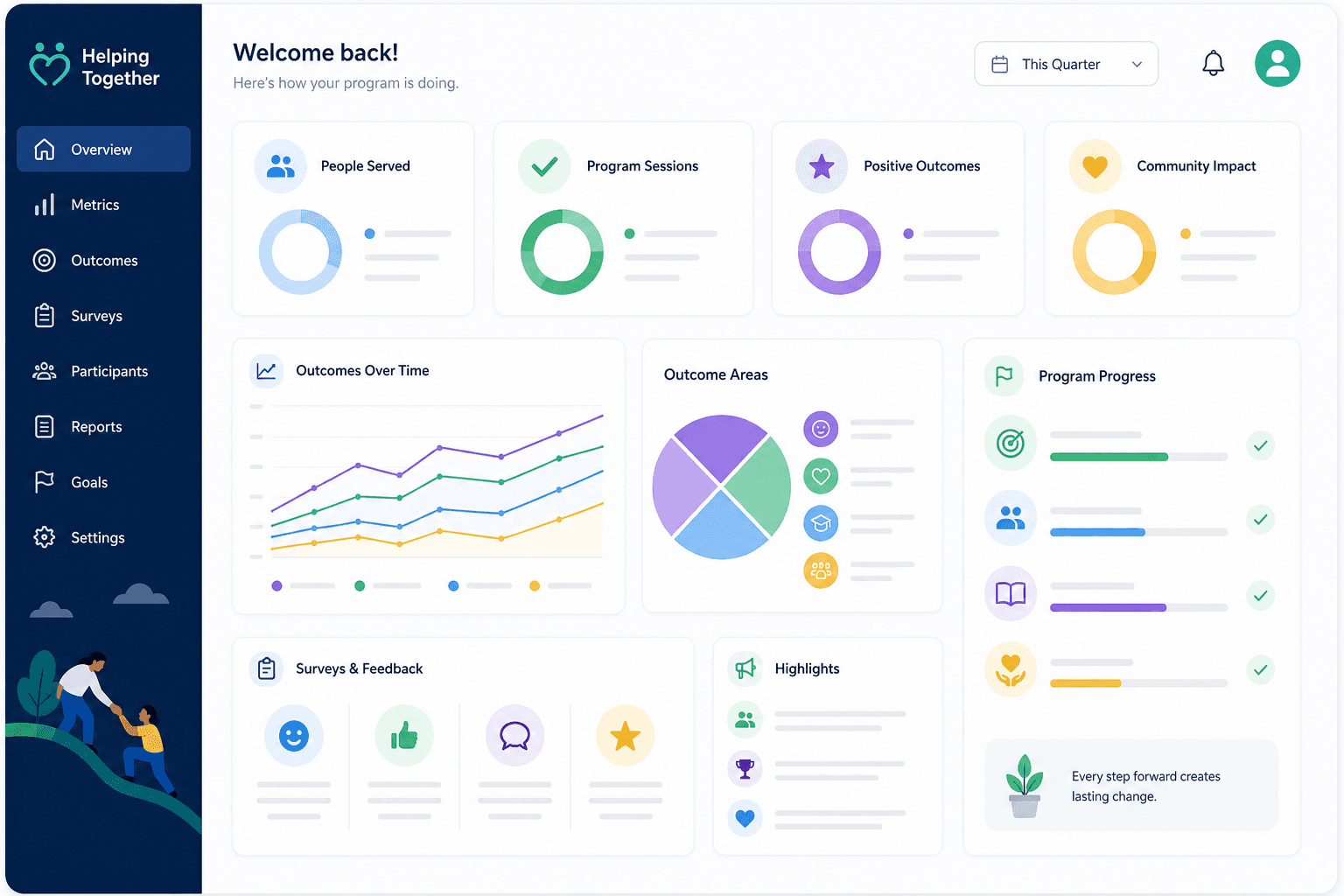
The evaluation plan explains how you will know whether the project worked.
Funders usually want to see:
- Outputs: what you will do or deliver.
- Outcomes: what will change because of the project.
- Indicators: how progress will be measured.
- Data sources: where the evidence will come from.
- Collection schedule: when data will be gathered.
- Responsibility: who will track and report results.
Sample evaluation table:
| Objective | Indicator | Data Source | Collection Schedule |
|---|---|---|---|
| Enroll 120 students | Enrollment count | Program roster | Monthly |
| Improve reading levels | Reading benchmark change | District assessment | Baseline, midyear, final |
| Engage caregivers | Workshop attendance | Sign-in sheets | Each session |
| Improve family literacy confidence | Caregiver survey score | Pre/post survey | First and final session |
Template:
The evaluation plan will track both implementation and outcomes. Program staff will monitor [outputs] using [data source]. Outcome progress will be measured through [assessment/survey/tool] at [time points]. Results will be reviewed [frequency] and used to adjust [program element].
Example:
The evaluation plan will track tutoring participation, caregiver engagement, and
student reading growth. Program staff will monitor attendance, tutoring hours,
and workshop completion monthly. Reading progress will be measured using
district benchmark assessments at baseline, midyear, and year-end. Caregiver
confidence will be measured through a short pre/post survey. The program manager
will review results every six weeks and adjust tutoring groups based on student
progress.
For more detail, use the full grant proposal evaluation plan.
8. Budget
The budget should translate your project plan into costs. Every line item should
connect to an activity, output, or requirement.
Common nonprofit grant budget categories include:
- Personnel.
- Fringe benefits.
- Contractual services.
- Travel.
- Equipment.
- Supplies.
- Participant support.
- Evaluation.
- Indirect or administrative costs.
Sample budget:
| Category | Amount | Justification |
|---|---|---|
| Reading tutors | $36,000 | Three part-time tutors for after-school sessions |
| Family engagement coordinator | $12,000 | Workshop planning and caregiver outreach |
| Curriculum materials | $8,500 | Books, literacy kits, and tutoring materials |
| Evaluation | $6,500 | Assessment tools, survey analysis, reporting |
| Transportation support | $5,000 | Bus passes and ride support for families |
| Administrative support | $7,000 | Grant management, reporting, fiscal oversight |
| Total | $75,000 | Full project request |
Budget narrative template:
Personnel costs include [role] at [hours/FTE] for [responsibilities]. This position is necessary because [project need]. Supply costs include [items] needed for [activity]. Evaluation costs support [measurement/reporting work].
Sample narrative:
Personnel costs include three part-time reading tutors who will deliver
after-school tutoring three days per week across two partner schools. The family
engagement coordinator will recruit caregivers, plan monthly workshops, and
coordinate bilingual communication. Curriculum materials include leveled books,
take-home literacy kits, and tutoring supplies. Evaluation costs support
assessment tools, survey analysis, and funder reporting.
Use the full grant proposal budget template to build a more detailed budget and budget narrative.
Pair the budget table with a grant budget narrative that justifies each line in prose.
9. Sustainability Plan
The sustainability plan explains what happens after the grant period ends.
Funders do not always expect the project to become fully self-sustaining, but
they do want to know you have thought beyond the award.
Include:
- Future funding sources.
- Individual donors or earned revenue.
- Partner contributions.
- Existing organizational support.
- Cost reductions after startup.
- How results will support future fundraising.
Template:
After the grant period, [Organization Name] will sustain the project through [funding sources/partnerships]. The first year of funding will support [startup or expansion]. Evaluation results will be used to [future fundraising plan].
Sample:
After the grant period, Riverside Community Partners will sustain the Family
Literacy Bridge Project through a combination of school district partnership
support, annual campaign revenue, and renewed foundation requests. First-year
grant funding will establish the tutoring model, materials library, and
evaluation system. Outcome data from the first year will support future
applications to local education funders and corporate literacy programs.
10. Attachments
Attachments vary by funder, but common nonprofit grant attachments include:
- IRS determination letter.
- Board list.
- Organizational budget.
- Project budget.
- Audited financials or financial statements.
- Letters of support.
- Staff resumes or bios.
- Logic model.
- Work plan.
- Evaluation plan.
- Proof of SAM.gov registration or UEI for federal grants.
Create an attachment checklist as soon as you decide to apply. Missing
attachments are one of the easiest ways to lose points before a reviewer even
engages with your project narrative.
Attachments usually include letters of support for grants from partners. The strong ones commit named resources instead of offering praise.
Make the proposal easy for reviewers to understand
Human reviewers reward clear structure because it is easier to score. A clear
proposal also helps your own team check whether the budget, activities,
outcomes, and attachments match.
Use these formatting rules:
- Put the direct answer near the top of each major section.
- Use descriptive H2 and H3 headings.
- Include tables for sections, timelines, budgets, and evaluation metrics.
- Define acronyms the first time they appear.
- Keep each objective tied to a measurement method.
- Use consistent names for the project, organization, and population.
- Avoid vague adjectives such as innovative, transformative, or impactful unless
you immediately explain what they mean in practice.
For example, a section titled "Evaluation" is acceptable. A section titled "How
We Will Measure Student Reading Growth" is better. It tells the reviewer exactly
what information follows.
This does not mean writing stiffly. It means writing so clearly that a busy
reviewer, a board member, and a teammate all understand the same thing.
Sample Grant Proposal for a Nonprofit Organization (Annotated)
Here is a complete sample proposal for a fictional family literacy program requesting $75,000. The note after each section explains what a reviewer sees when it works.
Project Title
Family Literacy Bridge Project
Applicant
Riverside Community Partners
Funding Request
$75,000
Project Period
July 1, 2026 to June 30, 2027
Executive Summary
Riverside Community Partners requests $75,000 to support the Family Literacy
Bridge Project, a 12-month tutoring and caregiver engagement program serving 120
elementary students reading below grade level. The project responds to local
assessment data showing that 43 percent of third-grade students in the target
schools are not meeting reading benchmarks. Grant funds will support part-time
reading tutors, bilingual family workshops, curriculum materials, and evaluation
activities. By the end of the grant period, at least 80 students will improve by
one reading level or more, and 75 caregivers will complete at least three family
literacy sessions.
Reviewer note: Amount, timeline, population, and two measurable targets are all visible in the first paragraph a reviewer reads. The summary previews the proposal without introducing anything the later sections fail to repeat.
Need
Students in the target schools face persistent early literacy gaps that affect
long-term academic success. District benchmark data shows that 43 percent of
third-grade students in the partner schools are reading below grade level.
Families also report limited access to affordable tutoring and difficulty
attending school-based events because of work schedules and transportation
barriers. Without coordinated academic and family support, these students are at
risk of falling further behind in later grades.
Reviewer note: The need is local and specific. District benchmark data rather than national statistics, and two named barriers, work schedules and transportation, that the program design later answers directly.
Goals and Objectives
The project goal is to improve grade-level literacy and family reading support
for elementary students in the target schools.
Objectives:
- Enroll 120 students reading below grade level by month two.
- Provide at least 2,400 tutoring hours during the grant period.
- Help 70 percent of participating students improve by one reading level.
- Engage 75 caregivers in at least three literacy workshops.
Reviewer note: Each objective carries a number and a deadline, so the evaluation section can measure them without translation. The 70 percent target reads as honest planning; promising that every student improves would not.
Program Activities
The project will provide after-school tutoring three days per week at two
partner schools. Students will receive small-group instruction from trained
reading tutors. Monthly caregiver workshops will give families practical
strategies for supporting reading at home. Program staff will monitor progress
every six weeks and adjust tutoring groups based on assessment results.
Reviewer note: The schedule is concrete enough to picture the operating week: three days, two schools, progress checks every six weeks. Vague activity sections are the most common reason strong need statements still lose points.
Evaluation
The project will track enrollment, attendance, tutoring hours, caregiver
participation, reading benchmark growth, and caregiver confidence. Data will be
reviewed every six weeks by the program manager and shared with school partners.
Final results will be included in the funder report.
Reviewer note: The plan names who reviews the data and how often, not just what gets collected. Sharing results with school partners signals the program will use findings rather than file them.
Budget
The $75,000 request will support tutors, family engagement coordination,
curriculum materials, evaluation, transportation support, and administrative
oversight. Each cost is directly connected to the delivery and measurement of
the proposed program.
Reviewer note: Every cost category maps to an activity described above. A budget line with no matching activity is the first thing reviewers question, and this summary leaves none.
Sustainability
Riverside Community Partners will use first-year results to pursue renewed
foundation support, district partnership funding, and individual donor
contributions. The organization will also integrate literacy materials and
caregiver workshop content into its ongoing youth programs.
Reviewer note: The plan is modest and believable: renewed foundation support plus folding materials into existing programs. Claiming permanent funding will arrive after year one is a common credibility leak.
Grant Proposal Review Checklist
Before submitting, confirm:
- The proposal follows the funder's required order and formatting.
- The request amount matches the guidelines.
- The executive summary includes amount, need, activities, and outcomes.
- The statement of need uses specific data.
- Objectives are measurable and time-bound.
- Activities clearly connect to the need.
- Evaluation measures each major objective.
- Budget line items match project activities.
- Budget narrative explains assumptions.
- Attachments are complete and correctly named.
- Authorized signatures are included.
- The final PDF or portal submission was reviewed by someone other than the writer.
Related proposal section guides
Use the detailed section guides when one part of the proposal needs more work:
goals and objectives examples,
grant proposal cover letter examples.
Common Mistakes To Avoid
Mistake 1: Starting With Your Organization Instead of the Need
Funders care about your organization, but the proposal should start with the
problem and the community benefit. Keep the organization background concise and
relevant.
Mistake 2: Writing Objectives That Cannot Be Measured
Avoid vague objectives like "increase awareness" or "improve outcomes" unless
you define how you will measure them.
Better:
By June 30, 2027, 75 percent of participating caregivers will report increased
confidence supporting reading at home, as measured by a post-program survey.
Mistake 3: Letting the Budget Drift From the Narrative
If the narrative says you will run monthly workshops, the budget should include
the staff time, materials, space, transportation, or translation support needed
to run those workshops.
Mistake 4: Forgetting the Reviewer's Experience
Reviewers often read many proposals in a short period of time. Use headings,
tables, and direct language. Do not make them hunt for the request amount,
project timeline, target population, or outcomes.
Mistake 5: Reusing the Same Proposal Without Adapting It
Templates save time, but funders can tell when a proposal was copied without
being tailored. Adjust the language to match each funder's priorities, scoring
criteria, and required terms.
FAQ
What is a grant proposal template?
A grant proposal template is a reusable outline that helps nonprofits organize
the standard sections of a funding request. It usually includes the executive
summary, need statement, program plan, outcomes, evaluation, budget,
sustainability, and attachments.
How long should a grant proposal be?
The funder's instructions decide the length. A short foundation proposal may be
three to five pages. A larger foundation or federal proposal may be 10 to 25
pages or more, not including attachments.
What is the most important part of a grant proposal?
The most important part is the logic connecting the need, program design,
outcomes, and budget. Reviewers should be able to see why the project matters,
why your organization can deliver it, and how the requested funds will produce
measurable results.
Can I use the same grant proposal for multiple funders?
You can reuse core language, but you should tailor each proposal to the funder's
guidelines, priorities, word limits, and scoring criteria. Reusing a proposal
without adaptation is risky.
What is the difference between a grant proposal and a letter of intent?
A grant proposal is a full funding request. A letter of intent, or LOI, is
usually a shorter preliminary request that asks the funder to invite a full
proposal. Use this letter of intent for grant example if the funder requires an LOI first.
What is the difference between a cover letter and an executive summary?
A cover letter is a formal transmittal letter. An executive summary is a concise
overview of the project, need, funding request, and outcomes. Some funders ask
for both. If you need a letter, start with this grant proposal cover letter example.
Where can I find a sample grant proposal for a nonprofit organization?
The annotated example earlier on this page is a complete sample: executive summary, need statement, objectives, program plan, evaluation, budget summary, and sustainability plan for a $75,000 request. Adapt the structure and replace every specific; funders recognize copied boilerplate quickly. For funded proposals from outside sources, use this list of real grant proposal examples.
Next Step
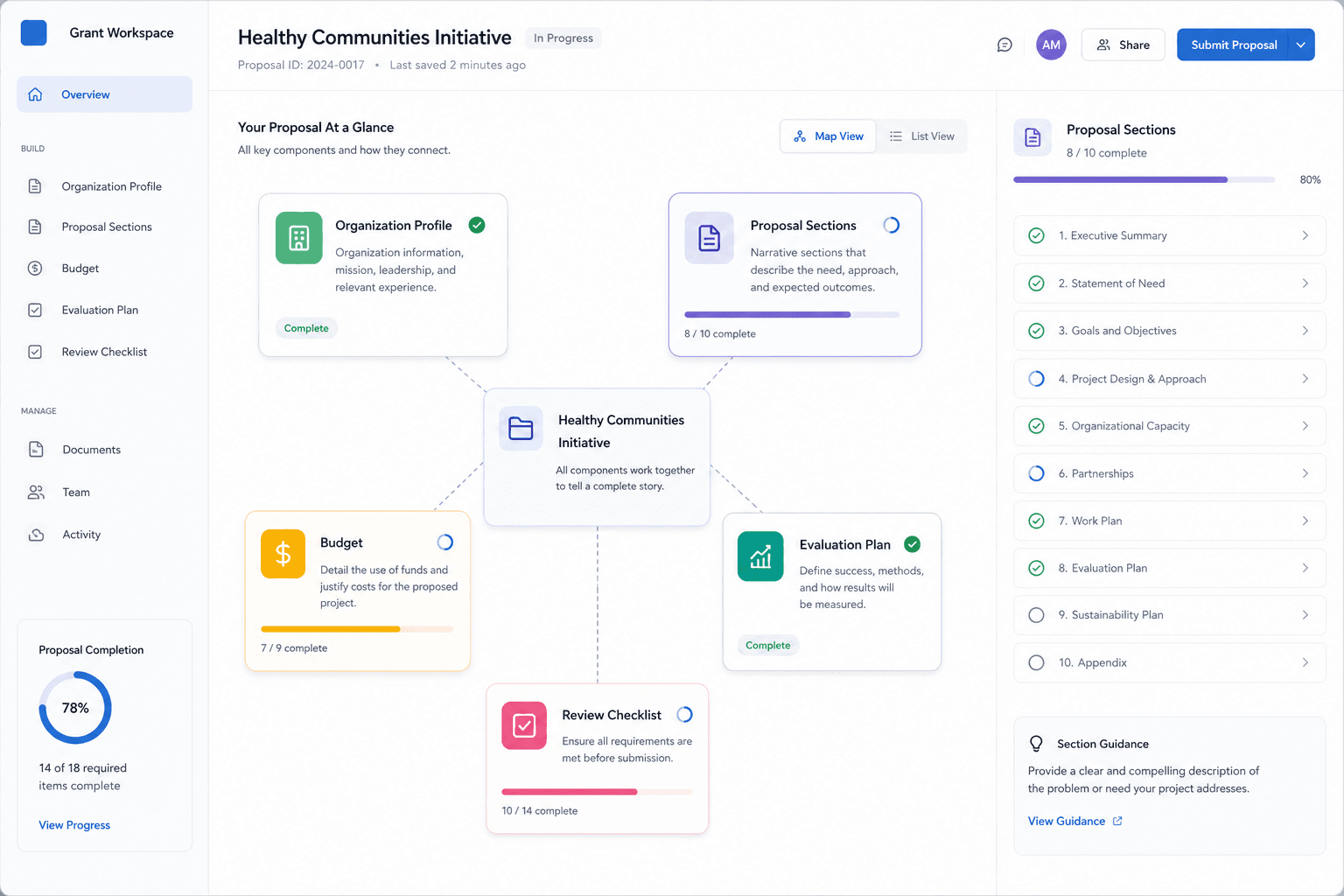
Use this template as your master outline, then strengthen each section with the
detailed guides linked throughout this article, starting with the grant proposal executive summary example
that reviewers read first. If you are writing with a team, keep the outline,
budget, deadlines, and review checklist in one shared workspace such as GrantCue,
assign an owner to each section, and have someone other than the writer check the
final version before you submit.