Logic Model Template for Grants: Fillable Table and 2 Worked Examples
Download the free templateHow to build a grant logic model: a fillable five-column template, completed examples for a literacy program and a mobile food pantry, and the tests that keep outputs and outcomes straight.
In this article (19)
- Quick Answer: What Goes in a Logic Model?
- Logic Model Template (Fillable)
- How To Fill It In: Outcomes First
- Example 1: Family Literacy Program
- Example 2: Mobile Food Pantry
- Outputs vs Outcomes: Where Models Fall Apart
- How the Logic Model Connects to the Rest of the Proposal
- Common Mistakes
- Mistake 1: Outputs Dressed Up as Outcomes
- Mistake 2: Activities With No Outcome Attached
- Mistake 3: Impact Written as a Guarantee
- Mistake 4: A Model Nobody Uses Again
- FAQ
- Do funders require a logic model?
- How long should a logic model be?
- What is the difference between a logic model and a theory of change?
- Can I reuse one logic model across applications?
- Next Step
- Sources and Further Reading
A logic model is a one-page map of how a grant-funded program is supposed to work. It reads left to right: the resources you put in, the activities you run, the outputs you can count, the outcomes you expect, and the longer-term impact you are working toward. Funders ask for one because it shows in a single glance whether your program design actually connects to the results you promise.
This guide gives you a fillable logic model template, two completed examples, and a filling order that keeps the model honest. If the funder asked for a full evaluation section rather than a one-page model, start with the evaluation plan for a grant proposal and come back here for the model itself.
A free logic model workbook with the same five columns is available as an Excel .xlsx download. No email address required.
Quick Answer: What Goes in a Logic Model?
Most funders expect the model to fit on one page. A table is enough. You do not need diagram software or arrows unless the funder asks for them.
Logic models feed the objectives and evaluation sections. The section-by-section proposal guide shows where the model actually gets used.
Logic Model Template (Fillable)
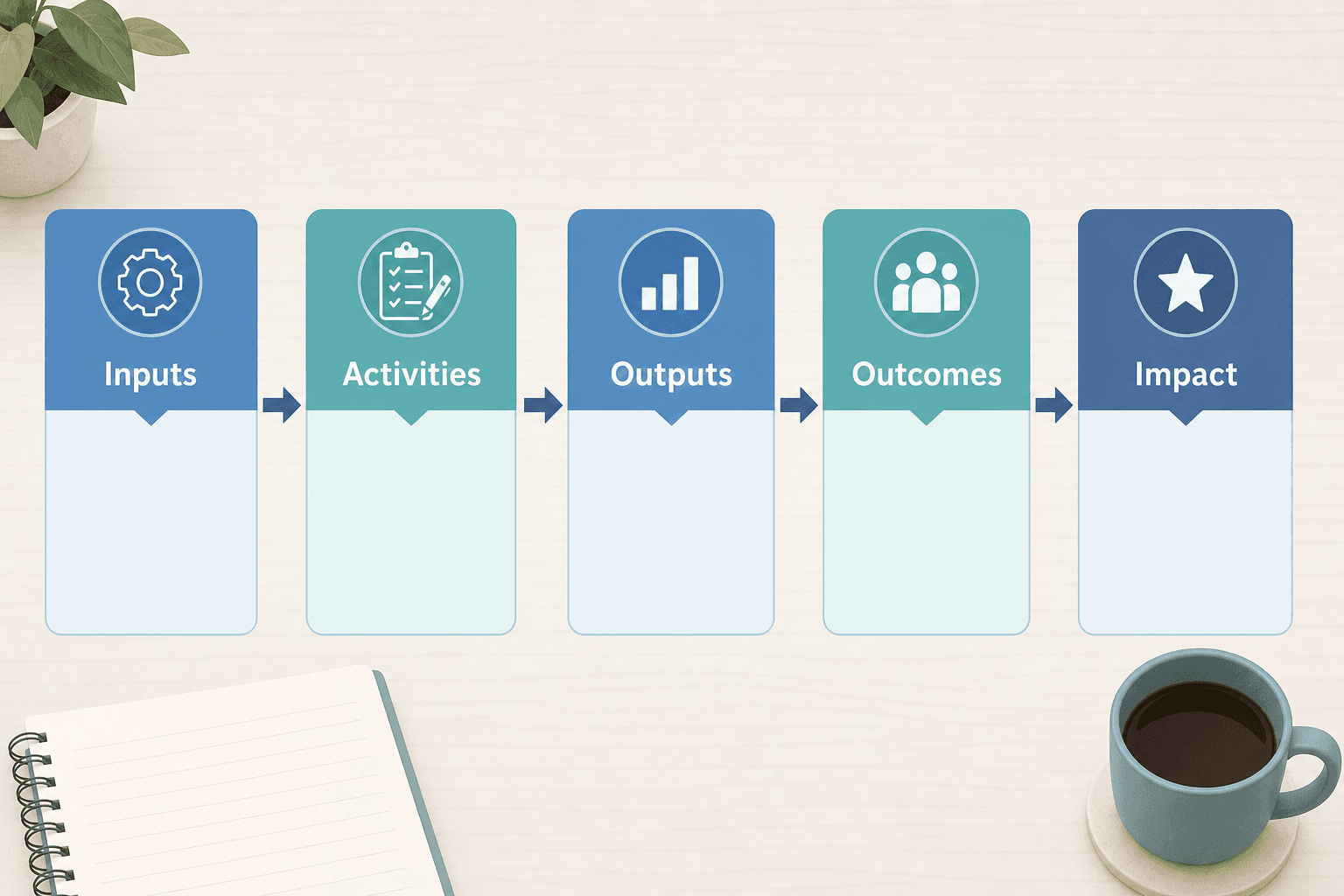
Copy this table and replace each prompt with your program's specifics.
Two rules keep the template useful. Every activity should trace back to at least one input, and every outcome should trace back to at least one activity. If a box has no connection to its neighbors, either the program design has a gap or the box does not belong.
How To Fill It In: Outcomes First
Filling the table left to right feels natural and produces weak models. You end up describing what you already do, then hunting for results that might follow. Reviewers can tell.
Fill it in this order instead:
- Outcomes. Write the participant-level change the funder is paying for.
- Activities. Ask what work would plausibly cause that change.
- Outputs. Count what those activities produce at your planned scale.
- Inputs. List what the activities require. This becomes a budget check.
- Impact. State the longer-term change your outcomes feed into. One or two lines is plenty.
Working backward from outcomes forces the design question early: would these activities really produce that change at this dose? It is much cheaper to answer that in the planning stage than in a year-one report.
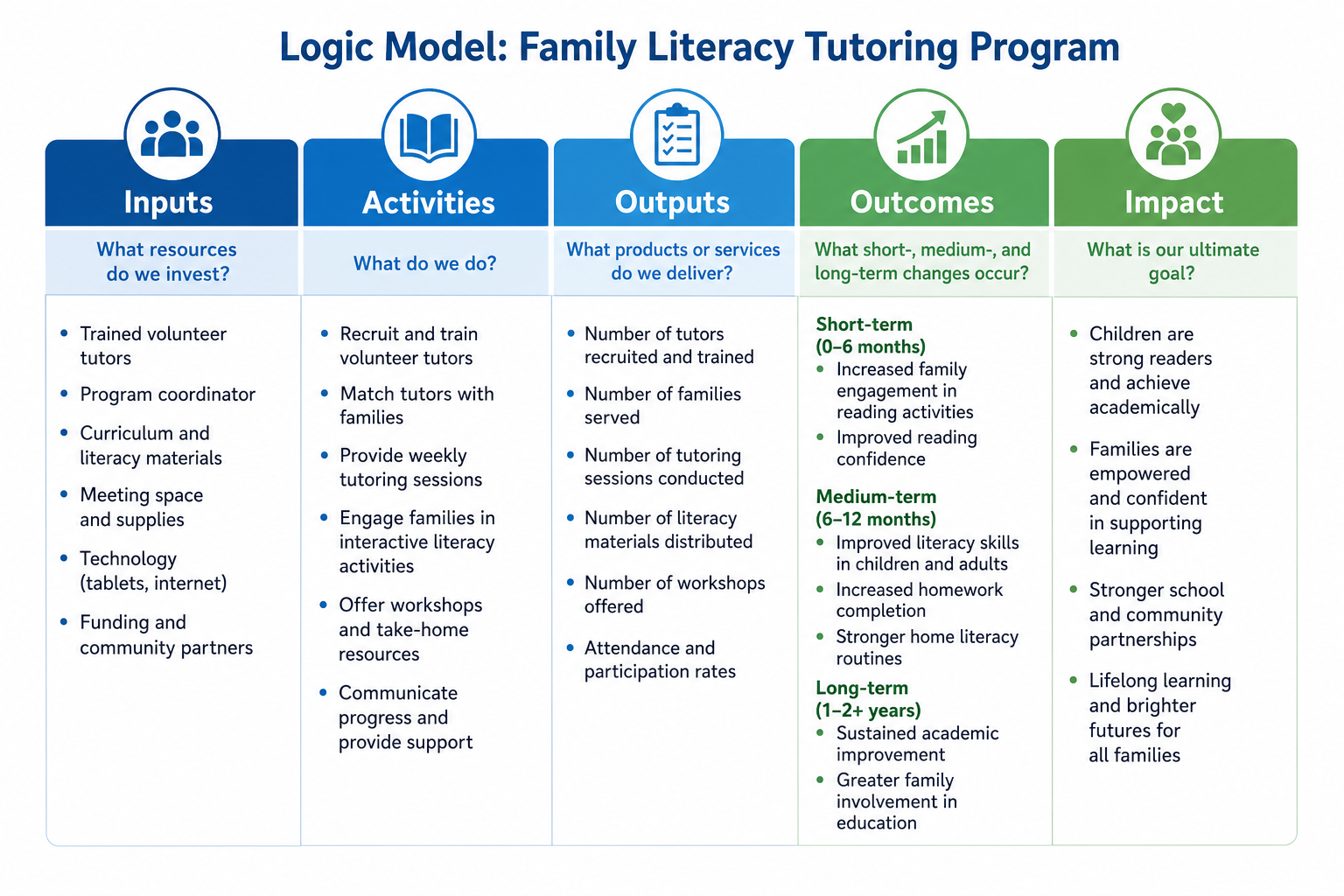
Example 1: Family Literacy Program
Here is a completed model for a tutoring program requesting $75,000.
Why this model works:
- Every output is a number a program assistant could pull from attendance records.
- The outcomes name a percentage and a measurable change, not a hope.
- The inputs match what the budget will request, so the two documents confirm each other.

Example 2: Mobile Food Pantry
The same structure works for a service program with no classroom component.
Why this model works:
- Distribution counts stay in the outputs column. The outcome is the change in households, not the pounds of food.
- The screening activity explains where the referral outputs come from, so the columns connect.
- Impact is stated at the community level and is clearly bigger than the grant alone. That is expected. Impact is direction, not a promise.
Outputs vs Outcomes: Where Models Fall Apart
The single most common logic model problem is an output wearing an outcome costume. If the number describes your effort, it is an output. If it describes a change in a person or household, it is an outcome.
A reviewer who finds outcomes like "serve 120 students" will ask what happens to those students. Have the answer in the model before they ask.
Long-term outcomes shade into sustainability; the sustainability plan examples show how to write that section without hand-waving.
How the Logic Model Connects to the Rest of the Proposal
A logic model is a summary of commitments you make elsewhere in the application, so the columns should reconcile with the other sections:
The problem your statement of need documents is the reason the whole chain exists. If the need is third-grade reading gaps and the outcomes are about caregiver employment, the model has drifted.
To see where the model sits inside a full application, use this sample grant proposal for a nonprofit organization.
Activities also need dates; a project timeline template turns the logic model into a schedule reviewers can check. For how activities, outcomes and indicators hold together across a whole proposal, see the longer guide to the logic model for grants.
Common Mistakes
Mistake 1: Outputs Dressed Up as Outcomes
"Serve 120 students" is an output. Reviewers look for the change in the students. Run every outcome through one test: does this describe my effort, or their change?
Mistake 2: Activities With No Outcome Attached
If an activity produces outputs but leads to no outcome, the model is telling you something. Either connect it to a change you expect or question why the program includes it.
Mistake 3: Impact Written as a Guarantee
Impact is the long-term change your program contributes to alongside other forces. Writing "the county will reach food security by 2028" overpromises. "Lower food insecurity in the county's rural census tracts" states direction without pretending the grant does it alone.
Mistake 4: A Model Nobody Uses Again
A logic model built the night before the deadline and never opened again was wasted effort. The outputs column is your reporting checklist and the outcomes column is your evaluation plan in miniature. Teams that revisit the model at each report cycle write those reports faster.
FAQ
Do funders require a logic model?
Many federal programs and larger foundations require one, and some state programs request it as an attachment. Even when it is optional, a clear model tends to help, because it answers the design questions reviewers ask anyway.
How long should a logic model be?
One page. If it runs longer, the model is probably carrying narrative that belongs in the program design section.
What is the difference between a logic model and a theory of change?
A theory of change explains why you believe the change will happen, including assumptions and outside conditions. A logic model shows what you will do and what it produces. Funders who ask for both want the reasoning and the operational map side by side.
Can I reuse one logic model across applications?
Reuse the structure, not the numbers. Scale outputs and outcomes to each grant's actual funding level. A model promising identical results for a $25,000 request and a $100,000 request tells reviewers neither number is real.
Next Step
Draft the model before you write the narrative sections, then keep the columns in sync as the proposal develops. When you are ready to expand the measurement column into a full section, the grant proposal evaluation plan template walks through metrics, data collection, and reporting.
Sources and Further Reading
Candid Learning — free courses and reference material on proposal writing and funder research, from the organization behind Foundation Directory.
NIH Grants Process — the National Institutes of Health's step-by-step guide from application through award.