Grant Evaluation Methods: How to Choose the Right One for Your Grant
A comparison of the grant evaluation methods used in practice, covering what each one proves, what it costs in staff time, and which grant types it fits.
In this article (12)
- Quick Answer: What Are Grant Evaluation Methods?
- What Grant Evaluation Means
- Types of Grant Evaluation
- Grant Evaluation Methods Compared
- Quantitative and Qualitative Grant Evaluation Methods
- How to Choose a Grant Evaluation Method for Your Grant Type
- Cost and Rigor Tradeoffs
- What Funders Want in the Evaluation Section
- Common Grant Evaluation Mistakes
- Tracking Evaluation Across the Grant Lifecycle
- FAQ
- Pick the Method Before You Write the Section
Grant evaluation is a section teams often write last, and reviewers notice. The methods you name tell a funder whether your promised outcomes are measurable or merely hoped for. Rigor is the wrong first question. Fit is the first question, and fit means the design works inside the award you are applying for.
The methods below are compared on what each proves, what each costs, and which grant types they suit.
Quick Answer: What Are Grant Evaluation Methods?
Grant evaluation methods are the data collection and analysis designs used to measure whether a funded project did what it promised. The common ones are pre-post measurement, comparison group designs, randomized trials, surveys, interviews, focus groups, administrative records, observation, and case studies. Most grants combine two or three, chosen to match the award and the staff you have.
Free download: Evaluation methods comparison workbook as Excel .xlsx. No email address required.
What Grant Evaluation Means
Grant evaluation is the systematic collection of evidence about what a funded project delivered and what changed as a result. It is separate from monitoring, which tracks whether activities happened on schedule and whether money was spent as budgeted.
The distinction decides what you write in a proposal. Monitoring answers how many sessions ran and how many people attended. Evaluation answers whether those sessions produced the change the proposal claimed. A funder reading an evaluation section that lists only attendance counts is reading a monitoring plan, and reviewers score it that way. Our grant proposal evaluation plan template covers how to structure the written section once a method is chosen.
Types of Grant Evaluation
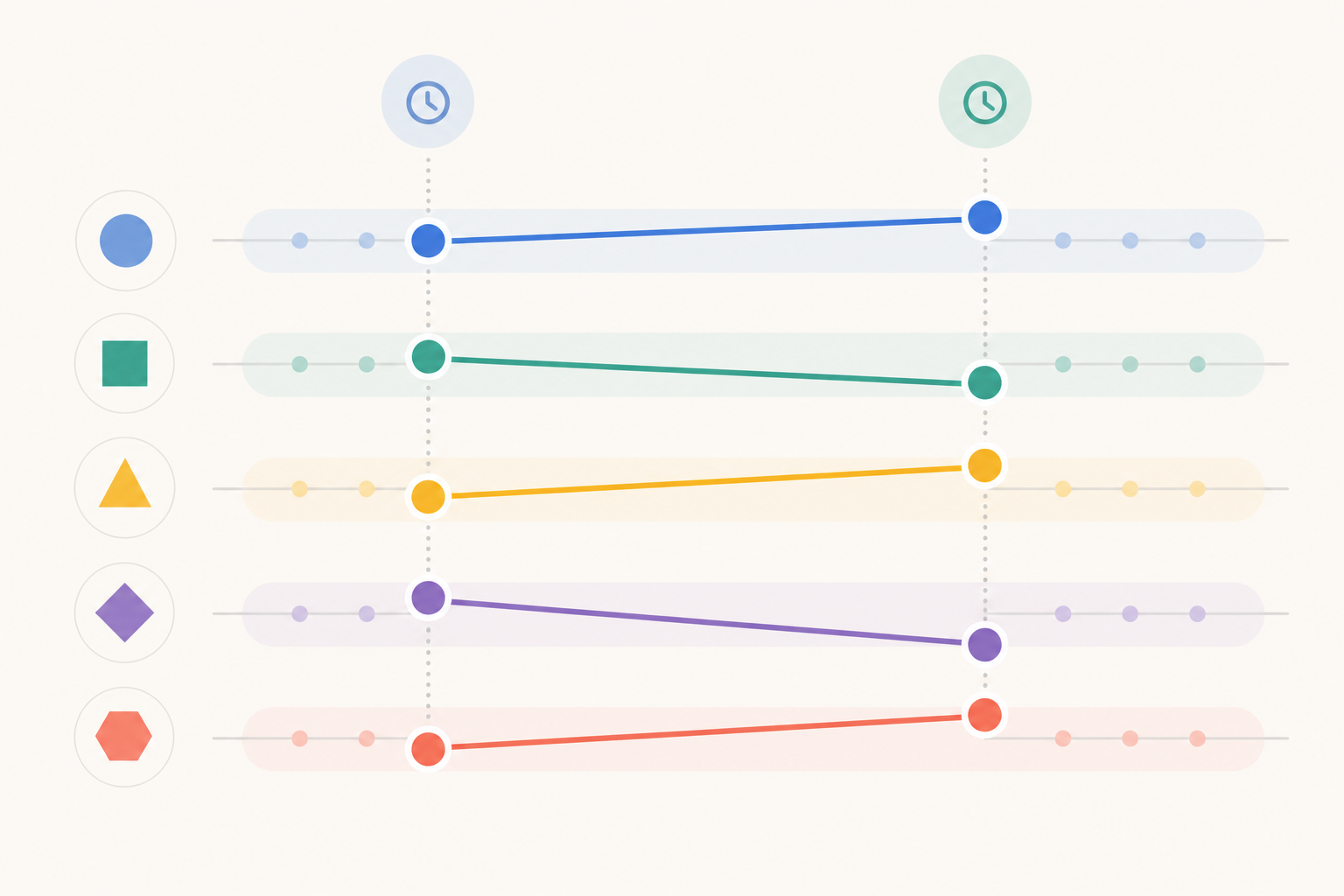
Grant evaluations are described along two axes: when the evaluation runs and what it judges. Formative and summative describe timing and purpose. Process and outcome describe focus. Most grants need one from each axis, which is why a process evaluation is usually formative and an outcome evaluation is usually summative.
Formative evaluation
Formative evaluation runs during the project and feeds findings back while there is still time to change the program. Funders ask for it when the work is new or untested, usually in year one of a multi-year award or in a pilot. Its deliverable is a memo of recommended changes.
Summative evaluation
Summative evaluation runs at or near the end of a project and judges whether it achieved its stated outcomes. It is only as good as the baseline captured at the start. A design decided in the final quarter has nothing to compare against. That is how final reports end up describing activities.
Process evaluation
Process evaluation measures whether the program was delivered as designed, to the intended people, at the intended dose. When outcomes come in flat, process data separates a program that does not work from one that was never fully delivered. Without it, both look identical in a report.
Outcome evaluation
Outcome evaluation measures the change in participants the project intended to produce, such as skills gained, health indicators, or employment. Outcomes need a defined time horizon. A workforce program measuring job placement at exit reports something different from one measuring retention six months later, so state the horizon.
Select to enlarge (opens in a new tab).
Grant Evaluation Methods Compared
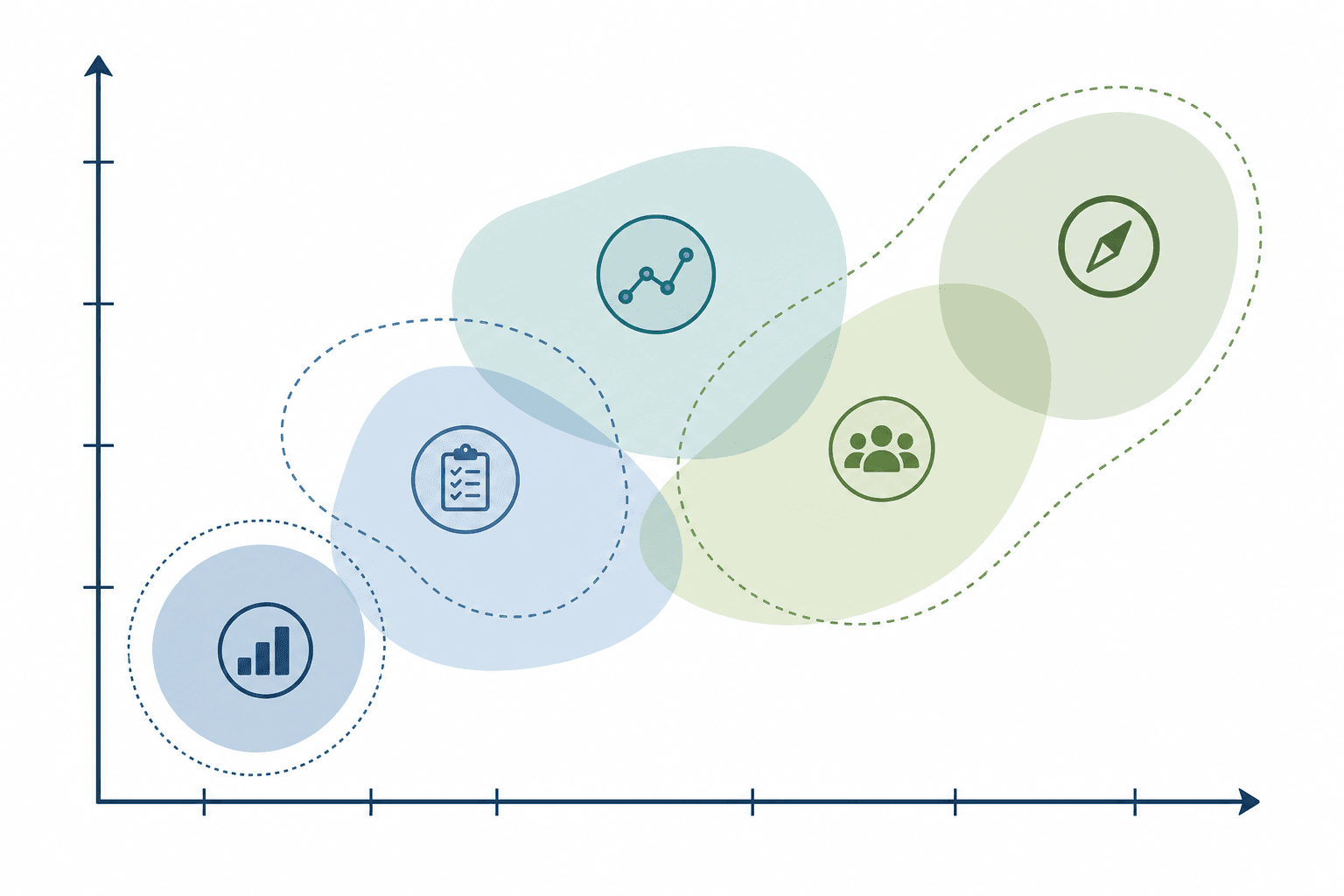
The methods differ mainly on one axis: how confidently they let you attribute a change to your program rather than to everything else in a participant's life. Cost and staff time rise along that same axis.
Pre-post measurement
Pre-post measurement compares the same participants before and after the program using the same instrument. It needs no comparison group, which is the usual reason a small nonprofit picks it.
Its weakness is attribution. A gain shows participants changed, not that the program caused the change. That is acceptable for a short, modest award, and it fails the moment a notice asks for evidence of impact. Build baseline collection into intake, or the pre-test never happens.
Comparison group designs
Most comparison groups fall apart on one thing: the group has to resemble participants on whatever actually drives the outcome. People who never sought your service usually differ in motivation from people who did, and that difference shows up in the results looking exactly like a program effect.
A comparison group design measures a second group that did not receive the program and sets its results against participants' results. It approaches the attribution of a randomized trial only when the comparison group genuinely resembles participants. A waitlist is usually the most defensible source, because everyone in that pool already chose to enroll.
Randomized controlled trials
A randomized controlled trial assigns eligible participants to the program or to a control condition by chance, so the groups are comparable in expectation on every characteristic, measured or not. Small samples can still come out unbalanced, which is why trials publish a baseline comparison alongside their results. Trials produce the strongest causal evidence available and cost the most to run. They suit research awards and funders whose notices ask for causal evidence in those words. They rarely suit a one-year service grant, where the sample is too small to detect anything and randomization means withholding a service from people who need it.
Surveys
A survey collects self-reported data from participants using an identical set of questions. Once it is written, each additional respondent costs almost nothing, which is what makes surveys the default for reach. Response rate then decides whether the results mean anything. A survey answered mostly by people who finished the program describes finishers, not the program. An exit survey handed out before participants leave the room reaches people an emailed one never will. Validated instruments already exist for many common outcomes.

Select to enlarge (opens in a new tab).
Interviews and focus groups
Interviews and focus groups collect open-ended accounts from the people who experienced the program. They explain why a number moved, or why it did not, in a way a fixed-response survey cannot.
Take a composite example: an after-school program at a small youth nonprofit sees flat test scores, and interviews reveal that attendance collapsed after a bus route changed. That turns a failed outcome into a fixable implementation problem. How interviewees were selected belongs in the write-up, since staff-chosen samples skew toward people who liked the program.
Administrative and secondary data
Administrative data evaluation uses records that already exist: attendance logs, service counts, enrollment files, or case notes. Collection already happened as part of the work, so the marginal cost is close to zero.
Two conditions make those records usable: consistent definitions across the grant period, and permission to extract. Both need settling before submission, and a partner's data such as a school district's is where that usually stalls.
Observation and fidelity checks
Observation measures whether the program was delivered as designed, scored against a structured checklist. If the proposal names a specific curriculum or model, the funder is buying that model, and fidelity data is the proof they got it.
Case studies
A case study is a detailed account of one participant, site, or cohort followed through the program. A case study illustrates. It cannot generalize, and it should never be the only method in a plan. Consent has to be collected at the same time as the story, because going back for it later rarely works.
Quantitative and Qualitative Grant Evaluation Methods
Quantitative methods count things and produce numbers a funder can compare across grantees. Qualitative methods gather descriptions and produce explanations. A mixed methods design uses both, and it is what most program funders ask for when their guidelines specify a design at all.
A workable default for a program grant: one quantitative outcome measure, one administrative measure of delivery, and one qualitative method. That combination fits inside a normal staff workload and covers both halves of what a funder asks, the number and the reason behind it.
How to Choose a Grant Evaluation Method for Your Grant Type
Choose the method by working backwards from three constraints: what the funder's notice requires, how long the project runs, and who will do the measurement work. Anything that survives all three is a candidate.
Two rules simplify the choice. Read the notice first, because a funder that names its own required measures has already decided for you. And write the method into the logic model so the measures line up with the outcomes you claimed instead of being bolted on afterward.
Cost and Rigor Tradeoffs
Evidence strength and cost move together, so the decision is how much rigor the award justifies. Spending a large share of a small grant on evaluation is a legitimate reason for a reviewer to question the budget.

Select to enlarge (opens in a new tab).
Score a candidate method on five things before committing to it: the strength of the evidence it yields, what it costs to set up, how much ongoing staff time it consumes, how large a sample it needs, and whether it requires an external evaluator. A method that scores well on the first and badly on the other four is the wrong method for a small award, however impressive it would look in the narrative.
Most budgets miss two costs. Instrument development is the first, and it applies whenever you cannot reuse an existing tool. Data cleaning is the second, and it routinely takes longer than collection. Both belong in the budget narrative as named lines.
What Funders Want in the Evaluation Section
Funders want to see the measure, the method, the source of the data, who collects it, and when. A section that names outcomes without naming how they will be measured reads as an intention.
Federal awards add a reporting layer on top of that. Under 2 CFR 200.329, part of the Uniform Guidance as revised by OMB in April 2024 and effective for awards made on or after October 1, 2024, recipients submit performance reports at intervals set by the award, no less frequent than annually and no more frequent than quarterly unless the agency has applied a specific condition. That section also fixes the due dates: annual reports within 90 calendar days of the reporting period, quarterly or semiannual reports within 30 calendar days, and the final performance report within 120 calendar days of the end of the period of performance. Agencies must collect the information using OMB-approved common information collections, such as the Research Performance Progress Report. Your specific measures sit in the notice of funding opportunity and the award notice, so confirm them per award.
Foundation requirements vary far more, so read the funder's guidelines first. The evaluation plan format handles this with a simple table that becomes your reporting schedule once the award lands.
Common Grant Evaluation Mistakes
These are planning failures, not statistical ones.
Two of them account for most of the damage. Nobody runs the pre-test at intake, so nothing exists to compare the end-of-project data against. And the measures drift away from the outcomes: the narrative promises improved family stability while the plan counts workshop attendance.
Four more show up repeatedly:
- A design nobody is funded to run. A comparison group study appears in the narrative with no evaluator and no data staff in the budget.
- Outcome horizons left vague. The proposal says participants will find employment without saying when that gets measured.
- Evaluation planned after the program starts. By then you have already made the decisions that would have made measurement possible.
- A final report that lists activities. Session counts answer a monitoring question, and funders read that as an empty outcome section.
Decide the measures while writing the statement of need, because the problem you document there is what your outcomes have to move.
Tracking Evaluation Across the Grant Lifecycle
Evaluation gets designed before the award and executed after it, and the person who wrote the method is rarely the person collecting data eighteen months later. That handoff is where plans tend to fail.
Put the collection schedule somewhere shared the day the award is signed. Every measure needs an owner, a collection point, and a date. Put each one in GrantCue as a task with an owner and a due date, next to the award's deadlines and its pipeline status. The measurement work then sits where the reporting deadlines already live. Opportunities found in grant search across federal and state portals carry into the same pipeline, so the grant you applied for is the same record you report on.
FAQ
These are the questions funders and program staff ask most often when choosing a grant evaluation method.
What is grant evaluation?
Grant evaluation is the systematic collection of evidence showing what a funded project delivered and what changed as a result. It differs from monitoring, which tracks whether activities happened on schedule and whether spending matched budget. A complete evaluation names the outcome, the method, the data source, the owner, and the timing.
What are the different types of grant evaluation?
Evaluations are described along two axes. Timing and purpose give you formative evaluation, which runs during the project and feeds findings back while changes are still possible, and summative evaluation, which judges results at the end. Focus gives you process evaluation, which measures whether the program was delivered as designed, and outcome evaluation, which measures the change in participants. Most grants need one from each axis.
What evaluation method should a small nonprofit use?
For a short grant with limited staff, pre-post measurement of one clear outcome, combined with records you already collect and a few participant interviews, is usually enough. It fits a normal workload and it produces both a number and an explanation. Avoid proposing a comparison group design without funded evaluation capacity.
How much of a grant budget should go to evaluation?
There is no universal figure. Some funders cap evaluation spending in the notice of funding opportunity, some require a specific evaluation line, and others expect it absorbed into program costs. Read the budget instructions first, then budget instrument development and data cleaning explicitly.
What is the difference between monitoring and evaluation?
Monitoring is ongoing tracking of activities, outputs, and spending against plan. Evaluation is periodic assessment of whether those activities produced the intended change. Monitoring tells you the program ran; evaluation tells you whether it worked. Funders usually require both.
Do you need a control group for a grant evaluation?
Usually not. Funders expect control groups in research awards and large federal demonstrations where the notice asks for causal evidence. Program grants more often accept a pre-post design supported by administrative and qualitative data. Check the notice: words like impact and causal signal that a control condition is expected.
Pick the Method Before You Write the Section
The evaluation section gets easier once the method is settled, because everything else follows from that decision. Choose against the funder's requirement and the staff you actually have.
Score two or three candidates on evidence strength, setup cost, staff time, sample size, and evaluator requirement, then take the winner into your draft. Use the evaluation plan template and examples to write it up. If you are formalizing this across a portfolio, the grants lifecycle management guide covers where evaluation sits in the cycle.