What Is a Grant Proposal? Definition, Sections, and What Funders Read
A grant proposal is a formal written request for funding. Here is what one contains, how long each section runs, and what a reviewer looks at first.
Last updated: September 2026
A board member forwards a funding opportunity and asks whether the organization should apply. Before anyone can answer that, someone has to say plainly what a grant proposal is. A grant proposal is a written request that asks a funder to pay for a specific piece of work, and it makes that case with evidence instead of enthusiasm. The shape is predictable enough that you can recognize the same parts in a forty-page federal notice and in a two-page family foundation form.
Quick Answer: What Is a Grant Proposal?
A grant proposal is a formal written request submitted to a government agency, foundation, or corporate funder that asks for money to carry out a specific project. It states the problem being addressed, the plan to address it, the people responsible, the budget, and the method for measuring results. Funders use it to compare competing requests.
Free download: Grant proposal anatomy one-pager as Word .docx. No email address required.
What Is a Grant Proposal? Definition and Purpose
A grant proposal is a structured funding request that gives a reviewer enough evidence to judge the work without ever meeting the organization behind it. That constraint, and not any house style, is what dictates the contents.
The document has an audience of a few people, and those people are reading many requests in a row. A federal review panel scores against published criteria. A family foundation may have one program officer and a board that meets quarterly. In both cases the proposal is doing the same job: converting an idea into something a stranger can evaluate without meeting you.
Two things separate a proposal from a general fundraising appeal. The funder restricts the money to the project you described, so it cannot quietly become rent or payroll later. And the funder scores the request against written criteria instead of judging it on relationship alone. That is why a proposal carries a budget and an evaluation plan while a donor letter does not.
The word "proposal" also gets used loosely. Some funders call the whole package an application. Some ask for a two-page concept note first and only invite a full proposal later. The underlying content stays the same, so start from the structure and then fit it to whatever the funder actually requests. Our guide on how to write a grant proposal walks through that drafting process step by step.

What Goes in a Grant Proposal? The Anatomy of Every Section
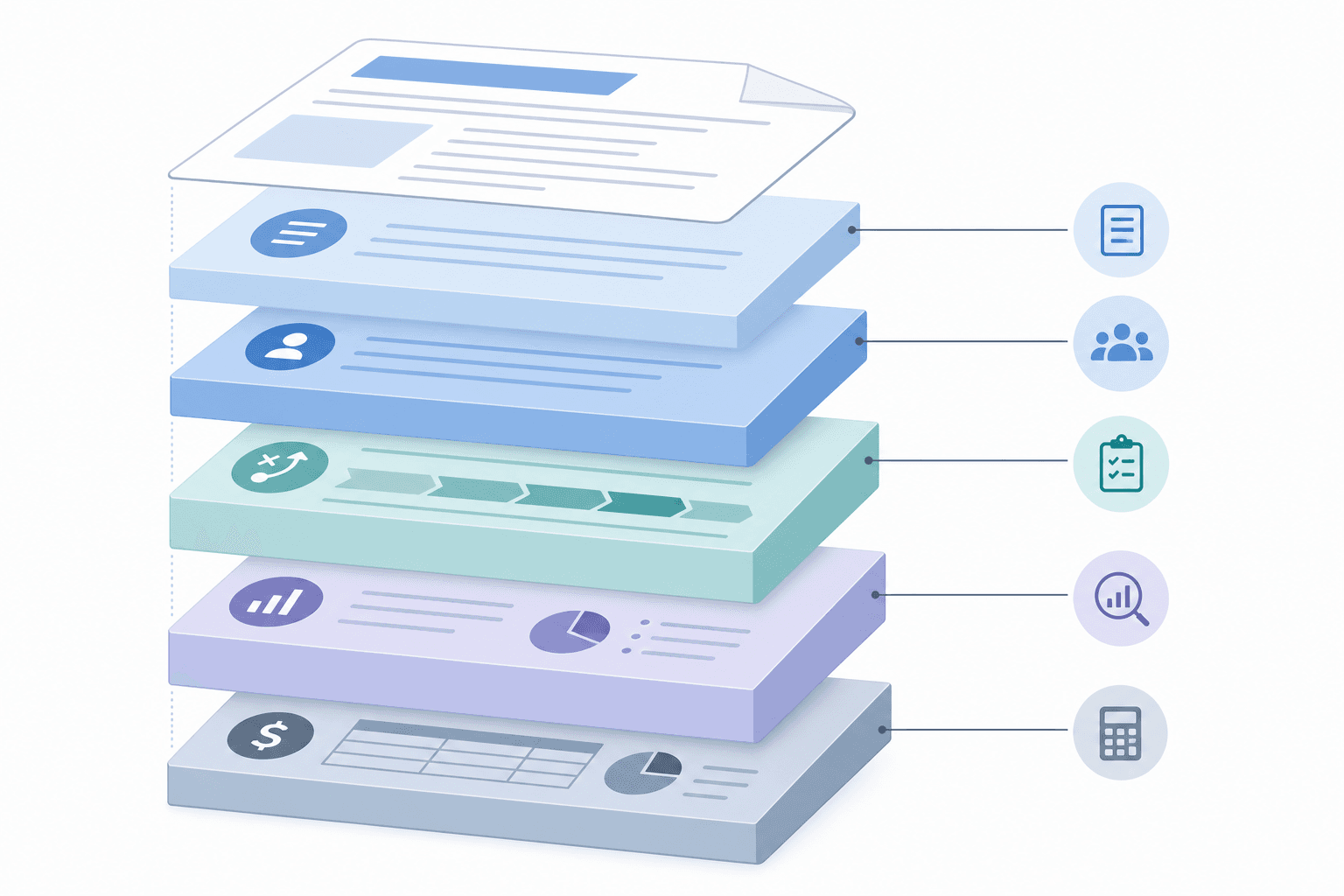
A grant proposal usually contains a summary, an organizational background, a statement of need, goals and objectives, a project description, an evaluation plan, a budget, a budget narrative, and attachments. Funders reorder and rename these, but the underlying set rarely changes.
The lengths in the table are drafting defaults, not funder requirements. Any limit published in the guidelines overrides them.
| Section | What it does | Suggested length when the funder sets no limit |
|---|---|---|
| Cover letter | Introduces the request and names the amount | 1 page |
| Executive summary | Compresses the entire request into something that stands alone | Half a page to 1 page |
| Organization background | Shows you have the track record and capacity to deliver | Half a page to 1 page |
| Statement of need | Proves the problem exists for these people in this place | 1 to 2 pages |
| Goals and objectives | States the change you will produce and how it is measured | Half a page |
| Project description | Explains the activities, timeline, staffing, and who the project serves | 2 to 4 pages |
| Evaluation plan | Defines what data you collect, who collects it, and when you report | 1 to 2 pages |
| Sustainability plan | Answers what happens to the work when the grant period ends | Half a page |
| Budget | Lists every cost by line item, usually as a table | 1 to 2 pages |
| Budget narrative | Justifies each line and shows the arithmetic behind it | 1 to 2 pages |
| Attachments | Supplies proof: tax determination letter, board list, financials, letters | Set by the funder |
Most of the score comes down to the statement of need and the grant proposal budget. The need section has to document a problem for a specific population instead of citing a national trend, and the budget has to add up and match what the narrative says you will do. The evaluation plan matters for a different reason. Whatever you name in it becomes your reporting obligation if you win, so a plan written to sound impressive is a plan you will spend the grant period failing to deliver.
Attachments are the part people underestimate. A tax determination letter, a board roster, a recent financial statement, and signed letters from partners each sit with a different person, and some of them take days to produce. Pull that list on day one and start asking, because a finished narrative with a missing attachment scores the same as nothing submitted.
What Are the Different Types of Grant Proposals?
Funders sort requests by what the money buys, and the type decides which sections carry the score. Naming the type before you draft stops you from writing a project proposal for a funder that makes only general operating grants.
| Type | What the money pays for | Where the proposal spends its effort |
|---|---|---|
| Program or project support | A defined activity with a start and an end date | Project description and evaluation plan |
| General operating support | Salaries, rent, and the rest of running the organization | Track record, financial health, and mission fit |
| Capital | Buildings, vehicles, equipment, renovation | Cost estimates, ownership, and long-term upkeep |
| Capacity building | Staff training, systems, planning, technology | The gap being closed and what works differently after |
| Research | An investigator-led study or trial | Methods, prior work, and investigator qualifications |
| Planning or seed | Early work that designs something fundable later | What the planning period will produce |
Most first proposals are project requests, which is why the standard section list leans toward activities and outcomes. Check the funder's stated priorities before you assume yours belongs there. Plenty of foundations fund projects and nothing else. Others fund operations only, or say outright that they will not pay for capital costs or equipment. The guidelines carry that rule, and a request that ignores it gets screened out before anyone reads the need section.
What a Grant Proposal Looks Like: A Worked Example
A finished grant proposal describes one project the same way in every section, so the need, the plan, the measures, and the money all point at the same work. The request below is a composite example written for illustration. No organization, funder, or figure in it is real.
Say a small literacy nonprofit asks a community foundation for $25,000 to run after-school tutoring at two elementary schools for one school year.
The statement of need names those two schools. It uses the reading-proficiency figures the district publishes for those buildings and says how many students there have no after-school option now. A sentence about national literacy rates would not do that job, because it describes a country rather than the children this money would reach.
Goals and objectives make the change countable. The goal is that more third and fourth graders at the two schools read at grade level. The objective under it names how many students will be served, how many tutoring hours each one gets, which reading assessment measures the change, and by what date.
The project description explains the mechanics. Sessions run two afternoons a week for thirty weeks in groups of four, led by a part-time coordinator working with trained volunteers. It says who recruits those volunteers, who trains them, where sessions happen, and how a student gets referred into the program.
The evaluation plan names the assessment, states that it is given in September and again in May, and assigns scoring and reporting to a role rather than to a named individual. Whatever appears here becomes a reporting obligation the day the award arrives.
The budget carries the coordinator's salary and fringe at the fraction of time actually worked, volunteer background checks, books and materials, and a snack line because sessions run through dinner. The budget narrative shows the arithmetic: the coordinator at 0.4 FTE for ten months, materials priced per student and multiplied by the number of students named in the objective.
Then look at how the sections agree with each other. The student count in the objective reappears in the materials line. The thirty weeks of sessions sit inside the coordinator's ten months. The assessment named in the objective is the one the evaluation plan schedules. A reviewer moving between sections finds the same project every time, which is the difference between a proposal and four documents saved in one file.
Grant Proposal vs. Grant Application vs. Letter of Intent
A grant proposal is the written argument for funding. A grant application is the funder's form and portal submission that carries it. A letter of intent is the short notice you send earlier to say you plan to apply.
| Document | What it is | Who sends it | When it appears |
|---|---|---|---|
| Letter of intent | A brief notice of intent to apply, with the project in outline | Applicant to funder | Before the full proposal, often as a screening step |
| Concept note | A condensed version of the project, cut to the essentials | Applicant to funder | Early, sometimes only by invitation |
| Grant proposal | The full written request: need, plan, budget, evaluation | Applicant to funder | At the stated deadline |
| Grant application | The funder's form, character-limited fields, and required uploads | Applicant through a portal | At the stated deadline |
| Award agreement | The contract that governs how the money may be spent | Funder to applicant | After the funding decision |
The practical difference between a proposal and an application shows up in the portal. Some funders have replaced the uploaded narrative with a sequence of text boxes that each cap at a set character count. The proposal still exists. You write it in a document first, then paste it in. Drafting directly in a portal is how teams lose work when a session times out.
Read the instructions before you decide which document you are producing. A funder that asks for a letter of intent and receives a forty-page proposal has learned that the applicant does not follow directions. Following directions is the first thing they test.
How Long Is a Grant Proposal?
The funder sets the length. Federal opportunities frequently cap the project narrative at a stated page count with a required font size and margin, while a small family foundation may accept two pages or a single online form.
When guidelines specify a limit, treat it as a hard rule. If you go past the cap, assume the extra pages will not be read, and expect some portals to reject an over-length upload outright. When the funder gives no limit, let the size of the request set the length.
An example makes that ratio concrete. A $10,000 request to a community foundation for program supplies might run three or four pages in total, most of it need and budget, because there is not much plan to describe. A three-year request covering two staff positions and an outside evaluator needs room for the staffing model, the timeline, and the measures, and it will run several times longer whether or not the funder asks it to. Padding the small request with sections it does not need works against you, because a reviewer reads the padding as a signal that you could not tell what mattered.
Long is not the same as thorough.
Length is also a budgeting question for your own team. A first federal submission takes far longer than the page count suggests, because the attachments involve registrations, certifications, and signatures you may not have on hand. Build the schedule backward from the deadline and confirm portal registration early, since that step is often the one that runs long.
Who Writes a Grant Proposal?
A proposal usually has one writer and several contributors. A program lead supplies the plan and the need evidence, a finance lead builds the budget, and an executive signs. Small organizations often have one person doing all of it.
The division matters because the sections have to agree with each other. If the narrative promises a part-time coordinator and the budget carries no personnel line, a reviewer sees a proposal nobody read end to end. That inconsistency is easy to catch and easy to miss when three people draft in parallel on separate documents.
Give one person the guidelines check, and make it someone who did not write the narrative. That job is not editing. It is reading the funding opportunity line by line against the assembled package: page limits, font size, required attachments, signature blocks, file naming, submission format. Writers are poor at this on their own work, because they read what they meant to write.
Writing a grant proposal well is mostly a project management problem once the first draft exists. Clear assignments and a fixed internal review date do more for the score than another pass on the prose. Our guide to writing a grant proposal covers the drafting mechanics.
What a Reviewer Reads First
A reviewer checks eligibility, then reads the summary, then compares the budget to the narrative. Anything that fails at the eligibility step never gets a score.
The eligibility screen is administrative and unforgiving: organization type, geography, tax status, registration, and whether every required attachment is attached. Next comes the executive summary, where the reviewer forms an impression of the project and then spends the rest of the document confirming or revising it. In the statement of need they are checking whether you documented a problem for a specific population or simply asserted one. In the project description, the question is whether the staff and timeline you describe could plausibly deliver the plan. Then they set the budget beside the narrative. Do the numbers match the activities? A budget that contradicts the narrative costs points and is entirely avoidable. The evaluation plan comes last in the read: at the end of this grant, will you be able to report anything meaningful?
Reviewers work from a scoring rubric when one is published. If the opportunity lists criteria and point values, mirror that language in your section headings so a scorer can find each item without hunting. This costs nothing and makes the document easier to score in your favor.
Where a Grant Proposal Starts: Finding the Right Opportunity
A grant proposal starts with the funding opportunity, read in full, before anyone writes a word of narrative. Drafting first produces a document that has to be rebuilt around eligibility rules you did not know about.
Federal agencies post discretionary opportunities on Grants.gov, the government's central listing of federal funding, as of September 2026. State and local funding lives on separate agency portals, and those portals do not share a search index, so one search rarely covers them. Private foundation giving shows up in the Form 990-PF returns those foundations file with the IRS, which record what a funder actually paid out in prior years and who received it.
GrantCue pulls federal and state portal opportunities into one searchable grant database with deadline tracking, and layers 990-PF foundation data on top so you can see a funder's past grantmaking before you spend a week drafting. Fit determines the outcome more than wording does.
FAQ
What is a grant proposal?
A grant proposal is a formal written request for funding that describes a project, the problem it addresses, the activities involved, the budget, and how results will be measured. It goes to a public agency or a private funder, which scores it against published criteria alongside competing requests.
What is grant writing?
Grant writing is the practice of researching funding opportunities, matching them to an organization's work, and producing the proposal documents a funder requires. It is part research and part document assembly, and the composition is the smaller half. Most of the effort goes into gathering evidence and coordinating the people who hold it.
What is the difference between a grant proposal and a grant application?
The proposal is the written argument for funding. The application is the funder's submission mechanism: the form, the character-limited fields, the uploads, and the portal. The two terms get used interchangeably, so the practical answer comes from the instructions in the funding opportunity itself.
How long should a grant proposal be?
As long as the guidelines allow and no longer. When a page limit is published, treat it as absolute and assume anything past it will not be read. When no limit is stated, match the length to the size and complexity of the request rather than filling space.
What are the stages of a grant?
The common stages are finding the opportunity, deciding whether to apply, writing and submitting the proposal, and waiting for the funder's decision. If the request is funded, the work continues through managing the award, reporting on progress and spending, and closing out the grant. The proposal covers one stage, and the reporting obligations you promise in it govern several later ones.
Do you need 501(c)(3) status to submit a grant proposal?
Not always. Some opportunities are limited to tax-exempt organizations, while others are open to schools, government agencies, tribes, businesses, or individuals. Groups without their own exemption sometimes apply through a fiscal sponsor. The funding opportunity states the eligibility rules, and a reviewer checks them before reading anything else.
The Short Version
The parts of a grant proposal stay stable across funders even when the names and the page limits change. Learn the set once and every new set of guidelines becomes a search for differences rather than a fresh start.
Start by confirming that the opportunity fits your organization and your work. Then build the document section by section against the guidelines, and keep the budget and the narrative describing the same project. When you are ready to draft, our step-by-step grant proposal guide picks up from there.