Grant Proposal Budget Template for Nonprofits With Examples, Categories and Budget Narrative
Download the free templateA grant proposal template with budget, including a sample grant budget table, a worked budget proposal example, grant budget categories and narrative wording.
In this article (24)
- Quick Answer: What Should a Budget Proposal for a Grant Include?
- Sample Grant Proposal Budget
- Budget Proposal Example: How It Differs From a Grant Budget
- Budget Narrative Template
- Personnel Budget Example
- Budget Narrative Example
- Matching Funds and In-Kind Support
- Budget Review Checklist
- Grant Proposal Template With Budget: How the Two Fit Together
- How the Budget Connects to Evaluation and Objectives
- Common Mistakes
- Grant Budget Categories
- Budget Narrative Formula
- Sample Budget With Narrative Notes
- Cost Reasonableness and Allowability
- Matching Funds and In-Kind Detail
- Budget Alignment Test
- AI Prompt for Budget Narrative Drafting
- Foundation Budget vs Federal Budget
- Budget Narrative Review Questions
- What To Do When the Budget Is Too High
- Example: Revising a Weak Budget Narrative
- FAQ
- Add the Budget to the Full Proposal
A grant proposal budget explains how much funding you need, what the money will pay for, and why each cost is necessary. A strong budget matches the proposal narrative. If the project promises tutoring, workshops, evaluation, transportation, or reporting, the budget should show the costs needed to deliver those activities.
Use this grant proposal template with budget examples alongside the complete grant proposal template so your numbers support the full application. This page covers the grant budget, with the categories and cost rules a funder scores; the budget proposal examples show three complete budgets line by line.
Free download: Grant budget spreadsheet with live formulas as Excel .xlsx. No email address required.
Quick Answer: What Should a Budget Proposal for a Grant Include?
A budget proposal for a grant should include every cost category the project uses, a calculation for each line, a total that matches the request, and a narrative line saying why each cost is needed. A grant proposal template with budget keeps those numbers beside the activities they pay for, so the two sections agree.
Budgets are scored against the narrative beside them. The complete proposal-writing guide shows how the two are expected to line up.
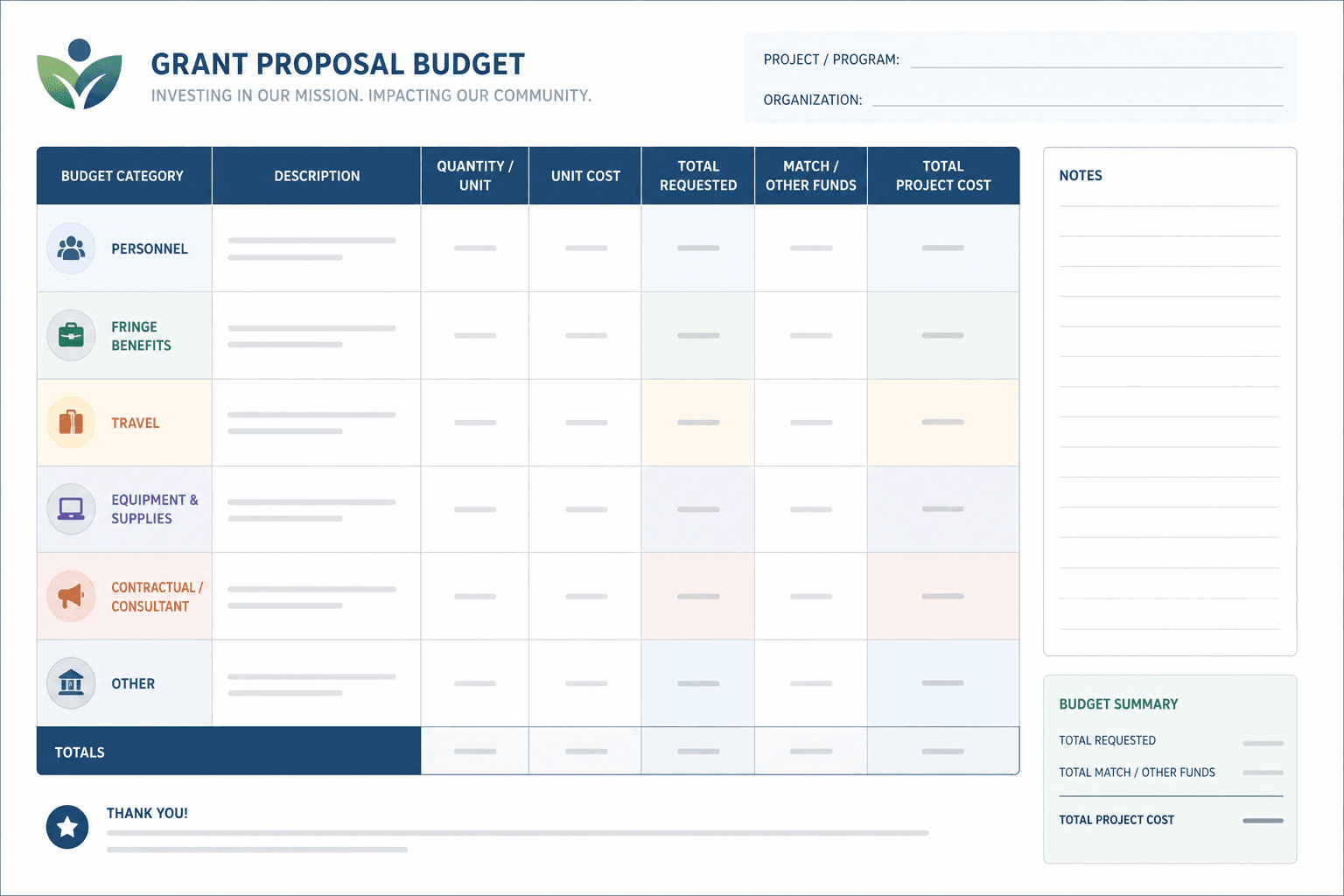
Sample Grant Proposal Budget
Illustrative figures, not data from a real organization.
The budget is easy to understand because every line item connects to a project activity.
Budget Proposal Example: How It Differs From a Grant Budget
A budget proposal is any document that asks a decision maker to approve spending on a defined piece of work. A grant budget is one type of budget proposal, written for a funder and bound by that funder's cost rules. The structure is nearly identical: scope, line items, calculations, totals, and a short justification for each cost.
The differences matter when you borrow a template from one context and use it in the other.
If you came here for a general budget proposal example, the worked example in this section is the one to copy. If you are writing for a funder, keep reading past it. The grant version adds cost rules that a generic template will not warn you about.
Worked Budget Proposal Example
This is an example of a proposed budget for an internal project, not a grant request. Example Regional Food Bank (composite) wants to add a Saturday distribution shift for six months and needs the operations director to approve the spend.
Proposal: Saturday distribution pilot, January through June
Amount requested: $18,400
Source: operations budget, unrestricted
Illustrative figures, not data from a real organization.
Three things make this example approvable. Every amount shows its arithmetic. Every line names the reason it exists. The total matches the amount in the first line, so the reader never has to reconcile two figures.
The same tests apply to a grant budget. A funder adds one more: each cost has to be allowable under that funder's rules, which is the job the grant budget narrative does and a plain budget proposal never has to.
Budget Narrative Template
[Category] costs include [item or role] at [rate, quantity, or time period]. This cost is necessary because [connection to project activity or outcome].
Example:
Personnel costs include three part-time reading tutors who will deliver after-school tutoring three days per week across two partner schools. Tutor costs are necessary to provide the 2,400 tutoring hours described in the project work plan.

Personnel Budget Example
Personnel is often the largest and most important part of a nonprofit grant budget.
Illustrative figures, not data from a real organization.
Use calculations whenever possible. Reviewers trust budgets more when they can see the assumptions.
Budget Narrative Example
Weak:
We need $36,000 for tutors.
Stronger:
Tutor costs include 1,800 total paid hours at $20 per hour for three part-time tutors. Tutors will deliver small-group reading support three days per week at two partner schools. This staffing level is necessary to provide the 2,400 student tutoring hours projected in the work plan.
The stronger version explains cost, quantity, purpose, and connection to outputs.
Matching Funds and In-Kind Support
Some funders require match. Others like to see other funding sources even when match is not required.
Examples of match:
- Cash from another funder.
- Staff time paid by the organization.
- Donated space.
- Volunteer time if allowed.
- Partner services.
- Donated supplies.
Always follow the funder's rules. Do not count volunteer time or donated goods as match unless the funder permits it.
Budget Review Checklist
Before submitting:
- Totals are correct.
- Request amount matches the proposal and forms.
- Budget categories match funder instructions.
- Every major activity has a corresponding cost.
- Every cost is allowable.
- Match is documented if required.
- Indirect costs follow the funder's policy.
- Evaluation costs are included.
- Budget narrative explains assumptions.
- Attachments match the final numbers.
Grant Proposal Template With Budget: How the Two Fit Together
A grant proposal template with budget treats the budget as one section of the proposal, not a separate file: each narrative section that promises an activity points to the budget lines that pay for it. One commenter on Reddit wrote of proposal templates that "most miss out important things like budgeting" (Reddit thread 1hu8m0x, read September 2026), which is why the template and the budget belong in one working document.
Build them in one order: the activities, a cost line for each, the narrative note for each line, then a check of the totals against the request.
How the Budget Connects to Evaluation and Objectives
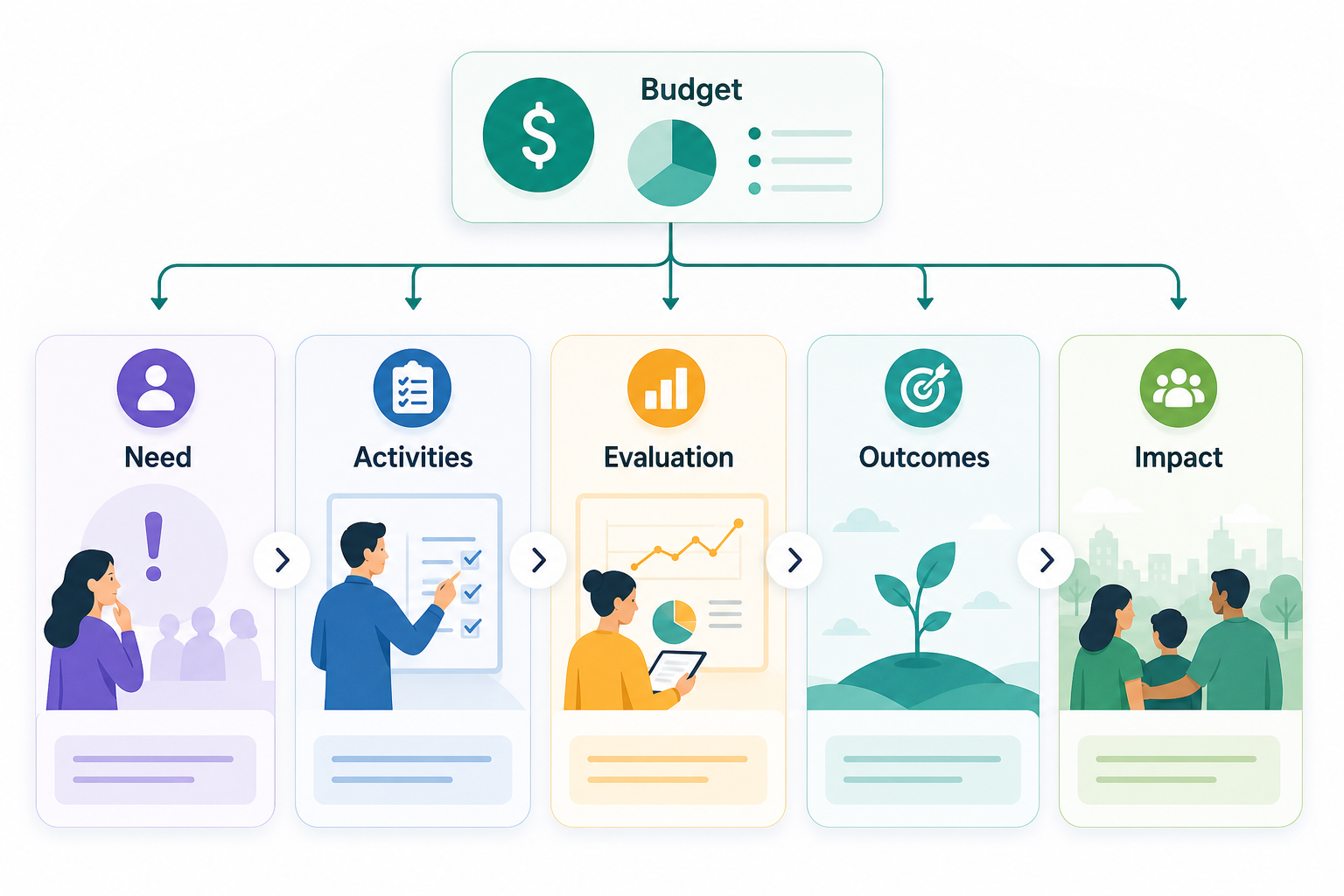
If the grant proposal goals and objectives examples promise measurable outcomes, the budget should include the resources needed to achieve and measure them. If the grant proposal evaluation plan includes surveys, assessments, or analysis, include evaluation time or tools in the budget.
Budgets for internal or sponsor-facing proposals follow the same logic; the budget section of a nonprofit project proposal template uses the same quantity, rate, and justification columns.
Common Mistakes
Mistake 1: Budget Does Not Match Narrative
If the narrative includes activities missing from the budget, reviewers may question feasibility.
Mistake 2: Round Numbers With No Explanation
Round numbers can look invented. Show rates, quantities, or assumptions.
Mistake 3: Forgetting Administrative Work
Grant management, reporting, and fiscal oversight take time. Include administrative costs if allowed.
Mistake 4: Ignoring Restrictions
Some funders exclude food, equipment, lobbying, capital expenses, or indirect costs. Read the guidelines closely.
Grant Budget Categories
Grant budget categories are the standard groupings funders use to organize costs: personnel, fringe benefits, contractual or consultant costs, travel, supplies, equipment, space, participant support, and indirect costs. Most funder forms use some version of this list, and federal forms use it almost exactly.
Many funders provide their own budget form. When they do, use it exactly. If the funder does not provide a form, organize costs in these categories so the reviewer finds each cost where they expect it.
Grant Budget Template in Excel or Google Sheets
A grant budget template works in any spreadsheet tool. Build it with one row per cost and these seven columns, then let the sheet do the arithmetic so the numbers cannot drift away from the narrative; the grant budget spreadsheet guide builds one step by step.
Add a totals row that sums the Amount column. Put match and in-kind on a second sheet or in a separate block so those figures never get added into the request by accident.
In Google Sheets, share the file with the finance reviewer using comment access instead of emailing versions around. In Excel, lock the Rate and Quantity cells once finance signs off, so a late edit cannot move the total without anyone noticing. Either way, keep the spreadsheet in the same folder as the application, and when the budget changes, change the narrative in the same sitting.
EPA's budget training says it "will help applicants and recipients when preparing work plans, budgets, and budget narratives for EPA grants" (EPA, grants training page, updated August 17, 2026). OJP's Grants 101 guidance sets a practical standard: "The budget should be as concrete and specific as possible in its estimates," and "Each of the major components should be subtotaled with a grand total at the end" (OJP, Grants 101, Develop a Budget, read October 2026). That is the standard this template should meet.
Budget Narrative Formula
For each line item, explain four things:
- What the cost is.
- How the amount was calculated.
- Why the cost is necessary.
- Which project activity it supports.
Formula:
[Cost item] is requested to support [activity]. The amount is calculated as [rate x quantity x time]. This cost is necessary because [reason connected to project design].
Example:
"Part-time tutor wages are requested to provide after-school reading support at two partner schools. The amount is calculated as 2 tutors x 10 hours per week x 32 weeks x $25 per hour. The cost is necessary to deliver the proposed small group tutoring sessions and achieve the objective of helping at least 65 percent of participating students improve by one reading level."
This is stronger than "Tutor wages: $16,000" because it gives the reviewer the calculation and the program logic.
Sample Budget With Narrative Notes
Illustrative figures, not data from a real organization.
The exact categories will vary, but every cost should have a reason. If a cost does not connect to the project plan, remove it or revise the narrative. Keep this budget aligned with the rest of your nonprofit grant proposal so reviewers see one consistent request.
Cost Reasonableness and Allowability
Reviewers often ask three questions:
- Is the cost allowable under the funder rules?
- Is the cost reasonable for the project?
- Is the cost allocable to this grant?
"Allowable" means the funder permits the cost. "Reasonable" means the amount would make sense to a prudent person reviewing the project. "Allocable" means the cost benefits this grant and is assigned in proportion to that benefit.
For federal awards, applicants and recipients should also be aware of the Uniform Guidance at 2 CFR Part 200 and the specific terms of the award. Do not use a general blog article as the final authority for federal cost rules. Use the funder's NOFO, award terms, and finance/compliance review.
Administrative overhead is also an allowability question: claim the indirect cost rate for federal grants you are entitled to, including the de minimis rate of "up to 15 percent of modified total direct costs (MTDC)" set in the 2024 Uniform Guidance revision (eCFR 2 CFR 200.414(f), current as of September 2026).
Matching Funds and In-Kind Detail
If the funder requires match, explain the source and documentation method.
Examples:
- Cash match from board-designated funds.
- Partner contribution documented by letter.
- Volunteer time calculated at an approved rate.
- Donated space documented by fair market rental value.
- In-kind professional services documented by provider invoice or letter.
Do not include match that cannot be documented. If the funder has specific match rules, follow those rules exactly.
On federal awards those rules come from 2 CFR 200.306, and how federal cost sharing is valued and recorded covers the tests for volunteer time and donated space.
Budget Alignment Test
Before submission, compare the budget to the narrative:
If the budget includes something the narrative never mentions, reviewers may question it. If the narrative promises something the budget does not support, reviewers may question feasibility.
For a quick manual check before you finalize, list every activity in the narrative in one column and every major cost in the budget in another, then draw a line between related items. Anything left without a line needs attention: either the activity is unfunded, the cost is unexplained, or the project design has changed.
AI Prompt for Budget Narrative Drafting
Draft a grant budget narrative from the approved budget lines below.
Use only the budget amounts and project facts provided.
Do not invent rates, quantities, funder rules, or match sources.

Budget table:
[Paste line item, calculation, amount]

Project activities:
[Paste activities]

Objectives:
[Paste objectives]

Funder restrictions:
[Paste restrictions]

For each line item, explain what the cost is, how it was calculated,
why it is necessary, and which activity it supports.
Then have finance review every calculation. AI can improve wording, but it cannot approve the budget.
Foundation Budget vs Federal Budget
Foundation budgets are often simpler than federal budgets, but the same logic applies: costs should be allowable, reasonable, documented, and tied to the work.
Do not assume a simpler foundation budget can be casual. A clean budget still signals that the organization can manage the award.
Sponsorship and in-kind asks use a lighter format altogether; the donation proposal template for nonprofits covers that case.
Budget Narrative Review Questions
Ask these questions line by line:
- Would a reviewer understand the calculation?
- Does the narrative explain why the cost is necessary?
- Does the cost appear in the correct category?
- Is the amount consistent with the project timeline?
- Does the cost require funder approval?
- Is there documentation for the rate or estimate?
- Is the cost included in match by mistake?
- Does the budget narrative match the spreadsheet total?
For larger proposals, have the program lead and finance lead review together. Program staff can confirm whether the resources are enough to deliver the work. Finance staff can confirm calculations, cost treatment, match, and documentation. Do not submit until the person responsible for financial reporting has confirmed payroll assumptions, fringe rates, indirect cost treatment, match documentation, restricted cost rules, and spreadsheet formulas. This matters most when a program person drafted the first budget, because a fundable budget has to be both programmatically realistic and financially clean.
Once the budget is approved, save it with the budget narrative and calculation notes in one place. If the grant is awarded, those documents become the starting point for spending, reporting, amendments, and closeout, and they save the next writer from rebuilding the same assumptions. For recurring grants, add a short note explaining what changed from the prior budget so renewals reflect current staffing, vendor pricing, and program scale.
What To Do When the Budget Is Too High
If the first budget is above the funder's maximum request, do not cut randomly. Prioritize the project design.
Options:
- Reduce the number of participants served.
- Reduce the grant period.
- Move nonessential activities to another funding source.
- Request partial support for one component.
- Remove costs the funder will not pay for.
- Add confirmed match or in-kind support if allowed.
Do not cut evaluation, grant management, or supervision to make the numbers look lean. Those costs often protect the project.
Example: Revising a Weak Budget Narrative
Weak:
"Supplies are needed for program activities. Total: $5,000."
Stronger:
"Program supplies are requested for 120 participating students and 75 caregivers. The amount includes student workbooks, take-home reading kits, workshop materials, printing, and basic classroom supplies. The cost is calculated at an average of $25 per student for reading materials, $18 per caregiver for workshop materials, and $650 for shared printing and classroom supplies. These materials support the tutoring sessions and caregiver workshops described in the project narrative."
The stronger version gives quantities, use of funds, and a connection to activities. It also gives finance staff something concrete to check before submission.
GrantCue's Team plan, at $109 a month, keeps a shared document library for each opportunity, a place for the approved budget and its narrative, and tracks an awarded grant with "post-award lite" budget versus actuals and payment schedules; a budget narrative tool is among the AI writing tools that start on Essentials at $49 a month (grantcue.com, October 2026). The features overview covers the writing tools.
FAQ
What Is a Budget Narrative?
A budget narrative explains the assumptions behind each budget line and connects costs to project activities.
Should the Budget Include Staff Time?
Yes, if staff will work on the project and the funder allows personnel costs.
What If the Funder Gives a Budget Form?
Use the funder's form. You can still prepare your internal budget using this template before entering it into the portal.
What Is a Budget Proposal Example?
A budget proposal example is a completed sample budget showing how a request is structured: the line items, the calculation behind each amount, the total, and a short reason for each cost. The Saturday distribution pilot in this guide is one. A grant budget follows the same structure and adds the funder's rules about which costs are allowed.
What Are the Standard Grant Budget Categories?
Personnel, fringe benefits, contractual or consultant costs, travel, supplies, equipment, space or facilities, participant support, and indirect costs. Federal budget forms use close to this exact list. Foundation forms are often shorter but map onto the same groupings.
Add the Budget to the Full Proposal
Add your budget and narrative to the full proposal, then confirm every cost supports the project activities and outcomes.