Grant Proposal Evaluation Plan Sample: Template, Metrics, and Logic Model
Download the free templateA grant proposal evaluation plan guide with examples, metrics tables, logic model guidance, data collection methods, and related proposal resources.
In this article (25)
- Quick Answer: What Goes in an Evaluation Plan for a Grant Proposal?
- Evaluation Plan Template
- Sample Evaluation Metrics Table
- Logic Model Basics
- Formative vs Summative Evaluation
- Data Collection Methods
- Internal vs External Evaluation
- How Evaluation Connects to Goals and Objectives
- Common Mistakes
- Start With Evaluation Questions
- Evaluation Matrix Template
- Data Quality Matters
- Evaluation Timeline Example
- Small Nonprofit Evaluation Plan
- Example Evaluation Narrative
- Budget for Evaluation
- AI Prompt for Evaluation Planning
- Reporting Plan: How Findings Will Be Used
- Evaluation Risks and Mitigation
- What To Avoid in Evaluation Language
- Example: Turning Objectives Into Evaluation Measures
- Project Evaluation Example
- Evaluation Readiness Check
- FAQ
- Next Step
A grant proposal evaluation plan explains how your nonprofit will measure project implementation, participant outcomes, and progress toward the funder's goals. It should connect directly to your goals and objectives, use realistic data sources, and show who will collect, analyze, and report results.
For the full application structure, use the complete grant proposal template with this evaluation section guide. This page is the template and the worked sample; for the step-by-step method, from objectives to reporting dates, see how to build an evaluation plan for a grant proposal.
Quick Answer: What Goes in an Evaluation Plan for a Grant Proposal?
Reviewers read the evaluation plan against your goals and budget, so it is worth working through the full guide to writing a grant proposal alongside this one.
Evaluation Plan Template
The evaluation plan will track both implementation and outcomes. Program staff will monitor [outputs] using [data source]. Outcome progress will be measured through [assessment, survey, or tool] at [time points]. Results will be reviewed [frequency] by [role/team] and used to [improve program/report to funder].
Example:
The evaluation plan will track tutoring participation, caregiver engagement, and student reading growth. Program staff will monitor attendance, tutoring hours, and workshop completion monthly. Reading progress will be measured using district benchmark assessments at baseline, midyear, and year-end. Caregiver confidence will be measured through a short pre/post survey. The program manager will review results every six weeks and adjust tutoring groups based on student progress.
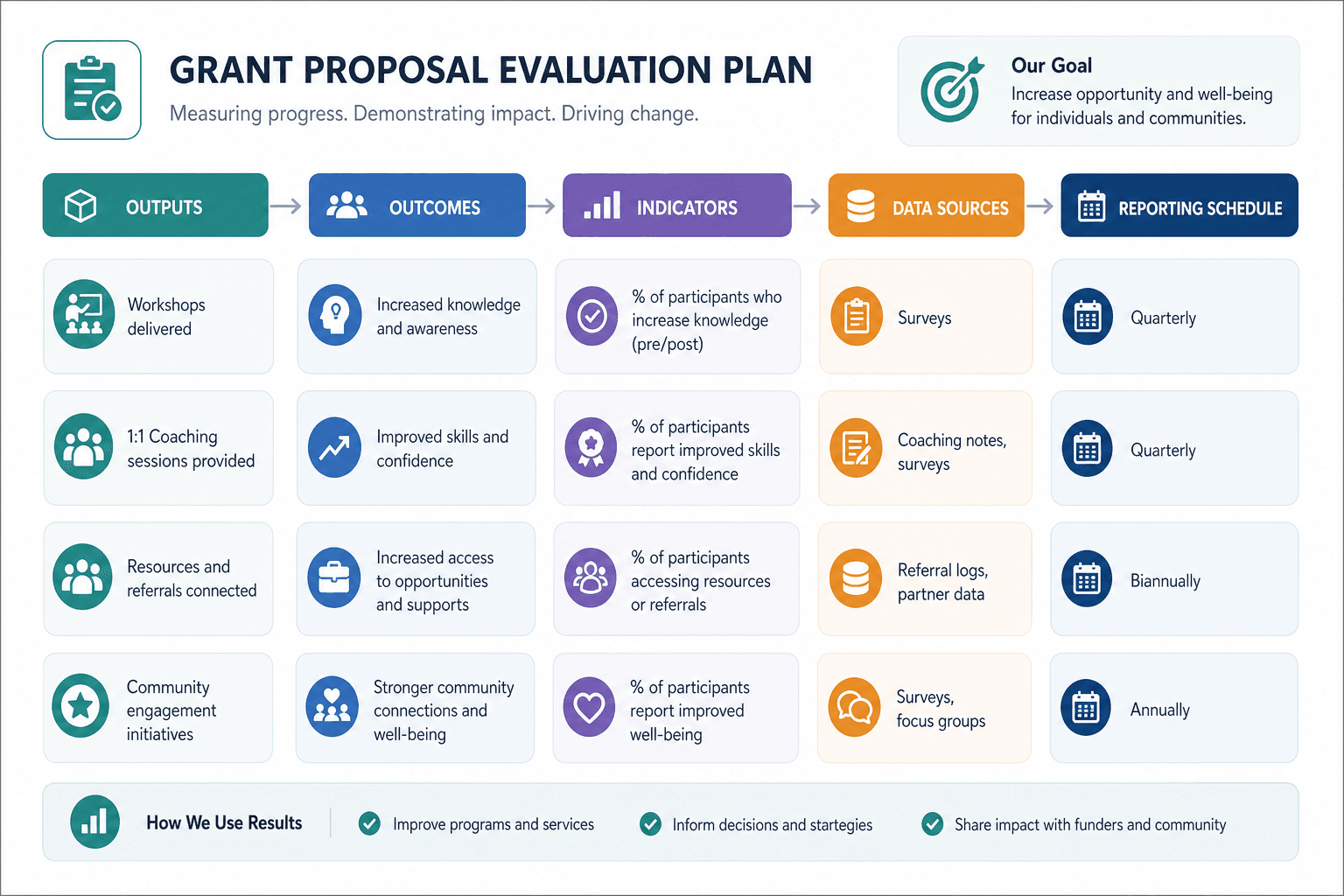
Sample Evaluation Metrics Table
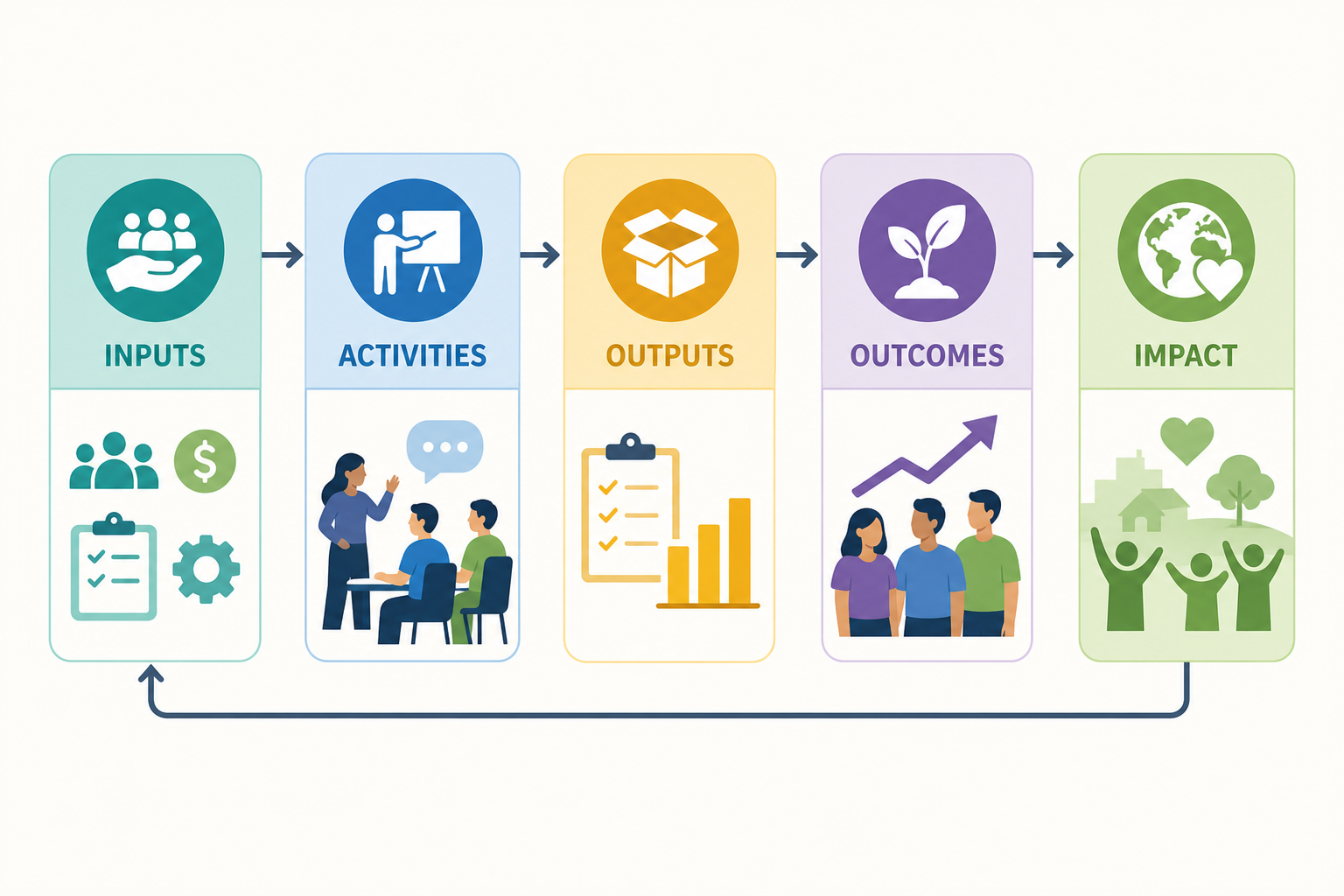
Logic Model Basics
A logic model shows how resources turn into activities, outputs, outcomes, and impact.
A logic model is helpful because it makes the evaluation plan easier to understand. If the funder asks for one, keep it simple and tied to the proposal narrative. For a fillable version with two completed examples, use this logic model template for grants.
Formative vs Summative Evaluation
Formative evaluation helps improve the project while it is happening. Summative evaluation assesses results at the end.
Strong proposals often include both. They show the funder that you will learn during the project and report results after it.
Data Collection Methods
Choose methods your team can realistically manage.
Common methods:
- Attendance logs.
- Enrollment records.
- Pre/post surveys.
- Assessments.
- Interviews.
- Focus groups.
- Case notes.
- Partner reports.
- Financial records.
- Platform analytics.
Do not propose a complex evaluation design if you do not have the staff, budget, or expertise to run it. A clean, realistic evaluation plan is better than an impressive plan nobody can execute.
Internal vs External Evaluation
Some projects can be evaluated by program staff. Others may need an external evaluator.
Use internal evaluation when:
- The grant is small or moderate.
- Data collection is straightforward.
- Staff already track the relevant information.
Consider external evaluation when:
- The funder requires it.
- The project is large or multi-site.
- The evaluation design is complex.
- The findings need independent validation.
If you include external evaluation, remember to include the cost in the grant proposal budget template.
How Evaluation Connects to Goals and Objectives
The evaluation plan should measure your objectives. If the objective says students will improve by one reading level, the evaluation plan should name the assessment and schedule.
Use the grant proposal goals and objectives examples first, then build the evaluation table from those objectives.

Evaluation evidence also feeds the sustainability plan for grant proposals, where funders ask what outlives the grant.
Common Mistakes
Mistake 1: Measuring Only Activities
Activities matter, but funders also want outcomes. Track what you did and what changed.
Mistake 2: Using Too Many Metrics
Too many metrics create noise. Choose the measures most connected to the project's purpose.
Mistake 3: Forgetting Who Owns the Data
If a school, clinic, or partner owns the data, confirm access before promising to report it.
Mistake 4: Ignoring Privacy
Do not collect more participant data than needed. Follow privacy, consent, and data-security requirements.
Start With Evaluation Questions
An evaluation plan should start with the questions the nonprofit and funder need answered. Without evaluation questions, the plan becomes a list of disconnected metrics.
Good evaluation questions include:
- Did the project reach the intended population?
- Were activities delivered as planned?
- Did participants complete the program?
- Did participants experience the expected change?
- Which parts of the project worked best?
- What should be improved before renewal or expansion?
These questions make the evaluation useful after the grant ends. They also help the proposal feel practical instead of performative. EPA's grants management and budget training materials emphasize the full grant life cycle, including application preparation, award management, and closeout. A good evaluation plan supports that full life cycle because it creates the evidence needed for reports and future funding.
Evaluation Matrix Template
Use a matrix to make the plan easy for reviewers to scan:
Once the matrix is filled in, drop it into the evaluation section of your full grant proposal template so reviewers can read it alongside the rest of the application.
Data Quality Matters
Evaluation is only as strong as the data collection process. If staff collect data inconsistently, the final report will be weak even if the program work was strong.
Build these data quality checks into the plan:
- Define each metric before the project starts.
- Use the same intake form at every site.
- Train staff on how to enter data.
- Decide how duplicate participants will be handled.
- Schedule monthly data reviews.
- Keep source documents organized.
- Limit access to participant-level information.
- Document any changes to methods.
For example, if the objective is to serve 200 unduplicated participants, the team needs a rule for identifying duplicates. If the objective is a 20 percent knowledge increase, the team needs the same pre-test and post-test for everyone included in the calculation.
Evaluation Timeline Example
The timeline should match the grant calendar. If the funder requires quarterly reports, the team should not wait until month 11 to review progress.
Your evaluation milestones should sit inside the project schedule; a worked grant proposal timeline example shows the alignment.
Small Nonprofit Evaluation Plan
Small organizations often worry that evaluation requires a formal evaluator. Not always. For a small foundation grant, a practical evaluation plan may use:
- Intake forms.
- Attendance logs.
- Pre/post surveys.
- Staff observation notes.
- Partner referral counts.
- Short participant interviews.
- Final report review meeting.
The key is to keep the method proportional to the grant. A $5,000 community grant does not need the same evaluation design as a multi-year federal award. But every grant needs a credible way to show what happened.
Example Evaluation Narrative
"The project director will oversee evaluation using attendance records, participant intake forms, pre/post knowledge surveys, and monthly partner referral logs. Baseline data will be collected at enrollment, and follow-up data will be collected at program completion. The team will review participation and completion data monthly to identify attendance barriers early. Outcome data will be analyzed at the midpoint and end of the grant period. Results will be shared with program staff, the executive director, and the funder in the final report. All participant-level data will be stored in a restricted-access database, and public reports will use aggregate results only."
This example is concise, but it answers ownership, methods, schedule, use of findings, and privacy.
Budget for Evaluation
Evaluation takes time and sometimes money. If the evaluation plan includes surveys, translation, data software, participant incentives, an outside evaluator, or staff analysis time, the budget should reflect that. OJP's Grants 101 guidance on proposal budgets advises applicants to make the budget as clear as possible, keep it consistent with the program narrative, and justify all expenses. The same principle applies here: if evaluation work is promised, the cost should be visible.
AI Prompt for Evaluation Planning
Create a grant evaluation plan from the objectives below.
Use only the provided objectives and project details.
For each objective, identify indicators, data sources, collection schedule,
owner, and reporting use.
Do not invent tools that the organization does not have.

Objectives:
[Paste objectives]

Project activities:
[Paste activities]

Available data sources:
[Forms, surveys, attendance, database, partner records]

Grant reporting requirements:
[Paste funder requirements]
Ask the AI to flag objectives that cannot be measured with the available data. That turns the tool into a quality-control partner rather than a source of fake certainty.
Reporting Plan: How Findings Will Be Used
Funders do not ask for evaluation only to create paperwork. They want to know whether the project worked, what changed, and what the organization learned. Add a short "use of findings" paragraph to show that data will shape decisions. On federal awards, 2 CFR 200.301 says the awarding agency should communicate in the award any expected outcomes, indicators, targets, baseline data, or data collections the recipient is responsible for measuring and reporting (eCFR, Title 2 current as of October 5, 2026; read October 2026).
Example:
"The project team will review evaluation findings during monthly implementation meetings and quarterly leadership reviews. Participation data will be used to identify outreach gaps, attendance data will be used to adjust session schedules, and outcome data will be used to refine the curriculum before the next grant cycle. Final findings will be summarized for the funder, board, partner schools, and program staff."
This paragraph makes the evaluation plan more credible because it explains how data will affect management.
Evaluation Risks and Mitigation
Every evaluation has risks. Naming them can strengthen the proposal when the mitigation is practical.
This level of detail shows the funder that evaluation is not an afterthought.
What To Avoid in Evaluation Language
Avoid promising proof that the project alone caused a broad community change unless the evaluation design can actually support that claim. A small tutoring program may contribute to better reading outcomes, but it probably cannot prove that it caused district-wide achievement changes. Use accurate language:
- "Participants will demonstrate..."
- "The project will track..."
- "The organization will compare..."
- "Survey results will indicate..."
- "Program records will show..."
Precise verbs protect credibility. They also make final reporting easier because the promised evidence matches the available data.
Example: Turning Objectives Into Evaluation Measures
Objective: "By June 30, 2027, 70 percent of participating students will improve by at least one reading level."
Evaluation measure: district benchmark assessment administered at enrollment and at the end of the school year. The program manager will compare baseline and final scores for students who participate in at least 20 tutoring sessions. Results will be reported as the number and percentage of students improving by one or more levels.
Objective: "At least 75 caregivers will complete three literacy workshops."
Evaluation measure: workshop sign-in sheets and attendance logs. The site coordinator will review attendance monthly and identify families needing reminder calls, transportation support, or alternate session times.
These examples show why objectives and evaluation should be written together. The objective gives the promise. The evaluation measure explains how the promise will be checked. If the team cannot name the measure, owner, and schedule, the objective may need to be rewritten.
Project Evaluation Example
A project evaluation is the check a team runs at the end of a defined piece of work to learn whether it delivered what it promised and what should change next time. The evaluation plan template above works for any project, funded or not. A grant evaluation plan is simply a project evaluation written before the work starts, with the funder named as one of the audiences.
This is a labelled composite example, not a real client. A community center ran a six-month senior meal delivery pilot and evaluated it against the three questions set at launch.
The numbers inside the table describe the composite scenario, not sector research. What makes the example useful is its shape: three questions set before launch, one named owner per data source, and findings a board can act on. The rural route gets redesigned, the menu adds two options, and the cost trend supports a request to continue.
An evaluation of a project does not need more than this unless the funder asks for it. Write the questions first, collect only the data that answers them, and report what you would do differently. That is the whole discipline, whether the money came from a grant, a donor, or the operating budget.
Evaluation Readiness Check
Before submission, ask the person responsible for evaluation to confirm the plan in writing. They should be able to answer:
- What data will be collected?
- Who will collect it?
- Where will it be stored?
- When will it be reviewed?
- How will errors be corrected?
- Which results will be reported to the funder?
If the evaluation owner cannot answer these questions, the plan is not ready. The proposal may sound complete, but the reporting process will be difficult after award.
For complex applications, schedule the first evaluation meeting before the grant begins. That meeting should confirm tools, owners, due dates, data definitions, privacy rules, and the first internal reporting date.
That preparation turns evaluation from a last-minute reporting scramble into a management routine, and it makes renewal proposals easier to write.
FAQ
What is an evaluation plan in a grant proposal?
An evaluation plan is the section that explains how the applicant will measure project outputs, outcomes, and learning.
Do small grants need evaluation plans?
Yes, but the plan can be simple. Small grants may only need outputs, one or two outcomes, and a short reporting plan.
What is the difference between outputs and outcomes?
Outputs are what the project delivers. Outcomes are the changes that result.
What is an example of a project evaluation?
A project evaluation example is a completed review showing the evaluation questions, the data collected, the method used, and what the team learned. The senior meal delivery pilot above is one: three questions, three data sources, and findings that changed the next phase.
Is a project evaluation the same as a grant evaluation plan?
They share the same structure. A project evaluation reviews any defined piece of work. A grant evaluation plan is written before the project starts, promises specific measures to a funder, and becomes the outline for the reports the funder requires.
Next Step
Add your evaluation table to the sample grant proposal template, name the person who owns the data, and confirm the budget covers the staff time, tools, and reporting work needed to collect it.