Grant Writing Examples for Nonprofits: Weak and Strong Versions, Side by Side
Grant writing examples for nonprofits that put weak and strong versions of each proposal section side by side, with notes on what changes a reviewer's score.
In this article (25)
- Quick Answer: What Do Good Grant Writing Examples for Nonprofits Show?
- What Grant Writing Involves, and Why Examples Beat Blank Templates
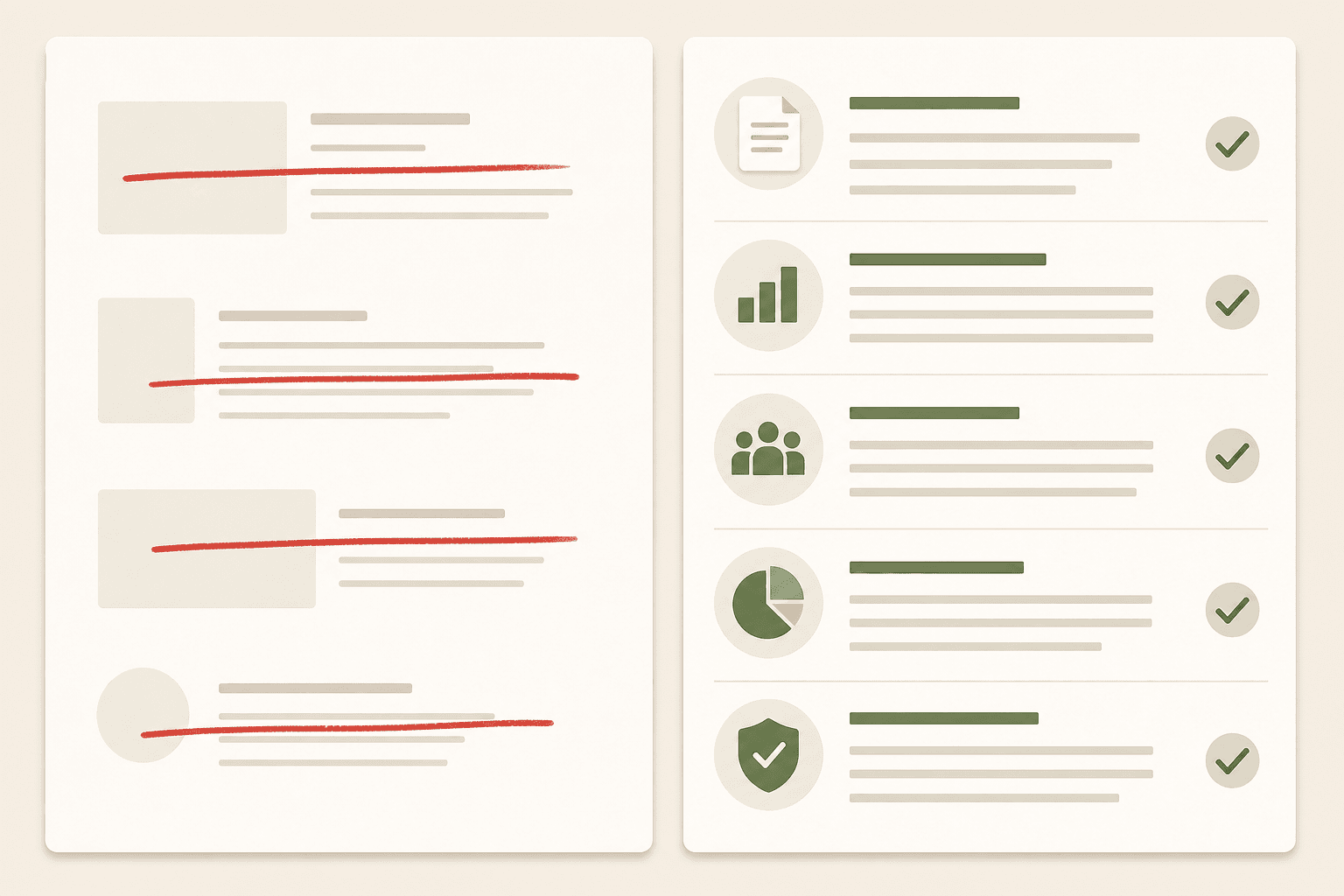
- The Tells That Separate Weak Grant Writing From Strong
- Grant Writing Examples for Nonprofits: Seven Sections, Weak and Strong
- Statement of Need
- Goals and Objectives
- Program Description and Methods
- Organizational Capacity
- Evaluation Plan
- Budget Narrative
- Sustainability
- How to Turn One Weak Sentence Into a Strong One
- Nonprofit Grant Samples: What to Copy and What to Leave Behind
- Grant Writing Examples by Funder Type
- Phrases That Signal a Weak Draft
- How to Practice With Grant Writing Examples
- FAQ
- What does a good grant proposal example look like
- Can I copy a sample grant proposal
- Where can I find free nonprofit grant writing examples
- What is grant writing
- How long should a nonprofit grant proposal be
- Do you need a professional grant writer
- How to write a nonprofit grant proposal
- Next Steps
Most grant writing examples for nonprofits show you a finished proposal and leave you to guess what made it work. Reviewers read your application next to every other application in the stack, and the gap between a funded request and a rejected one often comes down to a handful of sentences. This guide puts a weak and a strong version of the same section next to each other so you can watch the swap happen, then gives you the phrases to search for in your own draft.
Quick Answer: What Do Good Grant Writing Examples for Nonprofits Show?
Strong grant writing examples for nonprofits replace general claims with specific, checkable detail. A weak need statement says the community faces challenges. A strong one names the population, the size of the gap, and where the number came from. The same swap applies to goals, methods, evaluation, and budget narrative.
Free download: Grant writing example pack, strong and weak versions side by side as Word .docx. No email address required.
What Grant Writing Involves, and Why Examples Beat Blank Templates
Grant writing is the practice of turning a program plan into a funding request a reviewer can score against published criteria. A blank template tells you which boxes exist; an example shows you what belongs inside them.
Filling a need statement box is easy. Filling it with something a reviewer can verify is the skill, and no template teaches that. Paired examples work better than either a blank form or a single finished sample, because the weak version shows you the habit you already have and the strong version shows the fix.
We invented the organizations, numbers, and dates in every example below for illustration. They do not describe a real nonprofit or a real funder.
If you have never assembled a full application, start with how to write a grant proposal for the section order, then come back here for the sentence-level work.
The Tells That Separate Weak Grant Writing From Strong
Weak grant writing describes intentions. Strong grant writing describes commitments a reviewer can check without calling you.
Scroll horizontally to see all columns when needed.
| Section | Weak version sounds like | Strong version does this |
|---|---|---|
| Statement of need | "Our community faces significant challenges" | Names the population, the size of the gap, and where the number came from |
| Goals and objectives | "Improve outcomes for local youth" | Commits to a number, a date, a measurement method, and a baseline |
| Program description | "Evidence-based services and best practices" | A reviewer can tell who runs each session and on what days |
| Organizational capacity | "A long track record of success" | Gives titles and tenure, plus a recent audit history |
| Evaluation | "We will evaluate effectiveness" | Names the assessment instrument and who reviews the results |
| Budget narrative | A list of line items with totals | Shows the arithmetic behind each line |
| Sustainability | "We will seek additional funding" | Points to sources already committed and a renewal decision date |
The pattern across all seven rows is the same: the strong column answers a question the reviewer would otherwise have to ask you. If you strip every adjective out of a paragraph and nothing measurable is left, the paragraph is not saying anything yet.

Select to enlarge (opens in a new tab).
Grant Writing Examples for Nonprofits: Seven Sections, Weak and Strong
Strong grant writing examples for nonprofits differ from weak ones in the same seven sections every time: need, goals, program description, capacity, evaluation, budget narrative, and sustainability. In each one, the strong version replaces an adjective with a number, a date, or a named source.
The examples here come from one composite: a small literacy nonprofit requesting $25,000 from a community foundation for an after-school reading program at two elementary schools. The weak version is the kind of draft a first attempt usually produces, and the strong version is the same content after the writer went looking for evidence.
Statement of Need
Weak: "Our community faces significant challenges around childhood literacy. Many students are falling behind, and there is a great need for additional support. Our organization is uniquely positioned to meet that need."
Strong: "Second and third graders at the two elementary schools we serve read below grade level at a higher rate than the district average, according to the district's spring assessment summary. The nearest free tutoring program ended its afternoon sessions in 2024. Our own intake log shows 84 families turned away last year because every reading slot was full."
The weak version asks the reviewer to accept three claims on faith. The strong version gives a source for each one and hands the reviewer a number they can repeat in their committee summary. Longer worked versions of this section live in statement of need examples.
Goals and Objectives
Weak: "Our goal is to improve literacy outcomes for the children we serve and help them succeed in school."
Strong: "Goal: raise reading proficiency among second and third graders at both partner schools. Objective 1: by June 30, 2027, 60 of the 80 enrolled students will gain at least one grade level on the district reading assessment, measured against their fall baseline. Objective 2: by June 30, 2027, average attendance across the four weekly sessions will reach 75 percent."
A goal that cannot fail also cannot succeed, so a reviewer has nothing to score. The strong version commits to a count, a date, an instrument, and a baseline, so the funder knows exactly what you will report back next year.
Program Description and Methods
Weak: "We will provide high-quality tutoring services using evidence-based curricula and best practices, delivered by trained volunteers in a supportive environment."
Strong: "Two paid site coordinators run 90-minute sessions four afternoons a week, one coordinator at each school. Volunteer tutors work with four students at a time using the phonics curriculum the district already teaches in class. Each tutor completes six hours of training before their first session and logs attendance and session notes the same day."
A reviewer reading the strong version can picture a Tuesday afternoon at your site, which is what makes the staffing costs legible when the reader reaches your budget.
Organizational Capacity
Weak: "We have a long track record of success serving this community and a dedicated, experienced team."
Strong: "The program director has run the reading program for six years and supervises four part-time staff. Our finance manager closes the books monthly and reconciles restricted funds by grant. We completed an independent financial audit in each of the last three fiscal years."
A capacity section answers one question: will this organization handle the money correctly? Named roles and a recent audit history answer it. Praise for the team leaves the reviewer to take your word.
Evaluation Plan
Weak: "We will evaluate the program regularly to determine its effectiveness and make improvements as needed."
Strong: "We measure reading level with the district assessment in September and May, using each student's fall score as their baseline. Site coordinators enter scores within two weeks of each testing window. The program director reviews results in June and reports gains by grade level and by attendance band, so we can see whether students who attended more sessions gained more."
The strong version names the instrument, the schedule, and the person responsible. It also names the comparison that makes the result meaningful. Reporting gains by attendance band tells a funder whether the sessions are what moved the scores, which a single program-wide average cannot do.
Budget Narrative
Weak: "Personnel: $18,000. Supplies: $4,000. Training: $3,000."
Strong: "Personnel, $18,000: two site coordinators at 0.2 FTE each of a $40,000 annual salary, $16,000 combined, plus benefits at 12.5 percent, $2,000. Supplies, $4,000: 80 student workbooks at $22 each, $1,760, and shared classroom materials, $2,240. Training, $3,000: six hours of tutor onboarding for 25 volunteers at $120 each, covering the 20 tutor slots an afternoon plus five for turnover."
The three lines add to the $25,000 request, and each one shows the arithmetic behind it. A reviewer who can follow that arithmetic has no reason to go hunting for a problem in it. Worked budget examples are in the grant proposal budget template.
Sustainability
Weak: "We will seek additional funding to continue the program after the grant period ends."
Strong: "The board set aside $6,000 in reserve for the reading program at its June 2026 meeting, restricted to the year after this award ends. Both partner schools have committed $2,500 each in Title I funds for a second year, confirmed by email from their principals in July 2026. We decide whether to submit a renewal request to this foundation by March 2027, three months before the current award period closes."
Funders read this section to find out what happens in month 13. Two committed sources and a decision date answer that question. A promise to seek funding answers nothing, because every applicant makes it. If you have no commitments yet, name the funders you plan to approach and the month you will approach them.
How to Turn One Weak Sentence Into a Strong One
Revising a weak sentence means finding the fact it was standing in for. Take the opening line of the weak need statement, "Our community faces significant challenges around childhood literacy," and work it through one question at a time.
That sentence makes a single claim: children in the service area struggle to read. A reviewer can do nothing with it. So the writer asks what a skeptical reader would ask and goes looking for each answer.
Scroll horizontally to see all columns when needed.
| Question a reviewer would ask | Where the answer came from | What it added to the draft |
|---|---|---|
| Which children, and how many? | Enrollment counts published by the district for both partner schools | Second and third graders at two named schools |
| Behind by how much, measured against what? | The district's spring assessment summary, published each June | A comparison to the district average |
| Is anyone else already covering this? | A phone call to the county library and the school counselor | The afternoon program that ended in 2024 |
| How do you know families want the service? | The program's own intake log | 84 families turned away last year |
Two of those answers were sitting in documents the district already publishes. One took a phone call. The fourth came from the nonprofit's own records, and that one deserves a second look. The intake log produced a number only because someone had been writing down every family the program turned away. An organization that does not record turn-aways cannot answer the demand question next year either. Start that log now, even if this year's application has already gone out.
The rewritten need statement runs about twice as long as the weak one. That trade pays even under a tight word limit, because the three weak sentences it replaced gave a reviewer nothing to score. When space runs short, cut from the paragraph describing how committed your team is, not from the paragraph carrying your evidence.
Nonprofit Grant Samples: What to Copy and What to Leave Behind
Copy the structure and the level of specificity from nonprofit grant samples. Do not copy their sentences.
Borrowed sample language is easy for a program officer to spot, because the phrasing does not match the rest of your application. A sample also carries assumptions that may not match your situation: it was written for a different funder, with a different word limit.
What transfers from a good sample:
- The section order and how much space each section gets.
- The level of detail, especially how often a claim carries a source.
- How the budget narrative explains each figure instead of listing it.
- Objectives that name an instrument and a date.
What does not transfer:
- The funder's priorities and scoring criteria, which are specific to that program.
- Word and page limits.
- The evaluation instrument, which has to match your program and your data.
- Your program's story, which no other applicant can submit.
If the sequence itself is the part you are unsure about, writing a grant proposal walks through the order from cover letter to budget.
Select to enlarge (opens in a new tab).
Grant Writing Examples by Funder Type
A federal reviewer works from published criteria with point weights, while a community foundation program officer often works from a conversation and a short application form. The same example will not serve both.
Scroll horizontally to see all columns when needed.
| Funder type | What examples should emphasize | Typical format |
|---|---|---|
| Federal agency | Direct alignment with published review criteria, section by section | Long narrative with strict page limits, submitted through a federal portal |
| State agency | Statutory eligibility and geographic priorities | Portal-based application, and the portal software differs by state |
| Community foundation | Local relationships and a plain description of the need | Short application, often a letter of inquiry first |
| Corporate giving program | Visibility and a simple ask | Short online form with tight character limits |
Read the actual solicitation before you adapt any example. GrantCue tracks opportunities across Grants.gov and state and local portals, so you can compare requirements from several funders before you commit to a writing approach. Start with the grant search.
Phrases That Signal a Weak Draft
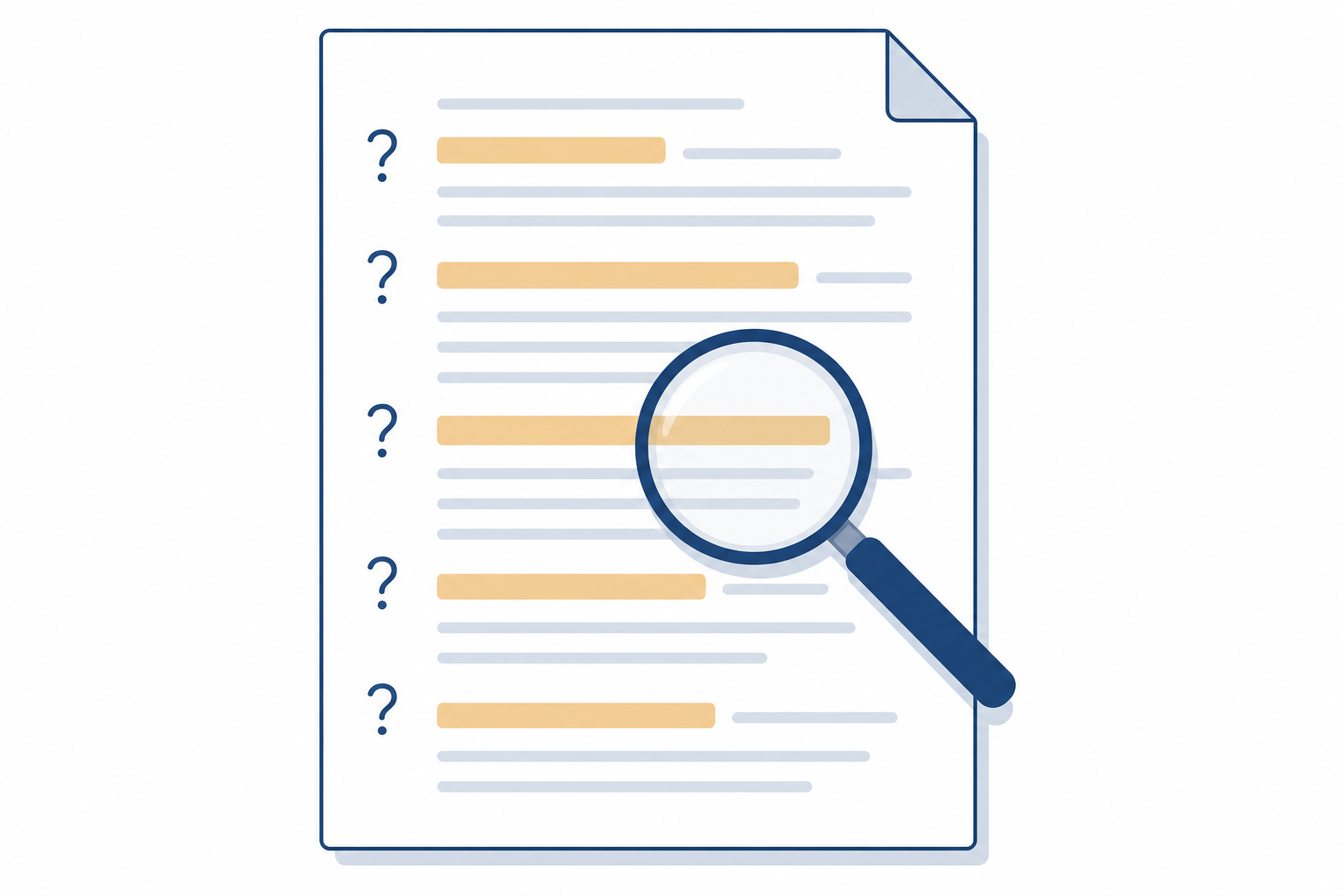
Certain phrases show up in weak nonprofit grant writing because they sound like content while committing to nothing. Search your own draft for them before you submit, then replace each one with the number, date, or source it is standing in for.
Scroll horizontally to see all columns when needed.
| Phrase in your draft | What the reviewer still cannot tell | Replace it with |
|---|---|---|
| "significant need" | How large the need is | The count or rate, and the year it was measured |
| "evidence-based" | Which evidence, and whose | The name of the curriculum or model you use |
| "uniquely positioned" | Why you rather than another applicant | What you run today that no one else in the service area runs |
| "we will evaluate" | What gets measured, and when | The instrument, the testing window, and who enters the data |
| "as needed" | Whether it happens at all | A frequency and the person responsible |
| "community partners" | Who they are | Named organizations and what each one contributes |
| "seek additional funding" | Whether anything is committed | Sources already committed and the date you decide on renewal |
Work the table as a comparison exercise rather than a checklist. Put your own sentence beside the question in the middle column, and if you cannot answer that question from what you wrote, you have found something to fix before a reviewer finds it.
Select to enlarge (opens in a new tab).
How to Practice With Grant Writing Examples
The fastest way to improve is to run your own draft through a weak-to-strong swap, one section at a time.
- Print your draft and highlight every sentence that could appear in any other nonprofit's application. Those are the weak lines.
- For each highlighted sentence, write down the number, date, or source that would make it checkable. If you cannot find one, you have found a program design gap rather than a writing problem.
- Rewrite the sentence with that detail inside it. Delete the adjectives you no longer need.
- Open the funder's review criteria and confirm that each criterion has a paragraph aimed at it.
- Ask someone outside the program to read it and mark anything they cannot picture.
Steps two and five find the most. People close to a program forget how much of it lives in their heads rather than on the page. If you are early in your first application, the first-time grant writing guide covers the process around this work, including how far ahead to start.
FAQ
What does a good grant proposal example look like
A good grant proposal example shows a complete section rather than a fragment, and every claim inside it carries a number, a date, or a named source. Read its budget narrative first. If the narrative explains how each figure was calculated instead of listing totals, the rest of the example is usually worth studying.
Can I copy a sample grant proposal
Copy the structure of a sample grant proposal, not its sentences. A sample was written for a different funder with different scoring criteria, so wording that earned points there can miss the criteria you are scored against. Reuse the section order and the habit of putting a source behind each claim.
Where can I find free nonprofit grant writing examples
Start with the funder you are applying to. Some agencies and foundations post sample applications or previously funded project abstracts on their own program pages, and those are the closest thing to an example scored by the people who will score you. The paired weak and strong examples in this guide cover each core proposal section.
What is grant writing
Grant writing is the practice of preparing a written funding request that a funder evaluates against published criteria. Most of the work is research: you take what your program already does and present it in the structure and level of evidence a specific funder requires.
How long should a nonprofit grant proposal be
The solicitation sets the length, usually as a page count for the narrative or a character limit on each form field. Write to the limit rather than well under it, since unused space is space a competing applicant used to answer another criterion. When no limit is published, ask the program officer before you draft.
Do you need a professional grant writer
No. Funders score the proposal, not the person who typed it, and program staff usually know the operating details a reviewer asks about better than an outside writer does. Paid help earns its cost when the deadline is tight or nobody on staff has written for that funder before. Ask for an edit of your draft rather than a draft from scratch the first time.
How to write a nonprofit grant proposal
Write a nonprofit grant proposal by matching your program to a funder whose priorities already fit, then building each section around evidence you can produce. Give yourself enough time for an internal review round, and check the arithmetic in the budget against every number in the narrative. A budget figure that does not match the narrative forces a reviewer to decide which number to believe.
Next Steps
Pick one section of a draft you already have and rewrite it against the paired weak and strong example for that section. One section is enough to see whether the swap changes anything.
After that, work through the full grant proposal guide section by section, keep your list of weak phrases beside you while you draft, and track deadlines for every funder you are writing to so the submission date never squeezes your revision time.