Grant Proposal Timeline: Example, Template, and Writing Schedule
A grant proposal timeline means two things: the project schedule inside the proposal and the writing schedule before the deadline. This guide covers both, with examples.
In this article (14)
- Quick Answer: What Is a Grant Proposal Timeline?
- The Two Meanings of "Grant Proposal Timeline"
- The Grant Project Timeline Inside Your Proposal: What Funders Score
- Milestone List vs Gantt Chart: Choosing a Format
- Grant Proposal Timeline Example: A 24-Month Project by Quarter
- Research Proposal Timeline Gantt Chart: A Text Version You Can Paste
- How the Project Timeline Must Match the Budget Period and the Evaluation Plan
- The Grant Writing Timeline: 8 Weeks From Deadline Backward
- Grant Application Timeline for Federal Deadlines
- How to Compress When You Find the Opportunity Late
- Grant Proposal Timeline Templates You Can Copy
- Grant Proposal Timeline Mistakes That Cost Review Points
- FAQ
- Next Step
The phrase grant proposal timeline gets used for two different documents. One is the project timeline inside the proposal, which shows when funded activities happen after the award starts. The other is the internal schedule your team follows to get the thing written before the deadline. Both are covered below. If you are earlier than either, start with how to write a grant proposal.
Quick Answer: What Is a Grant Proposal Timeline?
A grant proposal timeline is a schedule showing when work happens. The phrase covers two documents:
- Project timeline. The funded activities, milestones, and deliverables inside the proposal, laid out across the period of performance.
- Writing timeline. The internal schedule your team works backward from the deadline, usually 6 to 8 weeks.
Reviewers score the first one. The second never leaves your office, but it decides whether you submit at all.
Free download: Grant proposal timeline template (project timeline, quarter view and 8-week writing schedule) as Excel .xlsx. No email address required.
The Two Meanings of "Grant Proposal Timeline"
One timeline is a commitment you make to a funder about the next two years. The other is an internal work plan for the next two months. Both end up as a table, which is the only thing they have in common.
The Grant Project Timeline Inside Your Proposal: What Funders Score
A grant project timeline is a proposal section that maps each funded activity to a start month, an end month, an owning role, and a deliverable someone else could verify.
Some funders score it directly. The Department of Education's selection criteria at 34 CFR 75.210(g)(2) let a competition rate the management plan on one or more factors, and the first of those is feasibility "on time and within budget, including clearly defined responsibilities, timelines, and milestones for accomplishing project tasks." Another factor weighs whether key personnel time commitments are "appropriate and adequate" (ecfr.gov, verified October 6, 2026). NIH asks small business applicants for one: section G.400 of the SF424 application guide tells SBIR and STTR applicants to "provide a tentative sequence or timetable for the project" (grants.nih.gov, verified October 6, 2026).
Every row needs five things:
- The activity, named exactly as the budget names it.
- Start and end points in project months, not calendar dates you do not control.
- An owner, named as a single role rather than a committee.
- A deliverable with a number or an artifact attached.
- The data collection point, where the activity produces evaluation evidence.
Milestone List vs Gantt Chart: Choosing a Format
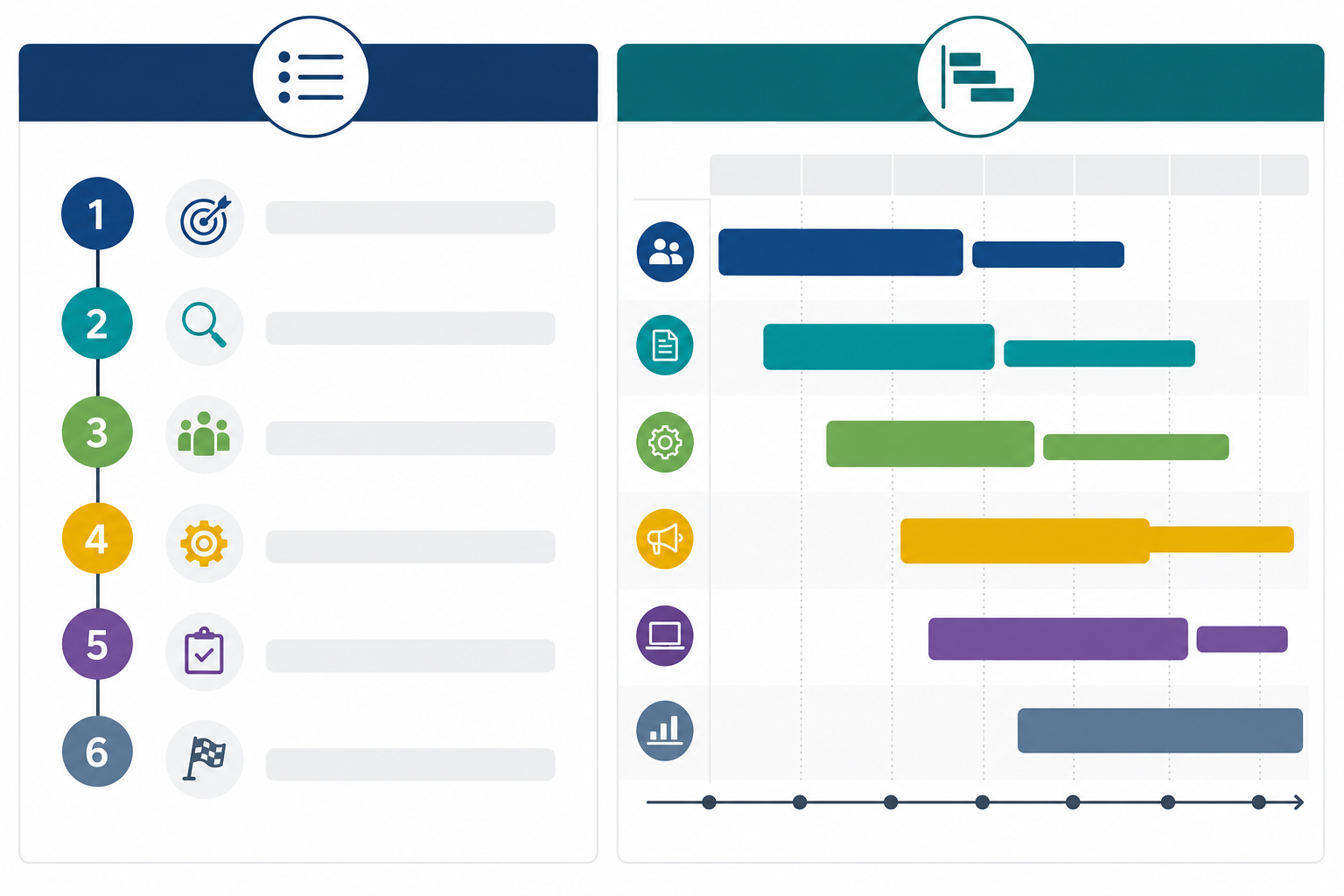
Short projects do fine with a numbered milestone list. Most multi-year projects read better as a quarter table. Save the Gantt chart for cases where workstreams overlap and dependencies change what happens next.
Page limits usually settle the question. The NSF Project Description "may not exceed 15 pages," and conformance "will be strictly enforced" (PAPPG 24-1, effective May 20, 2024). NIH caps the Research Strategy at 12 pages for an R01 and 6 for an R21. Both verified October 6, 2026. A full-page Gantt chart inside a 12-page limit costs you a page of argument.
Grant Proposal Timeline Example: A 24-Month Project by Quarter
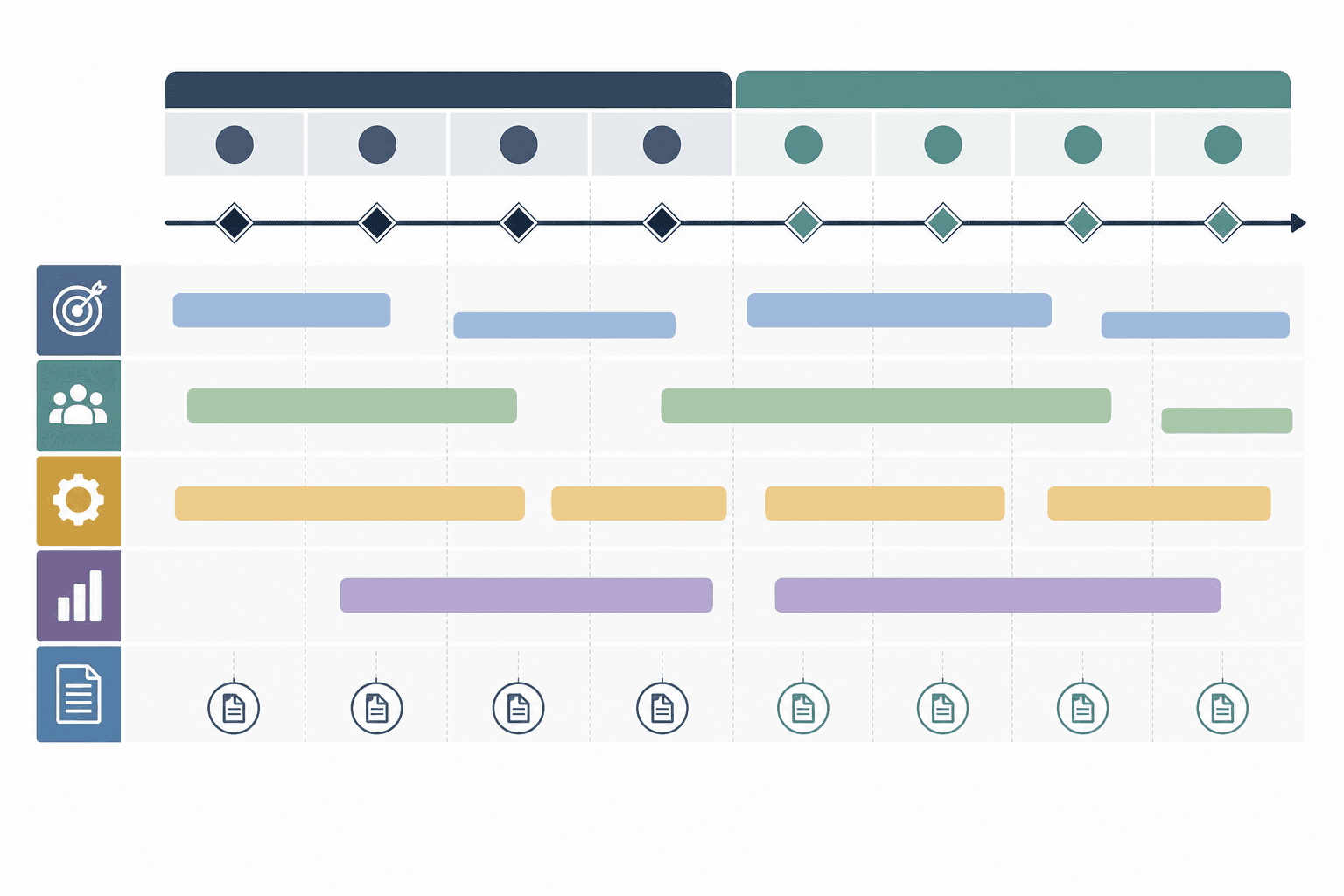
A 24-month grant proposal timeline runs across eight quarters, with one milestone and one verifiable deliverable in each. This example is illustrative, not a real award: an adult literacy and job-readiness project serving three cohorts on a $180,000 request across two 12-month budget periods.
Every milestone carries a number or a document, so a reviewer can tell whether it happened. Reporting sits on the timeline as work. The Q4 row marks the end of budget period 1, which keeps the money year distinct from the project period.
Research Proposal Timeline Gantt Chart: A Text Version You Can Paste
A Gantt chart shows workstreams as bars across time, so you can see overlaps and dependencies without reading every row. A plain table does the same job.
Legend: ■ means the workstream is active that quarter, ◆ means a milestone or deliverable is due.
Use the same row labels here that appear as budget category names, so a reviewer moving between pages never has to translate.
How the Project Timeline Must Match the Budget Period and the Evaluation Plan
A timeline that contradicts the budget is an easy place to lose management-plan points. The contradiction shows up the moment a reviewer compares two pages.
Federal awards separate two spans. Under 2 CFR 200.1, a budget period is "the time interval from the start date of a funded portion of an award to the end date of that funded portion, during which recipients and subrecipients are authorized to incur financial obligations." The period of performance runs between the award's start and end dates and may include one or more budget periods. Award notices must state both, per 2 CFR 200.211(b)(5) and (b)(6).
Spending follows those spans. 2 CFR 200.403(h) allows administrative closeout costs until the final report is due and requires that "all other costs must be incurred during the approved budget period" (ecfr.gov, verified October 6, 2026). A reviewer will catch a month 14 activity staffed by a position funded only through month 12.
Build the timeline after the budget. The grant proposal budget template fixes what you can staff each year. Data collection rows should match the measurement schedule in the evaluation plan, and activity rows should match the activities column of the logic model. All three should use the same nouns for the same things.
2 CFR 200.308(g)(2) allows a one-time extension of the period of performance by up to 12 months, but it "may not be exercised for the sole purpose of using unobligated balances."
The Grant Writing Timeline: 8 Weeks From Deadline Backward
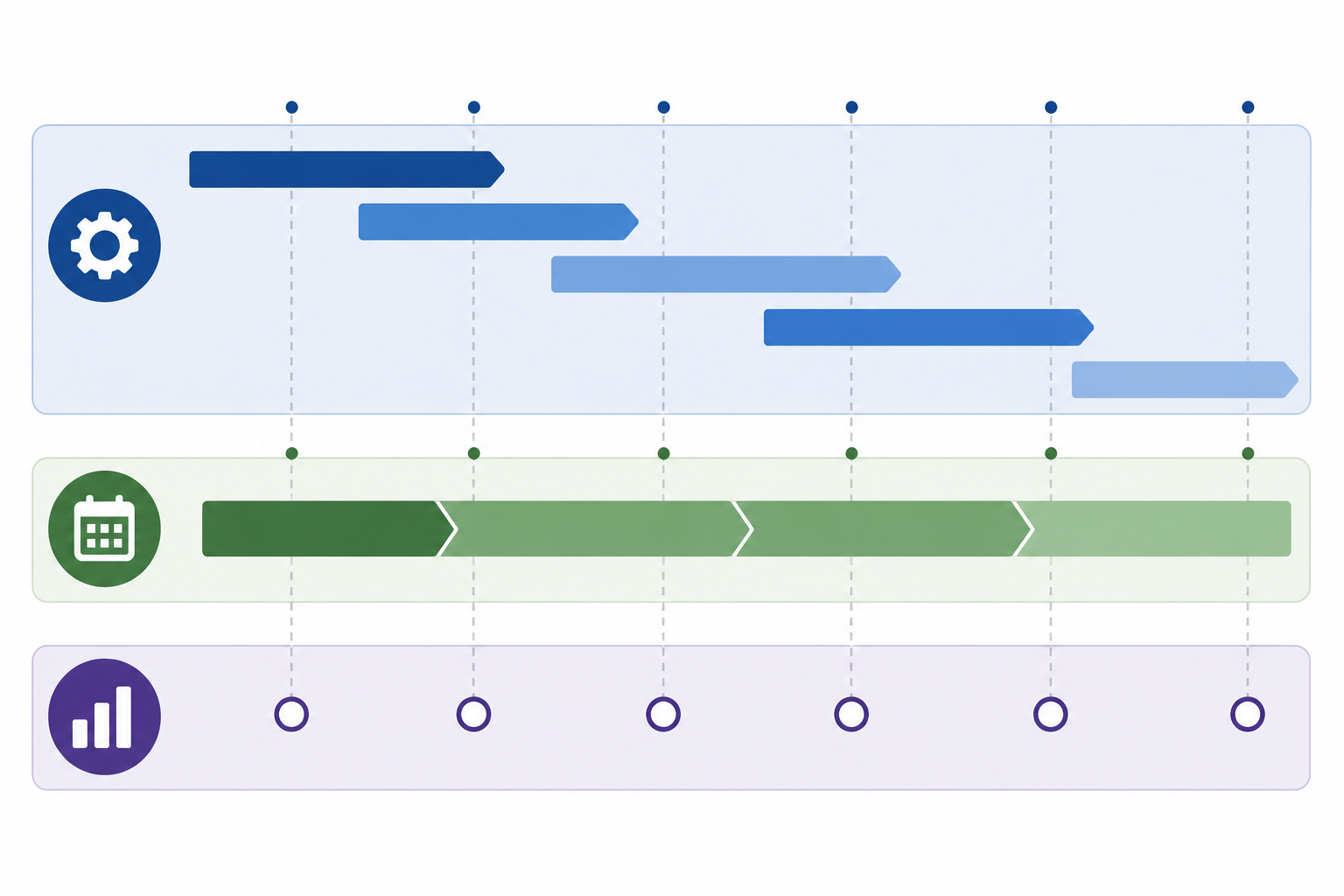
A grant writing timeline is a backward-planned schedule that starts at the submission deadline and assigns every proposal component to a week and an owner. Eight weeks is comfortable for a federal application.

Registration and validation drive the last two weeks. Grants.gov states that "you can't start applying in Grants.gov until your organization is registered in SAM.gov," and tells applicants to "allow up to 10 business days for SAM registration to become active." A submission produces a receipt email, then either a validation confirmation or a rejection with errors; Grants.gov says to contact support if neither arrives within two business days (grants.gov, applicant registration and check application status, verified October 6, 2026). If that rejection lands after the closing time, you have missed the deadline.
The closing hour matters as much as the date. NIH states that applications "are due by 5:00 PM local time of applicant organization on the specified due date" (grants.nih.gov, verified October 6, 2026). Put that hour in your grant calendar beside every internal due date, alongside the sections a grant proposal has to contain.
Grant Application Timeline for Federal Deadlines
Federal cycles run long. Project timelines break in the gap between submitting and actually starting work, usually because the writer assumed a start date that never arrived.
Source: NIH Standard Due Dates, grants.nih.gov, verified October 6, 2026. Cycle I council review falls in August or October, moving the earliest start to September or December respectively. Not every opportunity uses standard due dates. New R01 applications are due February 5, June 5, and October 5.
Six to ten months separate a due date from the earliest start, and federal start dates move. Write "Month 1" in your timeline, never "January 2027."
How to Compress When You Find the Opportunity Late
Two weeks is enough time if what you cut is the sequence rather than the care in any single piece. Build the budget before the narrative, use one reviewer, and keep the last day free for submission problems.
Some things will not compress. SAM.gov registration can take up to 10 business days to become active, so a lapsed one ends a two-week sprint on day one. Signatures run on somebody else's calendar, so the request goes out on day 1 with a placeholder.
Grant Proposal Timeline Templates You Can Copy
Both grant proposal timelines start as a blank table: one row per funded activity, one row per writing component.
Project timeline template. Order rows by start month:
Writing timeline template. Fill the countdown column from your deadline, working upward:
Keep both with the opportunity record. A timeline living in somebody's inbox disappears the week they take leave.
Grant Proposal Timeline Mistakes That Cost Review Points
Most deductions come from contradictions with other sections rather than from the timeline itself.
FAQ
What is a grant proposal timeline?
A grant proposal timeline is a schedule of project activities, milestones, and deliverables covering the period of performance, usually shown as a quarter table or Gantt chart inside the proposal. The same phrase also describes the writing schedule a team follows before the deadline.
How far in advance should you start writing a grant proposal?
Eight weeks is comfortable for a federal application; two weeks is workable if the budget is built first. Registration is the hard floor: Grants.gov advises allowing up to 10 business days for a SAM.gov registration to become active.
What is the difference between the project period and the budget period?
Under 2 CFR 200.1, the period of performance runs between the award start and end dates and may contain more than one budget period. A budget period is the funded portion during which the recipient may incur financial obligations. A 36-month award often has three.
Do you need a Gantt chart in a grant proposal?
Only when the funder asks for one, or when overlapping workstreams make the schedule hard to read as a list. Page limits are enforced and a chart consumes them: NIH allows 12 pages for an R01 Research Strategy, NSF 15 for the Project Description. A quarter-by-quarter table carries the same information in less space.
Can project activities be scheduled after the grant period ends?
No, apart from closeout. 2 CFR 200.403(h) allows administrative closeout costs until the final report is due and requires all other costs to be incurred during the approved budget period. A one-time 12-month extension of the period of performance is available under 2 CFR 200.308(g)(2), but that is a post-award remedy.
Next Step
Open the notice you are working on and find the period of performance. Write the timeline in project months before drafting another paragraph, then check every row against budget staffing and the evaluation schedule. For the sections it has to agree with, work through how to write a grant proposal.