How to Manage Grant Deadlines Across Multiple Awards
A working system for managing grant deadlines across several awards: one intake list, two dates per deliverable, named owners, reminders and a weekly review.

In this article (9)
- Quick Answer: How Do You Manage Grant Deadlines Across Multiple Awards?
- How to Manage Grant Deadlines: Capture Every Date at Intake
- Federal Grant Deadlines: What Kind of Date Is It?
- Loading a Standing Calendar: NIH Grant Deadlines for 2026
- Two Dates and One Owner for Every Deliverable
- Run a Weekly Deadline Review
- When Federal Grant Deadlines Move
- FAQ
- Set Up the List Before the Next Notice Arrives
Knowing how to manage grant deadlines starts with counting them. One application can carry a letter of intent date, a pre-application date and a submission time, and one award adds report dates, an end date for the period of performance and registration renewals. Hold a few awards and a few open applications, and the list runs to dozens of dates, each on its own clock.
On Reddit, in a thread about splitting payroll across several grants, one commenter wrote that "grant periods starting and ending on different dates is the actual hard part" of the poster's question (Reddit thread 1vmiey8, read October 2026). Memory does not scale to that. A system does, and the one that holds up has five parts: intake, two dates per deliverable, a named owner for each date, reminders, and a regular review.
Quick Answer: How Do You Manage Grant Deadlines Across Multiple Awards?
Put every date from every notice and award into one list the day it arrives. Give each deliverable two dates, the funder's deadline and an earlier internal one, and one named owner with a backup. Send reminders from the internal date, and review the whole list weekly, because dates move when awards are extended or renewed.
Tracking these dates? GrantCue reminds you before each deadline and report you add. Track deadlines free
How to Manage Grant Deadlines: Capture Every Date at Intake
Managing grant deadlines starts at intake. The day a notice of funding opportunity or an award document arrives, copy every date in it into one list, with the clock time, the time zone and the system each deliverable runs through.
The notice is required to hand you most of what you need. A notice's "Submission Dates and Times" section must "include due dates and times for all submissions," including "Any preliminary submissions, such as letters of intent, white papers, or pre-applications" (2 CFR part 200, Appendix I, eCFR, current as of September 2026). The same appendix requires the notice to state "The type of reporting required, such as financial or performance," and "The reporting frequency" (2 CFR part 200, Appendix I, eCFR, current as of September 2026). You can load the reporting rhythm of an award before you apply for it.
The award document supplies the anchors. Every federal award must state its "Period of Performance Start and End Date" and its "Budget Period Start and End Date" (2 CFR 200.211(b), eCFR, current as of September 2026). Nearly every later date is counted from one of those four, and the grants lifecycle management guide follows those dates through award setup, reporting and closeout.
Decide before you load. An opportunity you will not pursue only adds noise, so run a go/no-go check on each opportunity first and enter dates only for the ones that pass. Keep one list for every award and application, never one per staff member, because a date that lives in one person's inbox leaves with that person.
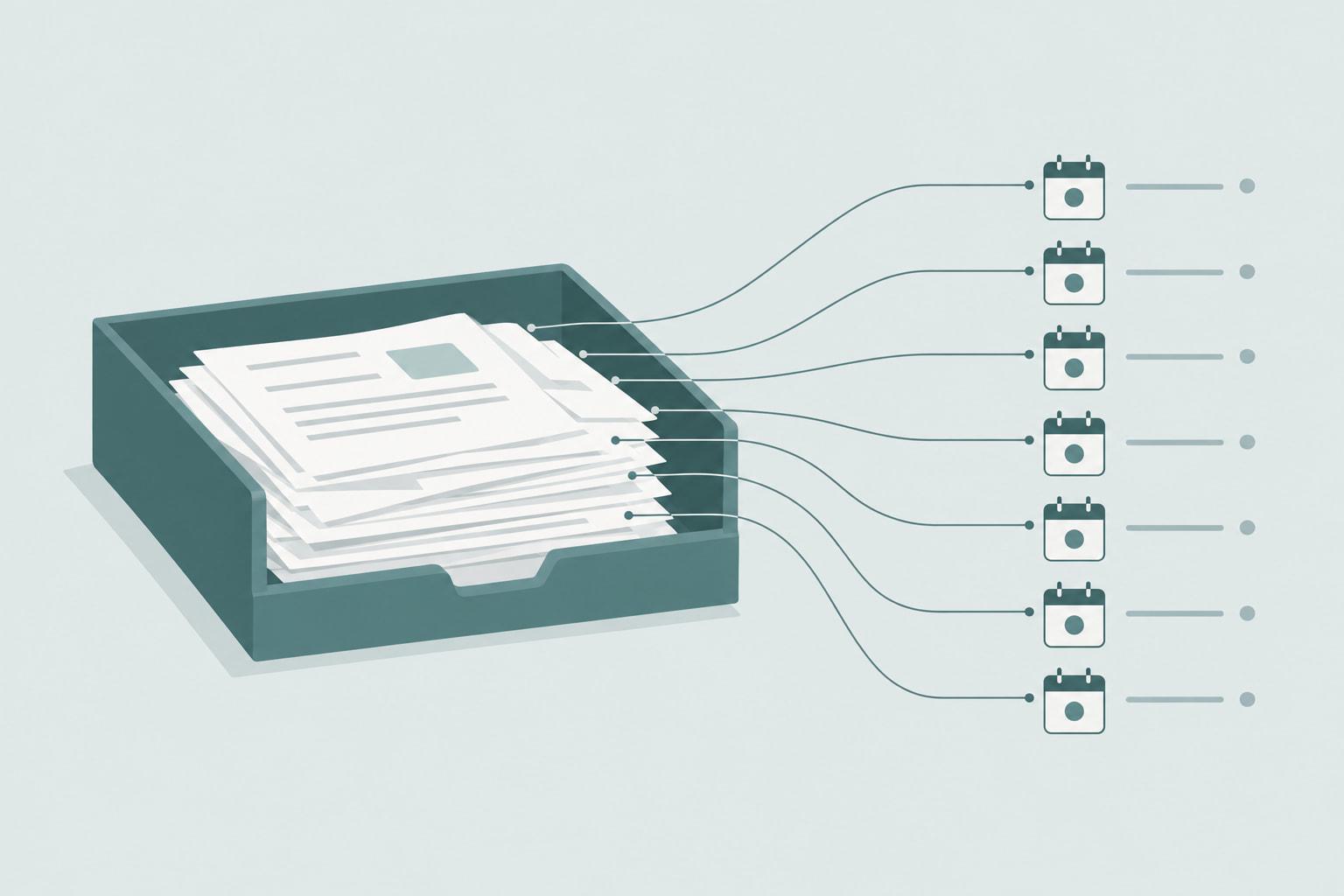
Federal Grant Deadlines: What Kind of Date Is It?
Federal grant deadlines come in several kinds, and your list should record which kind each date is, because a hard deadline, a target date and a rolling window call for different plans. One notice can mix them, and NSF's proposal guide defines the main kinds in terms that work as labels for any funder's dates.
Record the clock time with every date, because there is no single federal deadline time. NIH applications are due "by 5:00 PM local time of applicant organization" (NIH, Standard Due Dates, updated March 24, 2026), while HRSA's standard is 11:59 p.m. Eastern "on the due date/deadline we list in the NOFO's Deadlines section" (HRSA Application Guide, updated September 30, 2025). The notice decides, so copy the time and zone from its text.
Posting windows set your planning horizon. Agencies "should make all funding opportunities available for application for at least 60 calendar days," and "no funding opportunity should be available for less than 30 calendar days unless the Federal agency determines that exigent circumstances justify this" (2 CFR 200.204(b), eCFR, current as of September 2026). Expect about two months between posting and deadline, and sometimes less, which is why intake has to happen the day a notice appears.
Rolling programs still belong on the list. NSF says "Many NSF programs accept proposals at any time," and proposers "should allow up to six months for programmatic review and processing" (NSF PAPPG 24-1, effective May 20, 2024). Give an open-ended program an internal date of your own so it competes for staff time with the dated work.
Loading a Standing Calendar: NIH Grant Deadlines for 2026
NIH's standard due dates show how to load a standing calendar: dates listed by month and day for each activity code, which apply whenever a funding opportunity says standard dates apply (NIH, Standard Due Dates, updated March 24, 2026). Load the pattern for the codes you use as the page listed it, then confirm each date against the notice you answer.
Source: NIH, Standard Due Dates, updated March 24, 2026.
Note where R21 sits. It shares its dates with the R03, R33, R34 and R36 codes, not with R01 (NIH, Standard Due Dates, updated March 24, 2026), so a team that copies an R01 calendar for an R21 plans around the wrong days. The dedicated AIDS dates are gone as well: NIH says "We no longer have dedicated AIDS application due dates (NOT-OD-26-029)" (NIH, Standard Due Dates, updated March 24, 2026). Its final HIV/AIDS-specific receipt date was May 7, 2026, and HIV/AIDS-related applications now use the standard dates for non-HIV/AIDS applications (NIH Extramural Nexus, January 28, 2026).
SBIR and STTR applicants can plan on the programs running. They were reauthorized on April 13, 2026, through September 30, 2031, ending a six-month lapse (Congressional Research Service, Insight IN12705, July 13, 2026). The same law requires each agency's SBIR or STTR program director, beginning in FY2027, to set a limit on the maximum number of Phase I and Phase II proposals a small business can submit in a single fiscal year (Congressional Research Service, Insight IN12705, July 13, 2026). Once an agency sets its limit, every deadline you target draws on a fixed allowance. For running an SBIR award after it arrives, see our guide to SBIR and STTR grant management.
Treat these dates as a published pattern, not a promise about later cycles (NIH, Standard Due Dates, updated March 24, 2026): each funding opportunity states whether they apply, so check the current notice and NIH's current page before a date goes on your list as final.

Two Dates and One Owner for Every Deliverable
Every deliverable gets two dates, the funder's deadline and your own earlier one, and one named owner with a backup who holds the same system access. Without the second date, the funder's deadline becomes the day work finishes; without the owner, the date belongs to nobody.
The earlier date absorbs problems that only surface at submission. NIH warns that errors in its eRA checks "are showstoppers" that must be fixed "before the submission deadline," and it recommends "submitting at least two days before the due date to provide time to track your application, correct any errors, view your application, and address any unforeseen issues by the due date" (NIH, How to Submit, Track, and View Your Application, updated September 9, 2024). Set each internal date at least that far ahead, plus your own review time.
Owners need system access as well as responsibility. On Grants.gov, "Only users with the Standard Authorized Organization Representative (AOR) role who are added as a Workspace Participant may submit an application," while a user with the Expanded AOR role "may submit any workspace, even if they are not added as a Workspace Participant" (Grants.gov, Applicant FAQs, read September 2026). The owner of a submission date is either an AOR or someone who has booked time with one.
Registrations need owners too. SAM.gov registration must be renewed every 365 days (SAM.gov, Entity Registration, read September 2026), and the Federal Service Desk recommends starting the renewal 45 to 60 days before it expires and assigning the Entity Administrator role to "at least one other person in your organization" (Federal Service Desk grant registration guide, read September 2026). Grants.gov deactivates an account after 365 days without a login, following four weekly warning emails (Grants.gov, Applicant FAQs, read September 2026), so an AOR who submits once a year should log in during your review.
Check the expiration date itself. Grants.gov's Sign and Submit button works only while "Your organization's SAM.gov registration is active," and the Manage Workspace page header displays the expiration date (Grants.gov, Quick Start Guide for Applicants, read September 2026). After a July 18, 2025 release, some renewed SAM.gov records showed a 90-day expiration instead of 365 days, and SAM.gov said its fix "corrected most (but not all) of the impacted records" (SAM.gov alert, updated August 2, 2025). First-time registrants can start with our readiness check for new applicants.
Run a Weekly Deadline Review
A weekly deadline review looks at the whole list, catches dates that moved and reassigns anything whose owner is away, while a reminder only tells one person that one date is close. A spreadsheet alone sends no reminders; a date in it surfaces only when someone opens the file. Nor does it keep a lasting record of who changed each date, so close that gap in the review notes by writing down every date that changed, who changed it and why.
Do not lean on funder emails either. For applications, NIH says "email can be unreliable and should not be used as your primary way to track your application" (NIH, Email Notifications from Grants.gov and NIH, read September 2026). Run your own reminders, timed from the internal date, and treat anything the funder sends as a second signal.
In GrantCue, every award's dates can live in one workspace. Tasks, comments, reminders, daily and weekly digests, a calendar feed and Google Calendar sync come with every plan, Free included (grantcue.com pricing, October 2026). A subscribed feed is read-only in your calendar app and refreshes on that app's schedule; for Outlook.com, Microsoft says an update "can sometimes take more than 24 hours" (Microsoft Support, read September 2026), so the weekly review still owns the question of what changed. GrantCue's deadline and calendar features show how the pieces connect.

When Federal Grant Deadlines Move
Dates on the list move for a few common reasons: a due date lands on a weekend or holiday, the period of performance is extended or renewed, or the funder amends the notice. Whoever owns the date updates the list the day it changes.
Weekend and holiday rules belong to each agency. NIH moves a due date that falls on a weekend, Federal holiday or Washington, DC area Federal office closure to the next business day (NIH, Submission Policies, read September 2026). NSF extends a weekend deadline to the following Monday and a holiday deadline to the next business day (NSF PAPPG 24-1, effective May 20, 2024). A single audit reporting package due on a Saturday, Sunday or Federal holiday is due the next business day (2 CFR 200.512(a)(1), eCFR, current as of September 2026).
Extensions move whole strings of dates. No-cost extension requests "should be submitted at least 10 calendar days before the conclusion of the period of performance" (2 CFR 200.308(f)(10), eCFR, current as of September 2026), and "A one-time extension may not be exercised for the sole purpose of using unobligated balances" (2 CFR 200.308(g)(2), eCFR, current as of September 2026). Once an extension is approved, the period of performance ends at the completion of the extension (2 CFR 200.309, eCFR, current as of September 2026), and NIH says "no-cost extensions update the project period end date and submission deadlines" (NIH Grants Policy Statement 8.6, revised March 2026). Every report and closeout date keyed to the old end date moves with it, and the closeout checklist covers the steps that follow the new end date.
Renewals start a fresh set. "The start date of a renewal award begins a new and distinct period of performance" (2 CFR 200.309, eCFR, current as of September 2026), so a renewal gets its own intake, never an edit to the old award's rows.
Notices change too. CDMRP tells applicants to "subscribe on Grants.gov to receive official notifications of new funding opportunity postings and updates" (CDMRP FY26 General Application Instructions, read September 2026). Subscribe to each notice and recheck its dates on every update. The rules can shift as well: OMB published a proposed rewrite of 2 CFR 200 on May 29, 2026, with a proposed effective date of October 1, 2026, and as of September 2026 no final rule had been published, so the current text was still in force (Federal Register document 2026-10817, May 29, 2026). Check the Federal Register before relying on a section number.
FAQ
Do NIH Standard Due Dates Apply to Every Funding Opportunity?
No. NIH's standard dates apply when a funding opportunity says they do, and an opportunity can set dates of its own. When they apply, new R01 applications are due February 5, June 5 and October 5, and NIH applications are due by 5:00 PM local time of the applicant organization (NIH, Standard Due Dates, updated March 24, 2026). Read the notice before a date goes on your list.
Do R21 and R01 Applications Share NIH Due Dates?
No. New R21 applications share their standard dates with the R03, R33, R34 and R36 codes, February 16, June 16 and October 16, while new R01 applications are due February 5, June 5 and October 5 (NIH, Standard Due Dates, updated March 24, 2026). Resubmissions can have dates of their own, as R01 resubmissions do, so check the same NIH page before loading one.
Do SBIR Applications Follow NIH's Standard Due Dates?
At NIH, SBIR, STTR and Commercialization Readiness Pilot applications of every type have three standard dates of their own: September 5, January 5 and April 5 (NIH, Standard Due Dates, updated March 24, 2026). The programs were reauthorized through September 30, 2031 (Congressional Research Service, Insight IN12705, July 13, 2026). Defense SBIR/STTR proposals go through the Defense SBIR/STTR Innovation Portal on their own schedule (Defense SBIR/STTR, Funding Opportunities, read September 2026).
Where Can You Find Federal Grant Deadlines for 2026?
In each notice of funding opportunity, which must list its own due dates and times (2 CFR part 200, Appendix I, eCFR, current as of September 2026). Grants.gov search marks each announcement as Posted, Closed or Archived (Grants.gov Online Help, Search Grants Tab, read September 2026), and standing agency calendars such as NIH's standard due dates fill in the rest. No single federal calendar covers every program.
How Often Should You Review Grant Deadlines?
Weekly for the whole list, monthly for each award's end dates and extension decisions, and at least twice a year for registrations and system access. Make the weekly look-ahead reach past your longest lead time; the Federal Service Desk recommends starting a SAM.gov renewal 45 to 60 days before the registration expires (Federal Service Desk grant registration guide, read September 2026).
What Is the Difference Between a Grant Target Date and a Deadline Date?
At NSF, proposals submitted after a target date "will still be accepted, although they may miss a particular panel or committee meeting," while proposals submitted after a deadline date "will not be accepted or will be returned without review" (NSF PAPPG 24-1, effective May 20, 2024). Record which kind each date is, since a target date still rewards finishing early.
Set Up the List Before the Next Notice Arrives
Start with the awards you already hold. Pull each award document, copy its period of performance and budget period dates, and list every report and renewal date that follows from them. Add each open application with its date, clock time and time zone as the notice states them, then put your internal date beside each one.
Name an owner and a backup for every row, and confirm both have the system access the deliverable needs. Check each SAM.gov expiration date against the Grants.gov workspace header. Then book the weekly review for the same day and time every week, and hold the first one before the next notice lands.