SBIR/STTR Grant Management: How Startups Track Deadlines, Submissions, and Awards
A practical guide to SBIR/STTR grant management for startups: program phases, agency deadlines, registrations, proposal tracking, and post-award obligations.
Last updated: August 2026
SBIR and STTR are the largest source of non-dilutive funding for U.S. technology startups: eleven federal agencies are required to set aside a portion of their R&D budgets for small businesses, amounting to billions of dollars in awards every year. Unlike venture capital, the government takes no equity; unlike a contract, Phase I exists specifically to fund unproven ideas.
The catch is operational. SBIR funding is spread across agencies that each run their own solicitations, deadlines, portals, formats, and review cultures. Most startups don't lose SBIR opportunities on technical merit — they lose them to logistics: registrations that weren't active in time, solicitations discovered three weeks before deadline, and resubmission windows that closed while everyone was building product. This guide covers the program mechanics and then the management system that keeps a small team competitive across cycles.
Quick Answer: What Are SBIR and STTR?
- SBIR (Small Business Innovation Research) funds R&D at for-profit U.S. small businesses (under 500 employees, majority U.S.-owned). The company performs the work; a majority of the effort stays in-house.
- STTR (Small Business Technology Transfer) is the sibling program requiring formal collaboration with a nonprofit research institution — the small business performs at least 40% of the work and the partner institution at least 30%.
- Phase I funds feasibility (typically $50,000–$300,000 for 6–12 months, varying by agency).
- Phase II funds full R&D (typically $750,000–$2 million over about 2 years); usually requires a Phase I award first.
- Phase III is commercialization — funded by non-SBIR money, including sole-source federal contracts that your SBIR data rights make possible.
The authoritative program details, open topics, and past awards live on SBIR.gov.
Which Agencies Fund What — and How Differently They Run
The participating agencies include the Department of Defense, NIH, NSF, DOE, NASA, USDA, and others — and they behave like different funders, not branches of one program:
| Agency style | What it means for you |
|---|---|
| DoD | Topic-driven solicitations on fixed cycles; proposals respond to specific numbered topics; strong contract (not grant) culture |
| NIH | Investigator-initiated: you propose the idea under broad omnibus solicitations; standard due-date cycles; grants culture with resubmission norms |
| NSF | Project pitches screened before full proposals; emphasis on broad commercial potential and intellectual merit |
| DOE / NASA / USDA | Topic-driven with agency-specific portals and formats |
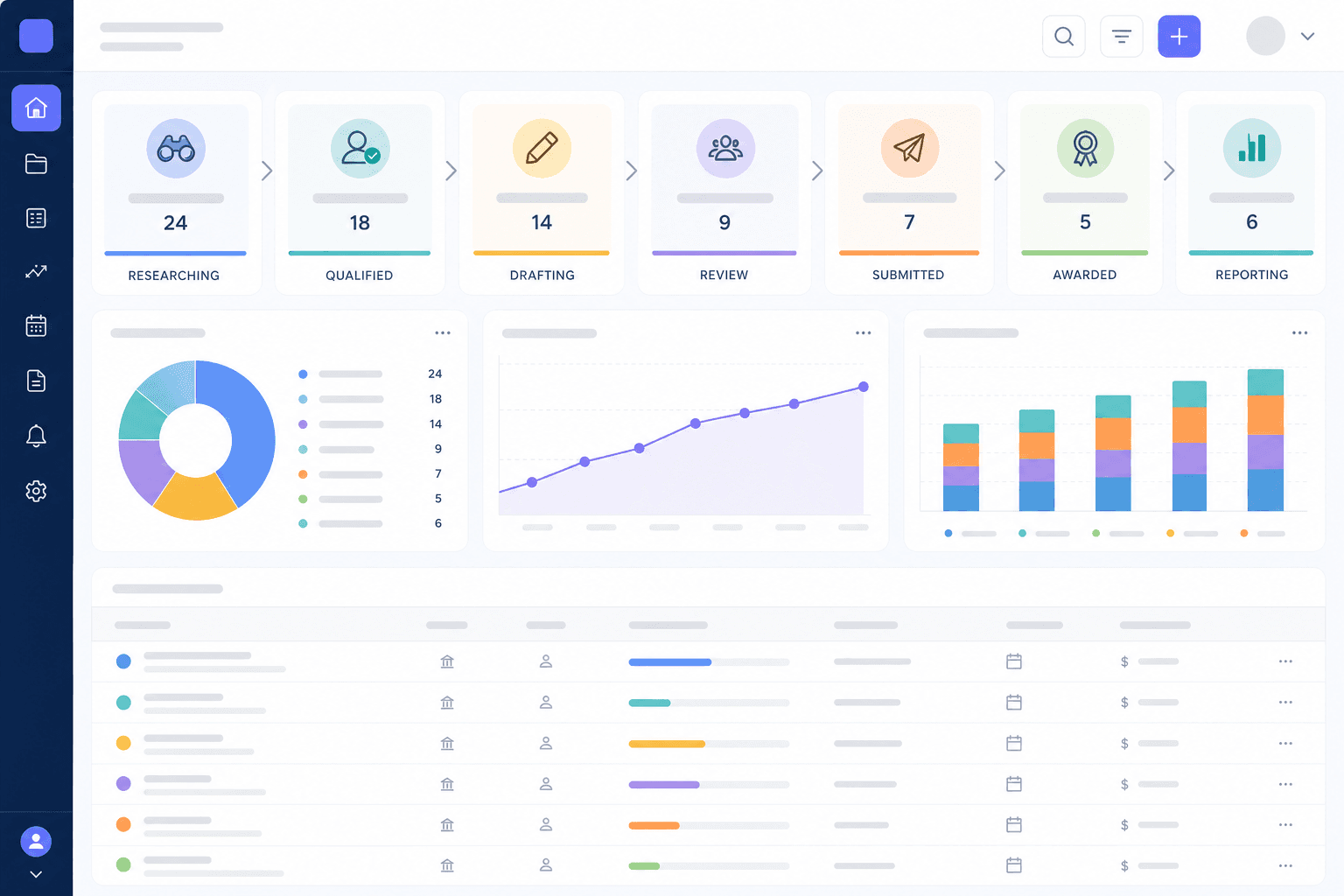
The practical consequence: a startup whose technology fits three agencies is managing three different deadline calendars, three portal registrations, and three proposal formats at once. That multi-agency spread is exactly what makes SBIR a portfolio-management problem rather than a single-application problem — and it's the problem GrantCue's SBIR and startups solution is built around: every relevant solicitation, deadline, and submission tracked in one pipeline the whole team can see.
Solicitation timing bunches around the federal fiscal year end; see SBIR deadlines in the FY-end calendar.
Before You Can Apply: The Registration Stack
Registrations are the classic first-time failure. Several have multi-week lead times, and every submission requires them to be active:
- SAM.gov — the federal entity registration behind every award. Register and renew annually at SAM.gov; initial registration commonly takes several weeks. It is free — ignore paid "registration service" solicitations.
- SBIR.gov company registry — required of SBIR/STTR applicants.
- Agency portals — Grants.gov for many agencies (Grants.gov), DSIP for DoD, eRA Commons for NIH, Research.gov for NSF.
Start the stack the day you decide SBIR is on your roadmap, not the month you find a topic. Calendar the SAM.gov renewal date immediately — an expired SAM registration at deadline is an automatic rejection no reviewer ever sees.
Writing the Proposal: What's Different About SBIR
The proposal argument is the same one behind every grant: problem, plan, measurement, cost. If you've never written one, the section-by-section proposal guide covers that core. SBIR adds three emphases:
- Innovation with evidence. Phase I reviewers fund technical risk, not incremental improvement — but they want preliminary evidence the risk is worth taking. State the technical hypothesis and what feasibility will prove.
- Commercialization is scored. Every agency now weighs the path to market: who buys this, at what scale, against what alternatives. NIH and NSF expect a commercialization narrative even in Phase I; DoD wants the transition path to a program of record.
- The team must be eligible and credible. PI employment requirements (majority employment at the small business for most agencies), work-percentage rules, and — for STTR — the formal research-institution agreement all get checked before merit review.
Budgets follow federal cost principles: direct costs, indirect rates (negotiated or safe-harbor, agency-dependent), and strict rules about who performs the work. The mechanics of a defensible line-item budget are the same as any federal application — the budget template guide covers the show-the-math format, which you then fit to agency forms.
The Management Layer: Running SBIR as a Pipeline
A funded SBIR strategy is a multi-year, multi-agency campaign. Here's what the teams that win repeatedly do differently:
They track solicitations before they open. Agency topics are pre-announced (DoD publishes pre-release topics; NIH standard due dates repeat predictably). Teams that start at topic pre-release get weeks the deadline-discoverers don't.
They run every submission backwards from the deadline. Registrations verified, technical narrative, budget, letters, portal upload — each with an owner and a date. A missed internal milestone three weeks out is recoverable; discovering it at upload is not.
They treat rejection as a cycle, not an ending. SBIR success rates for first submissions are low everywhere; resubmissions with reviewer-comment responses do measurably better, especially at NIH. Log every review, calendar the next cycle, and resubmit.
They watch multiple agencies at once. The same core technology often fits several agencies' topics with reframing. That multiplies opportunities — and deadline-tracking load.
They start Phase II planning during Phase I. Phase II proposals typically come due while Phase I is still running, alongside Phase I's own reporting. The overlap is where solo founders drown.
This is pipeline management, and doing it in spreadsheets is how deadlines get missed — the same failure mode we've documented for teams outgrowing grant spreadsheets in every sector. GrantCue puts federal opportunity discovery, AI fit scoring that reads a solicitation against your company profile, deadline tracking, and per-submission task lists in one place — built for a founder-plus-a-few team, not a contracts department. The broader federal funding landscape beyond SBIR (other grant programs your business may be eligible for) is covered in our federal grants guide.
After the Award: For-Profit Compliance Basics
Winning creates obligations most startups haven't faced before:
- Reporting. Technical progress reports and financial reports on the agency's schedule — quarterly or per-milestone, plus final reports. Every date belongs on the team calendar the week the award letter arrives.
- Cost accounting. You'll need to track project costs against the approved budget, keep time records supporting effort charged, and handle any agency audits. Set the bookkeeping up at award, not at the first report.
- Data rights. SBIR data rights protect your technical data from government disclosure for a protection period — one of the program's most valuable and least-understood assets. Mark deliverables correctly from day one.
- Phase III positioning. Document commercialization progress as you go; agencies increasingly check prior-award commercialization when scoring your next proposal.
Post-award management — budget tracking, report deadlines, document storage, renewal planning — is where a management system pays for itself twice; see the full grants lifecycle guide for the discipline end to end.
FAQ
Are SBIR grants worth it for a venture-backed startup?
Often, yes — SBIR is non-dilutive and signals technical validation, and majority-VC-owned firms are eligible at some agencies under specific provisions. The real cost is founder time: budget 100+ hours for a competitive first proposal. Fit matters more than enthusiasm — if no agency funds your problem area, that time is better spent elsewhere. Checking that fit before writing is exactly what AI fit scoring is for.
Can I apply to multiple agencies with the same technology?
Yes, and strong SBIR companies do — but you must disclose overlapping submissions, and you cannot accept duplicate funding for the same work. Reframe the technical objectives to each agency's mission rather than resubmitting one proposal verbatim.
What's the difference between an SBIR grant and contract?
Grants (NIH, NSF, USDA style) fund your proposed research with flexibility in execution; contracts (DoD style) procure R&D toward the agency's stated requirement with deliverables and milestones. The management burden differs: contracts carry more formal reporting and modification processes. SBIR.gov identifies which instrument each agency uses.
How does GrantCue help with SBIR specifically?
GrantCue continuously ingests federal opportunities, scores them against your company's profile with evidence you can audit, and turns pursued opportunities into tracked submissions with deadlines, owners, and tasks. It's the system-of-record layer for the campaign — see the SBIR and startups page for what's included and what it doesn't do.