Federal Grant Deadlines: How the Fiscal Year Calendar Works
How federal grant deadlines work: the October to September fiscal year, the September 30 obligation date, fixed, standard and rolling cycles, and NIH and SBIR dates as examples.
In this article (10)
- Quick Answer: When Are Federal Grant Deadlines?
- Why September 30 Matters for Grant Deadlines
- Federal Grant Deadlines by Cycle Type: Fixed, Standard and Rolling
- NIH Grant Deadlines 2026: Standard Due Dates
- SBIR Grant Deadlines 2026: Solicitation Cycles
- What Fiscal Year End Changes, and What Is a Myth
- An 8-Week Run-Up Plan for a September 30 Deadline
- How to Avoid Missing a Grant Deadline
- FAQ
- Next Step: Put Every Deadline and Its Clock in One List
Federal grant deadlines follow the federal fiscal year, not the calendar year, and no single date or closing time covers them. The fiscal year runs from October 1 through September 30 (31 U.S.C. 1102), and each notice of funding opportunity sets its own due date, time and time zone. Some programs close once a year, some repeat fixed dates, and some take proposals at any time.
NIH and the SBIR programs show the pattern clearly, and their 2026 dates appear here as examples of how each cycle runs. Confirm the current date in the notice before you plan around any of them.
Quick Answer: When Are Federal Grant Deadlines?
Federal grant deadlines are set program by program in each notice of funding opportunity, never on one national date. The federal fiscal year ends on September 30, when one-year money expires, so agencies face pressure to obligate funds by that date. Other programs repeat fixed cycles, such as NIH's three standard due dates a year, or accept proposals continuously.
Why September 30 Matters for Grant Deadlines
September 30 is the last day of the federal fiscal year, which makes it the last day one-year appropriations can be obligated. Under 31 U.S.C. 1102, "The fiscal year of the Treasury begins on October 1 of each year and ends on September 30 of the following year." Under 31 U.S.C. 1502(a), the balance of an appropriation limited to a definite period "is available only for payment of expenses properly incurred during the period of availability" (U.S. Code, read October 2026).
Not every federal dollar expires that day. The Government Accountability Office's budget glossary defines one-year authority as "available for obligation only during a specific fiscal year," multiple-year authority as "available for a fixed period of time in excess of 1 fiscal year," and no-year authority as available "for an indefinite period of time" (GAO-05-734SP, September 2005). An office running on no-year money has much less reason to rush in September.
An agency holding one-year money either obligates it before the clock runs out or loses it. GAO puts it directly: "As funds approach the end of their period of availability for obligation, a 'use-it or lose-it' mentality can set in, creating an incentive to rush to obligate" (GAO-17-807T, September 20, 2017). The obligation date can also sit well past the application date: the Congressionally Directed Medical Research Programs (CDMRP) state that fiscal year 2026 research funds "must be obligated no later than September 30, 2027" (CDMRP General Application Instructions, FY26 version).
For applicants, a September closing date competes with everything else your signing official and finance office owe at fiscal year end. Put every September closing date on a shared grant calendar for grants management in early August.

Federal Grant Deadlines by Cycle Type: Fixed, Standard and Rolling
Federal grant deadlines come in five cycle types, and the notice of funding opportunity tells you which one applies. Federal rules require each notice's key dates to "include due dates for submitting applications" and for any letters of intent or preapplications (2 CFR 200.204(a)(7)).
Sources: 2 CFR 200.204, eCFR current as of September 2026; HRSA Application Guide, updated September 30, 2025; NIH Standard Due Dates page, updated March 24, 2026; SAM.gov notice on the 2026 SBIR and STTR announcements, April 2026; NSF PAPPG 24-1; CDMRP How to Apply page, updated July 2, 2026.
Rolling does not mean unlimited time. NSF separates target dates, after which proposals "will still be accepted, although they may miss a particular panel or committee meeting," from deadline dates, after which proposals "will not be accepted or will be returned without review by NSF" (NSF PAPPG 24-1). The Office of Naval Research's long range announcement took proposals at any time for about two years, yet it stated that ONR "reserves the right not to review proposals submitted under this BAA after 30 September 2026" (ONR BAA N0001425SB001, amended January 14, 2026). An open window can still end on the fiscal calendar.
A Grants.gov forecast gives early warning before a notice posts, although "it is not guaranteed that a grant forecast will become an FOA" (Grants.gov Online Help, read September 2026). The federal grants guide to Grants.gov covers searching and registering there.
State and local programs are the easiest part of the calendar to miss, because most states do not share the federal year: "Forty-six states and Puerto Rico begin their fiscal years in July and end them in June" (NASBO Fiscal Survey of States, Spring 2026). The August 2026 grant funding snapshot breaks down how much tracked money sat on state portals compared with Grants.gov that month. Those portals run different software state by state, so one Grants.gov search never surfaces their closing dates, and our grant listings carry federal and state programs side by side.
NIH Grant Deadlines 2026: Standard Due Dates
NIH publishes fixed standard due dates by activity code instead of one annual deadline, and the same dates repeat each year. The dates in this table come from the NIH standard due dates page, last updated March 24, 2026 (grants.nih.gov, read October 2026). A notice of funding opportunity can override a standard date, so confirm against the NOFO.
Renewal, resubmission, and revision applications shift a month later for R01 (March 5, July 5, November 5), K series (March 12, July 12, November 12), and R03, R21, R33, R34 (March 16, July 16, November 16). F series fellowships keep April 8, August 8, and December 8 (NIH standard due dates page, updated March 24, 2026).
NIH rolls a due date forward when it lands on a non-business day: "When a postmark/submission date falls on a weekend, Federal holiday, or Washington, DC area Federal office closure (NOT-OD-17-041), the application deadline is automatically extended to the next business day" (NIH submission policies page, read September 2026). In 2026 that rule moved four standard dates, shown here as examples of how it works.
NIH also runs a different clock from some other agencies: applications are due "by 5:00 PM local time of applicant organization on the specified due date" (NIH standard due dates page, updated March 24, 2026), while HRSA sets 11:59 p.m. ET (HRSA Application Guide, updated September 30, 2025).
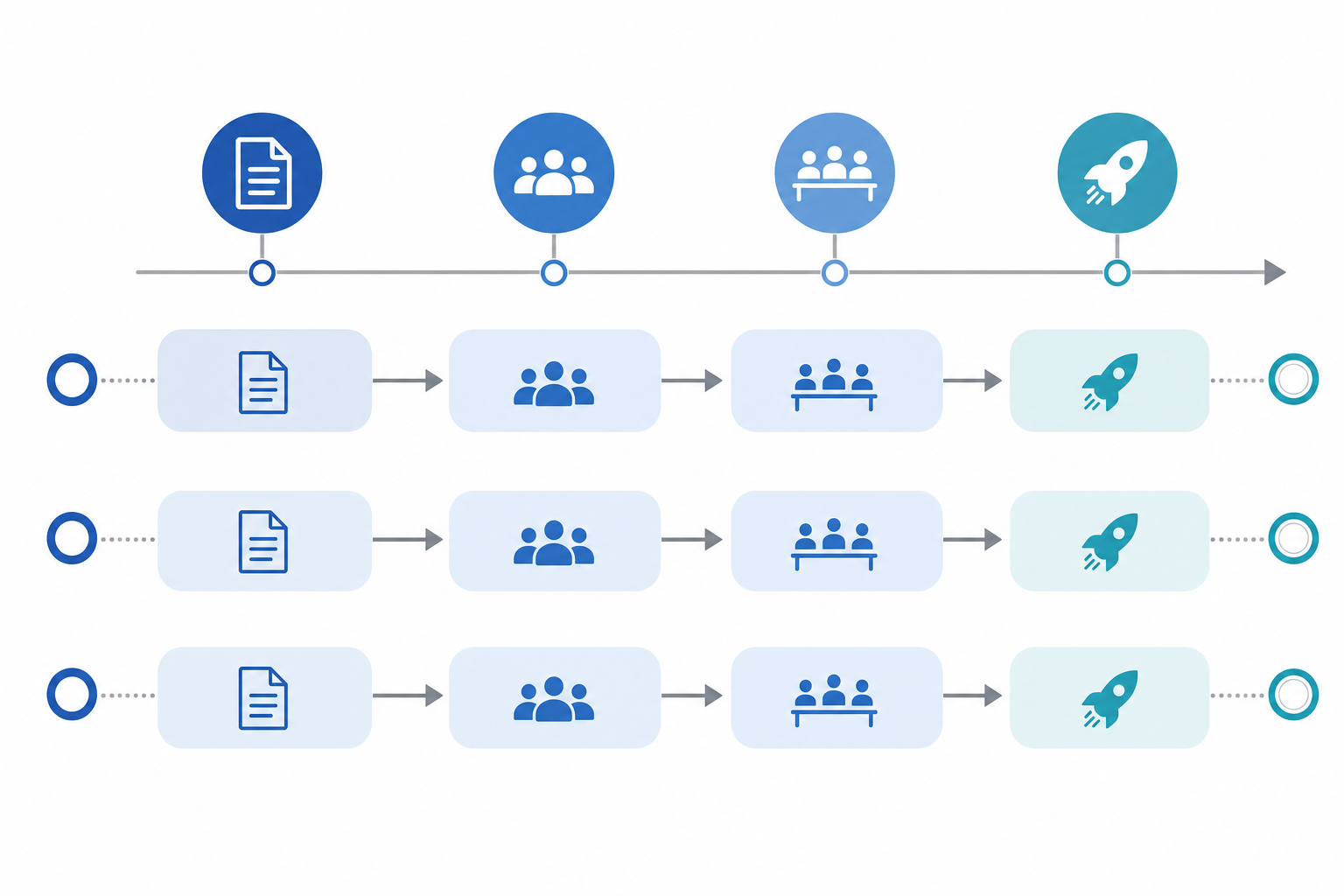
Meeting the due date is only the start of a fixed review cycle.
An application filed at the Cycle III due date of October 5 has an earliest project start date of July, nine months later. NIH also requires applications to be complete at submission: "Placeholder attachments must not be used," and applications that include them "are incomplete and will be withdrawn" (NIH notice NOT-OD-26-025, December 17, 2025).
SBIR Grant Deadlines 2026: Solicitation Cycles
SBIR and STTR deadlines follow each agency's solicitation cycle, not one national date, and NIH, the Department of Defense and NSF each run a different pattern. Congress reauthorized both programs on April 13, 2026, "through September 30, 2031" (Congressional Research Service Insight IN12705, July 13, 2026).
NIH uses standard due dates of September 5, January 5, and April 5 for R41, R42, R43, R44, UT1, UT2, U43, U44, SB1, and UB1 (NIH standard due dates page, updated March 24, 2026). September 5, 2026 was a Saturday and the next Monday was Labor Day, so the working date was Tuesday, September 8, 2026.
The Department of Defense, which Executive Order 14347 allows to be called the Department of War, ran monthly releases in fiscal year 2026. Its notice said components "may elect to release topics under this solicitation once a month," with new topics scheduled to "pre-release on the first Wednesday of each month" (SAM.gov notice on the 2026 SBIR and STTR announcements, April 2026). As an example of the rhythm, the published schedule listed Release 5 with a pre-release on August 5, an open date of August 26 and a close date of September 23, 2026 (Defense Logistics Agency 2026 release schedule, read September 2026). The schedule notes "Dates are subject to change," and component and topic dates can differ, so check each topic in the portal.
Defense releases close at noon Eastern, not at the end of the day: DARPA listed its Release 5 topics as "Closes: Sept. 23, 2026 12:00 PM ET" (DARPA SBIR/STTR topics page, read September 2026). Proposals go through the Defense SBIR/STTR Innovation Portal, not Grants.gov (Defense SBIR/STTR Funding Opportunities page, read September 2026).
NSF requires an invitation before a Phase I proposal is allowed. Solicitation NSF 26-510, posted May 22, 2026, states that proposers "must submit a Project Pitch and receive an official response (via email) from the program staff." Its full proposal deadlines repeat each year on the first Wednesday in November, the first Thursday in March and the first Wednesday in July, each due by 5 p.m. submitting organization's local time (NSF 26-510, posted May 22, 2026).
The invitation step is what breaks small-company schedules, and NIH adds a second trap. Its late application period is two calendar weeks, and NIH states "We will not accept late submission" for fellowship and small business applications, so the September working date is hard (NIH notice NOT-OD-26-064, for due dates on or after May 25, 2026). Beginning in fiscal year 2027, the reauthorization law also requires each agency's SBIR or STTR director to limit how many Phase I and Phase II proposals a small business can submit in a fiscal year (Congressional Research Service Insight IN12705, July 13, 2026). Guidance on running these awards after the win is in the SBIR/STTR grant management guide.
What Fiscal Year End Changes, and What Is a Myth
Fiscal year end changes obligation pressure inside agencies and workload inside applicant organizations. It does not change the rules governing your submission.
Sources: GAO-05-734SP, September 2005; GAO-17-807T, September 20, 2017; NIH notice NOT-OD-26-064, March 31, 2026; NIH standard due dates page, HRSA Application Guide, CDMRP How to Apply page, NSF PAPPG 24-1 and DARPA topics page, read September 2026; NASBO Fiscal Survey of States, Spring 2026.
An 8-Week Run-Up Plan for a September 30 Deadline
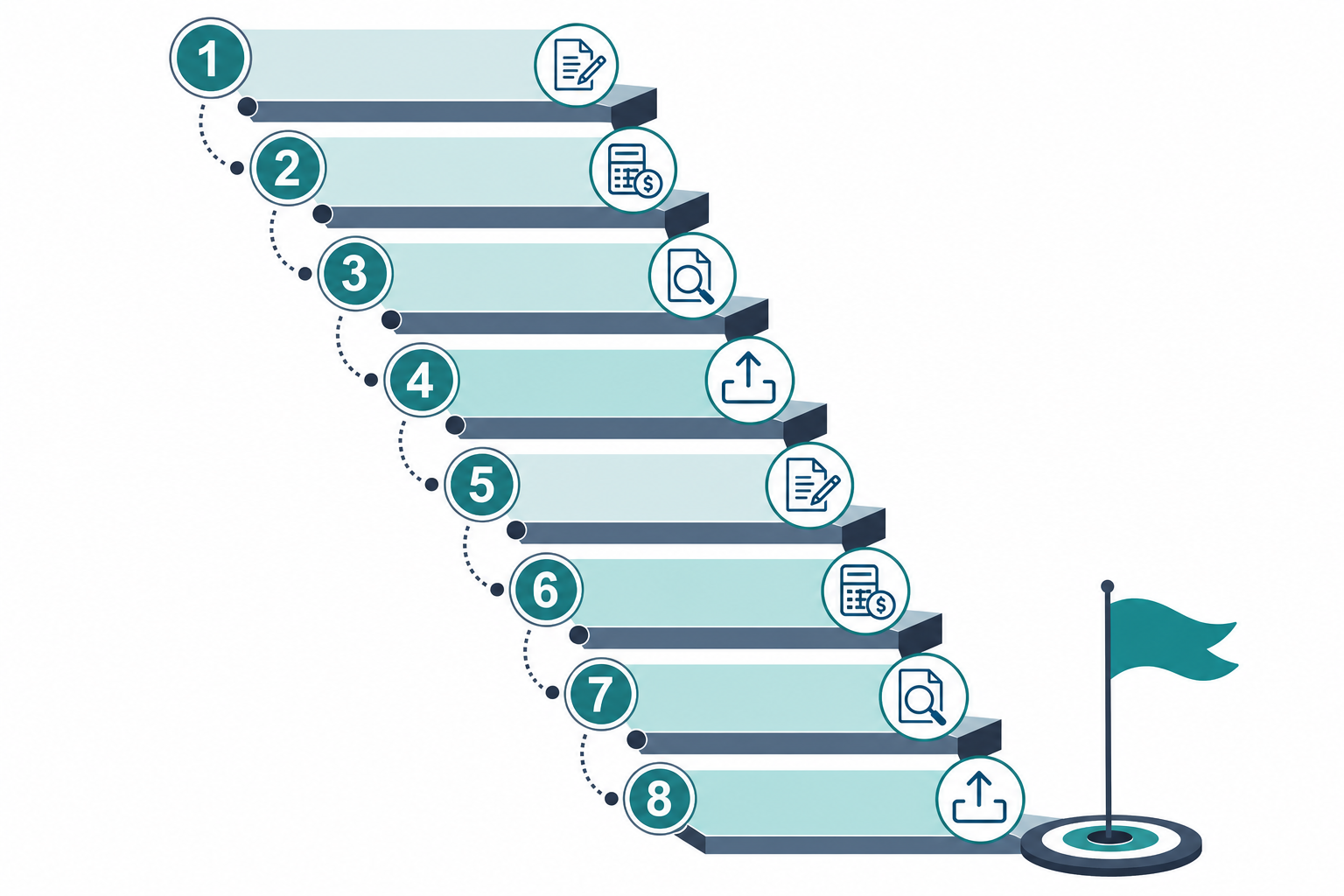
An eight-week run-up works backward from the closing date, not forward from today. The example dates in the table count back from Wednesday, September 30, 2026. Shift every date to match your own closing date.
The submission target is two days early. NIH recommends "submitting at least two days before the due date to provide time to track your application, correct any errors, view your application, and address any unforeseen issues by the due date" (NIH submission page, updated September 9, 2024). Grants.gov tells applicants who have not received their confirmation emails within two business days to contact support (Grants.gov Check Application Status help page, read September 2026). Submit at 11:00 p.m. on the closing date, get errors back, and there is no time to fix them.
How to Avoid Missing a Grant Deadline
A lapsed registration or a failed validation can sink an application whose narrative is finished. Four controls head off most of those failures.
1. Track a Buffer Date
Show everyone an internal due date two to three business days ahead of the funder's date, and keep the real closing date, time, and time zone in the same record. Name one owner per deadline and one backup who can submit.
2. Renew SAM.gov Before It Becomes Urgent
SAM.gov states "You must renew your registration every 365 days to keep it active" (SAM.gov entity registration page, read September 2026). The Federal Service Desk's registration guide says to "Allow at least ten business days after you submit your registration for it to become active in SAM.gov" and recommends beginning a renewal 45 to 60 days before the registration expires (Federal Service Desk quick start guide for grant registrations, read September 2026). Grants.gov makes its Sign and Submit button available only when the organization's SAM.gov registration is active (Grants.gov Quick Start Guide for Applicants, read September 2026).
3. Record the Clock With the Date
Storing "September 30" without its time and time zone is how a Pacific time organization planning to submit at 11:00 p.m. discovers that an 11:59 p.m. Eastern deadline passed at 8:59 p.m. its own time.
4. Treat the Validation Email as the Finish Line
A Grants.gov receipt confirms that the package arrived, not that it passed. Grants.gov statuses run from "Received" and "Validated" to "Agency Tracking Number Assigned," which "is the last status that Grants.gov tracks" (Grants.gov Check Application Status help page, read September 2026). Save the tracking number and the confirmation emails in the grant record the same day you submit.
A shared calendar only works here if it holds registration renewals alongside application deadlines. Portal expirations and indirect rate agreement end dates belong in the same view as the closing dates they can block. After an award, report due dates join the list, and the federal grant compliance checklist covers those; the Uniform Guidance (2 CFR 200) in plain English explains the rules behind them. Keep all of it in a shared system, not a personal calendar: when the owner leaves, the dates stay.
GrantCue is one place to keep that record. It lists federal and state opportunities and tracks them in a kanban pipeline, and every plan, Free included, has an ICS calendar feed for deadlines and simple email reminders, while Essentials at $49 a month adds daily or weekly email digests for deadlines and tasks (grantcue.com/pricing, October 2026). Its grant discovery across federal and state portals brings Grants.gov and state portal listings into one search.
FAQ
When Does the Federal Fiscal Year End?
The federal fiscal year ends on September 30. Under 31 U.S.C. 1102, it begins October 1 and ends September 30 of the following year. Fiscal year 2026 ended on Wednesday, September 30, 2026, and fiscal year 2027 began on Thursday, October 1, 2026. Most states use a different year: forty-six begin their fiscal years in July (NASBO Fiscal Survey of States, Spring 2026).
What Are the NIH Grant Deadlines in 2026?
NIH uses standard due dates by activity code, and the same dates repeat each year. New R01 applications are due February 5, June 5, and October 5. R03, R21, R33, and R34 are due February 16, June 16, and October 16. SBIR and STTR applications are due September 5, January 5, and April 5, all by 5:00 PM local time of the applicant organization (NIH standard due dates page, updated March 24, 2026).
Do Federal Grant Deadlines Move If They Fall on a Weekend?
NIH and NSF deadlines do. NIH extends a due date that falls on a weekend, a federal holiday, or a Washington, DC area federal office closure to the next business day (NIH submission policies page, read September 2026). NSF extends a weekend deadline to the following Monday and a federal holiday deadline to the following business day (NSF PAPPG 24-1). Other agencies set their own rules, so check the notice of funding opportunity.
Does Unspent Federal Grant Money Disappear on September 30?
Only money from one-year appropriations. GAO's budget glossary defines one-year authority as available for obligation only during a specific fiscal year, multiple-year authority as available for a fixed period longer than one fiscal year, and no-year authority as available for an indefinite period (GAO-05-734SP, September 2005). Which kind funds a program decides whether September 30 is its hard stop.
What Time Are Federal Grant Applications Due?
It depends on the agency. NIH sets 5:00 PM local time of the applicant organization, and NSF sets 5 p.m. submitting organization's local time. HRSA's standard is 11:59 p.m. ET, and Department of Defense SBIR and STTR releases close at 12:00 PM ET (agency pages, read September 2026). The closing time and time zone appear in the notice of funding opportunity.
Next Step: Put Every Deadline and Its Clock in One List
Pull every deadline you carry for the next 12 months into one list, add the submission time and time zone to each, and put your SAM.gov expiration date beside them. Then set an internal date two business days ahead of each one. Do it in early summer, before any September 30 closing arrives, so a crowded week shows on the calendar while there is still time to move work.