Sample Grant Proposal for Veterans Nonprofit Organizations: A Full Example
A sample grant proposal for veterans nonprofit teams, with example budget lines, outcome measures, the VA duplication question, and the objections reviewers raise.
In this article (20)
- Quick Answer: What Goes in a Grant Proposal for a Veterans Nonprofit?
- Why a Sample Grant Proposal for Veterans Nonprofit Applicants Reads Differently
- Section by Section: A Veterans Grant Proposal Example
- Defining Who You Serve: Veteran Status, Discharge, and Family
- Statement of Need: Proving the Gap the VA Does Not Fill
- Program Description: Peer Support, Navigation, and the Warm Handoff
- Veterans Program Budget: Example Line Items
- Outcome Measures Veterans Funders Recognize
- Five Objections Veterans Proposals Get, and How to Answer Them
- Where a Sample Grant Proposal for a Non Profit Organization Falls Short
- Where Veterans Grants Come From
- Before You Submit: A Veterans Proposal Checklist
- FAQ
- How do you write a grant proposal for a veterans nonprofit?
- What grants are available for veterans nonprofits?
- How long should a veterans grant proposal be?
- What outcomes should a veterans program promise a funder?
- Do veterans nonprofits need a partnership with the VA to get funded?
- How much should a veterans nonprofit ask for in its first grant?
- Next Step
A sample grant proposal for veterans nonprofit organizations has to answer a question most sectors never face: if this veteran is eligible for VA benefits, why is a private funder paying for it? Reviewers score down proposals that dodge that question for duplication, however strong the program is. This guide walks a veterans services proposal section by section, shows an example budget and outcome set, and answers the objections reviewers raise.
Quick Answer: What Goes in a Grant Proposal for a Veterans Nonprofit?
A veterans nonprofit grant proposal contains a cover letter, executive summary, organization background, statement of need, program description, goals and objectives, evaluation plan, budget with narrative, sustainability plan, and attachments. The section that decides the outcome is the one explaining how the program reaches veterans the VA does not serve, without duplicating VA benefits.
Free download: Complete sample proposal for a veterans nonprofit as Word .docx. No email address required.
Why a Sample Grant Proposal for Veterans Nonprofit Applicants Reads Differently
A veterans proposal has to establish who counts as a veteran in your program, what the VA already covers for that person, and where your service starts. Leave any of that implicit and the reviewer fills the gap with an unfavorable guess.
The funding pool is smaller than most sectors too. Measured on 2026-09-10 across GrantCue's copy of the IRS Form 990-PF grant records, veteran-focused grants numbered 6,284 and totaled $207 million. That corpus covers private foundations filing Form 990-PF, so it undercounts total veteran giving; community foundations, corporate programs, and donor-advised funds sit outside it. Education and health still run many times larger. A veterans nonprofit that applies only to funders with an explicit veterans program is competing for a small slice of private foundation giving.
So apply as the program type. A veterans employment program is a workforce proposal. Transitional housing for veterans is a housing proposal. The population does not change. The funder pool does. If the format itself is new to you, start with how to write a grant proposal and come back for the veteran-specific parts.

Select to enlarge (opens in a new tab).
Section by Section: A Veterans Grant Proposal Example
A veterans grant proposal runs ten sections: cover letter, executive summary, organization background, statement of need, program description, goals and objectives, evaluation plan, budget with narrative, sustainability, and attachments. Each one gets read for something different. The worked example here is a composite: a county-level veterans services organization requesting a peer navigation and employment program.
Scroll horizontally to see all columns when needed.
| Section | What a veterans funder reads it for | Typical length |
|---|---|---|
| Cover letter | Amount requested, program name, why this funder | 1 page |
| Executive summary | The ask, the population, the outcome, in that order | 250 to 400 words |
| Organization background | Whether you have served veterans before, and for how long | 300 to 500 words |
| Statement of need | Local evidence, and the gap the VA does not fill | 500 to 900 words |
| Program description | Staffing model, referral pathway, service dosage | 700 to 1,200 words |
| Goals and objectives | Numbers you will hit, by when | 200 to 400 words |
| Evaluation plan | Instruments, collection points, who reports | 400 to 700 words |
| Budget and narrative | Whether the staffing matches the caseload claimed | 1 to 2 pages plus table |
| Sustainability | What happens to the veterans served when the grant ends | 200 to 400 words |
| Attachments | IRS determination letter, board list, audit, MOUs, letters of support | Varies |
Two attachments carry unusual weight here: a memorandum of understanding with the VA medical center, vet center, or veterans service organization you refer to, and a letter of support from your county veterans service officer, which together settle the coordination question before the reviewer has to ask.
Defining Who You Serve: Veteran Status, Discharge, and Family
Write your eligibility definition into the proposal in plain language, because "veteran" means different things to the VA, to a funder, and to your intake staff. VA eligibility turns on character of discharge (38 CFR 3.12) and, for most service after 1980, a minimum active-duty service requirement of 24 months or the full period called to active duty (38 CFR 3.12a). Your program definition may be broader.
Put your eligibility rules in writing:
- Name who qualifies: active duty veterans, National Guard and Reserve members, and in many programs spouses, caregivers, and survivors.
- Say whether you serve veterans with other than honorable discharges, since community programs are often the only option open to veterans the VA turns away.
- Explain how you verify status without turning verification into a barrier. A DD-214 on file is the clean answer, with a documented alternative path for veterans who cannot produce one at intake.
That last point earns credit, because demanding a DD-214 on day one screens out the veterans in the worst shape.
Statement of Need: Proving the Gap the VA Does Not Fill
The strongest veterans statement of need names a specific gap and shows it with local evidence. The gap is usually distance, eligibility, timing, or trust.
Measure the distance: if the nearest VA medical center is 70 miles from your service area, cite the mileage. Eligibility you can document, whether the barrier is an other than honorable discharge, a pending benefits determination, or Guard service without a qualifying activation. Timing is the wait between referral and first appointment. For trust, use your own intake data, for example the share of your clients who had never contacted the VA before a peer contacted them.
Build the section from public data for the service area, your own program data, and a short client story labeled as an example. Keep the story to a paragraph. For worked language, see these statement of need examples and adapt the framing to your gap.
Avoid describing veterans as broken. Deficit language reads as an outsider writing about a population rather than with it, and veterans funders notice.
Program Description: Peer Support, Navigation, and the Warm Handoff
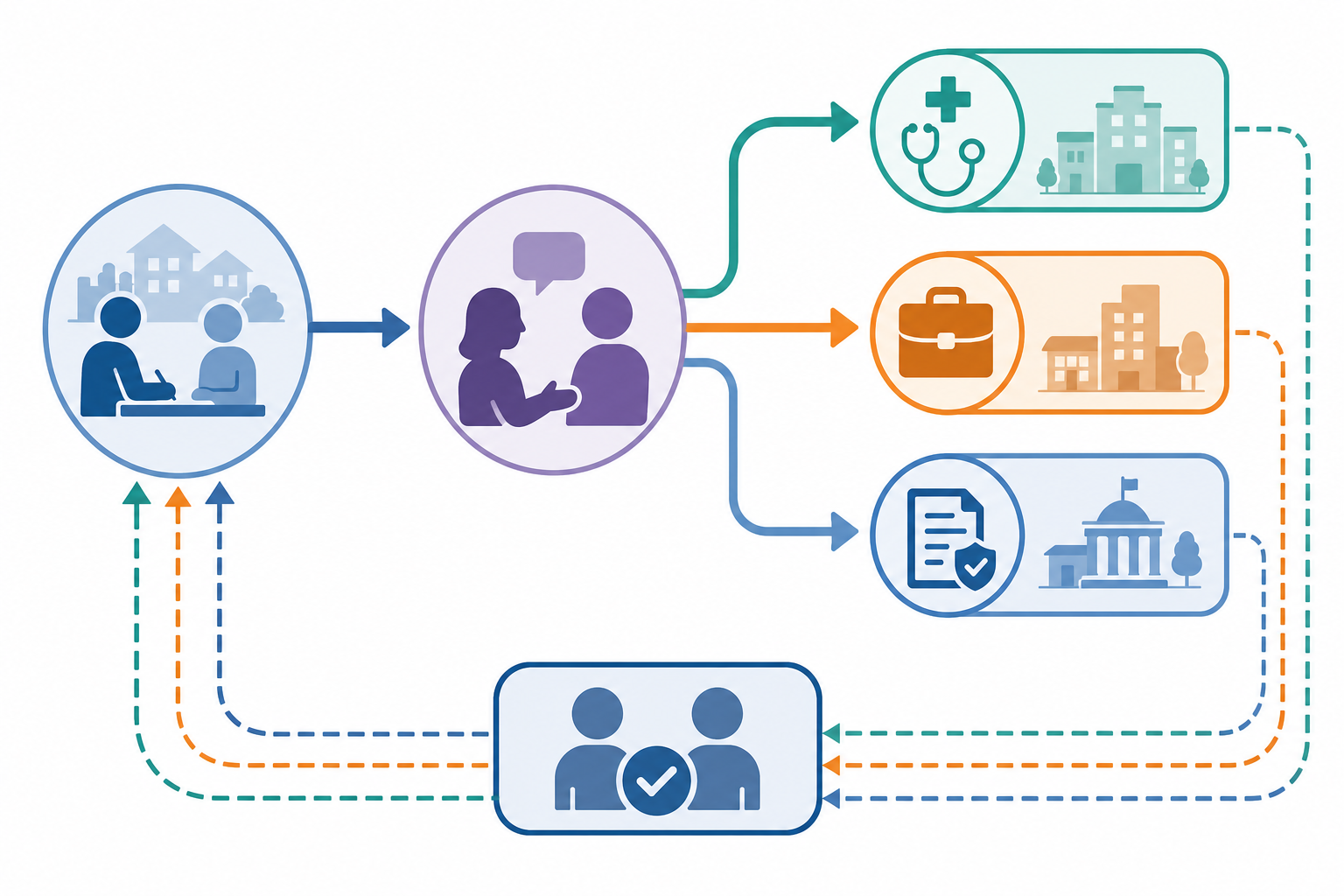
Describe the service as a sequence with a named staff role attached to each step. Veterans funders want to see who does what, how often, and what happens at the handoff.
The example program runs like this: outreach at a county veterans service office and two housing sites, intake within 72 hours, a peer support specialist assigned at intake, a needs screen covering housing, employment, benefits, and behavioral health, then a service plan reviewed every 30 days for up to nine months.
Vague descriptions fail on the same points:
- Say whether peer specialists hold a state or national certification, how many supervision hours they receive, and who provides clinical oversight.
- Define the warm handoff in the proposal itself. A warm handoff means your staff accompanies the veteran to the first appointment, or reaches the receiving provider while the veteran is present.
- State your after-hours coverage, your suicide risk screening practice, and your escalation path including the Veterans Crisis Line, then attach the written protocol.
Everything else in the document follows the ordinary rules for writing a grant proposal. The veteran-specific work concentrates in staffing, handoffs, and crisis response.
Select to enlarge (opens in a new tab).
Veterans Program Budget: Example Line Items
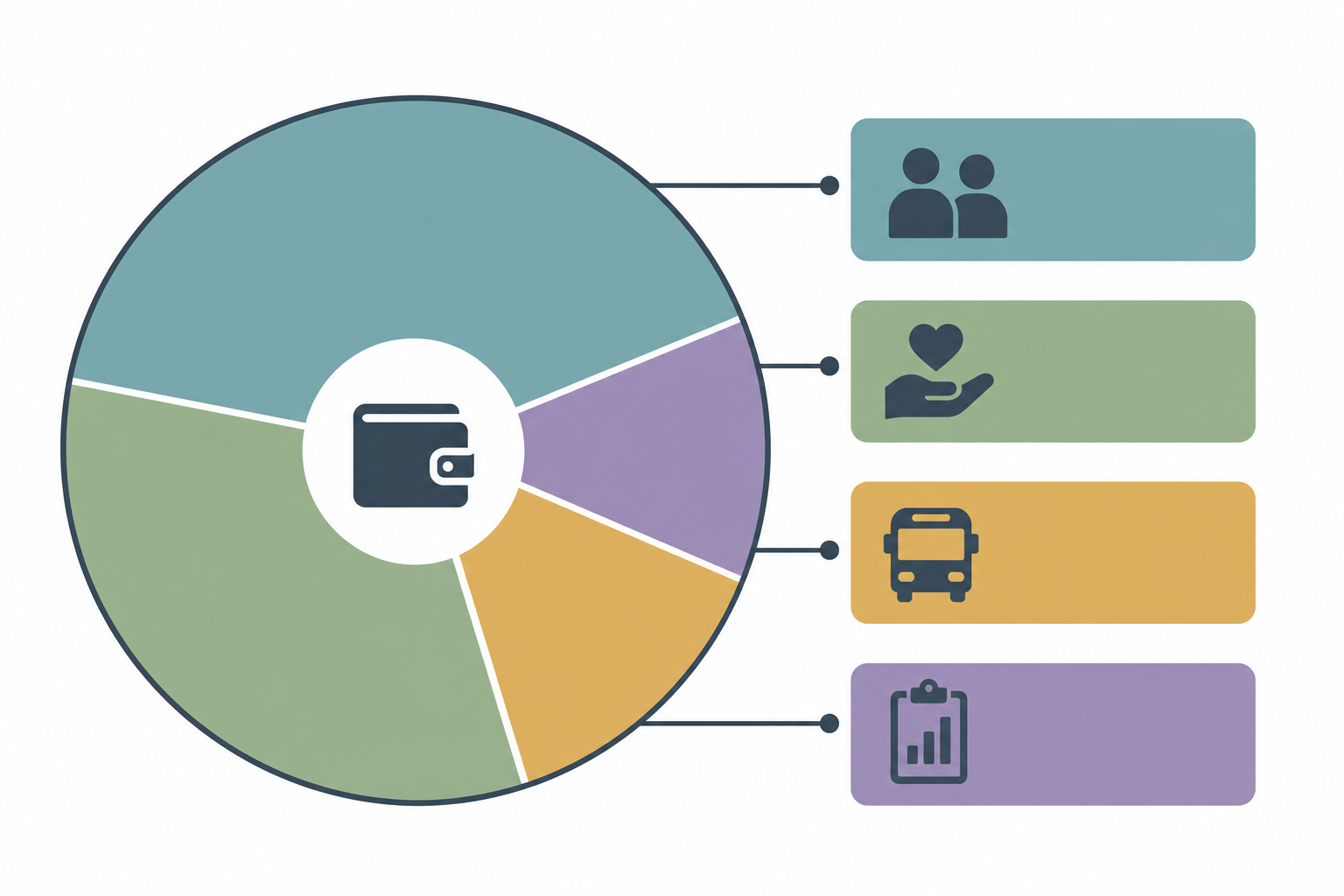
A veterans program budget is mostly staffing, and reviewers check whether the staffing supports the caseload you promised. The figures below are illustrative, built for a 12-month peer navigation and employment program serving roughly 60 veterans.
Scroll horizontally to see all columns when needed.
| Line item | Amount |
|---|---|
| Peer support specialist, 1.0 FTE | $44,000 |
| Fringe benefits at 22 percent | $9,680 |
| Employment navigator, 0.25 FTE including fringe | $14,000 |
| Peer certification, training, and clinical supervision | $4,320 |
| Flexible assistance fund: rent arrears, work gear, licensing fees | $3,000 |
| Transportation to VA and employer appointments | $1,500 |
| Screening tools and case management data license | $500 |
| External evaluation | $3,000 |
| Total direct costs | $80,000 |
| Indirect at the rate this funder allows, 10 percent in this example | $8,000 |
| Total request | $88,000 |
Some of these lines draw questions. The flexible assistance fund needs a written spending policy and a per-veteran cap, or reviewers read it as a slush line. Give transportation its own line, because distance to VA facilities is often the barrier the program exists to solve. Certification and supervision costs prove the peer model is supervised.
Confirm the indirect rate before you set it, since caps vary by funder and private foundations often stop well below any federal figure. On federal awards, a recipient without a negotiated rate may elect a de minimis rate of up to 15 percent of modified total direct costs (2 CFR 200.414(f)), a rate OMB raised from 10 percent for awards issued on or after October 1, 2024. Modified total direct costs exclude equipment, capital expenditures, rental costs, participant support costs, and the portion of each subaward above $50,000, so a flexible assistance fund paying rent arrears and work gear for veterans may sit outside the base. For the narrative that explains each line, work from a grant proposal budget template.
Select to enlarge (opens in a new tab).
Outcome Measures Veterans Funders Recognize
Pick measures a veterans funder already knows how to read, and state the collection method next to each one. Reviewers score "improved well-being" as unmeasurable.
Scroll horizontally to see all columns when needed.
| Measure | How you collect it | Reported |
|---|---|---|
| Veterans enrolled with verified status | Intake file review | Quarterly |
| Housing retention at 6 and 12 months | Case management records and follow-up contact | Semiannual |
| Employment placement and wage at placement | Employer confirmation or payroll verification | Quarterly |
| Employment retention at 180 days | Follow-up contact | Semiannual |
| Benefits claims filed and awarded | Case notes and award letters | Quarterly |
| Change in screening score at 90 days | Standardized screen at intake and 90 days | Semiannual |
| Completed warm handoffs to VA or community care | Referral tracking log | Quarterly |
Two things go wrong here more than elsewhere. The PHQ-9 and the PTSD Checklist for DSM-5 are free self-report screens that patients commonly complete themselves, and the National Center for PTSD publishes the PCL-5 for open use. Scoring, interpretation, and the risk response a score can trigger still need clinical competence, and item 9 of the PHQ-9 asks about thoughts of self-harm, so promise the instrument only if your staffing and supervision can act on the answer.
The second is benefits work. Preparing, presenting, or prosecuting a VA claim requires accreditation under 38 U.S.C. 5901, with the accreditation rules at 38 CFR 14.629. Unless your staff are accredited, describe your role as connecting veterans to a county veterans service officer or an accredited representative. A full evaluation plan template turns these measures into the narrative section funders expect.
Five Objections Veterans Proposals Get, and How to Answer Them
Veterans proposals get declined on five recurring objections: VA duplication, overlap with an existing local program, unsupervised peer staff, caseload that does not match the budget, and no plan for what happens after the grant. Each has an answer a reviewer will accept.
- "Why isn't the VA paying for this?" Name the specific eligibility, geographic, or timing gap, and show the share of your clients who fall into it. Argue that these particular veterans are outside the VA's reach, not that the VA does the work badly.
- "Are you duplicating an existing program?" List the veteran-serving organizations in your service area and state your referral relationship with each. A short table of partners and what you send to them answers this faster than a paragraph.
- "Is your peer staff supervised?" Give the supervision hours, the supervisor's role, and the certification pathway. Attach the position description.
- "What is your capacity to serve this many veterans?" Show caseload math. A 1.0 FTE peer specialist carrying 60 veterans over 12 months at the contact frequency you promised should reconcile with the budget on the page.
- "What happens after the grant?" Answer with a funding mix. Name the county allocation, the earned revenue, the recurring donors, or the second funder you are approaching, and say how much of the program each would carry.
Answer these inside the narrative, before the reviewer forms the question.
Where a Sample Grant Proposal for a Non Profit Organization Falls Short
A generic sample grant proposal for a non profit organization gives you the skeleton: need, program, outcomes, budget, sustainability. What it leaves out is everything a veterans review turns on.
A generic template says nothing about verifying military service or discharge status, gives you no partner structure with a VA medical center or vet center, and never mentions peer supervision or a crisis protocol. It also blurs the line between connecting a veteran to benefits and representing them. Starting there costs you the sections a veterans funder reads first.
Where Veterans Grants Come From
Veterans funding runs through four channels: federal agencies, state departments of veterans affairs, county veterans service offices, and private philanthropy. The federal programs come from the Department of Veterans Affairs and the Department of Labor Veterans' Employment and Training Service, including Supportive Services for Veteran Families, the Grant and Per Diem transitional housing program, and the Department of Labor's Homeless Veterans' Reintegration Program. All three were open as of September 2026. Confirm the current notice of funding opportunity on Grants.gov before planning a submission calendar.
State veterans trust funds and county allocations administered through veterans service offices make up the middle two channels. On the philanthropy side, foundation tax filings show which private funders have actually written veteran-related checks, which is more reliable than a stated funding interest. GrantCue carries 990-PF foundation data alongside federal and state portal listings, so a veterans nonprofit can see the workforce and housing opportunities it qualifies for next to the explicitly veteran-labeled ones.
The four channels run on different calendars, so deadline tracking gets messy fast. Keep them in one view.
Before You Submit: A Veterans Proposal Checklist
Run a veterans proposal through a short check before it goes out, because the recurring failures are structural: eligibility, the VA gap, coordination, supervision, and crisis response.
Scroll horizontally to see all columns when needed.
| Check | What good looks like |
|---|---|
| Eligibility definition | Discharge status, family members, and the verification path written into the narrative |
| VA gap argument | A named gap, backed by local data or your own intake records |
| Coordination evidence | An MOU or letter of support from a VA facility, vet center, or county veterans service officer |
| Peer supervision | Hours, supervisor role, certification pathway, and the position description attached |
| Crisis protocol | After-hours coverage, screening practice, escalation path, attached in writing |
| Caseload math | Staffing in the budget reconciles with the number of veterans promised |
| Scope of benefits work | Claims work limited to referral unless your staff hold VA accreditation |
| Sustainability | Named sources with the share of program cost each would carry |
FAQ
How do you write a grant proposal for a veterans nonprofit?
Write the standard sections, then add the three the sector requires: a clear eligibility definition covering discharge status and family members, an explanation of the gap in VA services your program fills, and a peer staffing model with named supervision. Support the need with local data and your own intake records.
What grants are available for veterans nonprofits?
Funding comes from Department of Veterans Affairs programs, Department of Labor veterans employment grants, state departments of veterans affairs, county veterans service offices, and private foundations. Many veterans organizations also qualify for workforce, housing, and behavioral health grants that never mention veterans in the title.
How long should a veterans grant proposal be?
Follow the funder's page limit exactly. Absent a stated limit, match the length to the sections the funder asks for, and ask the program officer what they expect. Federal applications follow the required structure in the notice of funding opportunity, which sets its own limits.
What outcomes should a veterans program promise a funder?
Promise outcomes you can document: verified enrollments, housing retention at 6 and 12 months, employment placement and retention at 180 days, benefits connections made, and completed handoffs to care. Attach a collection method and a reporting frequency to every one.
Do veterans nonprofits need a partnership with the VA to get funded?
Most funders do not require a formal partnership, but a documented referral relationship with a VA medical center, vet center, or veterans service organization strengthens an application. It answers the duplication question and shows the reviewer that veterans do not fall between your program and the system.
How much should a veterans nonprofit ask for in its first grant?
Ask for an amount your staffing can deliver. A first request that funds one peer specialist, modest direct assistance, transportation, and an evaluation line is a defensible size. Asking for more than you can staff puts the second-year renewal at risk.
Next Step
Build the submission calendar around the four veterans funding channels. Track which channel each opportunity belongs to, when it closes, and who owns the draft. If the structure is still the hard part, work through how to write a grant proposal before your next deadline. To handle discovery and deadline tracking in one place, create a free GrantCue account and search federal, state, and foundation sources against your program.