Sample Grant Proposal for Nonprofit Organization PDF: A Full Worked Example
Read a full worked sample grant proposal for a nonprofit organization, section by section, with what funders check in each part and how to save the page as a PDF.

Last updated: September 2026
A search for a sample grant proposal for nonprofit organization PDF is usually a search for a finished document. You want to see a proposal that has been written all the way through, find out how long a need statement runs before it starts repeating itself, and lift the shape of it into your own draft while the deadline is still a week away.
This page leads with the example itself: a worked proposal written out rather than sketched as bracketed prompts, followed by what changes when the funder changes and where a sample stops being useful.
Quick Answer: What Does a Sample Grant Proposal for a Nonprofit Organization Look Like?
A sample grant proposal for a nonprofit organization is a finished application you can read end to end and adapt. A full one contains a cover letter, executive summary, organization background, statement of need, goals and objectives, program design, evaluation plan, budget table, budget narrative, sustainability plan, and attachments. The worked example on this page covers all eleven sections.
Free download: Complete sample grant proposal as PDF or Word .docx. No email address required.
Sample Grant Proposal for Nonprofit Organization PDF: What Is in the Full Example
A complete foundation proposal runs eleven sections, and each one answers a question the reviewer will ask whether or not you address it. The example below uses a composite organization we will call the Riverside Literacy Collaborative, a small nonprofit requesting $48,000 for a one-year adult reading program from a regional community foundation.
Riverside is invented. So is every number attached to it, including the request amount, the participant counts, and the waitlist figures. They are in the example to show how figures behave across a proposal, where the total in the budget narrative has to match the total in the budget table and the participant counts in the objectives have to match the ones in the evaluation plan. Replace all of them.

| Section | What it has to accomplish | Where it goes wrong |
|---|---|---|
| Cover letter | Names the request amount, the program, and the reason for approaching this funder | Written first, so the numbers drift from the final budget |
| Executive summary | Stands alone if the reviewer reads nothing else | Reads as an introduction instead of a summary |
| Organization background | Establishes that you can run the thing you are proposing | Lists history instead of relevant capacity |
| Statement of need | Documents a specific gap in a defined population and place | Describes a national problem with national data |
| Goals and objectives | Converts the need into measurable targets with dates | Objectives that cannot be counted |
| Program design and methods | Explains who does what, how often, and for whom | Activities with no dosage or schedule |
| Evaluation plan | Says how you will know it worked and who collects the data | Names a measure with no instrument behind it |
| Budget table | Line items that add to the request amount exactly | Totals that disagree with the narrative |
| Budget narrative | Justifies each line and shows the math behind it | Repeats the table in sentences |
| Sustainability plan | Answers what happens when the grant year ends | Promises future fundraising with no plan |
| Attachments | Determination letter, board roster, financials, partner letters | Assembled the night before and incomplete |
The order you read those sections in is not the order you write them in. A reviewer starts at the cover letter and the executive summary, which is why both get finished last, once the numbers underneath them have stopped moving. Draft the summary first and you end up promising a program the budget no longer funds. Build from the evidence up, and write the two front pages once everything they summarize is settled.
For the same eleven sections presented as blank structure you can fill in, the sample grant proposal for a nonprofit organization templates guide lays out each one as a form.
Sample Grant Proposal for a Non Profit Organization: How the Core Sections Work
Four sections carry most of the argument in a foundation proposal: the statement of need, the objectives, the budget narrative, and the evaluation plan. Each is shown below in abbreviated form.
Statement of need
A statement of need is the section that documents a specific gap in a defined population and place. Riverside opens on its own intake data:
At the close of the last program year, 214 adults sat on the waitlist for Riverside's evening reading classes against 96 available seats. Two thirds of them live in the three neighborhoods the program draws from, and the median wait for a seat has run past eleven months.
Those figures are illustrative. What transfers is the move: local evidence, a countable gap, and a service area you can name. Structured versions of the pattern are in the statement of need examples and template.
Your own records are the strongest evidence you have, and the only evidence no competing applicant can produce. Intake logs, waitlists, attendance sheets, referral counts from partner agencies, and the reasons people give for leaving a program all describe a gap that exists at your address. Census and state agency data belong in the section too, as the frame around the local number. A reviewer who reads a county poverty rate and nothing else learns that the county has a problem, which was never in question. A reviewer who reads that 214 people are waiting for 96 seats learns that you have one.
Goals and objectives
Goals are directional. Objectives are countable. Riverside's goal is that more adults in its service area read at a functional level. Its objectives name a number, a population, a method, and a date:
By June 30, 120 enrolled adults will complete at least 60 hours of instruction, and 80 of them will gain one or more grade-equivalent levels on the program's standardized reading assessment.
The objective supplies the evaluation plan with something to measure and the budget with a caseload to staff. Write it before you write either one.
Budget and budget narrative
The budget table shows what you will spend. The narrative shows your reasoning. Riverside's narrative explains that the program coordinator sits at 0.6 FTE because sixty percent of that role's hours go to instruction and intake for this program, and it names the salary the percentage is drawn from. A funder reading a personnel line wants the percent of effort, the base it applies to, and a reason the number is what it is. Worked line-item examples are in the grant proposal budget template.
Evaluation plan
An evaluation plan names the measure, the instrument, the collection schedule, and the person responsible for each one. Riverside's fits in a four-column table: attendance hours from the sign-in system, reading level from the assessment administered at intake and again in month ten, retention from the enrollment record, and a short exit survey. Keep it to that shape. A paragraph of intentions about learning and growth gives a reviewer nothing to check.
The test on your own draft is whether someone outside your organization could execute the plan from the page. A row saying the coordinator collects assessment scores in month ten tells a stranger who acts, what they gather, and when. A row saying outcomes will be tracked on an ongoing basis tells them nothing. Name the instrument, and if you have not chosen one, say how you will choose it and by when. The evaluation plan template and examples shows the table format that stays short without going vague.
Why Sample Grant Proposals Non Profit Organizations Submit Look So Different
Funder types run different processes, so a proposal built for one shape rarely survives being pasted into another. Federal agencies announce discretionary competitions through funding opportunity announcements, which Grants.gov defines as the public document by which a federal agency makes known its intention to award discretionary grants or cooperative agreements, findable in its Search Grants tab (Grants.gov, Grant Terminology, retrieved September 2026). State portals each run their own software and their own registration steps. Foundations usually want a short letter of inquiry first.
| Funder type | Typical entry point | Structure comes from | What the example transfers |
|---|---|---|---|
| Federal agency | Funding opportunity announcement on Grants.gov | The announcement, section by section | Content only. Rebuild to the announcement's headings |
| State agency | A state grant portal, varies by state | The portal's form fields | Narrative text you paste into fields |
| Private foundation | Letter of inquiry, then invitation | The foundation's guidelines or common application | Nearly all of it, with length trimmed |
| Community foundation | Online application form | The form, usually with character limits | Compressed versions of each section |
| Corporate giving program | Short online form | The form, often one page total | The executive summary, mostly |
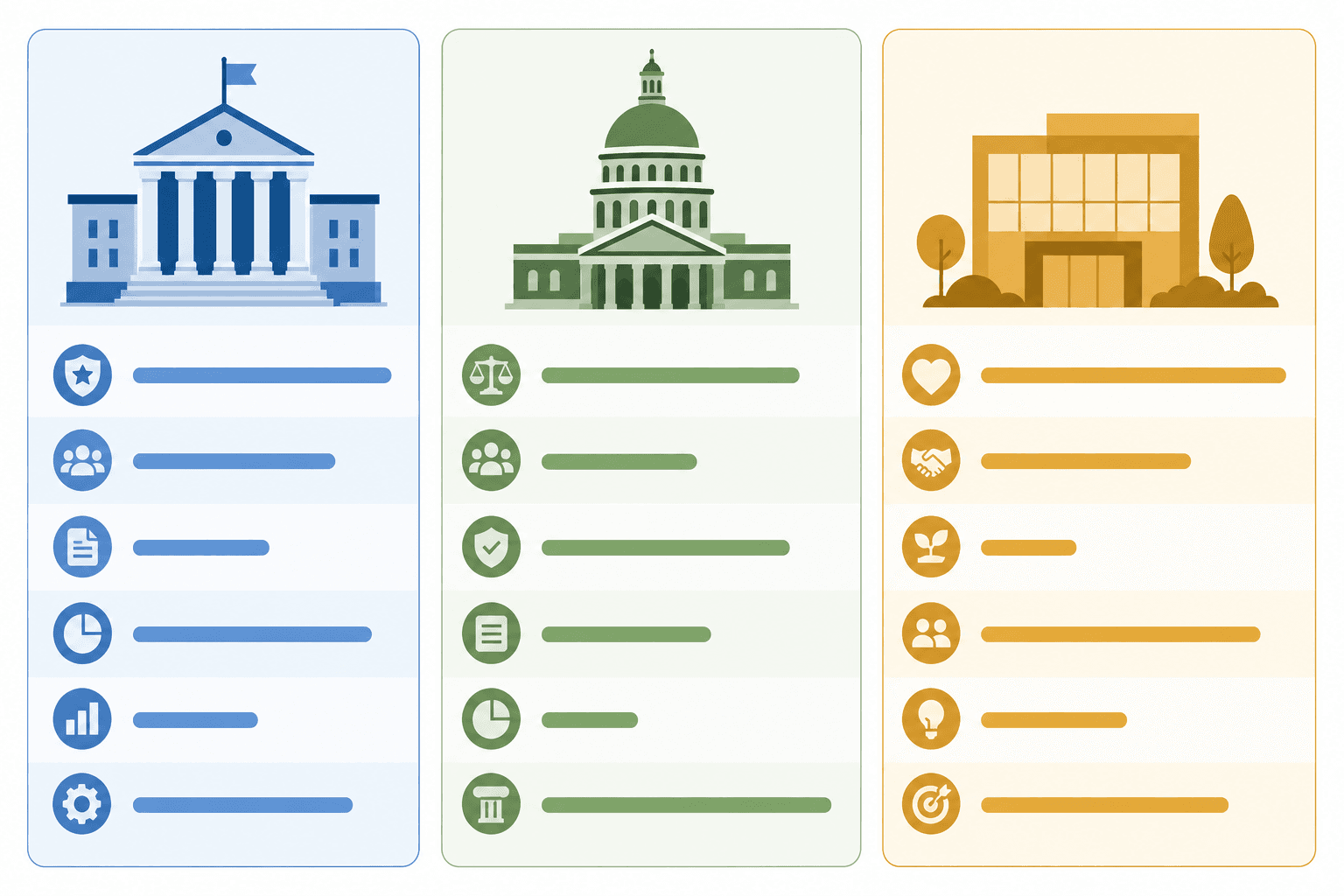
The example is closest to what a private or community foundation expects. For a federal application, treat it as a content source and rebuild the document against the announcement's own headings and its stated application instructions.
How to Adapt the Sample Grant Proposal for Non Profit Use Without Sounding Generic
Adapt in a fixed order, starting with the evidence and ending with the prose. Working from polished sentences backward toward the data produces a document that reads smoothly and says nothing specific about your organization.
- Replace the need evidence first. Swap in your own service-area data, your own waitlist or intake numbers, and your own sourced statistics with the source named and dated in the text.
- Rewrite the objectives to your real capacity. If you can serve sixty people, the objective says sixty, and it says so before the budget and the evaluation plan are touched.
- Rebuild the budget from your own costs. Start with real salaries and real percent effort. Scaling someone else's numbers up or down produces lines you cannot defend in a site visit.
- Match the funder's language. If the guidelines say "priority populations," use that phrase where you would have used your internal term.
- Cut to the page or character limit. Trim the program design section first.
- Read the cover letter last. It should name the exact amount and the exact program title that appear everywhere else in the document.
Budget rebuilding takes longer than it looks like it will, because it surfaces a staffing question the narrative has been avoiding. Leave a day for it. For a fill-in structure to paste your adapted text into, the templates guide has each section as a blank form.
How to Save the Sample Grant Proposal as a PDF
Every current browser prints a web page to a PDF file. On Windows, press Ctrl+P and choose Microsoft Print to PDF as the destination. On macOS, press Cmd+P and choose Save as PDF from the print dialog's PDF menu.
A fixed-layout copy is worth having for a team review. Page breaks fall in the same place for everyone reading it, which makes a comment about the second paragraph on page four mean something. Print it, mark it up, and keep the marked copy with the draft.
Two things to watch when you print. Wide tables split across pages in most browsers, so check that the budget table lands whole before you circulate the file, and switch the dialog to landscape if it does not. Number the pages before you send it.
Where a Sample Grant Proposal Stops Helping
A sample answers structural questions and nothing else. It cannot tell you whether this funder is a match for this program, and a mismatch is not something better writing repairs.
A foundation that funds capital projects in one county will decline a carefully written request for operating support in another, and the decline says nothing about the request. Run three checks before you adapt a word. Does the funder give in your subject area, judged by what it has paid out rather than by the language on its website? Does it give in your geography, at the county or metro level? Does it fund your request type, meaning program, operating, capital, or capacity? A no on any of the three means the strongest proposal you can write is still the wrong proposal.
The fourth check is timing. Foundations with a single annual deadline and a board that meets twice a year decide on a cycle you cannot shorten, so a program that needs money in eight weeks needs a different funder.
GrantCue builds foundation profiles from IRS Form 990-PF filings, so you can see what a private foundation has actually paid out before you write anything. Federal and state opportunities are searchable in the same system, filtered by deadline and category, across Grants.gov and official state and local portals.
After You Submit: Track What You Sent
The follow-up work starts the day the proposal goes out. Record the funder, the amount requested, the submission date, the expected decision date, the contact, and where the final file lives.
A submitted proposal nobody can find six months later is one you will rewrite from scratch at renewal. The same record becomes your reporting baseline if the grant is awarded, because a progress report asks about the objectives in the words you used. Keep the version you submitted, and note which attachments went with it.
Record the decision too, whichever way it goes. A declination that arrives with a reason is the cheapest program feedback you will get, and the reason is often fixable before the next cycle: the request sat above the funder's usual range, the geography fell outside the giving area, the evaluation was thin. Keep that note beside the submission record, because the person drafting next year's request may not be you.
Once several people touch the same application, deadline tracking has to live somewhere shared. A spreadsheet holds up until two people edit it in the same week.
FAQ
Is there a free sample grant proposal for a nonprofit organization in PDF?
The worked example on this page is free to read and free to save as a PDF through your browser's print dialog. It runs the full section set of a foundation proposal, with the need statement, objectives, budget narrative, and evaluation plan written out in full.
How to write a nonprofit grant proposal
Start with the funder's guidelines and work outward from the evidence. Confirm subject, geography, and request-type fit, gather your own local data, write the objectives, build the budget from real costs, then write the narrative sections around them and the cover letter last. The nonprofit proposal templates guide walks the same order with a blank structure for each section.
How long should a nonprofit grant proposal be?
The funder sets the length. Community foundation forms frequently cap each field at a character count, foundation guidelines often name a page range, and a federal announcement states its own limits in the application instructions. Read those instructions before you start writing and treat any stated limit as firm. Where no limit appears, shorter and more specific beats longer.
Can I copy a sample grant proposal word for word?
No. Copy the structure and the section order. Write your own sentences. The evidence, the numbers, the objectives, and the budget have to be yours, because every one of them is checkable against your intake records, your payroll, and your audited financials.
What sections does a nonprofit grant proposal need?
Most foundation proposals need a cover letter, executive summary, organization background, statement of need, goals and objectives, program design, evaluation plan, budget table, budget narrative, sustainability plan, and attachments such as the IRS determination letter, board roster, and recent financial statements. The funder's guidelines override this list wherever they differ.
How do I find funders to send a nonprofit grant proposal to?
Start with federal opportunities on Grants.gov and your state's grant portal, then work outward to private and community foundations. Private foundations report their grantmaking annually on IRS Form 990-PF, which the IRS describes as the return used to report charitable distributions and activities (IRS, About Form 990-PF, retrieved September 2026). Community foundations are public charities, so their grants appear on Schedule I of Form 990 instead, which the IRS describes as the schedule Form 990 filers use to report grants and other assistance made during the tax year (IRS, About Schedule I (Form 990), retrieved September 2026). Both filings are public, so you can check subject and geography fit before writing.
Take the Next Step
Read the example end to end once before you open a blank document, then rebuild it around your own evidence, starting with the need data.
One situation the section list does not cover: the funder's form has no field for a section you wrote. Fold that content into the nearest field it fits, keep the sentence that carries the number, and use the cover letter to say where it went. A sustainability plan compressed into the last paragraph of a project description still answers the reviewer's question.