Sample Grant Proposal for Library Literacy Program: Full Example and Free Download
A section-by-section sample grant proposal for a library literacy program, with a worked $38,000 example budget, county literacy data sources, and a free download.

Last updated: September 2026
A sample grant proposal for a library literacy program has to answer a question no other sector faces on page one: the applicant is usually already funded by taxes. A reviewer sees "public library" and thinks about the millage that pays for the building. Every section has to work around that thought. This guide walks through each part of a library literacy proposal and works a $38,000 example request through the hardest sections. If you have never assembled a request before, the structure in how to write a grant proposal is the place to start.
Quick Answer: What Goes in a Sample Grant Proposal for a Library Literacy Program?
A library literacy grant proposal contains a cover letter, an organization summary, a statement of need built on county-level adult literacy data, and a program description covering instruction and materials. It closes with outcome measures such as learner level gains, a line-item budget led by staff time, a sustainability plan, and attachments naming the fiscal agent.
Free download: Complete sample proposal for a library literacy program as Word .docx. No email address required.
Sample Grant Proposal for Library Literacy Program: What It Contains
A library literacy proposal is a funding request that asks a funder to underwrite instruction hours for a defined group of learners. The strongest version names the learners by count and the instruction by hours.
| Section | Length | What a funder reads it for |
|---|---|---|
| Cover letter | 1 page | Entity, amount, signer |
| Organization summary | Half a page | Service population and 501(c)(3) status |
| Statement of need | 1 to 2 pages | County literacy and district reading data |
| Program description | 2 to 3 pages | Who teaches, hours per learner, where |
| Goals and outcomes | 1 page | Level gains and persistence, with a date |
| Evaluation plan | Half a page | Which assessment, who gives it, how often |
| Budget and narrative | 1 to 2 pages | Staff time, materials, supplanting |
| Sustainability | Half a page | What the library absorbs afterward |
| Attachments | Varies | Governance documents, trustees, partners |
Every row answers a question the reviewer is already holding.
Library Literacy Grant Proposal Example: A $38,000 Family and Adult Literacy Request
This library literacy grant proposal example is a $38,000 twelve-month request from a county library district to a regional community foundation, covering a part-time literacy coordinator, tutor training, learning materials, and childcare. It is illustrative and does not describe a real organization, so copy the structure and replace the figures.
The applicant serves a small city and the rural townships around it, runs a volunteer adult tutoring program with a waiting list, and hosts a weekly bilingual storytime. The evening family literacy track is new.
Need statement, opening two sentences. "The PIAAC Skills Map estimates the share of adults in this county performing at or below the lowest literacy proficiency level, and that share sits above the state figure. Our adult tutoring waiting list has carried more names than we have matched tutors for every month of the past year."
Program description, opening. "The program serves 60 adult learners and 45 families over twelve months. Each adult learner is assessed at intake, matched with a trained volunteer tutor, and offered two sessions a week. Each family in the evening track receives a take-home reading kit and eight guided sessions while childcare runs next door."
Outcome statement. "Forty of 60 adult learners complete at least 40 instructional hours. Twenty-five advance one educational functioning level on a standardized post-test. Seventy percent of enrolled learners are still attending at twelve weeks."
Ask sentence. "We request $38,000 to fund a part-time literacy coordinator, tutor training, learning materials, and childcare for the 2027 program year."
There is no paragraph about the love of reading. The case rests on learner counts and instruction hours.
Writing the Statement of Need With Local Literacy Data
The need statement has to be county-level and sourced, because national literacy figures appear in nearly every application.
Three public datasets give you verifiable local evidence. The PIAAC Skills Map publishes literacy estimates for all 50 states and 3,141 counties, broken out by age and education group, and reports the percentage of adults at or below Level 1 proficiency (National Center for Education Statistics, U.S. PIAAC Skills Map, 2012 to 2017 data cycles). Those county figures are model-based small area estimates, and NCES asks in Guideline 1 of its user guidance that you report the 95 percent credible interval alongside the percentage. The Skills Map download supplies both bounds. American Community Survey tables add educational attainment and language spoken at home for the same geography, and your state education agency publishes district reading proficiency by grade for a family or early literacy request.
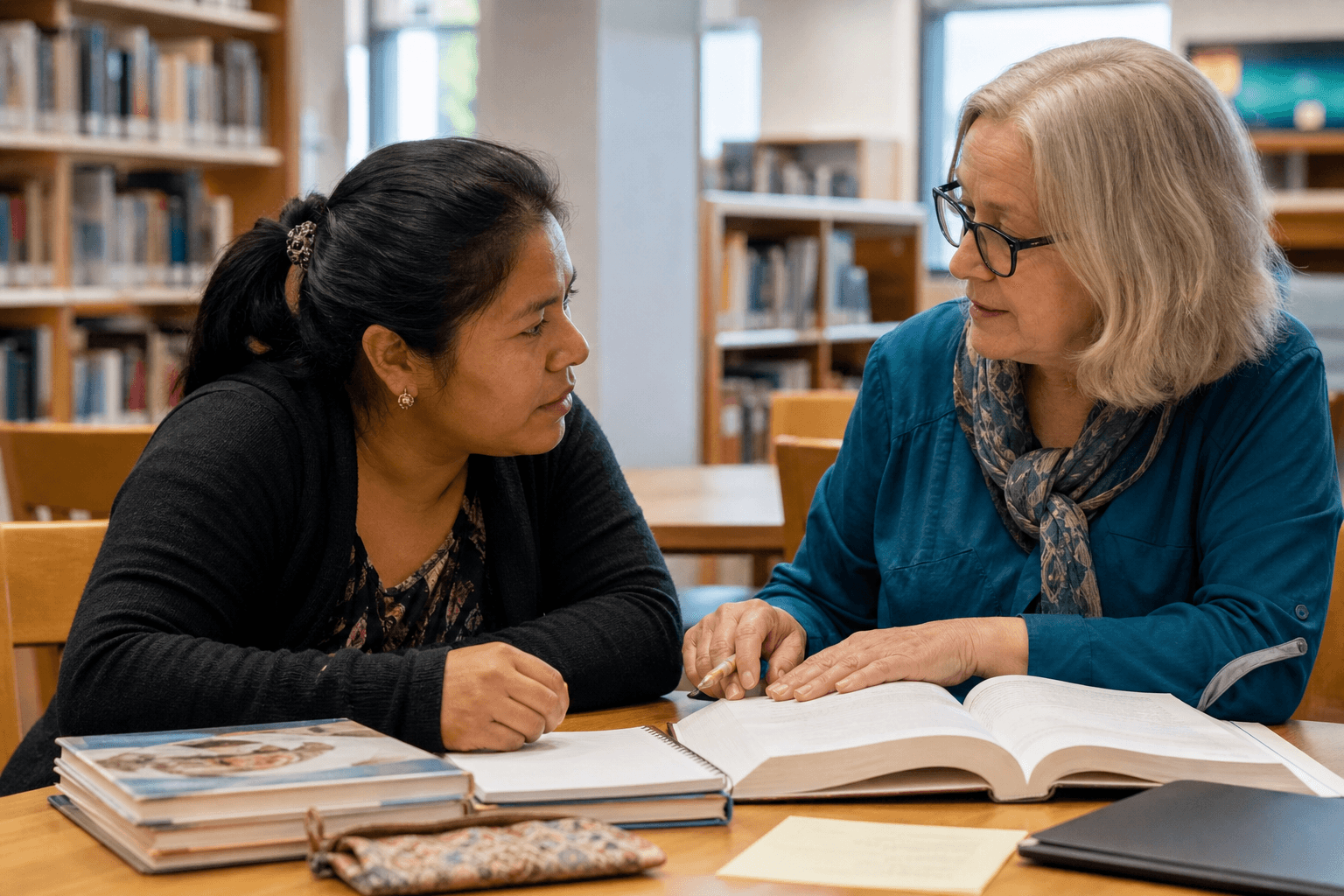
Then add the evidence only you hold: your tutoring waiting list, and the storytime families you turned away for lack of space. A waiting list proves demand rather than asserting it, which no borrowed statistic can do.
Two failure patterns recur. The first is opening with a national literacy percentage the funder can find in any application on the desk. The second is writing about the library's budget pressure when the funder is buying a change in community reading levels. The language patterns in this statement of need guide transfer cleanly once the county numbers are in hand.
Goals and Outcome Measures Literacy Funders Recognize
Literacy funders want measured gains and instruction dosage. A reviewer recognizes the six measures below without needing a definition.
| Measure | What it counts | How funders read it |
|---|---|---|
| Educational functioning level gain | Advancing a level on a standardized pre and post test | The recognized measure of adult progress |
| Instructional contact hours per learner | Hours each learner actually receives | Reviewers check dosage first |
| Persistence at 12 weeks | Share of enrolled learners still attending | Tests whether the model holds early |
| Credential and workforce transitions | Equivalency earned, jobs entered, courses enrolled | What a workforce-oriented funder weighs most |
| Early literacy screener results | Children reaching benchmark before kindergarten | Already collected by district partners |
| Caregiver reading behavior | Reported change in reading at home, by survey | The change a family literacy grant buys |
An educational functioning level is a standardized band of adult reading ability that programs use to record progress between an intake assessment and a post-test. Federal rules at 34 CFR Part 462 require providers funded under Title II of the Workforce Innovation and Opportunity Act to measure that gain with an approved assessment and report it to the National Reporting System, so a literacy funder knows the term.
In August 2025 the Public Library Association announced it was sunsetting the Project Outcome online platform and publishing its nine standardized surveys as free downloads through Outcome Measurement for Public Libraries (Public Library Association, August 19, 2025). The early childhood literacy and summer reading instruments are worth naming by title. Put the mechanics into a grant evaluation plan naming who administers each assessment and when.
Set targets against your own history. "Twenty-five of 60 learners advance one level by June 30" is defensible. "Improve literacy in our community" is not.
Building the Budget: What Library Literacy Line Items Look Like
Staff time dominates a library literacy budget. Materials feel like the natural ask because they are visible, but the instruction hours produce the measured gain a funder is buying. The figures below are illustrative. Replace them with your own salary scale.
| Line item | Basis | Amount |
|---|---|---|
| Part-time literacy coordinator | 20 hours per week for 12 months at $24 per hour | $24,960 |
| Volunteer tutor training and materials | 40 tutors at $65 | $2,600 |
| Leveled readers and bilingual family kits | 300 kits at $18 | $5,400 |
| Standardized assessment administrations | 120 at $9 | $1,080 |
| Childcare during evening adult classes | 40 sessions at $60 | $2,400 |
| Interpretation and translation | Intake and enrollment materials | $900 |
| Outreach mileage | Deliveries to partner sites | $660 |
| Total request | $38,000 |
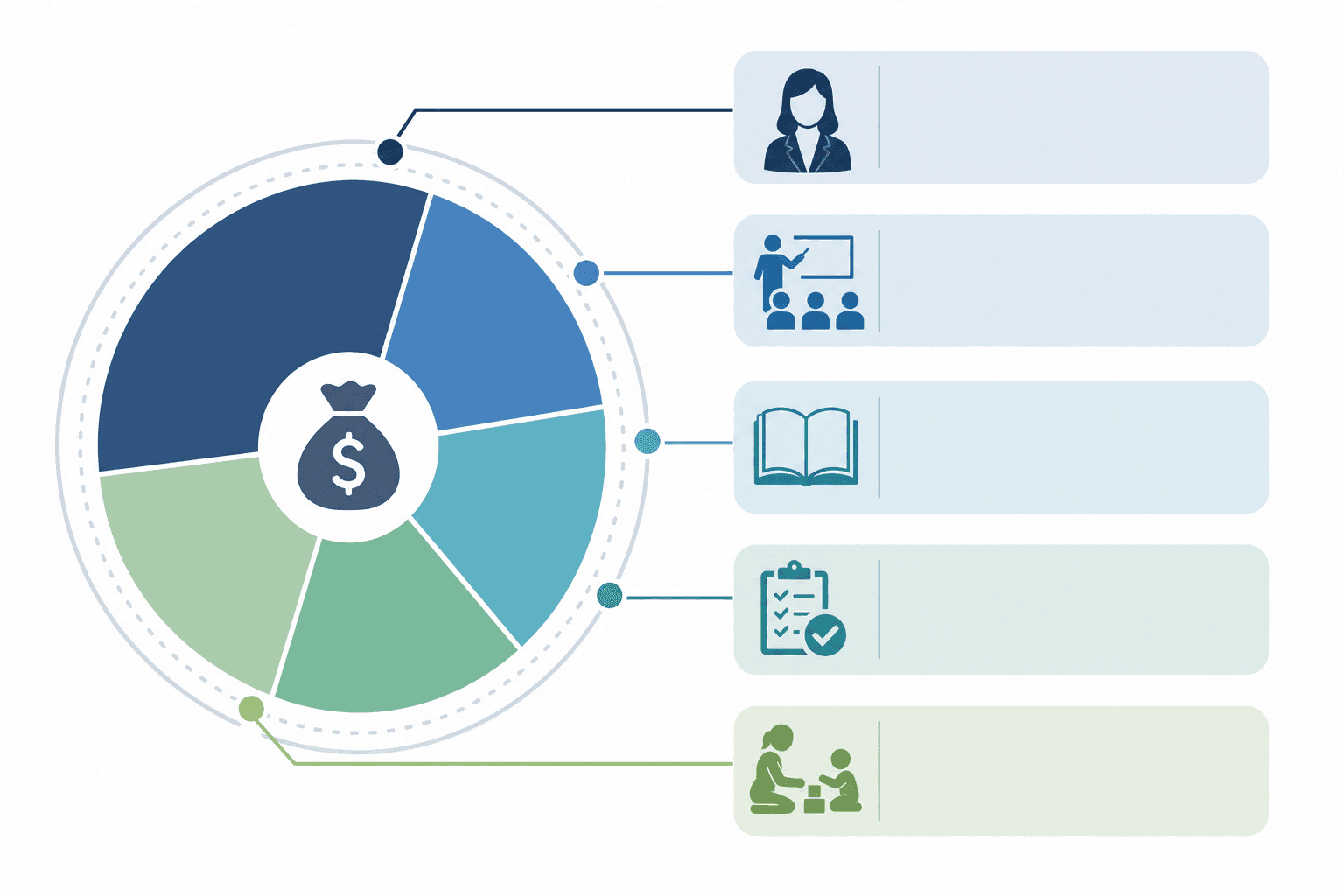
Fund the childcare line and defend it. Evening adult classes lose caregivers without it, and cutting it to shrink the ask costs you the attendance target.
Value volunteer tutor hours in a separate in-kind column. If volunteers deliver a meaningful share of your instruction, those hours demonstrate match value and keep the cash request small.
State plainly that the grant adds service rather than replacing tax revenue. One sentence confirming that local appropriation stays intact removes the supplanting concern early.
Show that materials outlive the grant. Books bought with grant funds stay in circulation long after the award closes, a sustainability argument most sectors cannot make. The grant proposal budget template guide shows how to justify lines like these.
Who Signs the Application: Library, Friends Group, or Literacy Council
Many public libraries are units of local government rather than 501(c)(3) corporations, so the eligibility field on a foundation form does not match the applicant. Settle this before drafting; it decides whose name goes on the cover letter.
| Applicant structure | How it usually works | What to check first |
|---|---|---|
| Public library, unit of local government | The library applies under its own identifier | Whether the form accepts a governmental applicant |
| Friends of the Library or library foundation | The 501(c)(3) applies, the library delivers the program | Whether a pass-through is allowed, and who reports |
| Independent literacy council | A nonprofit applies, the library hosts space and staff | Which partner owns the learner data |
| School or academic library | Routes through the district or institution | Internal approval time, longer than it looks |
Email the program officer and ask. A one-line question saves a rejection unrelated to program quality.
The answer also sets your attachment list. A governmental applicant supplies a trustee roster and a resolution from its parent body. A Friends corporation supplies the IRS determination letter, a recent Form 990, and a memorandum naming who holds the learner records. Chasing a signed resolution in the final week is how library applications miss deadlines.
How This Differs From a Sample Grant Proposal for a Non Profit Organization
The section headings match any nonprofit proposal, and the content inside three of them does not. A sample grant proposal for a nonprofit organization opens with a straightforward organization summary; a library has to explain trustees, a district or municipal parent, and sometimes a separate Friends corporation holding the tax exemption.
The need statement carries the extra burden of proving that a tax-funded institution still has an unmet need. A standalone nonprofit spends that whole section on the community. A library spends part of it on itself, which is why the county data and the waiting list have to work so hard.
The budget leans on staff time and childcare, and it has to address supplanting head on.
Four Objections Library Literacy Funders Raise
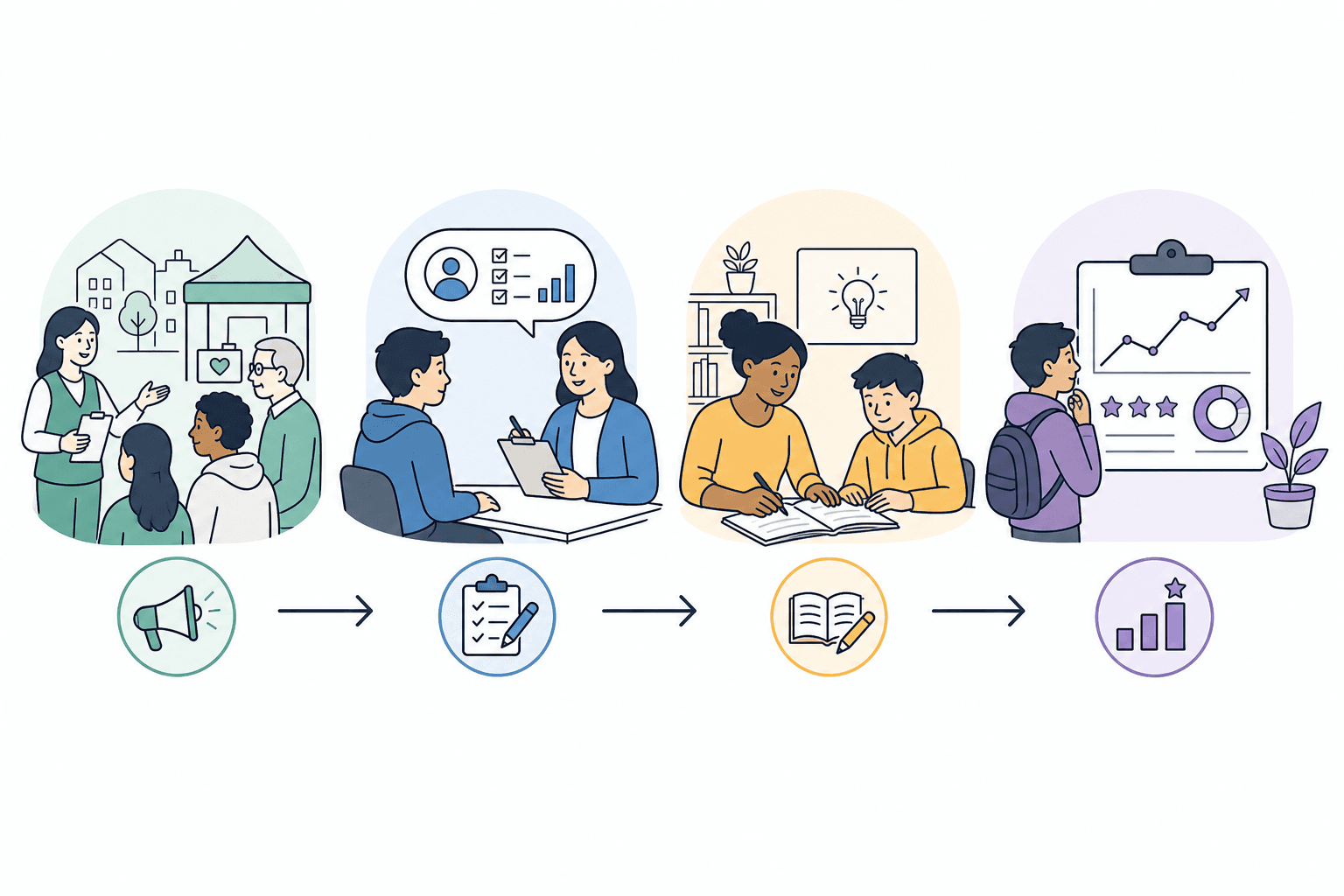
Library literacy funders raise four recurring objections: the existing tax base, supplanting, weak learning evidence, and year-two survival. Answer all four inside the proposal, before the site visit.
"The library already has a tax base." Name what the appropriation covers and what it does not. Operating funds pay for collections, buildings, staffing, and utilities. They rarely stretch to a dedicated literacy coordinator or evening childcare.
"Is this replacing money the county should be paying?" State that local appropriation continues at its current level and that the grant funds new service hours.
"How do you know anyone actually learned to read better?" Name the assessment, who administers it, and the interval. A proposal offering only headcount invites this objection.
"What happens in year two?" Show the absorption path. Name what the board has committed to picking up, and which partner carries the tutor training after the award closes.
Where Library Literacy Programs Find Funders
Library literacy money reaches programs through state agencies, private foundations, and local partners. The two federal formula programs behind the state layer, adult education under Title II of the Workforce Innovation and Opportunity Act and library services under the Library Services and Technology Act, are not competed on Grants.gov. Both flow to a state agency, which is where a library applies.
Your state adult education agency. Adult education carries a larger federal appropriation than library services. The Adult Education and Family Literacy Act, Title II of WIOA, put $629,600,400 into formula grants to states for fiscal year 2026, with a further $85,854,600 reserved for Integrated English Literacy and Civics Education (U.S. Department of Education, Office of Career, Technical, and Adult Education, FY 2026 AEFLA state allocation memorandum, April 2026). States re-award that money to local providers, and a public library can be one.
Your state library agency. The IMLS LSTA state allotment table for FY 2026 distributes $181,400,000 in federal funds to State Library Administrative Agencies. Those agencies run statewide services and pass funds through as competitive subawards to public, academic, school, and special libraries. For-profit and federal libraries are not eligible, and the cycle runs on its own calendar.
Private foundations. As of September 10, 2026, GrantCue's analysis of a 2.4 million record corpus of IRS Form 990-PF grant items identifies 18,712 grants for library and literacy purposes totaling $503 million across the filing years the corpus covers. Classification is keyword-based on the purpose text each foundation reports, so the count is a floor. A 990-PF reports the grants a foundation paid during the year with recipient name, purpose, and amount, so identifying funders already giving in your state beats broad searching.
State and local agency programs. Adult education, workforce, early childhood, and community development agencies fund literacy activity under names that never include the word "library." You can search federal and state grant listings in one place, which saves checking each state portal by hand.
Download the Full Library Literacy Grant Proposal
The complete proposal is a free Word download and does not ask for your email. It runs at full length, so you can adapt the text directly.
Inside the document:
- A finished cover letter with the ask sentence written out.
- An organization summary for a county library district with a separate Friends corporation.
- A need statement with bracketed slots for your county PIAAC estimate and credible interval, district reading scores, and waiting list count.
- A program description covering intake, tutor matching, session frequency, and the family track.
- A goals section using level gains, contact hours, and twelve-week persistence, plus a matching evaluation plan.
- A line-item budget and narrative, including the childcare and in-kind tutor lines, and a sustainability section built on institutional absorption.
Replace every bracketed field before you submit, and swap the illustrative unit costs for your own salary scale. A reviewer will check the arithmetic.
FAQ
How do you write a grant proposal for a library literacy program?
Start with county-level literacy data and your own waiting list, then build the request around a defined number of learners and instruction hours. Fund the coordinator position and treat materials as the smaller line. Name the assessment that will show learner gains, and confirm that local tax appropriation stays at its current level.
Can a public library apply for grants if it is not a 501(c)(3)?
Often yes, though it depends on the funder. Many public libraries are units of local government, and some foundation forms accept only 501(c)(3) applicants. The usual solutions are applying through the Friends of the Library or asking the program officer whether a governmental applicant is accepted.
What grants are available for adult literacy programs?
State adult education agencies award funds under Title II of the Workforce Innovation and Opportunity Act, which carried $629,600,400 in formula grants to states for fiscal year 2026 (U.S. Department of Education, April 2026). State library agencies award LSTA subawards from the $181,400,000 the Institute of Museum and Library Services distributed for FY 2026. Private foundations fund literacy directly, and their giving is visible in IRS Form 990-PF filings.
What outcomes do literacy funders want to see?
Adult programs are judged on educational functioning level gains, contact hours per learner, persistence at twelve weeks, and credential or workforce transitions. For children's programming, funders look at early literacy screener results and caregiver reading behavior. Every measure needs a baseline, a target, and a date.
Do funders pay for childcare during adult literacy classes?
Funders will, when the proposal explains why. Childcare is a direct participation cost for evening adult classes, and removing it reduces the attendance the program promised. Put it in the budget as its own line with a per-session basis tied to your persistence target.
Next Steps
Draft the need statement first, because the learner count in it determines every figure in the budget. Pull your county estimate and its credible interval from the PIAAC Skills Map and add your waiting list number. Settle the applicant-of-record question with the funder before anyone starts writing. Then download the proposal, replace the bracketed fields, and price the coordinator line against your salary scale. If proposal writing is new, work through the full proposal writing walkthrough as you go.