Sample Grant Proposal for Faith Based Organizations: A Section by Section Church Example
A section by section sample grant proposal for faith based organizations: church eligibility, shared cost allocation, secular outcomes, and the equal treatment rule.
In this article (26)
- Quick Answer: What Goes in a Grant Proposal for a Faith-Based Organization?
- The Eligibility Question Faith-Based Applicants Answer First
- Section by Section: A Sample Grant Proposal for Faith Based Organizations
- Nondiscrimination and Beneficiary Protections: The Section Only Faith-Based Applicants Write
- A Worked Example: One Program Week, Written for a Reviewer
- Writing the Statement of Need Without Preaching to the Funder
- The Faith-Based Program Budget: Splitting Ministry Costs from Program Costs
- Can Grant Money Pay for the Building Itself?
- Outcome Measures a Faith-Based Program Can Report
- Four Objections Faith-Based Proposals Get, and How to Answer Them
- "Will this money pay for religious activity?"
- "Do you serve people who do not share your faith?"
- "Your board is the church board. Who provides oversight?"
- "You do not file a Form 990. How do we assess your finances?"
- What a Sample Grant Proposal for a Non Profit Organization Leaves Out
- Finding Funders That Fund Faith-Based Programs
- FAQ
- How do you write a grant proposal for a faith-based organization?
- Can a church apply for grants without 501(c)(3) status?
- Can faith-based organizations receive federal grant money?
- What grants are available for churches and faith-based nonprofits?
- Can a grant pay for a pastor's salary?
- Can a faith-based organization hire staff who share its faith?
- Do you have to remove religion from a faith-based grant proposal?
- Do we have to cover up religious symbols during the funded program?
- Next Steps
A sample grant proposal for faith based organizations has to handle four things a secular template skips: proving eligibility when a church holds no IRS determination letter, drawing a visible line between worship and the funded service, allocating shared building costs with a written method, and reporting outcomes a public funder can verify. This page walks a church-run community program request section by section and answers the objections reviewers raise. New to the format? Start with how to write a grant proposal.
Quick Answer: What Goes in a Grant Proposal for a Faith-Based Organization?
A faith-based grant proposal runs the same sections as any other: cover letter, organizational background, statement of need, program design, budget, and evaluation plan. Three things are sector-specific. The background states legal status, the budget carries a written method for splitting shared facility and staff costs, and one section spells out who the program serves.
Free download: Complete sample proposal for a faith-based organization as Word .docx. No email address required.
The Eligibility Question Faith-Based Applicants Answer First
Which legal entity applies is the first decision, and it changes every document that follows. IRS Publication 1828, Tax Guide for Churches and Religious Organizations (Rev. 8-2015) states that churches meeting the requirements of IRC section 501(c)(3) are automatically considered tax exempt and are not required to apply for and obtain recognition of tax-exempt status from the IRS. The same publication excepts churches from the annual information return on Form 990, 990-EZ or 990-N, though a church with $1,000 or more in gross unrelated business income still files Form 990-T.
Portal forms ask for a determination letter date and a Form 990 upload anyway, and a form requiring both will not accept a church that has neither. Four paths work.
Scroll horizontally to see all columns when needed.
| Path | What it involves | When it fits | What the funder receives |
|---|---|---|---|
| Voluntary IRS recognition | File Form 1023 and pay the user fee | The congregation applies for grants regularly | A determination letter. Churches are excepted from the 27-month notice deadline, so recognition can run back to formation |
| Separate 501(c)(3) affiliate | Incorporate the program with its own board and books | The program outlives any one grant | Determination letter, Form 990, board list. A new affiliate files Form 1023 within 27 months to be exempt from the date formed |
| Fiscal sponsorship | An established 501(c)(3) administers the award | A first grant, or a very small program | The sponsor's documents and a signed agreement |
| Apply as the church | Submit the EIN, bylaws, budget, and reviewed financials | Guidelines name churches as eligible | Substitute documentation, offered unprompted |
Federal applications add a step unrelated to faith. SAM.gov states that entity registration is required to receive assistance directly from the federal government, and that a Unique Entity ID alone does not let you apply. Start it before you start writing.
Do not leave a missing determination letter for a reviewer to find. Say in the organizational background that the church is exempt under section 501(c)(3) without applying, cite Publication 1828, and attach what you have.
Section by Section: A Sample Grant Proposal for Faith Based Organizations
One section here does not appear in a secular outline: a short nondiscrimination and beneficiary protections statement telling the funder who may walk in the door and what is never asked of them.
Scroll horizontally to see all columns when needed.
| Section | Working length | What a reviewer checks |
|---|---|---|
| Cover letter | 1 page | Which entity is applying, and whether the ask matches guidelines |
| Executive summary | 250 words | The service, who it reaches, and that it is open to everyone |
| Organizational background | 450 words | Legal status, board composition, fiscal controls |
| Statement of need | 700 words | Community data for the service area |
| Program design | 800 words | Where religious activity sits relative to funded hours |
| Nondiscrimination and beneficiary protections | 250 words | Intake practice, referrals, written notice where required |
| Budget and narrative | 2 pages | The allocation method for shared space and shared staff |
| Evaluation plan | 450 words | Measures verifiable without setting foot in the sanctuary |
| Sustainability plan | 350 words | Whether the program survives a change of pastor |
| Attachments | List | Bylaws, board list, financials, EIN letter, facility use policy |
Treat each working length as a target for drafting, and cut to whatever page limit the guidelines set. Name the applying entity in the first line of the cover letter, because ambiguity there reads as a governance problem.
The sustainability section carries one question specific to faith-based applicants. Congregational programs often rest on one clergy member's commitment, and a reviewer will ask what happens when that person leaves. Name the board or committee that holds the program, not the person.
Select to enlarge (opens in a new tab).
Nondiscrimination and Beneficiary Protections: The Section Only Faith-Based Applicants Write
Federal rules decide what a nondiscrimination and beneficiary protections statement has to say. A joint final rule published March 4, 2024 at 89 FR 15671 rewrote the equal treatment regulations of nine federal agencies at once, effective April 3, 2024.
Scroll horizontally to see all columns when needed.
| Agency | Where its equal treatment rule sits |
|---|---|
| Agriculture | 7 CFR part 16 |
| Education | 2 CFR part 3474; 34 CFR parts 75 and 76 |
| Health and Human Services | 45 CFR part 87 |
| Homeland Security | 6 CFR part 19 |
| Housing and Urban Development | 24 CFR part 5 |
| Justice | 28 CFR part 38 |
| Labor | 29 CFR part 2 |
| U.S. Agency for International Development | 22 CFR part 205 |
| Veterans Affairs | 38 CFR parts 50, 61, and 62 |
Cite the part that matches your funder. A congregation applying to HUD is governed by 24 CFR part 5, not by the HHS part.
Three requirements shape what you write. Faith-based organizations are eligible to participate in an agency's grant-making programs on the same basis as any other organization. Explicitly religious activities, including worship, religious instruction and proselytization, must be separate in time or location from a program supported by direct federal financial assistance, and participation must be voluntary. A provider may not discriminate against a beneficiary or prospective beneficiary on the basis of religion, a religious belief, a refusal to hold a religious belief, or a refusal to attend or participate in a religious practice (89 FR 15671, March 4, 2024; for HHS-funded programs, 45 CFR 87.3).
The rule also set a notice deadline. Recipients required to give written notice to beneficiaries had to do so by July 2, 2024. Agency parts also fix the timing: in HUD programs the notice reaches a prospective beneficiary before enrollment or before services begin (24 CFR 5.109(g)(3)). Find the notice text in your agency's part, then say in the proposal when and how you hand it to participants.
A Worked Example: One Program Week, Written for a Reviewer
Program design is where a reviewer looks for the separation the rules require, so write it as a schedule with names attached rather than as an assurance. The week below belongs to an illustrative congregation-run neighborhood resource program.
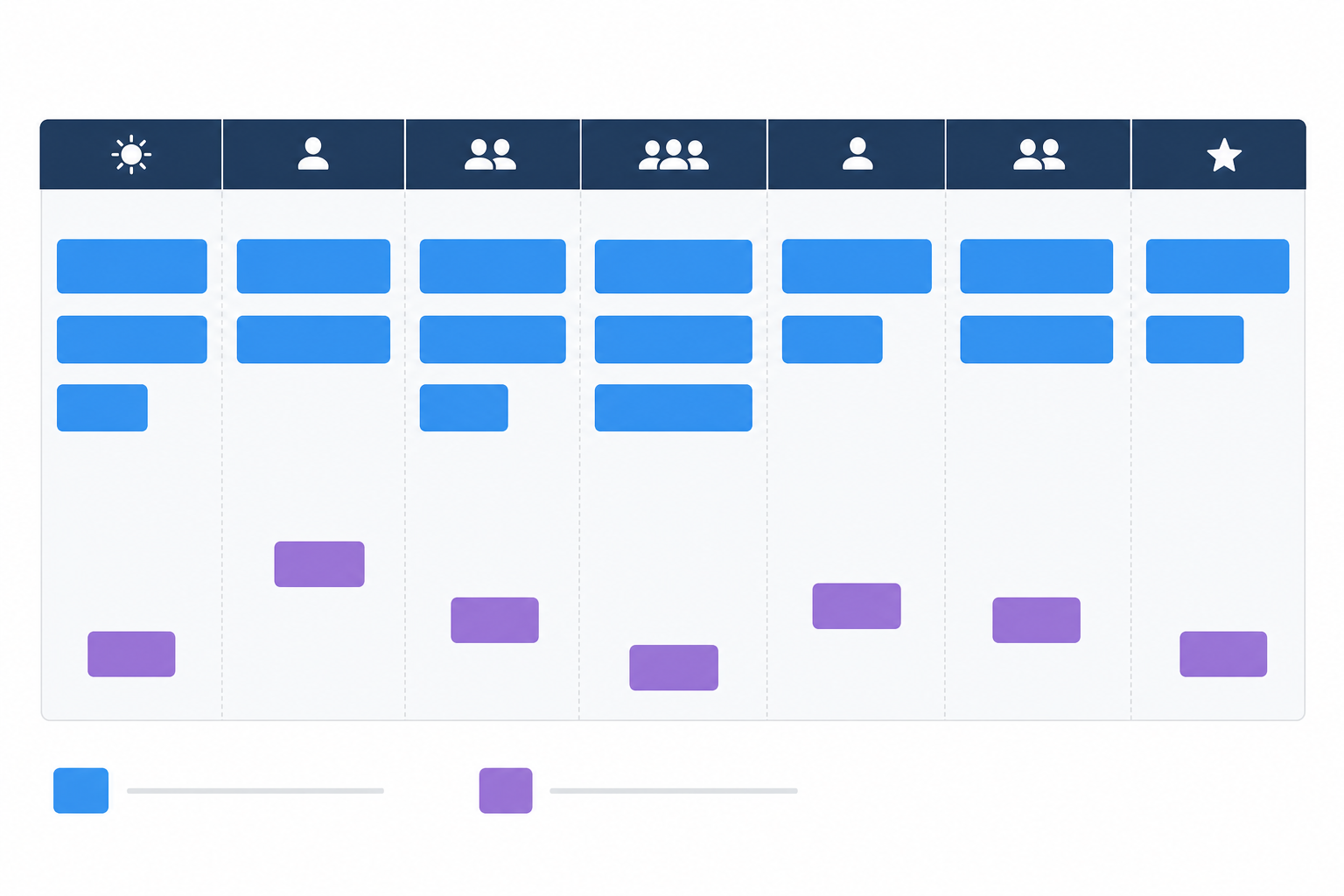
The pantry opens Tuesday and Thursday, 10 a.m. to 2 p.m., in the fellowship hall, run by the program coordinator with screened volunteers. Benefits navigation runs Wednesday, 1 p.m. to 5 p.m., in the two classrooms off the north corridor. The congregation's midweek prayer meeting starts Wednesday at 7 p.m. in the sanctuary, two hours after the last navigation appointment, led by clergy and paid from the offering.
A reviewer can check each of those sentences against the calendar you attach as an exhibit. Then add the line they are waiting for: no one is asked about religion at intake, and staff do not raise the prayer meeting during a funded appointment.
The same shift rewrites the sentences congregations tend to draft first.
Scroll horizontally to see all columns when needed.
| A first draft says | The revision says | What changed |
|---|---|---|
| "Our mission is to share our faith with our neighbors." | "The pantry serves any household in the five-mile service area, with no religious requirement of any kind." | Motive became eligibility, which is what the rule turns on |
| "Volunteers pray with clients when appropriate." | "Prayer happens only when a participant asks, away from the service line, and never during intake." | A vague permission became a practice a monitor can check |
| "The church contributes the use of its building." | "The program uses the fellowship hall and two classrooms 14 hours a week, allocated by square footage and hours, sanctuary excluded." | A gesture became an auditable allocation |
| "We expect to serve many families this year." | "240 unduplicated households, counted by unique identifier in the intake record." | A promise became a number with a source behind it |
Writing the Statement of Need Without Preaching to the Funder
Public data carries the argument and the congregation's own records carry the proof. Belief belongs in the motivation sentence, not in the evidence.
Build the public layer from named sources: American Community Survey estimates from the U.S. Census Bureau for poverty and rent burden in your tract, free and reduced-price meal counts from the school district, your county health department's most recent report, and the county needs assessment where one exists. Cite each by name and year.
Your own records count as evidence too. How many households asked for utility assistance last year, and how many you turned away after the fund ran dry. A reviewer wants to know whether anyone is already doing this work in the neighborhood, and your intake log answers that.
One sentence of motivation is enough. A line saying the congregation does this work because of what it believes reads as candor. A page of it reads as a program with no data. The general structure of a need statement is in this statement of need guide.
The Faith-Based Program Budget: Splitting Ministry Costs from Program Costs
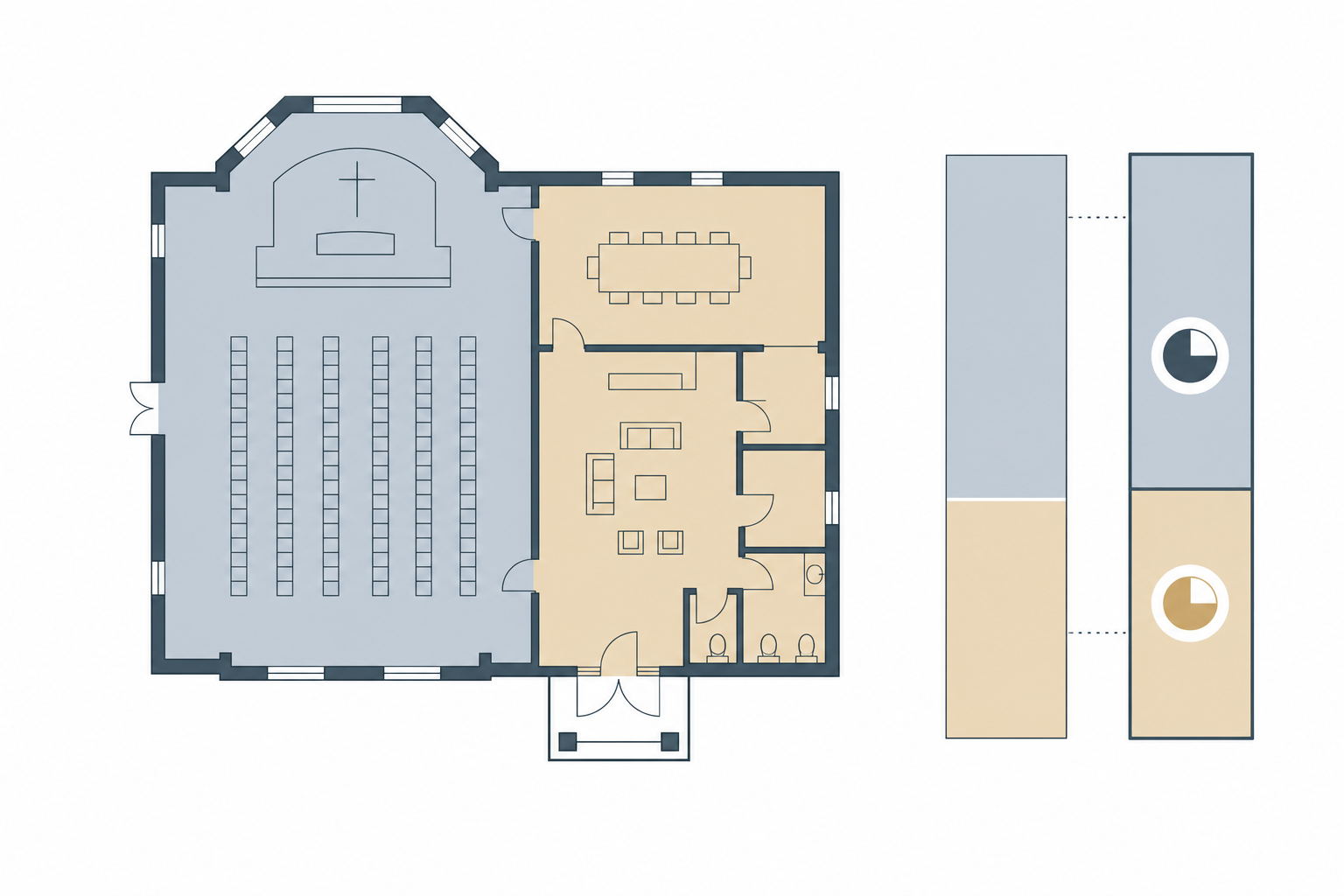
The grant pays only the program's share of every cost the congregation and the program share, so the narrative needs a written allocation method. The figures below are a composite one-year request for a congregation-run neighborhood resource program. All are illustrative.
Scroll horizontally to see all columns when needed.
| Line item | Amount | Why it appears in a faith-based budget |
|---|---|---|
| Program coordinator, 0.75 FTE | $39,000 | A defined secular position with its own job description |
| Fringe benefits at 22% | $8,580 | Applied to the coordinator only |
| Bookkeeping and program accounting, 0.1 FTE | $5,200 | Keeps awarded dollars out of the general offering |
| Allocated facility use: fellowship hall, two classrooms | $7,800 | Square footage times hours used, sanctuary excluded |
| Utilities and custodial allocation | $4,300 | Same basis as the space itself |
| Liability insurance rider for program hours | $1,900 | Congregational policies often exclude public programs |
| Volunteer background checks, 40 volunteers | $1,200 | Expected where children or vulnerable adults are present |
| Interpretation and translated intake materials | $2,600 | Serving past the congregation means serving past one language |
| Food and program supplies | $6,400 | The direct cost of the service |
| Emergency client assistance fund | $3,000 | Small payments that head off a larger crisis |
| Total request | $79,980 |
Facility allocation and separate accounting are the two lines that get budgets returned. Put the facility method in the narrative and not just the number: square footage the program uses, times hours of use, divided by the building's available hours, sanctuary excluded. Awarded funds belong in their own ledger from day one; reconstructing that split during a monitoring visit is far harder.
Clergy compensation needs a decision before submission. Ministry time is generally not chargeable. Where a member of the clergy fills a defined secular role in the funded program, that share can sometimes be charged if time and effort records support it, and some funders decline clergy pay as policy. Ask in writing. The grant proposal budget template covers the general budget format a faith-based version builds on.
Select to enlarge (opens in a new tab).
Can Grant Money Pay for the Building Itself?
Sometimes, and the answer depends on what happens in the room. Under 24 CFR 5.109(j), direct federal financial assistance may pay for acquisition, construction, or rehabilitation of a structure only to the extent the structure is used for eligible activities under the program. Where a space hosts both eligible and explicitly religious activities, the assistance may not exceed the share of cost attributable to the eligible ones. Sanctuaries, chapels, and other rooms a funded organization uses as its principal place of worship cannot be paid for with direct federal assistance.
Scroll horizontally to see all columns when needed.
| What the space does | Direct federal assistance under HUD's rule |
|---|---|
| Rooms used only for eligible program activities | Payable |
| Rooms used for both program activities and worship | Payable up to the eligible share of the cost |
| Sanctuary, chapel, or principal place of worship | Not payable |
Read it as a proration instruction. A kitchen producing pantry meals four days a week and coffee after Sunday worship has a defensible split, calculated on the same basis as the facility line in the operating budget. Two cautions apply. HUD's rule governs HUD money, so check the part that matches your funder. A later change in how the property is used pulls in the real property disposition rules at 2 CFR part 200 subpart D, which makes a capital request a longer commitment than a program grant. Private foundations set their own terms, and plenty of them decline capital requests from every applicant.
Outcome Measures a Faith-Based Program Can Report
Every number below comes from a record the program already keeps, so a funder can verify it without asking about anyone's beliefs.
Scroll horizontally to see all columns when needed.
| Measure | Definition | Data source | Sample target |
|---|---|---|---|
| Unduplicated households served | Distinct households enrolled during the year | Intake records with a unique identifier | 240 households |
| Service units delivered | Meals, classes, or appointments completed | Sign-in sheets and the service log | 4,800 units |
| Benefit applications completed | Applications submitted with staff assistance | Navigator case log | 120 applications |
| Application approval rate | Approved applications as a share of those submitted | Follow-up recorded in the case log | 70% |
| Participants with no congregational affiliation | Share who do not attend the congregation | Voluntary intake question | More than half |
| Trained volunteer hours | Hours logged by volunteers who completed orientation | Volunteer sign-in records | 2,000 hours |
The fifth row changes how a proposal reads. A congregation showing that most participants come from outside its membership answers the reviewer's quiet question with a number.
Keep religious outcomes out of the grant report. Worship attendance and professions of faith belong in the congregation's own records, not the funder's. The mechanics of a grant evaluation section are in this evaluation plan template.
Select to enlarge (opens in a new tab).
Four Objections Faith-Based Proposals Get, and How to Answer Them
Reviewers decline faith-based requests for four recurring reasons. You can settle each one inside the proposal before anyone raises it.
"Will this money pay for religious activity?"
Answer with the schedule, not with reassurance. Show a weekly timetable putting funded hours and religious gatherings in separate blocks, name who supervises each, and state that attendance at the religious blocks is voluntary.
"Do you serve people who do not share your faith?"
Quote the beneficiary nondiscrimination rule back to the funder, name the intake question that measures who walks in, and state that no one has to attend anything to receive the service.
"Your board is the church board. Who provides oversight?"
Independence is the thing being asked about. An advisory committee with outside members, an adopted conflict of interest policy, or an affiliate with its own directors will each supply it. Silence reads worse than any of them.
"You do not file a Form 990. How do we assess your finances?"
Offer the substitute set before the funder asks: audited or reviewed financial statements, the board-approved budget, two years of program-level financials, and the IRS notice assigning your EIN. Say in the cover letter that Publication 1828 excepts churches from that return.
What a Sample Grant Proposal for a Non Profit Organization Leaves Out
A generic sample grant proposal for a non profit organization gives a faith-based applicant the correct section order and none of the sector's content. The headings transfer to a faith-based application; the proof behind them does not.
A secular template never raises the entity question, because it assumes the applicant holds a determination letter. It offers no allocation method for shared space or clergy time, no beneficiary protection language, no written notice of the kind federal programs require, nothing on board independence, and no substitute document set for an applicant with no Form 990.
Secular templates also assume paid staff. Congregational programs often run on volunteers, and a proposal built on volunteer labor has to show how you recruit, screen, train, and supervise them. If the format is unfamiliar, the ground rules for writing a grant proposal come first.
Finding Funders That Fund Faith-Based Programs
Past grant records show which private funders already give to congregational programs. GrantCue's index of IRS Form 990-PF grant records holds 138,125 grants to recipients classified as faith-based or religious, totaling roughly $5.3 billion, measured on September 10, 2026. That figure covers grants recorded in GrantCue's 990-PF corpus rather than all foundation giving, and the classification is applied to recipient records inside the index rather than published by the IRS.
Read exclusion language carefully before ruling a funder out. A guideline saying the foundation does not support religious purposes usually refers to worship and evangelism, so read the rest before deciding the door is closed.
Community foundations, denominational funds, county human services contracts, and federal programs open to faith-based applicants publish on unrelated calendars, so tracking becomes a problem before writing does. GrantCue searches federal and state grant portals in one place and holds the 990-PF records behind that figure, so you can see which private funders give in your field.
FAQ
Common questions from congregations preparing a first grant application.
How do you write a grant proposal for a faith-based organization?
Settle the applying entity first, then build the need statement from community data rather than congregational conviction. Keep religious activity separate in time or location from the funded service, allocate shared building and staff costs with a written method, and report measures your intake records already produce.
Can a church apply for grants without 501(c)(3) status?
Yes. IRS Publication 1828 (Rev. 8-2015) says a church meeting the requirements of IRC section 501(c)(3) is already tax exempt without applying, so the gap is paperwork rather than status. Close it with voluntary recognition through Form 1023, a fiscal sponsor, an incorporated affiliate, or a direct application where guidelines name churches as eligible.
Can faith-based organizations receive federal grant money?
Yes. The joint equal treatment rule published at 89 FR 15671 on March 4, 2024 makes faith-based organizations eligible on the same basis as any other organization. Each agency implements it in its own regulations, HHS at 45 CFR part 87 and HUD at 24 CFR part 5. Direct federal assistance still cannot pay for explicitly religious activities.
What grants are available for churches and faith-based nonprofits?
Community foundations, denominational funds, private foundations with a record of church-affiliated grants, county human services contracts, and federal programs open to faith-based applicants. Search federal and state portals alongside foundation grant history.
Can a grant pay for a pastor's salary?
No for ministry time. Sometimes yes for the share of a pastor's week spent in a defined secular role in the funded program, if timesheets back it up. Several funders refuse clergy pay outright, so get the answer in writing before you build the budget line.
Can a faith-based organization hire staff who share its faith?
In HUD-funded programs, yes. 24 CFR 5.109(i) states that a religious organization's exemption from the federal prohibition on religious employment discrimination, at section 702(a) of the Civil Rights Act of 1964 (42 U.S.C. 2000e-1), is not forfeited when the organization participates in a HUD program. Some programs carry separate statutory nondiscrimination requirements that bind every grantee, so ask the program office which ones attach to your award.
Do you have to remove religion from a faith-based grant proposal?
No. Describe the organization accurately, religious identity included, and keep the funded service open to everyone and free of any religious requirement. What changes is the funded activity, not who you are.
Do we have to cover up religious symbols during the funded program?
Not under HUD's rule. 24 CFR 5.109(d)(2) lets a faith-based organization receiving direct federal financial assistance use space in its own facilities, a sanctuary or prayer hall included, to carry out program activities without concealing, altering, or removing religious art, icons, scriptures, or other religious symbols. Separation applies to the religious activity, not to the architecture.
Next Steps
Decide which entity is applying before you edit a word of the narrative, then rebuild the budget around your own building and its hours. Get the allocation method right first. Then search federal and state grants and shortlist the funders whose guidelines name churches. For the full sequence, the guide to how to write a grant proposal covers it end to end.