Sample Grant Proposal for Scholarship Program: Full Worked Example and Selection Criteria
A worked sample grant proposal for a scholarship program: selection criteria, award terms, bursar disbursement, a budget with the award split, and outcome measures.

Last updated: September 2026
A scholarship program proposal asks a funder to pay for something unusual: money that leaves your organization and lands on an individual student's tuition account. That single fact changes what reviewers look for. This sample grant proposal for scholarship program funding walks through a complete request section by section, from the selection procedure through the disbursement language that scholarship funders read first. The worked example in this article, including every dollar figure in it, is a composite built for the article and is not a real nonprofit or funder. Figures attributed to a named source are real and cited.
Quick Answer: What Goes in a Sample Grant Proposal for a Scholarship Program?
A grant proposal for a scholarship program covers six things: a need statement tied to unmet student cost, a selection procedure with a scoring rubric, and award terms covering amount and renewal. It sets out a disbursement plan that pays the institution, a budget splitting award dollars from administration, and outcome measures for persistence and completion.
Free download: Complete sample proposal for a scholarship program as Word .docx. No email address required.
What a Scholarship Proposal Has to Prove That Other Proposals Do Not
The funder is underwriting payments to named individuals, so the selection process itself lands under review. Most program proposals never face that question.
There is a tax reason behind it. Under Internal Revenue Code section 4945(g), a private foundation's grants to individuals for study are taxable expenditures unless the grant "is awarded on an objective and nondiscriminatory basis under a procedure approved in advance by the Service" (IRS, Grants to Individuals, page last reviewed June 28, 2026). Foundations request that approval on Form 8940, and the IRS looks for a procedure that awards grants on an objective and non-discriminatory basis and is reasonably calculated to result in performance by grantees of the activities the grants are intended to finance (IRS, Advance Approval of Grant-Making Procedures, page last reviewed June 28, 2026).
That rule creates the opening for your proposal. A private foundation's grant to a public charity is not treated as a grant to the individual when the grant funds a project undertaken and controlled by the charity, and the charity controls the selection of recipients, though that selection need not be completely independent of the foundation (IRS, Certain Private Foundation Grants to Public Charities Not Treated as Grants to Individuals, accessed September 10, 2026). A foundation with no approved procedure of its own can still fund scholarships through an existing nonprofit, so say so in the proposal. A sentence like "the Foundation's grant is made to [Organization], which retains full and independent control over recipient selection under the procedure described in Section 4" answers a question the program officer would otherwise have to raise.
Scholarship funding is widespread. GrantCue's IRS 990-PF corpus holds 2,426,795 grant items from 98,631 distinct funders across tax years 2021 through 2025. Measured on September 10, 2026, 168,499 of those items, from 16,296 distinct funders, name a scholarship in the funder's own free-text purpose field. The documentation bar filters applicants out long before the supply of money does.
Sample Grant Proposal for Scholarship Program: A Full Worked Example
The worked example is a $150,000 one-year request from a composite community scholarship fund serving graduating seniors in a two-county rural district, awarding 30 scholarships of $4,000 each plus completion coaching. The organization and every figure attached to it are composites built for this article.
Executive summary
Two paragraphs, no more. Name the amount, the number of awards, the award size, the population, the institutions students attend, and the completion outcome you are promising. A reviewer should be able to describe your program to a colleague after reading only this. Write it last. Our guide on how to write a grant proposal covers the drafting order.
Example opening line: "[Organization] requests $150,000 to award 30 scholarships of $4,000 to first-generation graduating seniors from [District], paired with two years of completion coaching, with the goal that 80 percent of recipients re-enroll for a second year."
Statement of need
Scholarship need statements fail when they describe poverty in the abstract. The gap is the number: cost of attendance at the institutions your students actually attend, minus every grant, scholarship, and aid dollar already committed. That remainder is what your award closes.
Pull the gap from real documents. Students submit their institutional financial aid award letter and their FAFSA Submission Summary, which reports the Student Aid Index. The Student Aid Index replaced the Expected Family Contribution beginning with the 2024-25 award year under the FAFSA Simplification Act (U.S. Department of Education, Dear Colleague Letter GEN-23-05, August 4, 2023; see also Federal Student Aid, Student Aid Index, accessed September 10, 2026). A median unmet gap across last year's applicant pool is more persuasive than any county-level statistic, and it is a number only you have.
Give the reviewer the size of the graduating class you draw from, the share of it that completes a FAFSA, and the median unmet gap for those who enroll. The patterns in our statement of need examples transfer directly to a scholarship need statement.

Program description
Give the reviewer dates. Application opens, application closes, committee convenes, awards notified, funds disbursed, renewal review: each of those gets a month and a named owner. State how long the committee takes between close and notification: a student who must commit to a college by May 1 cannot wait until June to learn whether your award exists.
Say what happens to a recipient who stops out, because a reviewer reading a persistence promise will ask what the program does when persistence fails. If coaching is part of the offer, state the contact frequency, who delivers it, and how many students one advisor carries.
Scholarship Selection Criteria Funders Expect to See
Write the rubric with fixed point values, name the reviewer pool by role, add a conflict rule that removes anyone connected to an applicant, and fix the tie-break in advance. Vague language about "merit and need" reads as an unmanaged process.
Publish the rubric inside the proposal. The worked example uses this one:
| Criterion | Points | Evidence reviewed |
|---|---|---|
| Unmet need after all other aid | 40 | Institutional award letter, Student Aid Index |
| Academic readiness | 20 | Transcript and cumulative GPA at application |
| Persistence plan | 20 | Written response on obstacles and available supports |
| First-generation status or district residency | 10 | Application attestation, proof of address |
| Recommendation | 10 | One structured recommender form |
| Total | 100 |
The selection section has to make five things checkable:
- Eligibility has to be testable. "Enrolled at least half time at a Title IV eligible institution" can be checked against an enrollment record. "Committed to their community" cannot.
- The committee is named by role: three community members and one finance reviewer, with no board member who has a family applicant.
- Scoring is blind where possible, with names and schools stripped before the essay round.
- Ties break by a rule fixed in advance. Highest need score wins, decided before the meeting rather than in it.
- The file survives an audit. Scores, reviewer notes, and the signed conflict form stay with the application for the full reporting period.
Award Terms: How Much, for How Long, and Where the Money Goes
Name a dollar amount per student, the number of terms it covers, the renewal standard, and the payee. The payee should be the college's student accounts office.
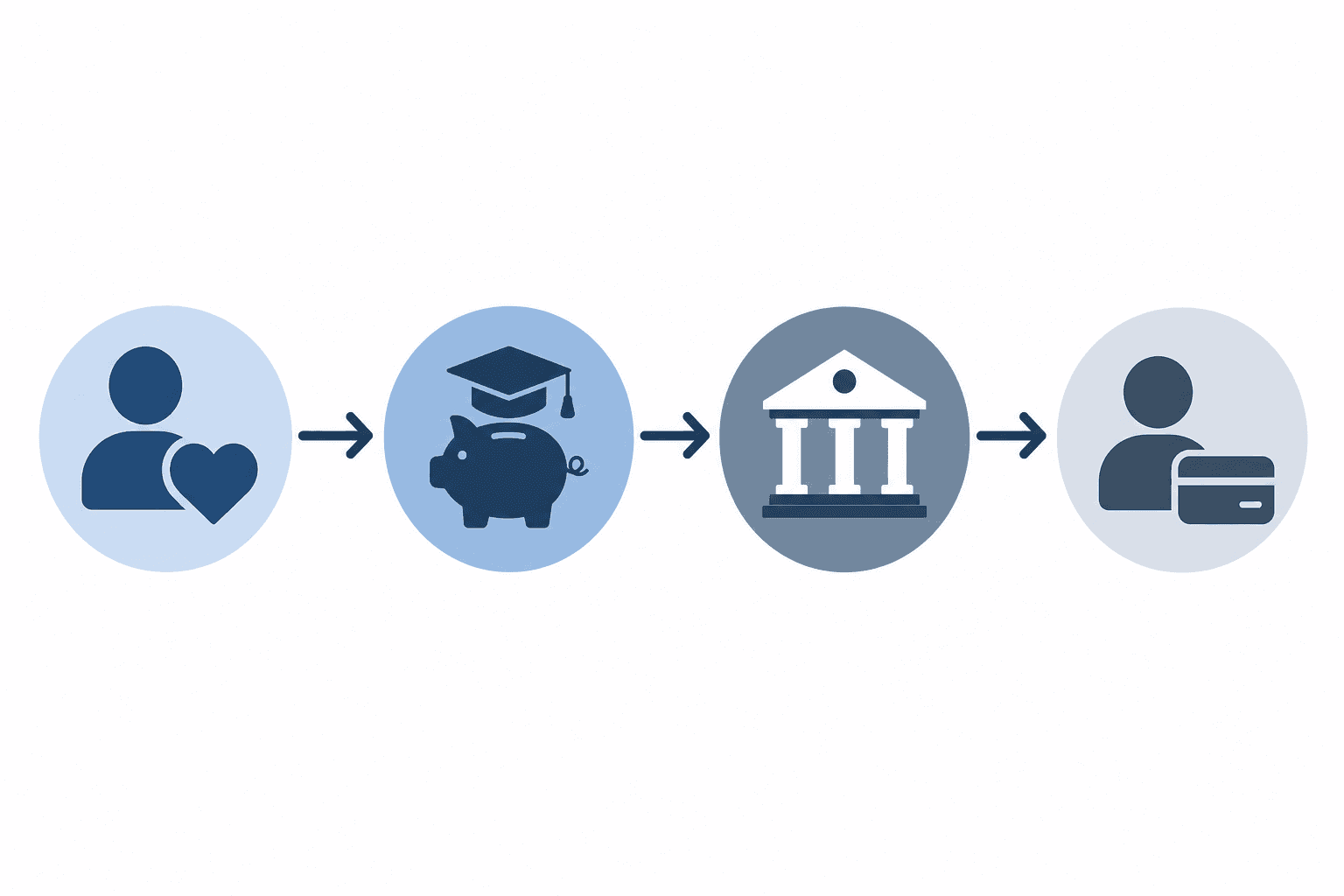
Pay the bursar. Write the check to the college financial aid or student accounts office, referencing the student ID, and require an enrollment verification before each disbursement. Splitting a $4,000 award into two $2,000 term payments means a student who withdraws in December carries no spring payment, and the unspent balance returns to the award pool.
The payee choice also has a tax consequence worth a sentence in the proposal. Scholarship money is tax free when the recipient is a candidate for a degree and the funds pay tuition and fees required for enrollment, or fees, books, supplies, and equipment required for courses. Amounts used for incidental expenses such as room and board, travel, and optional equipment are taxable to the student (IRS, Topic no. 421, page last reviewed February 9, 2026). Programs that hand a lump sum directly to students quietly create a tax bill for the people they meant to help.
The award letter and the proposal should both state:
- Renewal standard. Cumulative GPA floor, minimum credits completed per year, and continuous enrollment, stated as numbers.
- Displacement coordination. A written request that the institution apply the award against loans and unmet need before reducing institutional grant aid, so the student's net cost actually falls.
- Verification consent. Signed at application, authorizing enrollment and degree verification for the reporting period.
Scholarship Program Budget Example
Reviewers judge a scholarship budget on one ratio before anything else: how much of the request reaches students. Show that split on the face of the table rather than burying it in a narrative.
| Line item | Amount | Share of request |
|---|---|---|
| Student awards (30 × $4,000) | $120,000 | 80.0% |
| Completion coaching (0.4 FTE advisor) | $18,000 | 12.0% |
| Application platform and selection costs | $4,500 | 3.0% |
| Enrollment verification and disbursement processing | $2,500 | 1.7% |
| Outcome tracking and degree verification | $1,800 | 1.2% |
| Evaluation and reporting | $3,200 | 2.1% |
| Total request | $150,000 | 100% |
Under the table, state the restrictions in plain terms:
- Award dollars are restricted and cannot be reallocated to administration without written funder approval.
- Unspent award funds from mid-year withdrawals return to the award pool and are re-granted in the same cycle.
- Committee reviewer time is contributed and appears in the in-kind section rather than the cash request.
Coaching is the line a reviewer will push on, so justify it with contact hours: an advisor carrying 30 students at monthly check-ins for two years. Our grant proposal budget template covers narrative language for lines like this.
How to Measure Outcomes for a Scholarship Program
Measure what happens after the money lands: re-enrollment, credits earned, credential completion. Applications received and awards made are activity counts, and they belong in a separate paragraph from the outcome table.
| Measure | How it is verified | Reporting frequency |
|---|---|---|
| Fall-to-fall persistence of recipients | Enrollment verification record | Annual |
| Credits earned per academic year | Transcript release signed at application | Each term |
| Share of award applied to tuition and required fees | Bursar disbursement receipt | Each term |
| Credential completion within 150% of program length | Degree verification record | Annual, four years |
| Unmet gap remaining after the award | Award letter comparison | Annual |
Set the baseline with the institution's own prior-cohort rate for comparable students, and say which institution supplied it. A target measured against a named local baseline survives review, because the reviewer can see whether your students resemble the comparison group.
Track the four-year tail. Report persistence in year two and the completion number in year four, because completion is what supports a larger second request.

How a Scholarship Proposal Differs from a General Nonprofit Grant Proposal
A scholarship proposal follows the same outline as the general model in our sample grant proposal for a nonprofit organization guide, then replaces the contents of seven sections. The headings carry over and take entirely new evidence underneath them.
| Section | General nonprofit program proposal | Scholarship program proposal |
|---|---|---|
| Beneficiary | Participants described in aggregate | Named individuals selected one at a time |
| Need statement | Community-level problem data | Cost of attendance minus all committed aid, per student |
| Methods | Service model and staffing plan | Written, objective selection procedure and scoring rubric |
| Budget | Personnel-weighted | Award-pool-weighted, with a stated award-to-admin split |
| Legal framing | Standard charitable purpose | IRC section 4945(g) rules on grants to individuals |
| Outcomes | Units of service delivered | Persistence, credits earned, credential completion |
| Money flow | Funder to nonprofit to program costs | Funder to nonprofit to bursar to student account |
Reusing a general program proposal without swapping these sections is what makes a scholarship request read as generic. Teams running several proposal types keep the shared sections in one place and version the scholarship-specific ones. Our grant proposal guide covers the sections that carry over unchanged.
Funder Objections That Sink Scholarship Proposals
Five objections come up over and over, and each one already has a home somewhere in the document.
- "We do not fund individuals." The executive summary handles it: the grant is made to your 501(c)(3), which selects recipients independently under a documented procedure.
- "Our award will just replace the college's aid." Point to your displacement coordination language, and attach a financial aid office letter confirming how outside awards are applied if you have one.
- "$4,000 will not change whether this student graduates." The gap number from your need statement settles it: an award that closes a documented balance changes what the student actually owes in August.
- "Too much of this is administration." The share column in the budget table answers it, together with the in-kind note on volunteer committee time.
- "You will not know what happened to these students." The verification consent signed at application and the four-year reporting schedule cover this.
Put each answer where it naturally arises rather than in a defensive appendix.
What a Complete Scholarship Fund Proposal Contains
A complete scholarship fund proposal runs to ten parts, and a reviewer expects every one of them. Use the list as a build order and as a final check before you submit.
- Cover letter and a two-paragraph executive summary, written out in full.
- Statement of need carrying your district size, FAFSA completion rate, and median unmet gap.
- Program description with a dated annual cycle from application open through renewal review.
- Selection criteria, the 100-point rubric, the reviewer conflict-of-interest rule, and the tie-break rule.
- Application question set and the structured recommender form.
- Award terms and conditions letter, covering renewal standard, disbursement schedule, and verification consent.
- Bursar disbursement language and the displacement coordination request.
- Budget table with the award-to-administration split and the accompanying narrative notes.
- Evaluation plan with five outcome measures, the verification method for each, and a reporting calendar.
- Sustainability section and an attachment checklist.
The structured recommender form and the sustainability section are the two that go missing most often, and a reviewer notices both.
FAQ
How do I write a grant proposal for a scholarship program?
Draft the selection procedure first, then the need statement built on the median unmet gap of your applicant pool. Then the award terms and disbursement plan, the budget with its award-to-administration split, and the evaluation plan. Write the executive summary last, once the numbers are fixed.
What is a scholarship proposal?
A scholarship proposal is a funding request that asks a grantmaker to underwrite awards paid toward named students' education costs. It also documents how you select recipients, how much each one receives, how funds reach the institution, and how you verify enrollment and completion.
How much should a scholarship award be?
Size the award against the documented unmet gap for your students rather than against a round number. An award that closes a measured remaining balance at the institutions your students attend is easier to justify than a larger award with no stated relationship to cost.
Do foundations give grants to individual students?
Some do. A private foundation making grants to individuals for study must award them on an objective and nondiscriminatory basis under a procedure approved in advance by the IRS, requested on Form 8940 (IRS, Advance Approval of Grant-Making Procedures, page last reviewed June 28, 2026). Many foundations skip that step by funding a public charity that runs its own scholarship program.
Are scholarship funds taxable?
Scholarship money is tax free when the recipient is a candidate for a degree and the funds pay tuition and fees required for enrollment, or fees, books, supplies, and equipment required for courses. Amounts used for incidental expenses such as room and board, travel, and optional equipment are taxable (IRS, Topic no. 421, page last reviewed February 9, 2026).
How do you measure the success of a scholarship program?
Measure fall-to-fall persistence, credits earned per year, and credential completion within 150 percent of normal program length, verified through enrollment and degree records rather than self-report. Compare each against the institution's own prior-cohort rate for similar students.
Next Steps
Community foundations and education-focused private foundations both fund scholarship pools, and state education agencies post opportunities on portals that no single federal search reaches. GrantCue tracks federal and state grant opportunities in one searchable grant database and publishes 990-PF filing data for each foundation, including the recipients and stated purposes of the grants it has paid. Our guide to how to write a grant proposal gives the drafting order that puts the executive summary last.
After two scholarship cycles, renewal reviews and reporting dates stop fitting in a spreadsheet. Start a GrantCue account to keep every application deadline and reporting date in one place.