Conservation Grant Writing: A Sample Grant Proposal for an Environmental Nonprofit
A worked sample grant proposal for an environmental nonprofit: a composite $75,000 riparian restoration request with acreage targets and unit-cost budget lines.
Last updated: September 2026
Conservation proposals get rejected for reasons a generic template never mentions. A sample grant proposal for an environmental nonprofit has to answer questions about site control, permits, plant survival, and who mows the buffer in year three. The composite worked through below requests $75,000 over 18 months to restore 9,240 linear feet of streambank across five private parcels, with every budget line priced per unit so a reviewer can recompute the total.
Quick Answer: What Does a Grant Proposal for an Environmental Nonprofit Include?
An environmental nonprofit grant proposal includes the standard sections (need, goals, budget, evaluation) plus four conservation-specific ones: a site description with acreage and parcel detail, written site control from every landowner, current permit status, and a stewardship plan naming who maintains the site after the grant closes. You report outcomes in acres, linear feet, stems, and survival rate.
Free download: Complete sample proposal for an environmental nonprofit as Word .docx. No email address required.
Sample Grant Proposal for an Environmental Nonprofit: Section by Section
A conservation proposal uses the same nine sections as any other grant request, then adds site evidence a reviewer can verify on a map. A conservation program officer reads each section for a specific piece of evidence, and the third column below names a common way each one falls short.
| Proposal section | Evidence a reviewer can verify | Common weakness |
|---|---|---|
| Executive summary | Acres, linear feet, and the ask in the first paragraph | Opens with mission language, buries the site |
| Statement of need | Measured baseline conditions at this specific site | Global framing with no local data |
| Project description | Named practices, species, sequence, planting season | "Restoration activities" with no method |
| Site control | Signed landowner agreements and their term | Assumes permission is implied |
| Permits | Each permit named, with current status | Silence, which reads as unpermitted |
| Goals and outcomes | Countable units plus a monitoring protocol | Promises water quality gains in 12 months |
| Budget | Unit costs a reviewer can recompute | Lump sums like "restoration: $40,000" |
| Stewardship plan | A named party funded through year five | Plan ends the day the grant does |
| Partners | Defined roles and who signs off | Logos with no described responsibility |
If the general structure is new to you, start with how to write a grant proposal and treat conservation requirements as an overlay on that structure.
What Goes in a $75,000 Riparian Restoration Request
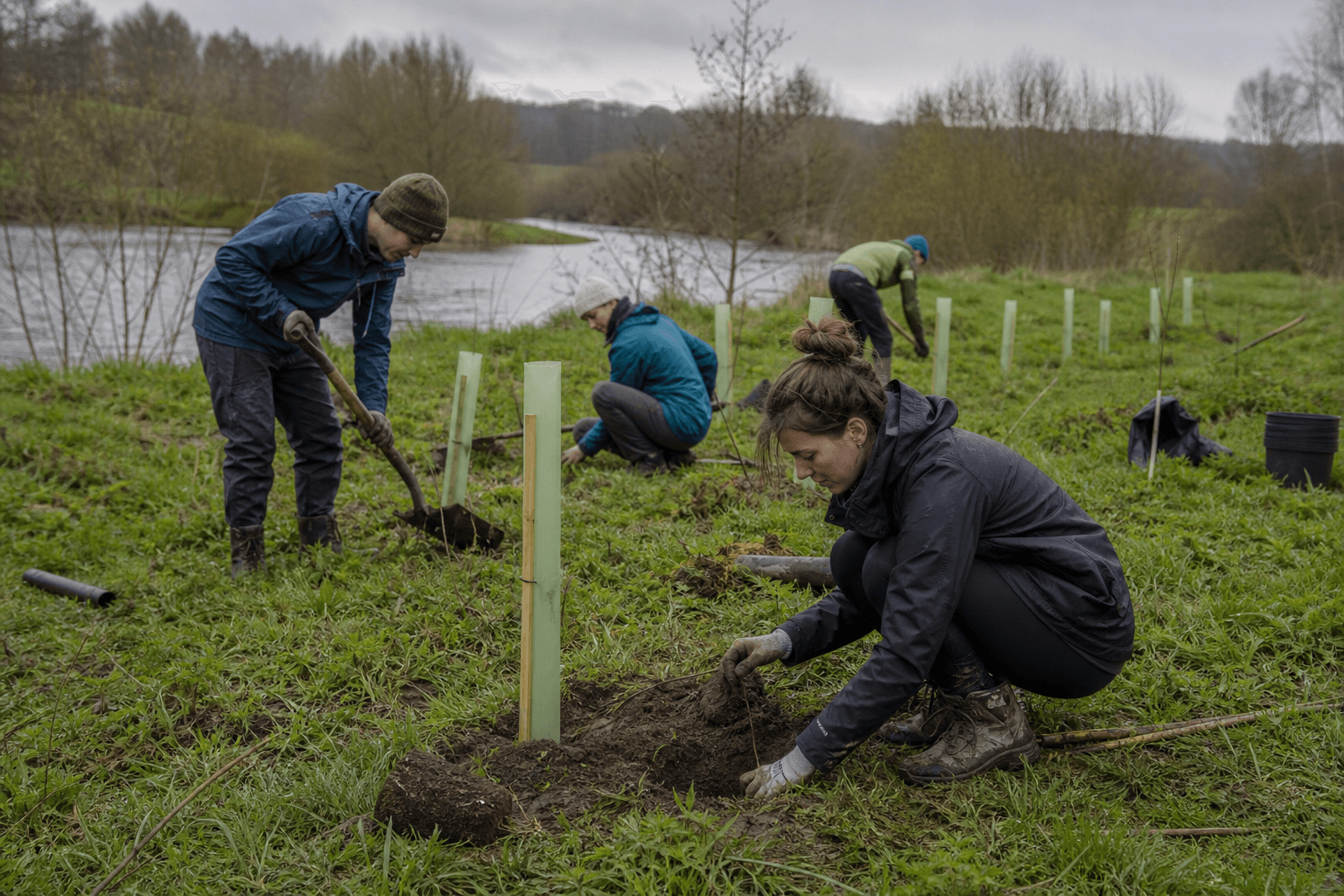
The example request funds 9,240 linear feet of streambank restoration across five private parcels on a headwater tributary, over 18 months, for $75,000. It plants 22 acres of riparian buffer with 4,400 native trees and shrubs across 18 species, treats 9 acres of invasive cover, and excludes livestock from the channel with 3,800 linear feet of fencing, two hardened crossings, and two off-stream watering systems. The applicant is a composite example, not a real organization: a watershed nonprofit with four staff and an annual operating budget in the low six figures, applying to a regional family foundation that funds land and water conservation.
A reviewer can divide the request by the linear feet, compare the result against other restoration proposals on the desk, and decide whether $8.12 per foot is defensible.
What a Sample Grant Proposal for a Non Profit Organization Leaves Out
Generic nonprofit proposal samples leave out four things a restoration request cannot skip: site control, permitting, plant establishment, and post-grant stewardship. A program proposal can promise to serve 300 students without proving it owns the classroom. A restoration proposal cannot.
Name every parcel, every landowner, and the instrument that gives you access. A signed 15-year landowner agreement reads differently than a handshake. If a parcel is unsigned at submission, say so and give the date you expect it.
List each permit by name with its status. Work that discharges dredged or fill material into a stream or wetland generally needs a federal permit under Section 404 of the Clean Water Act, administered day to day by the U.S. Army Corps of Engineers (EPA, "Permit Program under CWA Section 404," accessed September 10, 2026). State authorizations sit alongside it, and their names vary by state. In Pennsylvania the same crossing needs a Chapter 102 earth disturbance authorization and a Chapter 105 water obstruction and encroachment permit, and DEP and the Corps accept one joint application covering Chapter 105 and Section 404 together (Pennsylvania DEP, Chapter 105 permitting guidance, accessed September 10, 2026). Reviewers assume an unmentioned permit is an unstarted permit.
Planting is the cheap part of establishment. Restoration budgets actually go to watering through the first dry summer, mowing competing vegetation, straightening tree shelters after ice, and replacing failed stems. Fund it or explain who does.
Say who holds the site in year five and what money pays for it. If the answer is a partner such as a conservation district or a land trust, get that in writing and attach it.
Statement of Need for a Conservation Project
Describe measured conditions at the project site, not the state of the planet. A conservation statement of need is the section where a reviewer decides whether the gap is visible on a map.
Start with the site: current buffer width, bank condition, livestock access points, invasive cover, and any monitoring data you or a partner already hold. Add the watershed context: whether the stream appears on a state impaired waters list, whether an approved watershed plan or county open space plan names this reach, and what upstream and downstream neighbors have already restored. Close with the consequence of doing nothing, stated in the same units as your outcomes.
If your only baseline is a walk-through with photographs and GPS points, use that and label it as what it is. Local dated observation carries more weight here than national figures. For the general pattern, see these statement of need examples and swap the social data for site data.
Outcome Measures Environmental Funders Score
Environmental outcome measures are physical counts with a stated method and a stated date. Acres, linear feet, stems, percent cover, and survival rate all survive an audit, because each one names a unit and a counting method. "Improved ecosystem health" names neither.
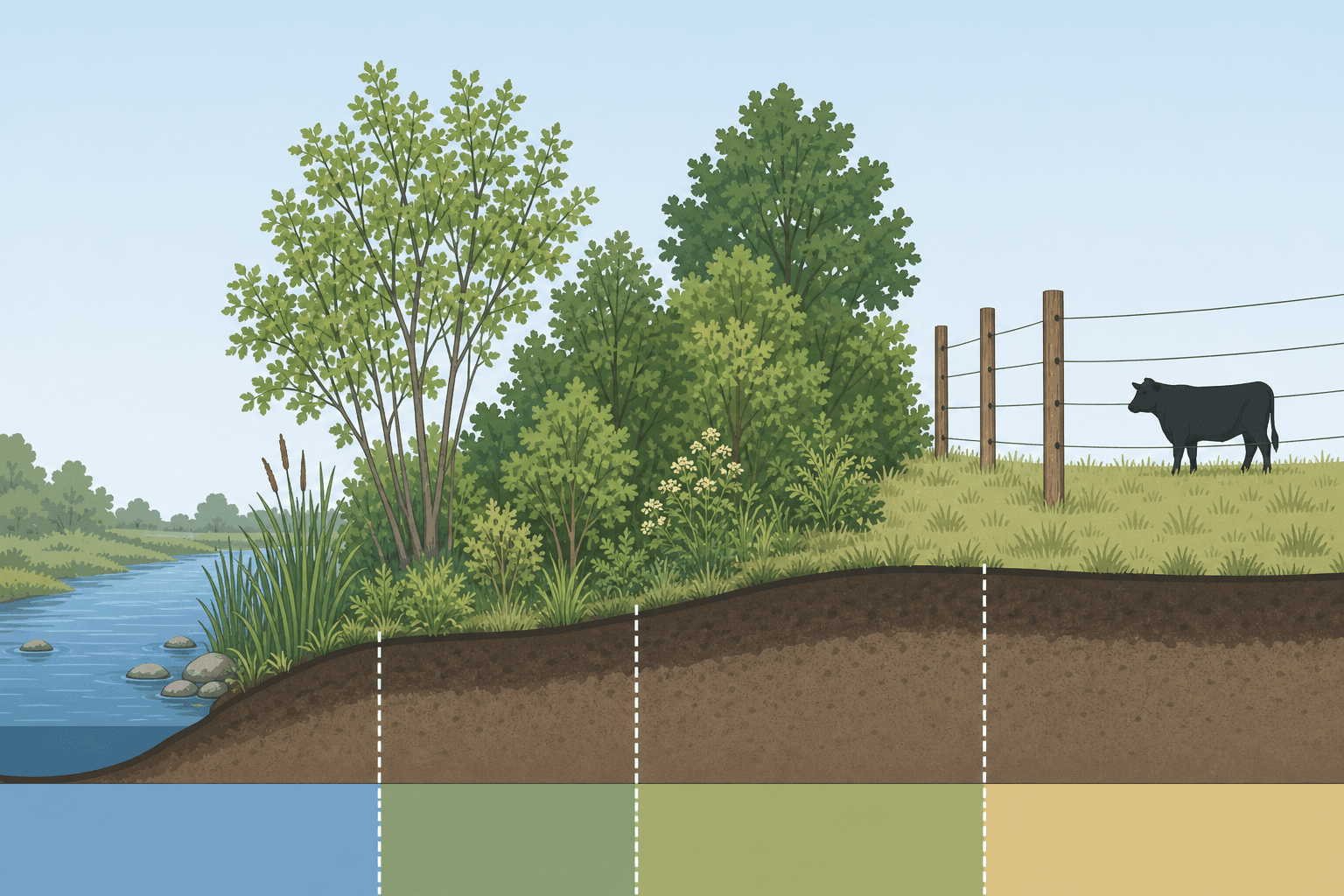
Time is the part that breaks an environmental outcome section. Bank stability and shade begin to change within a few seasons, while measurable in-stream water chemistry can lag well past the end of an 18-month award. Promising a nitrate reduction inside the grant term invites a reviewer to mark the proposal as unrealistic, and invites a final report you cannot write.
The fix is to separate implementation measures, which you control, from response measures, which you monitor and report without promising a value.
| Measure | Baseline in the example | Target at month 18 | Method | Type |
|---|---|---|---|---|
| Streambank with woody buffer at least 35 feet wide | 1,100 of 9,240 linear feet | 9,240 linear feet | GPS field survey plus GIS | Implementation |
| Native stems installed | 0 | 4,400 across 18 species | Planting records by parcel | Implementation |
| Stem survival | Not applicable | At least 80% at month 12 | Count in 10% sample plots | Implementation |
| Invasive cover on treated acres | 45% mean cover | 10% or less mean cover | Line-intercept transects | Implementation |
| Direct livestock access points | 5 | 0 | Field inspection with partner | Implementation |
| Macroinvertebrate condition | Spring baseline score | Reported, direction of change | State volunteer monitoring protocol | Response |
| Turbidity and suspended solids | 3 baseline events at 4 stations | Reported after 3 post-implementation events at the same 4 stations | Certified lab | Response |
That split is the honest answer to a reviewer asking how you will know the project worked: you counted what you installed, and you keep monitoring what you cannot promise. Build the section using an evaluation plan template and label every row as implementation or response.
Line Items Specific to Restoration and Land Protection
Price every line in units before writing a word of the budget narrative. A restoration budget names what the unit is and what it costs, so a reviewer can recompute the total.
The unit costs below are illustrative figures for the composite example. Price stems, shelters, fencing, contracted treatment, and lab work against local quotes before you use any of them.
| Line item | Amount | Basis |
|---|---|---|
| Native plant material, 4,400 bare-root stems, 18 species | $15,400 | $3.50 per stem, delivered |
| Tree shelters and stakes, 2,600 tree stems | $5,200 | $2.00 per sheltered stem; shrubs planted unsheltered |
| Invasive treatment, 9 acres, two passes | $9,000 | Contracted crew, $500 per acre per pass |
| Livestock exclusion fencing, 3,800 linear feet | $7,600 | $2.00 per foot, materials and installation |
| Two hardened crossings and two off-stream waterers | $6,400 | Fabricated units plus site preparation |
| Water quality monitoring, 3 baseline plus 3 post events at 4 stations | $4,320 | 24 sample suites at $180, certified lab |
| Establishment materials, months 6 to 18 | $3,500 | 400 replacement stems, shelter repairs, two contracted mowing passes |
| Project manager, 0.15 FTE for 18 months | $13,500 | 0.225 FTE-years at a $60,000 fully loaded salary |
| Seasonal field technician, 0.2 FTE for 12 months | $8,400 | 0.2 FTE-years at a $42,000 fully loaded rate |
| Vehicle mileage and small equipment | $1,680 | Field travel across five parcels |
| Total request | $75,000 | All direct costs |
The example carries direct costs only. The narrative has to state how the organization handles indirect costs. Follow the funder's written policy, and on a federal award, the cost principles in 2 CFR Part 200 Subpart E (eCFR, Title 2 current as of August 28, 2026). Ask the program officer before you assume a rate.
The seasonal field technician line is the establishment labor budget: watering, mowing supervision, and shelter repair through month 18. The establishment materials line pays for the 400 replacement stems that back up the 80% survival target.
Conservation work has match sources that other sectors do not: landowner in-kind contributions, donated heavy equipment hours, volunteer labor at whatever valuation rate the funder permits, and federal agricultural cost-share such as the NRCS Environmental Quality Incentives Program, which provides technical and financial assistance to agricultural producers and forest landowners for conservation practices (USDA Natural Resources Conservation Service, accessed September 10, 2026). Show leverage as a separate column with a source for each entry. A grant proposal budget template gives you the underlying layout to build on.
Site Control, Permits, and the Questions Conservation Funders Ask First
Conservation reviewers ask a predictable set of hard questions. Answer each one up front, in its own short paragraph. The general grant proposal writing steps tell you where each answer belongs in the narrative.
Do you have the right to be on this land, and for how long? Attach the agreements. State the term. A five-year agreement on a 40-year planting is a real risk, so name it and explain what you are doing about it, whether that is a longer term at renewal or a future easement conversation.
Are the permits in hand? Give the status of each one with a date. If a permit is pending, say who filed it and when a decision is expected.
Why isn't a public program paying for this? This one comes up on agricultural and stream work, because public cost-share exists for many of these practices. Cost-share often covers the practice itself and stops short of the invasive pretreatment or the technical assistance that gets a landowner to sign. Say which parts are covered and which parts you are asking the funder to close.
Does this sit inside a larger plan? Many conservation programs award points for alignment with an approved watershed, county, or regional conservation plan, so read the scoring rubric and name the plan and the page it appears on.
What stops this from being undone? Land changes hands. Say what protects the investment: the agreement term, a recorded easement, the partner that holds monitoring responsibility, or the landowner relationship that keeps the fence standing.
What Happens After the Grant Ends
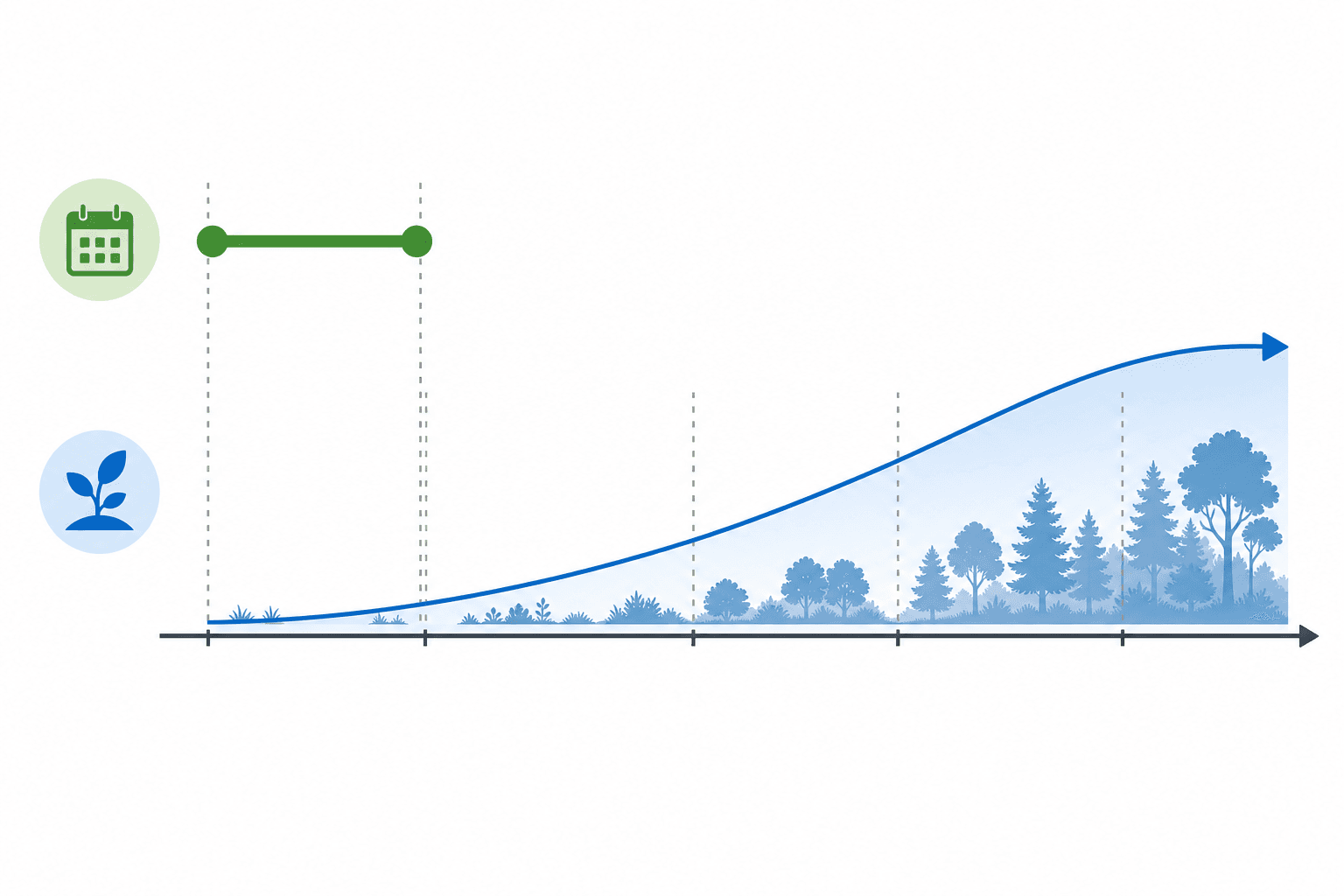
A stewardship plan names the party responsible for the site after closeout, the tasks that party performs, the years those tasks run, and the money that pays for them.
Cover four things. Maintenance tasks by year, since year one is watering and mowing while year four is shelter removal and spot treatment. The responsible party for each task, named. The funding source for that work, whether that is a stewardship line in your operating budget, a partner agreement, or the establishment line in this grant. Finally, the trigger for replanting: if survival falls below the threshold you promised, state what happens and who pays.
Attach the maintenance schedule and the budget line that funds it.
Where Environmental Nonprofits Find the Funders
No single portal covers environmental funding. It splits across private foundations, federal programs, state agencies, and county or utility-level programs, and each layer runs its own systems.
GrantCue's IRS Form 990-PF grant corpus held 2,426,795 grant records drawn from filings for tax years 2021 through 2025 when it was reviewed on September 10, 2026. GrantCue classified 61,580 of those records, totaling roughly $3.5 billion, as environmental and conservation giving. That count spans five tax years, so it is not an annual figure. Filed 990-PF returns are historical, arrive on a delay, and may be incomplete, which makes the total a floor rather than a census of environmental giving.
Federal opportunities post to Grants.gov. State environmental and natural resources agencies run their own portals on their own software, which is why a search that works in one state returns nothing in the next. County open space programs, water utility source-protection funds, and regional conservation partnerships often never appear in a searchable database at all.
You can search federal and state grant listings in one place, and pair that with a foundation list built from 990-PF filings to find funders that give in your watershed more than once.
How to Adapt the Example to Your Site
Swap the example's parcels, species, acreage, and unit prices for yours, then confirm the scope numbers still agree across the project description, the budget, and the outcome table.
Start with the scope numbers, because everything downstream is derived from them. Measure the linear feet and the acres, set the stem count from your own planting density, and price stems, shelters, fencing, and lab work from local quotes. Then run the reconciliation a reviewer will run: divide the request by the linear feet, confirm every outcome has a budget line paying for the measuring, and confirm the survival threshold you promise has a replacement line behind it.
Last, write the stewardship plan before the narrative. The answer to who mows the buffer in year three usually changes what the budget has to cover.
FAQ
How do you write a grant proposal for an environmental nonprofit?
Write the standard sections first, then add the conservation layer: a site description with acreage and parcel detail, signed landowner agreements, permit status with dates, outcome measures in physical units, and a stewardship plan funded past the grant period. Price the budget in units so a reviewer can recompute it.
What do conservation funders look for in a grant proposal?
Conservation funders look for site control, permits, credible unit costs, countable outcomes, and a named party maintaining the site after closeout. They also check whether the project appears in an existing watershed or regional plan, so name the plan and the page it appears on.
Do you need landowner permission before applying for a restoration grant?
Yes for most restoration awards. Written site control at submission is a common requirement, and a funder that requires it may hold disbursement until the agreement is signed. If an agreement is still in progress, name the parcel, name the landowner status, and give the date you expect signature.
What outcome measures work best for environmental grants?
Physical counts with a stated method: linear feet of streambank buffered, acres treated, native stems installed, percent survival at 12 months, and percent invasive cover after treatment. Report water chemistry and biological indices as monitored response measures instead of promising a value inside the grant period.
How long should an environmental grant proposal be?
Follow the funder's stated limit exactly. When no limit is given, a complete conservation request usually runs eight to twelve pages of narrative plus appendices for maps, landowner agreements, permits, and the species list. Reviewers care more about whether the acreage, budget, and outcomes reconcile than about length.
How do environmental nonprofits track multiple grant deadlines?
Track deadlines, reporting dates, and monitoring windows in one calendar tied to each award. Restoration reporting is seasonal, and a missed spring planting window pushes an entire deliverable a year. A shared pipeline with deadlines and assigned tasks handles this better than a spreadsheet once you pass a handful of active awards.
Next Steps
Work backward from the funder's deadline through your permitting and planting calendar, since a permit decision or a planting season usually sets the real submission date. Grants lifecycle management covers what happens after the award, when monitoring and reporting obligations outlast the grant period itself.