Sample Grant Proposal for Food Bank Funding: Example, Budget, and Free Template
A sample grant proposal for food bank funding, with a worked example covering statement of need, cold chain program design, budget lines, and meal metrics.
Last updated: September 2026
A sample grant proposal for food bank funding has to do something a generic nonprofit template never does: prove that pounds of donated food will reach people in edible condition. Need is the easy half of the argument. The harder half is sourcing product, keeping it cold, moving it, and pricing every budget line in writing.
Quick Answer: What Goes in a Sample Grant Proposal for a Food Bank?
A food bank grant proposal contains a cover letter, an organizational summary, a statement of need built on county-level food insecurity data, a program description covering food sourcing and cold chain handling, a line-item budget, an outcomes table stated in pounds distributed and meal equivalents, and a sustainability plan for the recurring costs after the grant ends.
Free download: Complete sample proposal for a food bank as Word .docx. No email address required.
Sample Grant Proposal for Food Bank Applications: What It Contains
A food bank proposal is a standard nonprofit proposal carrying a sourcing plan, a cold chain plan, and a measurement section stated in pounds. The rest follows the structure in our guide to how to write a grant proposal.
| Section | Length | What to put in it |
|---|---|---|
| Cover letter | 1 page | Amount requested, project name, executive director signature |
| Executive summary | 1 page | Pounds moved, households reached, total cost, amount requested |
| Statement of need | 1 to 2 pages | County-level data, not national data, plus your waitlist evidence |
| Program description | 2 to 3 pages | Sourcing agreements, cold chain handling, sites, schedule |
| Organizational capacity | 1 page | Warehouse and cold storage capacity, food safety credentials |
| Budget and narrative | 2 pages | Equipment quotes, cost per pound, indirect rate documentation |
| Outcomes and evaluation | 1 to 2 pages | Baseline, targets, who records each number and where |
| Sustainability | Half page | Who pays for fuel, insurance, and driver hours in year two |
The download with this article is a full-length Word version of that structure, with each section written out instead of left as a blank prompt: sample-grant-proposal-food-bank.docx. We do not ask for your email address.
How Much Food Banks Actually Receive From Foundations
Food security grants from private foundations are numerous and small. GrantCue's index of IRS Form 990-PF grant records, measured on September 10, 2026, holds 32,634 food security grant items totaling $689 million, an average of roughly $21,000 per grant.
| Sector | Grant records | Total awarded | Average per grant |
|---|---|---|---|
| Health and clinics | 108,962 | $14.8B | ~$140,000 |
| Community development | 29,910 | $3.3B | ~$110,000 |
| Education, K-12 | 339,302 | $31.8B | ~$94,000 |
| Environment and conservation | 61,580 | $3.5B | ~$57,000 |
| Arts and culture | 100,818 | $5.3B | ~$53,000 |
| Faith-based | 138,125 | $5.3B | ~$38,000 |
| Youth services | 95,969 | $3.6B | ~$38,000 |
| Housing and homelessness | 23,281 | $850M | ~$37,000 |
| Veterans | 6,284 | $207M | ~$33,000 |
| Libraries and literacy | 18,712 | $503M | ~$27,000 |
| Food security | 32,634 | $689M | ~$21,000 |
| Animal welfare | 27,228 | $479M | ~$18,000 |
Only animal welfare averages less per grant than food security in GrantCue's 990-PF index.
Source: GrantCue's index of IRS Form 990-PF grant records, measured September 10, 2026. Sector was assigned by matching purpose text on Part XV grant items, so each row is a purpose-matched bucket from the filings in GrantCue's corpus, not a census of all 990-PF filings. Averages are means derived from the rounded totals shown, and grant sizes are heavily right-skewed, so the typical award sits below the mean. These are private foundation grants only, excluding government awards and corporate in-kind donations.
Set your request from the individual funder's grant history rather than a sector average. And because awards run small, capital items like trucks and freezers usually get assembled from several funders, so your budget has to show what is already committed.
Food Bank Grant Proposal Example: Statement of Need
Build the need statement on your own service area first, then bring in outside data to frame it. A statement of need for a food bank establishes that hunger exists in a specific place and that your organization is the practical route to reducing part of it.
Cite the edition of every outside source you use.
| Source | Edition to cite | What it gives you |
|---|---|---|
| Feeding America, Map the Meal Gap 2026 | Released July 28, 2026, built on 2024 data | County and congressional district food insecurity estimates |
| USDA Economic Research Service, Household Food Security in the United States in 2024 | Report ERR-358, the final edition of the series | National and regional prevalence |
| USDA ERS, Food Access Research Atlas | Restructured July 2026; underlying store locations are 2019 data | Low-income, low-access census tracts |
| U.S. Census Bureau, Small Area Income and Poverty Estimates | Name the estimate year you used | County poverty and child poverty rates |
Two of those carry warnings. USDA announced on September 20, 2025 that it was ending future Household Food Security Reports and the survey behind them, so the 2024 edition is the last. The Food Access Research Atlas tract layer still runs on 2019 store locations after its July 2026 restructure. Feeding America has said its methodology changes for 2027.
Your own operating record is the other half, and no competing applicant can produce it. Record the waitlist at each pantry site, the households you turned away at closing, the product you refused for lack of cold storage, and the road miles between your nearest pantry and the tract you want to reach.
Example County Food Bank is a composite, not a real organization. It serves a rural county from one warehouse and four partner pantries in the county seat. Two townships in the northeast corner sit more than twenty road miles from the nearest pantry, and the food bank turns down donated dairy and protein because its only truck is unrefrigerated. The requested project follows from those facts.
For sentence-level structure, see our statement of need examples and template.
Food Bank Grant Proposal Example: Program Description
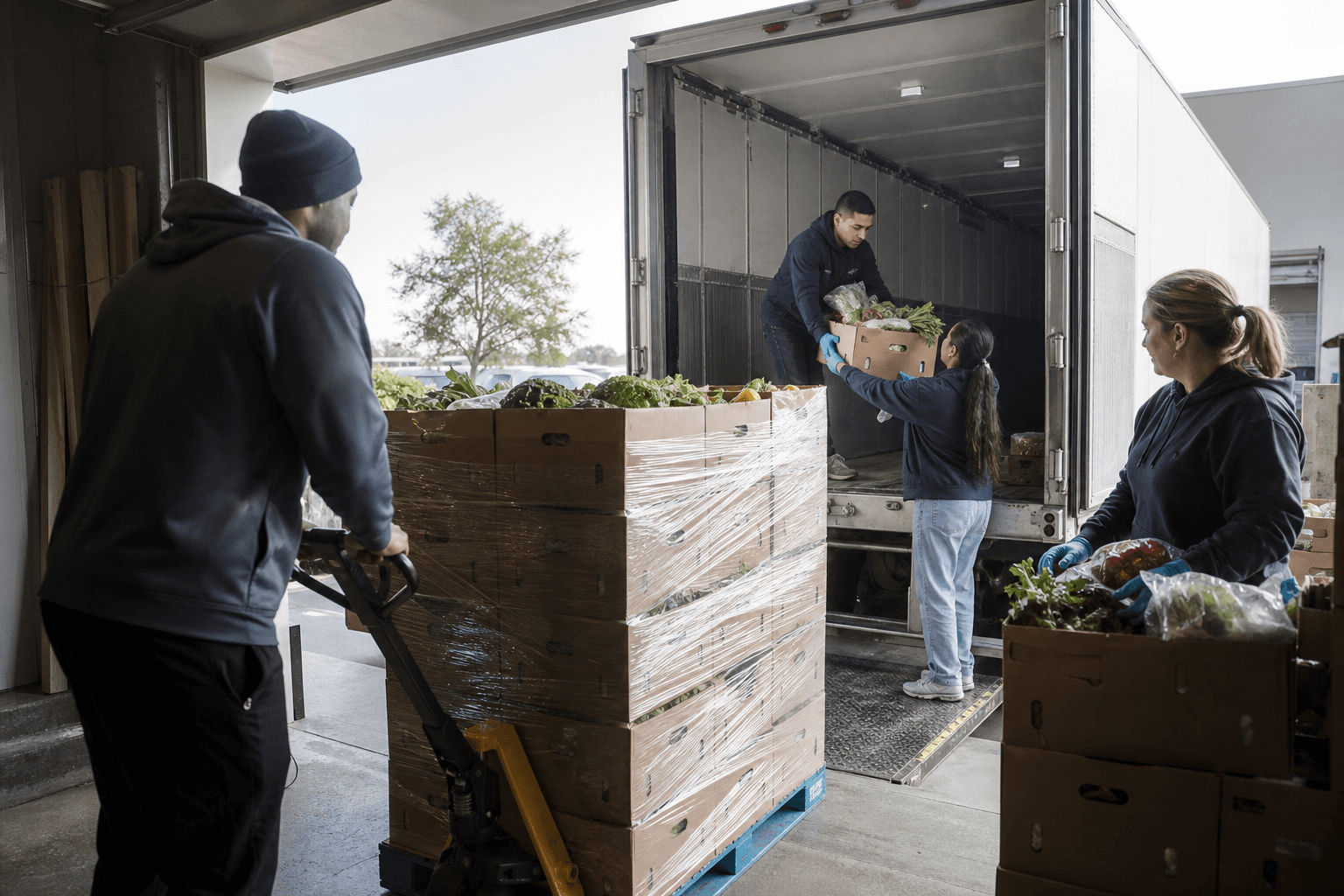
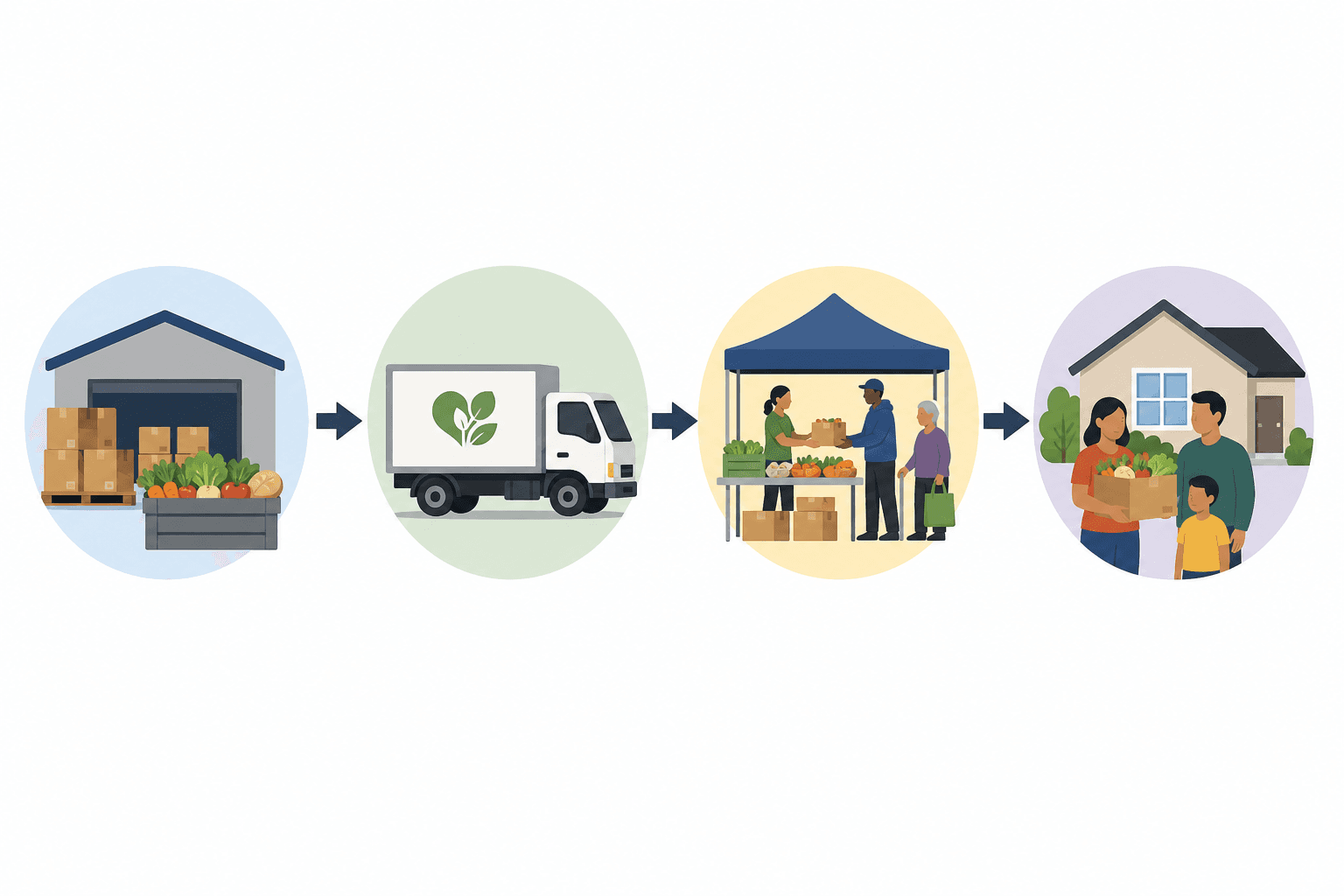
Trace the food from the dock it arrives on to the household that eats it, naming a temperature control step at every transfer. A program description that skips the logistics leaves a reviewer nothing to score.
Cover these points:
- Name where the product comes from: regional allocations, signed retail rescue agreements, grower donations, purchased bulk, and USDA commodity programs.
- State your cold storage capacity in pallet positions, your temperature monitoring method, who holds food handler certification, and how often the health department inspects you.
- List each distribution site, its census tract, hours, and expected household volume. For a new site, say who owns the lot and whether you have written permission.
- Describe the client experience: prepacked boxes or client choice, languages spoken on site, and whether clients get screened for SNAP eligibility.
- Give a month-by-month timeline from purchase order to first distribution.
In the example, the program is a refrigerated route. Example County Food Bank buys a used reefer box truck, hires a driver at 0.4 FTE, and runs two mobile pantry sites in the northeast townships on alternating weeks. The truck also lets the warehouse accept dairy and protein it turns down today, so one purchase raises both quality and volume.
Food Bank Grant Proposal Budget Example
Attach a written quote to every capital line. A reviewer cannot tell a vendor price from a guess, and an unpriced $34,000 truck reads as the second one.

| Line item | Amount | How it was priced |
|---|---|---|
| Used 16-foot refrigerated box truck | $34,000 | Written dealer quote, attached as an appendix |
| Pallet jack and cargo securing equipment | $1,900 | Supplier catalog pricing |
| Vehicle insurance, 12 months | $2,600 | Quote from the current carrier |
| Fuel and maintenance, 12 months | $4,300 | Planned route mileage at the current per-mile cost |
| Route driver, 0.4 FTE with benefits | $18,200 | Existing warehouse pay scale |
| Wireless temperature loggers, 4 units | $600 | Supplier catalog pricing |
| Food handler certification, 6 people | $900 | State program fee schedule |
| Mobile pantry site equipment | $2,500 | Supplier catalog pricing |
| Total direct costs | $65,000 | |
| Modified total direct cost base | $31,000 | Direct costs less the truck, excluded from MTDC as equipment |
| Indirect costs at the 15 percent de minimis rate | $4,650 | 15 percent of the $31,000 MTDC base |
| Total project cost | $69,650 | |
| Requested from this funder | $50,000 | |
| Committed from other sources | $19,650 | Board reserve plus a pledged local match |
Figures above are a composite example, not a real organization's budget.
The indirect line is where these budgets go wrong most often, because the base is not total direct costs. If your organization holds a federally negotiated rate, apply it to the base its agreement specifies. Otherwise 2 CFR 200.414(f) permits a de minimis rate of up to 15 percent of modified total direct costs, and 2 CFR 200.1 excludes equipment, capital expenditures, rental costs, participant support costs, and subaward amounts above $50,000 from that base. The $34,000 truck is equipment, since 2 CFR 200.1 caps that threshold at $10,000 per unit, so it leaves the base while the smaller supply lines stay in. Both come from OMB's Guidance for Federal Financial Assistance final rule, 89 FR 30046 (April 22, 2024), effective for awards issued on or after October 1, 2024. Verified on ecfr.gov, Title 2 current as of September 8, 2026. Private foundations set their own indirect policies, so check the guidelines before carrying a federal rate into a foundation budget.
Show a cost per pound too, so the project can be weighed against simply buying food. Our grant proposal budget template with nonprofit examples covers the matching narrative format.
Outcome Measures Funders Expect From a Food Bank
Funders count food bank outcomes in pounds, meal equivalents, and households. State who records each number and where, or the target is unverifiable.
| Measure | Baseline | 12-month target | Where the number comes from |
|---|---|---|---|
| Pounds distributed on the refrigerated route | 0, the route does not exist | 180,000 pounds | Warehouse scale logs at load-out |
| Fresh produce, dairy, and protein as a share of route poundage | Not applicable | 60% | Inventory category codes in the pantry system |
| Households served at the two new mobile sites | 0 | 640 | Site sign-in records, deduplicated by household ID |
| Meal equivalents delivered | 0 | Pounds divided by the published conversion factor | Conversion factor named and cited in the proposal |
| Product discarded for temperature excursion | Not applicable | Under 1% of route poundage | Temperature logger exports and discard records |
| Clients screened for SNAP eligibility on site | 0 | 300 | Screening log kept by the site coordinator |
Targets above are a composite example.
Meal equivalents deserve care. Food banks convert pounds to meals using a divisor that differs between organizations. Name the conversion factor, cite its source, and hold it constant for the life of the grant. A factor that changes between the proposal and the final report makes every meal number in both unverifiable.
Avoid claiming outcomes you cannot observe. A food bank can prove pounds delivered and households served. It cannot prove county food insecurity fell, because it does not control the other causes. Claim what you measure, then describe the longer chain as what you believe will follow. The evaluation plan template and examples shows that distinction on the page.
Sample Grant Proposal for a Non Profit Organization: What a Food Bank Changes
A sample grant proposal for a non profit organization gives you the standard skeleton, and a food bank keeps most of it. Four things change.
Need data is geographic, so census tracts and road miles carry more weight than participant profiles. The budget is capital-heavy, so vendor quotes do more work than staffing narratives. Outcomes are weights and counts, so pounds and households replace the pre and post survey scores that fill a typical services proposal. And capacity means physical capacity: state pallet positions, cubic feet of cold storage, and food safety credentials, because staff degrees do not establish whether you can hold a pallet of chicken at temperature.
Rewrite those four sections and keep the rest. Our guide to writing a grant proposal covers what stays the same.
Objections a Food Bank Proposal Has to Answer
Answer the obvious objections inside the narrative rather than leaving them for the review panel. Each has a factual answer.
"This is emergency relief, not a solution." Pair distribution with something that moves people forward, such as SNAP screening at every mobile site, and say what share of clients you expect to reach.
"Why not route this through the regional food bank?" Describe the last-mile gap you fill and attach the partner agreement.
"Can you keep the cold chain safe?" Say who holds food handler certification, what your temperature loggers record and how often, who reviews the logs, and attach the latest health inspection.
"Are you duplicating the pantry down the road?" Map your service area against the other pantries and mark the tracts none of you reach.
"What happens when the grant ends?" Give the annual operating cost of the route and name the budget line that carries it in year two.
Where to Find Grants for Food Banks
Federal commodity programs, state hunger relief line items, and private foundations each post in a different place. Searching one misses the other two.
Federal money reaches food banks two ways. Discretionary opportunities post on Grants.gov. Commodity programs work differently: USDA's Food and Nutrition Service administers The Emergency Food Assistance Program (TEFAP) and the Commodity Supplemental Food Program (CSFP) through state distributing agencies, so the paperwork goes to a state office rather than to Washington. The program pages at fns.usda.gov name the current structure.
State and county funding is the layer most applicants underuse. Departments of agriculture, human services, and aging carry hunger relief line items that rarely appear on Grants.gov, and each state runs its own portal software. Ask your state association of food banks which agency posts what, then calendar the recurring cycles, because most open once a year and close quickly.
The 32,634 records in GrantCue's 990-PF index are private foundation grants specifically. Community foundations file Form 990 rather than Form 990-PF, and corporate giving programs often file nothing public, so neither appears in that count even though both fund hunger relief. Check them separately: 990-PF filings for private foundations, a community foundation's published grant list, and a company's corporate responsibility page.
GrantCue's grant search covers federal and state portals in one place and includes foundation profiles built from IRS 990-PF filings, so you can check a funder's food security giving before you write.
FAQ
How do you write a grant proposal for a food bank?
Start with county-level need data and your own service records, describe the sourcing and cold chain path the food will take, price every capital item with a vendor quote, and state outcomes in pounds distributed and households served with a named recording system behind each target. Close with who pays the recurring costs.
How much money can a food bank ask for in a grant?
Check the funder's own grant history first. Across 32,634 food security grants in GrantCue's IRS 990-PF index, measured September 10, 2026, the mean award works out to roughly $21,000, lower than every other sector in that index except animal welfare. Grant sizes are right-skewed, so the typical award sits below that mean, and capital purchases usually get assembled from several funders.
What outcomes do funders want from a food bank grant?
Pounds distributed, the share of that poundage that is fresh produce and protein, households and individuals served, meal equivalents using a cited conversion factor, and product loss to spoilage. Include SNAP screening counts if you screen on site, since that measure connects emergency distribution to a longer-term benefit.
Do food banks qualify for federal grants?
Yes, though the route is often indirect. USDA's Food and Nutrition Service administers TEFAP and CSFP through state distributing agencies, so food banks apply at the state level. Discretionary federal opportunities post on Grants.gov.
What is the difference between a food bank and a food pantry grant proposal?
A food bank proposal emphasizes warehouse capacity, sourcing agreements, cold storage, and distribution logistics to partner agencies. A food pantry proposal emphasizes direct client service: site hours, client choice model, languages spoken, and households served at the door.
Can I use a sample grant proposal for food bank applications as my own?
Use it as a structure, not as text. Keep the section order and the budget format, then replace every fact with your own service area data, vendor quotes, and site list. A proposal still carrying a template's example numbers cannot be scored on your organization.
Put the Template to Work
Download the complete food bank proposal at sample-grant-proposal-food-bank.docx, replace the example organization with yours, and swap in your county data and vendor quotes. The file is free and ungated, so you can send it to a board member or a partner pantry without a signup form in the way.
Building a proposal from scratch instead? Our full guide to how to write a grant proposal walks through every section in order.