Program Budget vs Project Budget vs Organization Budget in a Grant
Organization budget vs project budget vs program budget in a grant: what each includes, a regional share of a national program, and a three-column template with other funding.

In this article (10)
- Quick Answer: How Do Organization, Program and Project Budgets Differ in a Grant?
- Program Budget vs Project Budget in a Grant
- Organization Budget vs Project Budget in a Grant
- Regional Share of a National Program Budget
- Sample Project Budget for a Grant Proposal
- What Is a Good Budget for a Grant Proposal
- Grant Budget Template: What a Grant Application Budget Template Must Carry
- Grant Budget Three-Column Template: A Worked Example
- FAQ
- Build Both Budgets From One Cost Sheet
Program budget vs project budget is a scope question every grant application has to settle, and teams that skip it usually end up with two spreadsheets, one of them wrong. The two words differ in scope, not in content. A program budget covers an ongoing service and every source that pays for it. A project budget covers one funded effort over a fixed period.
A grant application touches three budgets at once: the organization's, the program's, and the project's. Organization budget vs project budget is the widest gap of the three, the whole entity against one award. Each answers a different question about the same dollars, so settle which one the funder wants before you start building.
Quick Answer: How Do Organization, Program and Project Budgets Differ in a Grant?
An organization budget covers the whole entity's revenue and expenses for its fiscal year, a program budget covers one ongoing service and every source that pays for it, and a project budget covers only what one award will pay for over its period of performance. A grant application usually asks for the project budget; the other two give context.
Program Budget vs Project Budget in a Grant
The program is the standing service, and the project is the funded slice of it that runs for a fixed period. That difference decides which rows appear and which period the columns cover.
The Uniform Guidance treats a program as a cost objective: "Cost objective means a program, function, activity, award, organizational subdivision, contract, or work unit for which cost data [are] desired and for which provision is made to accumulate and measure [the] cost of processes, products, jobs, and capital projects" (eCFR 2 CFR 200.1, current as of September 2026). Budgeting follows from that definition, because every line you write gets assigned to a cost objective: "Allocation means the process of assigning a cost, or a group of costs, to one or more cost objective(s), in reasonable proportion to the benefit provided or other equitable relationship" (eCFR 2 CFR 200.1, current as of September 2026).
Two cost types fill both budgets. "Direct costs are those costs that can be identified specifically with a particular final cost objective, such as a Federal award, or other internally or externally funded activity, or that can be directly assigned to such activities relatively easily with a high degree of accuracy" (eCFR 2 CFR 200.413(a), current as of September 2026). Everything else that benefits several objectives at once is indirect: "Indirect cost means those costs incurred for a common or joint purpose benefitting more than one cost objective and not readily assignable to the cost objectives specifically benefitted, without effort disproportionate to the results achieved" (eCFR 2 CFR 200.1, current as of September 2026).
The project budget totals direct costs plus the share of indirect the funder agrees to pay, because "The total cost of a Federal award is the sum of the allowable direct and allocable indirect costs minus any applicable credits" (eCFR 2 CFR 200.402, current as of September 2026).
Read the rows together and the practical rule appears: the project budget is a subset of the program budget. If a project line has no home in the program budget, either the service does not exist yet or the line does not belong.
Organization Budget vs Project Budget in a Grant
The organization budget covers the whole entity, the program budget covers one service inside it, and the project budget covers the funded part of that service for a fixed period. Each document nests inside the one above it.
An organization budget reports every dollar of revenue and expense for the entity, and it reads most easily when it uses the functional split your financial statements already carry. For those statements, ASU 2016-14 "requires all not-for-profit entities, including health care entities, to report expenses by nature and function in one location" (AICPA & CIMA, issue analysis on natural and functional class presentation, dated December 11, 2017). The Form 990 carries the same split in Part IX, the "Statement of Functional Expenses," with columns for (A) Total, (B) Program Services, (C) Management and General, and (D) Fundraising (IRS, Instructions for Form 990, 2025).
A program budget expands one program's share of the program services column into line items. It lists everything the service uses, paid from grants, gifts, earned revenue and reserves, and it answers the question a reviewer asks when a proposal claims a service is underfunded: what does this program already cost, and who already pays for it?
What to Include in a Grant Program Budget
A grant program budget includes every cost the service uses over a full year and every source that pays for it, not only the costs one funder will cover. Build it with five parts:
- Direct costs of the service: staff time with fringe, supplies, travel, contracted services and any equipment the service uses.
- The service's share of shared costs, such as space, technology and administration, allocated on a stated basis. For jointly used space, the federal cost principles allow allocation on the basis of "the employees and other users on a full-time equivalent (FTE) basis or salaries and wages of those individual functions benefitting from the use of that space" (eCFR 2 CFR part 200, Appendix IV, current as of September 2026).
- Every revenue source: grants, gifts, earned revenue, in-kind support and reserves, each with an amount.
- The period, usually the fiscal year or the program cycle.
- A note on how the program figures tie to the organization budget, so the two reconcile.
The word "program" is where teams collide. One commenter on Reddit said their finance team "takes a VERY literal definition to program budget," describing a standing disagreement with development staff over what the document contains (Reddit thread 1lu9lh2, read September 2026). Settle the definition internally before numbers leave the building.
A project budget strips all of that back. It carries only costs the award will pay for, over the award's own dates, in the categories the announcement uses. Nothing about the rest of the organization appears except where the project depends on it.

Regional Share of a National Program Budget
The regional share of a national program budget is the region's own direct costs plus a documented share of the national costs that serve it. A regional funder wants to see that share, not the whole national budget and not a figure picked to match the request.
Two federal cost rules describe the method, and the same approach is a reasonable one to use with any funder. Where a cost "benefits two or more projects or activities in proportions that can be determined without undue effort or cost, the cost must be allocated to the projects based on the proportional benefit," and where proportions cannot be determined, costs "may be allocated or transferred to benefitted projects on any reasonable documented basis" (eCFR 2 CFR 200.405(d), current as of September 2026). Pick the basis that best tracks benefit, such as participants served, sites or staff full-time equivalents.
Illustrative figures, not data from a real organization.
The example belongs to Example National Mentoring Network (composite), whose region serves 20 percent of the network's participants. Write the basis into the budget narrative and use the same basis for every regional request, so two funders never pay for the same national cost.
Sample Project Budget for a Grant Proposal
A sample project budget for a grant proposal is one table: category rows in the funder's order, a column per budget period, subtotals, an indirect line computed on the right base, and a total. Everything a reviewer needs should be readable from the table alone.
This example is a composite 12-month project that elects the full de minimis rate, 15 percent of modified total direct costs (eCFR 2 CFR 200.414(f), current as of September 2026).
Illustrative figures, not data from a real organization.
The base is smaller than the direct total because "MTDC excludes equipment, capital expenditures, charges for patient care, rental costs, tuition remission, scholarships and fellowships, participant support costs, and the portion of each subaward in excess of $50,000" (eCFR 2 CFR 200.1, current as of September 2026). The rate itself is capped: recipients and subrecipients without a current federally negotiated rate "may elect to charge a de minimis rate of up to 15 percent of modified total direct costs (MTDC)" and that rate "does not require documentation to justify its use and may be used indefinitely" (eCFR 2 CFR 200.414(f), current as of September 2026). The equipment line is one item priced above $10,000, the level OMB set in its 2024 revision for "items that are considered to be equipment" (Federal Register, 89 FR 30136, published April 22, 2024).
Every row must be defensible as a cost that benefits this award: "A cost is allocable to a Federal award or other cost objective if the cost is assignable to that Federal award or other cost objective in accordance with the relative benefits received" (eCFR 2 CFR 200.405(a), current as of September 2026).
Two constraints shape how you build the lines. 2 CFR 200.308 lets a Federal agency "restrict the transfer of funds among direct cost categories (for example, personnel, travel, and supplies) or programs, functions, and activities" when the Federal share exceeds the simplified acquisition threshold and "The cumulative amount of a transfer exceeds or is expected to exceed 10 percent of the total budget, including cost share, as last approved by the Federal agency" (eCFR 2 CFR 200.308, current as of September 2026). And a budgeted salary line does not, by itself, support the charge later: "Budget estimates (meaning, estimates determined before the services are performed) alone do not qualify as support for charges to Federal awards" (eCFR 2 CFR 200.430(g)(1)(vii), current as of September 2026).
Each row then needs a sentence in the budget narrative naming what the money buys and which objective it serves. Our line-by-line budget narrative example shows that pairing.
What Is a Good Budget for a Grant Proposal
A good budget for a grant proposal is one where every line ties to an activity in the narrative, uses the funder's own category names, and prices the full cost of the work including indirect.
The indirect line is where good budgets go wrong, and the route you take decides the number.
Foundation rates are policy choices, not calculations you can copy. The guide written for Funders for Real Cost, Real Change sets the working formula as "IDC Rate (%) = Total Indirect Cost / Total Direct Cost" and warns that "indirect cost rate percentages may not be strictly comparable across organizations" because classification depends on each organization's own circumstances (BDO FMA / BDO Nonprofit Advisory, Indirect Cost Rate Guide 2022, dated February 11, 2022). The same guide states that "The same cost must not be treated as indirect for purposes of calculating an indirect cost rate and then budgeted as a direct cost within a grant (or vice versa)," since that "could result in double-charging of costs to funders" (BDO FMA / BDO Nonprofit Advisory, Indirect Cost Rate Guide 2022, dated February 11, 2022). Our walkthrough of indirect cost rates on federal grants works through the arithmetic.
The other question that stops a budget is cost share. Federal agencies "may not use voluntary committed cost sharing as a factor during the merit review of applications or proposals for Federal research grants" unless authorized by statute or regulation and specified in the notice of funding opportunity (eCFR 2 CFR 200.306(a), current as of September 2026). When a funder does require match, the contribution must pass seven tests, including that it is "verifiable in the recipient's or subrecipient's records" and "not included as contributions for any other Federal award" (eCFR 2 CFR 200.306(b), current as of September 2026).
In two Reddit threads, whether a funder pays admin and indirect costs came up as the question that holds a budget up (Reddit threads 1lu9lh2 and 1p2f7cl, read September 2026). Check that answer in the announcement before you build the table.
Grant Budget Template: What a Grant Application Budget Template Must Carry
A grant application budget template carries a fixed header block, category rows in the funder's order, one column per budget period, a total row, and a column linking each line to the narrative paragraph that justifies it. Everything else is optional.
Practitioners do not always get to choose the format. One commenter on Reddit noted that "the funding agency usually has a budget justification template they'll want used" (Reddit thread 1p2f7cl, read September 2026).
A Grant Proposal Budget Template in Word or Excel
Word suits a short request with narrative under each line. Excel suits anything with a period structure, because the indirect base and the totals have to recalculate when a single figure moves. Keep every total in a formula.
A commenter on Reddit described a shared workbook where "several people have hard coded some numbers and it's a train wreck now" (Reddit thread 1vmiey8, read September 2026). In a separate thread another wrote that they "realized a line-by-line budget was too much detail" (Reddit thread 1p2f7cl, read September 2026), so aggregate rows where the funder's form aggregates and keep the detail behind them.
For a finished structure to adapt, start from our grant proposal budget template for nonprofits or the spreadsheet version of a grant budget, then rename the rows to match the announcement you are answering.

Grant Budget Three-Column Template: A Worked Example
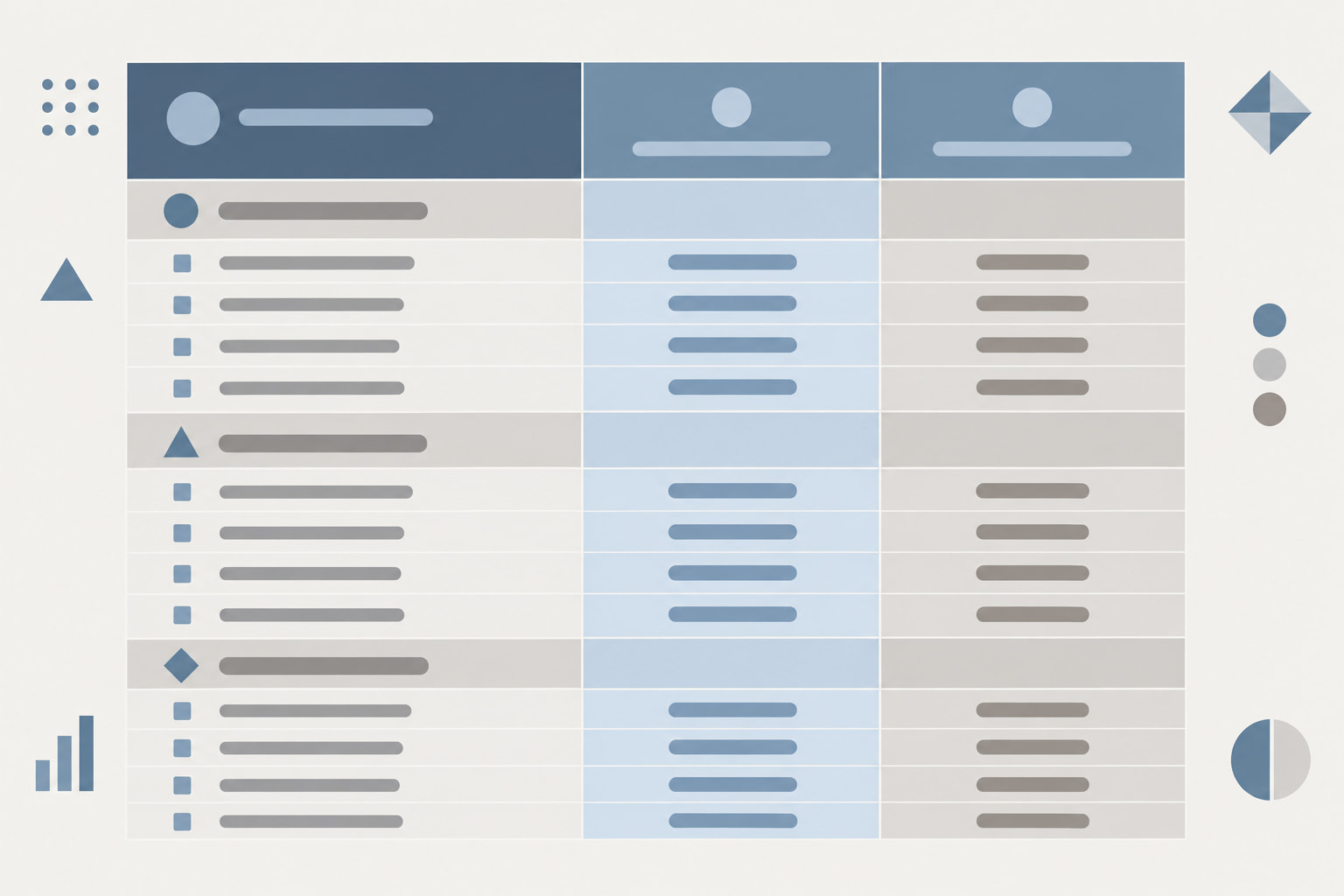
The three-column grant budget template shows the full cost of the program, the portion this funder is being asked to cover, and what other sources will pay, one row per budget line. It answers the funder's real question in a single glance: what does this work cost, and how much of it is already covered?
One commenter on Reddit described this layout: a three-column grant budget with full program cost, portion requested and other funding sources (Reddit thread 1lu9lh2, read September 2026).
Illustrative figures, not data from a real organization.
The first column is the program budget, the second is the project budget, and the third explains the gap. The program column's indirect line is that service's share of organization-wide indirect costs, so it need not equal 15 percent of the column's own base. Presenting all three keeps the request honest, because a reviewer can see the organization is funding part of the work from sources you already have.
A Grant Budget Showing Other Funding Sources
A grant budget showing other funding sources names each source behind the third column, its amount and its status, so the funder can see how firm the rest of the money is.
Illustrative figures, not data from a real organization.
If the third column contains required cost share, each contribution must be "verifiable in the recipient's or subrecipient's records" and "allowable under subpart E" (eCFR 2 CFR 200.306(b), current as of September 2026). Contributions you cannot document in the ledger do not count, however they read on the page. More worked layouts sit in our budget proposal examples, and the rules for required match are in federal grant match requirements.
Once the project budget is approved, it becomes the baseline for tracking. In a spreadsheet, a budget vs actual grant tracker holds that comparison.
GrantCue's Team plan, at $109 a month, includes "post-award lite" budget versus actuals and payment schedules, and its Organization plan, at $229 a month, adds full budget planning templates and spenddown tracking (GrantCue pricing page, October 2026). The GrantCue features page describes both.
FAQ
Is a Grant Budget the Same as a Project Budget?
It usually is. A grant budget covers the costs a specific award would pay over its own dates, in the funder's categories, which is what a project budget is. Read the request wording before you build: a funder that asks for a program budget may want the whole service with every funding source, and a request for an organizational budget means the entity's full revenue and expenses.
Do I Need to Submit an Organization Budget with a Grant Application?
You need one when the application asks for it. The reviewer uses it to check that the project sits inside an organization with real revenue and real expenses, so use the same functional categories in both documents. Form 990 Part IX splits expenses into (B) Program Services, (C) Management and General, and (D) Fundraising against (A) Total (IRS, Instructions for Form 990, 2025).
What Should a Grant Budget Workbook Contain?
A usable workbook has a header block for applicant, funder and budget period, category rows in the announcement's own order, one column per budget period, a total row, and a column pointing each line at its justifying narrative paragraph. Put subtotals, the indirect base and the indirect amount in formulas, so changing one salary updates every figure that depends on it, and lock the cells that hold rates.
Whose Budget Form Should You Submit?
The funder's, when it supplies one. Federal funding announcements arrive with their own budget form and instructions, so prepare numbers in your own file and submit in theirs. The categories are set by the agency. Once awarded, when the Federal share exceeds the simplified acquisition threshold, an agency may restrict transfers among direct cost categories or programs, functions, and activities once a cumulative transfer exceeds 10 percent of the total budget, including cost share, as last approved (eCFR 2 CFR 200.308, current as of September 2026), so budget in the categories you will report in.
Is There a Free Grant Proposal Budget Template?
Yes. Check the announcement first, because a funder that supplies its own budget form expects that form back, and its categories are the ones a reviewer reads against. When no form is supplied, any free spreadsheet template works once you rename its rows to match the announcement and replace typed totals with formulas.
What Does a Sample Grant Proposal Budget Template Look Like?
A sample grant proposal budget template is a table with category rows, a column per budget period, a direct cost subtotal, a modified total direct cost base, an indirect line calculated on that base, and a grand total. Add a column stating what each line buys and which narrative section describes it, so a reviewer can read the table alone and understand the project without opening the narrative.
Build Both Budgets From One Cost Sheet
Keep one cost sheet carrying every cost the program uses, then derive the other documents from it. Filter by award and date range to get the project budget. Add two columns, full cost and other funding, to get the three-column presentation. The organization budget is the same rows rolled up by function.
Set the category rows once, in your own standard order, and keep the period columns aligned to your fiscal year so a new application starts from filled structure instead of a blank page. Check the announcement before you rename anything, because the funder's row names win every time.
Start with your last proposal's budget. Add the full-cost and other-funding columns to the right of it, fill the full-cost column from the program budget, and only then decide what to request.