Local Government Grant Management: Process and Software
How cities and counties run grants under 2 CFR 200: the workflow, subrecipient monitoring, reporting and single audit duties, and grant software prices in county records.

In this article (11)
- Quick Answer: What Does Local Government Grant Management Involve?
- Grants Management for Local Government: How It Differs
- The Local Government Grant Management Workflow
- Financial Management Rules for City and County Grants
- Subrecipient Monitoring When a City or County Subawards Funds
- Reporting, Closeout and the Single Audit
- Local Government Grant Tracking: What the Dashboard Should Show
- Grant Management Software for Local Governments: Products and Prices on Record
- Choosing the Best Grant Management Software for Government
- FAQ
- Build the Award Register Before You Buy Software
Local government grant management is the work a city, county or town does to find grants, apply, spend each award within its rules, report on it and close it out. When the money is federal, the award also brings the financial management, monitoring and audit duties of 2 CFR 200.
The software question follows from the process: a county that only receives grants needs different tools from one that also passes federal money on to nonprofits and smaller towns.
GrantCue sells one of the products compared here, so every competitor figure below carries its source and a date.
Quick Answer: What Does Local Government Grant Management Involve?
Local government grant management covers finding, applying for, spending, reporting on and closing out grants. Federal awards add 2 CFR 200 duties: financial records comparing spending with each award's budget, monitoring of any subrecipients, final reports within 120 days after the award period (90 for subrecipients), and a single or program-specific audit in any fiscal year federal spending reaches $1,000,000.
Grants Management for Local Government: How It Differs
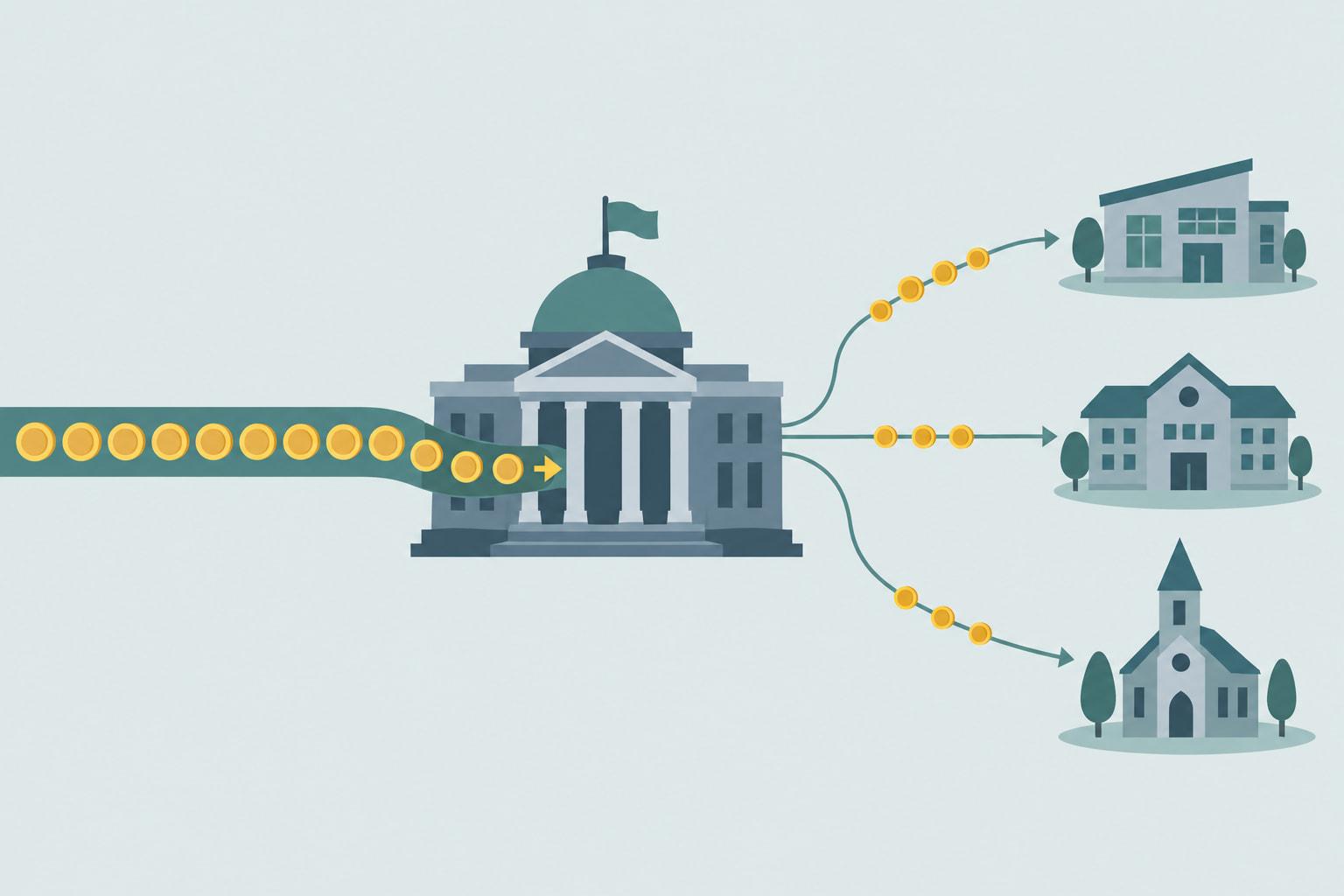
Grants management for local government differs from ordinary grant seeking in one structural way: a city or county can be a recipient and a pass-through entity at the same time. It receives awards from federal and state agencies, and it may subaward part of that money to nonprofits or smaller jurisdictions.
A pass-through entity is a recipient or subrecipient that provides a subaward to a subrecipient to carry out part of a federal program, and a subrecipient is an entity that receives a subaward from a pass-through entity to carry out part of a federal award (2 CFR 200.1, eCFR, current as of September 2026). A Rhode Island guide to the Grants Network system, written for grantors, states the double role plainly: "the source of funding could be a Federal grant where you are acting as the pass-through agency" (State of Rhode Island, Grants Network External User Guide, July 2024).
The double role doubles the records. A recipient-only process tracks awards coming in: identifiers, budgets, spending and reports. A pass-through process adds records for subawards going out, each with a risk rating, required subaward data, report reviews and an audit check. Software bought for one half does not cover the other by default, so settle which halves you need before you compare products.
A vendor survey points to tracking as a gap. Euna Solutions, which sells grant software to the public sector, reported from its own 2026 State of Grants Management and Technology Report that "40% of organizations are applying for more grants to fill revenue shortfalls, but 38% identified the lack of a centralized tracking system as one of their top three challenges in competing for that funding" (Euna Solutions blog, April 24, 2026, read November 2026).
The Local Government Grant Management Workflow
The local government grant management workflow follows the three phases Grants.gov names, pre-award, award and post-award (Grants.gov, The Grant Lifecycle, September 2026), and breaks into eight working stages. Each stage has a record to keep and, when the money is federal, a rule behind it.
Rule text from 2 CFR 200, eCFR, current as of September 2026.
Give each stage a named owner: the department that runs the project for the narrative and spending decisions, the finance office for cost coding and the financial report, and a grants coordinator, where one exists, for the register and the calendar.
The report stage is the easiest to underestimate, because each award runs its own recurring cycle of reports. A city with several open awards runs several of those cycles at once, each on its own clock.

Financial Management Rules for City and County Grants
A city or county that spends federal awards needs a financial management system that identifies each award, records its spending and obligations, compares spending with the award budget, and produces the reports the award requires (2 CFR 200.302, eCFR, current as of September 2026).
The standard starts with reports. The system "must be sufficient to permit the preparation of reports required by the terms and conditions," its records must identify "financial obligations, unobligated balances" among other items, and it must provide "Comparison of expenditures with budget amounts for each Federal award" (2 CFR 200.302(a), (b)(3) and (b)(5), eCFR, current as of September 2026).
In practice that means a grant or project code in the general ledger that ties every transaction to one award. A spreadsheet can summarize those records, but it should not replace the ledger as the record. Recipients must also "Take reasonable cybersecurity and other measures to safeguard information including protected personally identifiable information (PII) and other types of information" (2 CFR 200.303(e), eCFR, current as of September 2026), a duty that follows grant data into any software you buy.
Payroll needs its own support. "Charges to Federal awards for salaries and wages must be based on records that accurately reflect the work performed," and budget estimates alone do not qualify as support, though they may be used for interim accounting under the conditions the section lists (2 CFR 200.430(g)(1), eCFR, current as of September 2026). A public works crew split across two grants needs time records that show the split, not a percentage agreed at budget time.
Two thresholds shape purchasing and budgets. Equipment is tangible personal property with a useful life of more than one year and a per-unit acquisition cost at or above the lesser of your capitalization level or $10,000 (2 CFR 200.1, eCFR, current as of September 2026). A government without a current negotiated indirect rate may charge a de minimis rate of up to 15 percent of modified total direct costs (2 CFR 200.414(f), eCFR, current as of September 2026). The section-by-section guide to 2 CFR 200 places these rules in the rest of the Uniform Guidance.
Subrecipient Monitoring When a City or County Subawards Funds
A city or county that passes federal money on must decide whether each recipient is a subrecipient or a contractor, and for every subrecipient it must check exclusion status, put required data in the subaward, assess risk, review reports and verify audits (2 CFR 200.331 and 200.332, eCFR, current as of September 2026).
The classification comes first: "The pass-through entity is responsible for making case-by-case determinations to determine whether the entity receiving Federal funds is a subrecipient or a contractor" (2 CFR 200.331, eCFR, current as of September 2026). Only subrecipients carry the monitoring duties that follow.
Rule text from 2 CFR 200.332, eCFR, current as of September 2026.
Subrecipients close out on a shorter clock. A subrecipient must submit its final reports and liquidate obligations no later than 90 calendar days after its subaward ends, while the city itself has 120 days after its period of performance (2 CFR 200.344(b) and (c), eCFR, current as of September 2026). Set each subaward's end date early enough that its final reports arrive before yours are due. The wider set of duties is in the guide to subrecipient monitoring for pass-through entities.
Reporting, Closeout and the Single Audit
Every federal award a local government holds carries recurring financial and performance reports and a closeout deadline, and the government as a whole faces a single or program-specific audit in any fiscal year its federal spending reaches $1,000,000 (2 CFR 200.501(a), eCFR, current as of September 2026).
Grants.gov names the two recurring kinds, "financial reporting and programmatic reporting" (Grants.gov, The Grant Lifecycle, September 2026). The financial one is "the Federal Financial Report (SF-425)," due no later than 90 calendar days after an annual reporting period, 30 days after a quarterly or semiannual one, and 120 days after the period of performance for the final report (2 CFR 200.328(c)-(d), eCFR, current as of September 2026).
Closeout gathers every final report and the liquidation of all obligations inside those 120 calendar days (2 CFR 200.344(b) and (c), eCFR, current as of September 2026), and a grant closeout checklist keeps the pieces in order. Records then stay for three years from the date the final financial report is submitted (2 CFR 200.334, eCFR, current as of September 2026).
The audit threshold counts federal spending across all awards, not award by award.
Illustrative figures, not data from a real organization.
No single award reaches $1,000,000, yet the total crosses it, so the county needs the audit for that year. The reporting package is due within 30 calendar days after the auditor's report or nine months after the end of the audit period, whichever is earlier, and goes to the FAC, which the rule names "the repository of record for subpart F reporting packages and the data collection form" (2 CFR 200.512, eCFR, current as of September 2026). Private funders ask for audits on their own terms, which the guide to when audited financials are required covers.
Local Government Grant Tracking: What the Dashboard Should Show
A grant tracking dashboard for local government should show, for each open award, the identifiers the rules require, spending against budget, the unobligated balance, the next report and closeout dates, subrecipient status, and the running total of federal spending measured against the $1,000,000 audit threshold (2 CFR 200.501(a), eCFR, current as of September 2026).
Rule references from 2 CFR 200, eCFR, current as of September 2026.
Build the dashboard from the award register, so that every field traces back to the award document or the general ledger.
Where a spreadsheet holds the register, two limits show up first: it reminds no one until someone opens it, and it keeps little or no record of who changed an entry. The second limit bites at audit time, when someone asks who moved a report date or edited a budget line, and when.

Grant Management Software for Local Governments: Products and Prices on Record
Euna Solutions and SmartSimple, two vendors that sell grant software to governments, publish no price list, so county procurement records are the clearest public evidence of what grant management software for local governments is priced at (Euna Solutions blog, April 24, 2026; SmartSimple pricing page, read November 2026).
Read the records for their structure as much as their totals. Euna says its pricing model is based on organization size, not per-user fees (Euna Solutions blog, April 24, 2026). The Hays County line pairs "Unlimited Users" with a band labeled "USD 200M to 400M" without saying what the band measures, and the same quote says "eCivis apply a 5% increase beginning in year 2" (Hays County order form, quote dated April 29, 2025). Ask Euna which of your figures sets the price. The Weber County form states that "Access to the AmpliFund API is not included" (Weber County order form, undated, read November 2026), which matters if grant data has to reach the ledger.
Euna adds that "Most vendors also charge separately for implementation, integrations with your financial system, and ongoing support," and that for implementation "most mid-sized government organizations can expect four to five months" (Euna Solutions blog, April 24, 2026). Budget without nonprofit discounts, too: Google for Nonprofits, for one, is not open to "A governmental entity or organization" (Google for Nonprofits Help, September 2026). State agencies weighing a larger system can start from the government and public sector software guide.
Choosing the Best Grant Management Software for Government
The best grant management software for government is the product that covers your side of the grant, holds the fields 2 CFR 200 requires, connects to your ledger, and fits your budget and implementation calendar. No product is best for every city or county.
Match the side first. Euna lists "Grants Research Software," "Grant Seeking Software" and "Grant Making Software" as separate products (Euna Solutions grants page, read November 2026), while AmpliFund's order form says its Grant Seeker helps "conduct opportunity research, track deadlines, centralize information, and monitor budgetary grant progress" (Weber County order form, undated, read November 2026). A county that runs its own grant program needs the making side as well.
Then test the federal fields: ask each vendor to enter one real award with its FAIN, budget comparison and next report date, and one subaward carrying the data 2 CFR 200.332(b)(1) requires. Get implementation hours, the hourly rate beyond them, annual increases and integration fees in writing; Weber County's form priced implementation beyond 90 hours at $175 an hour (Weber County order form, undated, read November 2026). Settle exit terms too. Digital Science plans to sunset Symplectic Grant Tracker on December 31, 2026 (Symplectic announcement, July 14, 2025, read November 2026), and Ireland's Health Research Board, a Grant Tracker user since 2013, says it loses access to that system's data and functions after that date (HRB tender notice, December 19, 2025).
GrantCue covers the receiving side of this list. The public sector is one of the six audiences its solutions pages name, alongside nonprofits, schools and districts, research institutions, startups and grant consultants; its opportunity coverage is Grants.gov plus 748 state and state-agency sources across all 50 states, the District of Columbia, Puerto Rico and the U.S. Virgin Islands (grantcue.com, November 2026). Every plan, Free included, carries a pipeline board, post-award budgets, payment schedules and compliance tracking, an activity log, a calendar feed, Google Calendar sync, and Slack and Microsoft Teams alerts; Organization adds a read-only QuickBooks Online spend import mapped to grant budgets, and SSO/SAML comes with Enterprise (grantcue.com pricing, November 2026). The public sector solutions page covers its government use.
FAQ
What Is a Grant From the Government?
A government grant is money a federal, state or local agency awards to carry out a public purpose under the terms of the award. Grants.gov describes the process as a lifecycle that includes "creating the funding opportunity, applying, making award decisions, and successfully implementing the award" (Grants.gov, The Grant Lifecycle, September 2026). After the award, recipients report on both the money and the program.
What Are the Federal Grant Deadlines for Local Government?
A city or county often runs two clocks at once. As a recipient, it files annual financial reports within 90 calendar days after the reporting period, quarterly or semiannual ones within 30, and final reports within 120 days after the period of performance, while each of its subrecipients owes final reports within 90 days after the subaward ends (2 CFR 200.328(c)-(d) and 200.344(b), eCFR, current as of September 2026). Its single audit package is due within 30 days of the auditor's report or nine months after the audit period, whichever is earlier (2 CFR 200.512, eCFR, current as of September 2026).
How Much Does Grant Management Software for Local Governments Cost?
County records give the clearest answer. Hays County, Texas was quoted $19,000.00 for a Euna Grants renewal term running October 1, 2025 to September 30, 2026 (Hays County order form, quote dated April 29, 2025), and Weber County, Utah's AmpliFund order form priced the product at $22,500.00 a year plus a $12,500.00 implementation fee (Weber County order form, undated, read November 2026). Ask for implementation and integration charges in writing.
Does a Local Government Need a Single Audit?
A local government needs a single or program-specific audit for any fiscal year in which it expends $1,000,000 or more in federal awards (2 CFR 200.501(a), eCFR, current as of September 2026). Below that amount it is exempt from federal audit requirements for the year, but its records must still be available for review or audit (2 CFR 200.501(e), eCFR, current as of September 2026). The threshold counts spending across all federal awards together.
What Should a Grant Proposal Budget Template for Local Government Include?
A local government grant budget should follow the funder's cost categories and show each position's share of time, equipment measured against the lesser of your capitalization level or $10,000 (2 CFR 200.1, eCFR, current as of September 2026), any required match, and the indirect rate. Without a current negotiated rate, federal awards allow a de minimis rate of up to 15 percent of modified total direct costs (2 CFR 200.414(f), eCFR, current as of September 2026).
Build the Award Register Before You Buy Software
Start with a register of every open award: identifiers, period of performance, budget by category, report dates, subrecipients and federal spending to date. Fill it from the award documents and the general ledger, not from memory, then total the federal spending column against the $1,000,000 audit threshold (2 CFR 200.501(a), eCFR, current as of September 2026).
Update the register at each month-end close from posted ledger figures, so the federal total and every unobligated balance stay current. When demos start, hand every vendor the same award and the same subaward from the register, so the demos can be compared line by line.