Grant Management Software for Government: What Public-Sector Teams Need
A working guide to grant management software for government: pass-through duties under 2 CFR 200, the records an auditor asks for, the questions that expose a bad demo, and what rollout actually costs.
Last updated: August 2026
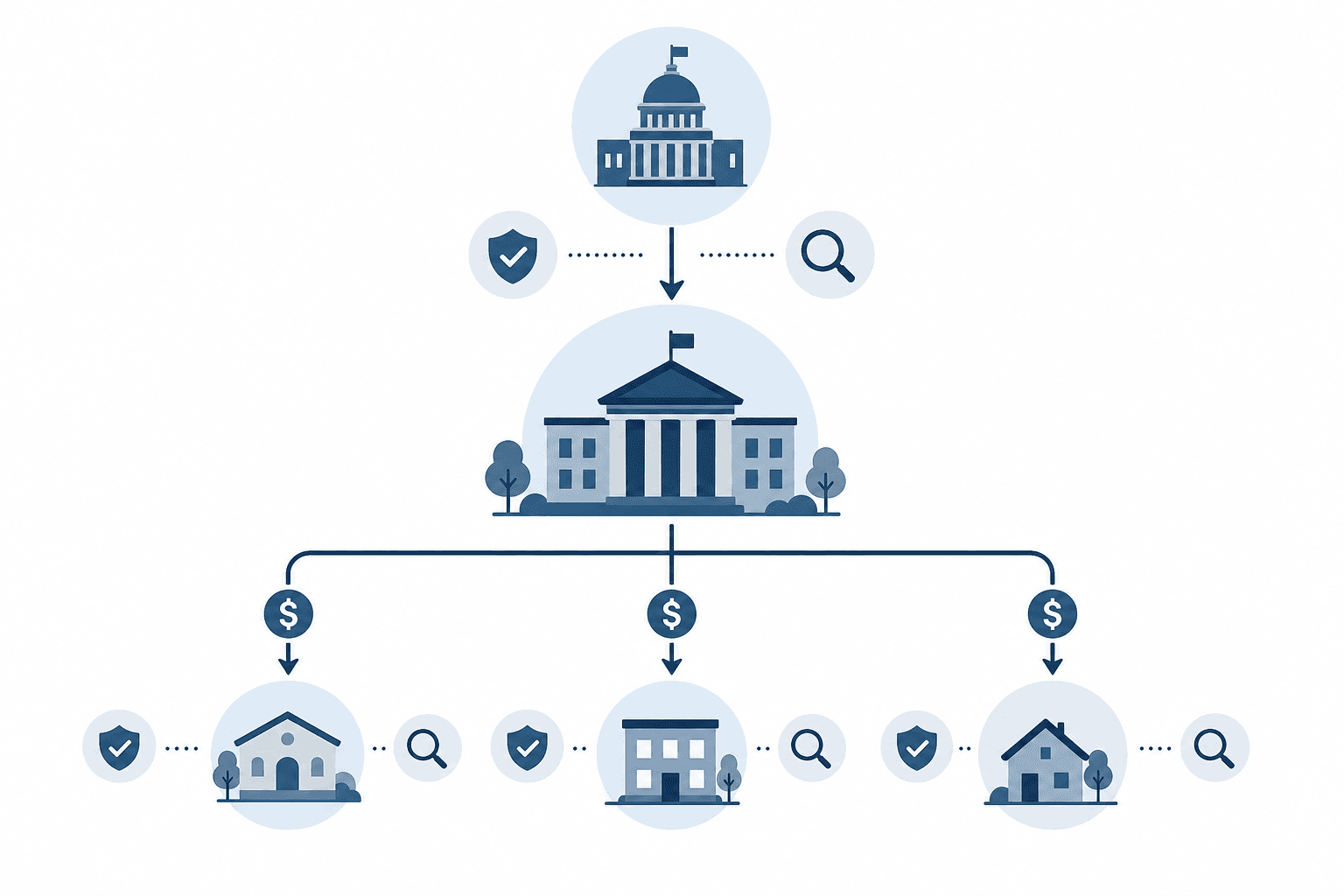
Grant management software for government has a harder job than the nonprofit version of the same category. A county or a state agency is usually receiving federal money and handing part of it back out. That second role brings subrecipient monitoring, procurement documentation, and public records duties, and a plain application tracker was never built to carry any of them. The questions below are the ones that expose a bad fit inside a demo. For the short version, see the grant management software for government overview.
Quick Answer: What Does Government Grant Management Software Need to Do?
Government grant management software has to cover both directions of the money. At minimum:
- Track applications, awards, deadlines, and reporting dates across departments.
- Support pass-through duties under 2 CFR 200.332: subaward data elements, risk evaluation, monitoring.
- Preserve an activity history and records for the retention periods in 2 CFR 200.334.
- Hold procurement documentation detailed enough to satisfy 2 CFR 200.318.
- Enforce role-based access that survives staff turnover and elections.
- Export cleanly for records requests and council packets.
How Government Grant Management Differs From Nonprofit Grant Management
The difference is the direction of the money. A nonprofit is almost always a grantee. A public agency is often grantee and grantor at once, so it needs award-making and subrecipient oversight on top of application tracking.
A pass-through entity is a recipient or subrecipient that provides a subaward to a subrecipient, including lower tier subrecipients, to carry out part of a federal program (2 CFR 200.1, verified on eCFR August 9, 2026). Once a city passes funds to a community organization, or a state education agency subgrants to districts, it becomes a pass-through entity with a defined list of duties.

2 CFR 200.332 enumerates them. Before the money moves, a pass-through entity must check SAM.gov to confirm a prospective subrecipient is not suspended, debarred, or otherwise excluded, and it must supply the required subaward data elements: the unique entity identifier, the Federal Award Identification Number, the subaward period of performance, the budget period, and the indirect cost rate. After that it has to evaluate each subrecipient's fraud risk and risk of noncompliance, monitor performance, review reports, issue management decisions on audit findings tied to the subaward, verify that required audits happen, and consider enforcement action where a subrecipient does not comply.
Three more rules shape the software requirement:
- Subrecipient or contractor. Under 2 CFR 200.331 the pass-through entity makes a case-by-case determination, the substance of the relationship counts for more than the form of the agreement, and no single factor is decisive. The rule calls for judgment rather than a formula, so keep the reasoning with the agreement where an auditor can find it.
- Fixed amount subawards. A recipient may issue fixed amount subawards up to $500,000, with prior written approval from the federal agency (2 CFR 200.333).
- Subaward transparency reporting. Under 2 CFR Part 170, a recipient must report each first-tier subaward of $30,000 or more in federal funds by the end of the month following the month it was issued. SAM.gov states that as of March 8, 2025, FSRS.gov was retired and subaward reporting now lives on SAM.gov.
Timing splits. A subrecipient has 90 calendar days after its subaward period of performance ends to file final reports; a recipient has 120 days (2 CFR 200.344). An agency in both roles runs two clocks.
| Factor | Nonprofit grantee | Government agency |
|---|---|---|
| Primary role | Applies for and receives grants | Receives grants and issues subawards |
| Subrecipient monitoring | Rare | Required under 2 CFR 200.332 |
| Procurement rules | Organizational policy | Purchasing law plus 2 CFR 200.318 through 200.327 |
| Records access | Internal and funder only | Subject to state public records law |
| Single Audit trigger | $1,000,000 expended | $1,000,000 expended |
| Continuity risk | Staff turnover | Staff plus elected turnover |
| Purchase approval | Executive director or board | Council vote, RFP, or purchasing threshold |
The Single Audit trigger is the same number for a nonprofit and a government agency. Under 2 CFR 200.501(a) a non-federal entity that expends $1,000,000 or more in federal awards during its fiscal year must have a single or program-specific audit. The 2024 Uniform Guidance revision raised that figure from $750,000, and it applies to fiscal years beginning on or after October 1, 2024 (OMB, Guidance for Federal Financial Assistance, 89 FR 30046, April 22, 2024). A borough with one bridge grant and one police grant can cross $1,000,000 in a year without noticing.
Grant Management Software for Government: Requirements Checklist
Nine requirement areas cover the government case, each one traceable to a rule in 2 CFR Part 200. Use the table below as the requirements page in your specification, and treat "we can configure that" as a prompt to ask for a screen share.
| Requirement | What the software has to do | Source |
|---|---|---|
| 2 CFR 200 compliance | Store award terms, period of performance, budget period, indirect cost rate, federal identifiers | 2 CFR 200.211, 200.332(b) |
| Subrecipient risk assessment | Hold a documented fraud and noncompliance risk evaluation per subrecipient: prior experience, previous audit results, new personnel, new or changed systems | 2 CFR 200.332(c) |
| Subrecipient monitoring | Log report reviews, site visits, training, corrective actions, management decisions on findings | 2 CFR 200.332(e), (f) |
| Audit trails | Attribute every status change, document version, and approval to a named user with a timestamp | 2 CFR 200.303 |
| Records retention | Hold records three years from the final financial report, longer for property and open litigation | 2 CFR 200.334 |
| Public transparency | Export award, subaward, and expenditure data on demand for records requests and council packets | State public records law; 2 CFR Part 170 |
| Role-based access | Separate finance, program, department, and read-only roles; revoke access the day someone leaves | 2 CFR 200.303(a) |
| Procurement documentation | Keep records sufficient to detail each procurement: method rationale, contract type selection, contractor selection or rejection, basis for the price | 2 CFR 200.318(i) |
| Data protection | Take reasonable cybersecurity and other measures to safeguard protected personally identifiable information | 2 CFR 200.303(e) |
Two procurement numbers changed recently. The FAR micro-purchase threshold is $15,000 and the simplified acquisition threshold is $350,000, up from $10,000 and $250,000, for acquisitions on or after October 1, 2025 (Federal Acquisition Regulation: Inflation Adjustment of Acquisition-Related Thresholds, 90 FR 41872, August 27, 2025, confirmed at 48 CFR 2.101). 2 CFR 200.1 pins the Uniform Guidance thresholds to those FAR values, and 2 CFR 200.320(a)(1)(iv) lets a recipient self-certify a micro-purchase threshold up to $50,000 on an annual basis with documented justification. Your own purchasing ordinance may be stricter, and the stricter rule wins.
Grantee-Side vs Grantor-Side Capabilities
Grantee-side grant management software is a system of record for money your agency receives: discovery, applications, deadlines, and reporting to a funder. Grantor-side software runs the other direction. It publishes a funding opportunity, scores applications, issues awards, and monitors the subrecipients who spend the money.
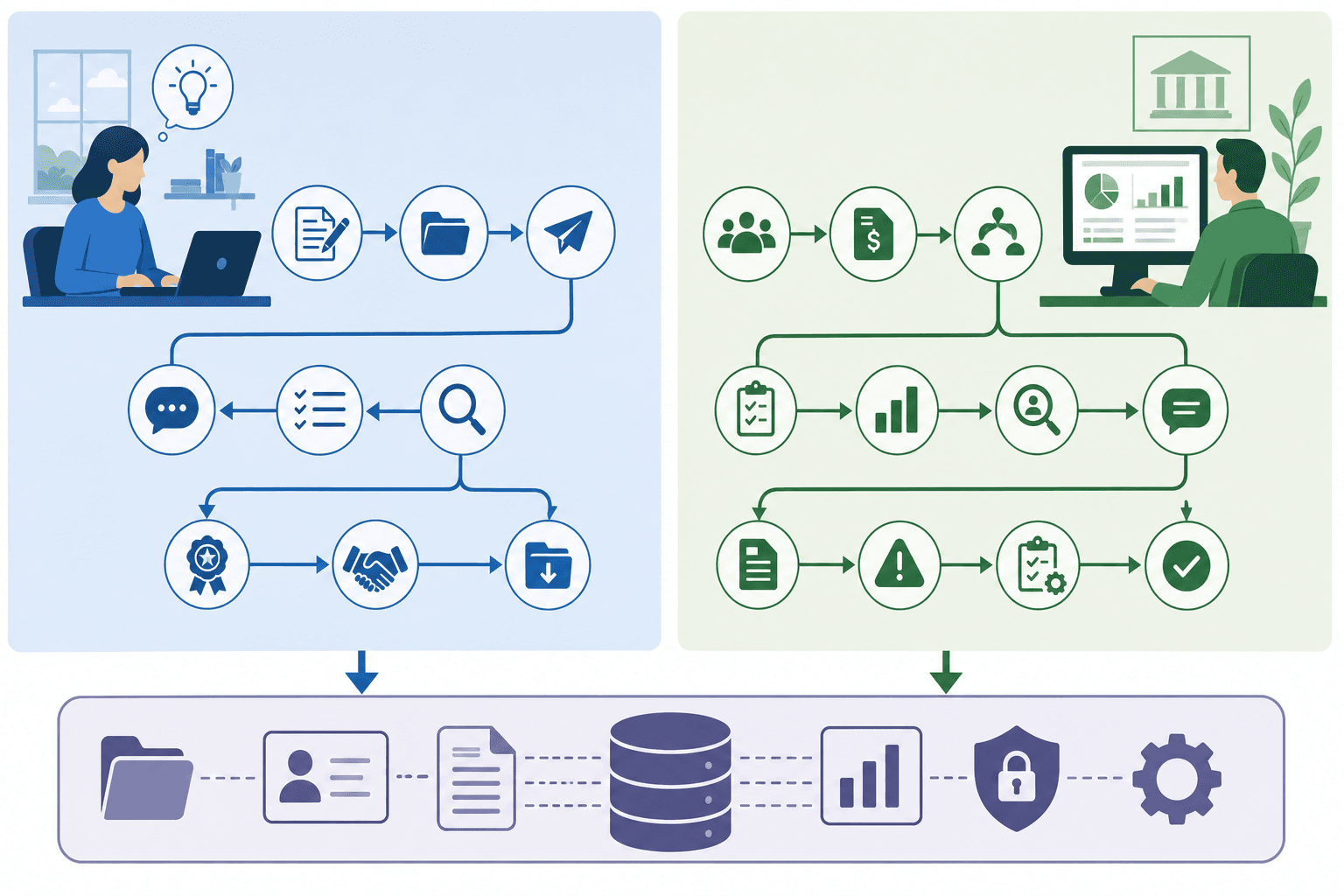
Most vendors sell and price these as separate modules. Euna Solutions markets its grants platform in three named parts, Research, Seeker, and Maker, and describes Maker on its own site as letting an agency design, evaluate, and award funding (eunasolutions.com, verified August 9, 2026). Euna announced its acquisition of AmpliFund on March 11, 2025, so a shortlist built from older reviews may list two products that now sit under one roof.
| Capability | Grantee-side | Grantor-side |
|---|---|---|
| Opportunity discovery and application authoring | Required | Not applicable |
| Public application portal and reviewer scoring | Not applicable | Required |
| Award agreements | Received | Generated |
| Budget and drawdown tracking | Your own spend | Subrecipient spend |
| Subrecipient risk and monitoring | Not applicable | Required |
| Reporting direction | Up to the funder | Down from subrecipients |
| Audit exposure | Your own Single Audit | Your audit plus subrecipient audit verification |
If your agency only receives grants, grantee-side software alone is enough. If it subgrants, you need the grantor-side column, and no grantee-side tool substitutes for it.
Buyer Evaluation Checklist: Questions to Ask a Vendor
Twelve questions separate a public-sector grant platform from a nonprofit tool with a government logo on the website. Ask them in a live demo, and make the vendor show the screen instead of describing it.
Scope
- Which modules handle money we receive, which handle money we give out, and what does each cost separately?
- Can we start grantee-side and add grantor-side later without a re-implementation?
Compliance
- Show me where a subrecipient risk assessment is stored and how it is scored.
- Show me a logged monitoring activity, including a site visit and a management decision on an audit finding.
- Where do the 2 CFR 200.332(b) subaward data elements live, and can we export them?
Records and access
- Show me the audit trail for one award, including who changed a status and when.
- Can a department see only its own awards, and how fast can access be revoked?
- Can we export the full dataset ourselves, without a support ticket and without a fee?
Contract and risk
- What happens to our data on the day the contract ends, and in what format?
- Do you hold SOC 2, StateRAMP, or FedRAMP authorization, and may we see the report?
- What is the total first-year cost including implementation, migration, and training?
- Who else in our state and our size band runs this, and may we call them?
The reference question does the most work of the twelve. A vendor with public-sector customers at your size and in your state can name three of them in a minute, and a vendor that cannot is selling you a first implementation.
Build vs Buy vs Spreadsheets for a Small Agency
For an agency with fewer than about ten active awards and no subgranting, a maintained spreadsheet is defensible. It stops being defensible once a second department touches the data, or the agency issues a subaward.
| Option | Works when | Fails when | Real cost |
|---|---|---|---|
| Spreadsheet | Under ~10 awards, one owner, no subawards | Two departments edit it, or the owner leaves | Free in license, costly in rework |
| Shared drive plus calendar | Documents matter more than status | Nobody can state total federal spend | Free, plus manual roll-ups |
| Low-cost grantee-side platform | Awards across departments, no subgranting | You start issuing subawards | Published subscription, self-serve purchase |
| Enterprise public-sector suite | Subgranting, monitoring, audit support | Budget and procurement capacity absent | Quoted per agency, usually behind an RFP |
| Custom build | No vendor fits, developers in house | The developer leaves, or the rules change | Highest, maintenance never ends |
Building is the option most small agencies should reject first. Grant rules change on a federal schedule you do not control. The October 2024 Uniform Guidance revision and the October 2025 threshold adjustment both proved that, and somebody has to keep the build current afterward. Most jurisdictions land in the middle two rows, and the deciding question is whether subgranting is in the picture. The public sector grant management page sets out how GrantCue fits the smaller end of that range.
Implementation and Data Migration Realities
Plan for the data cleanup to take longer than the configuration. In most agencies the award history sits in a finance system, a shared drive, and several inboxes that disagree on the amounts.
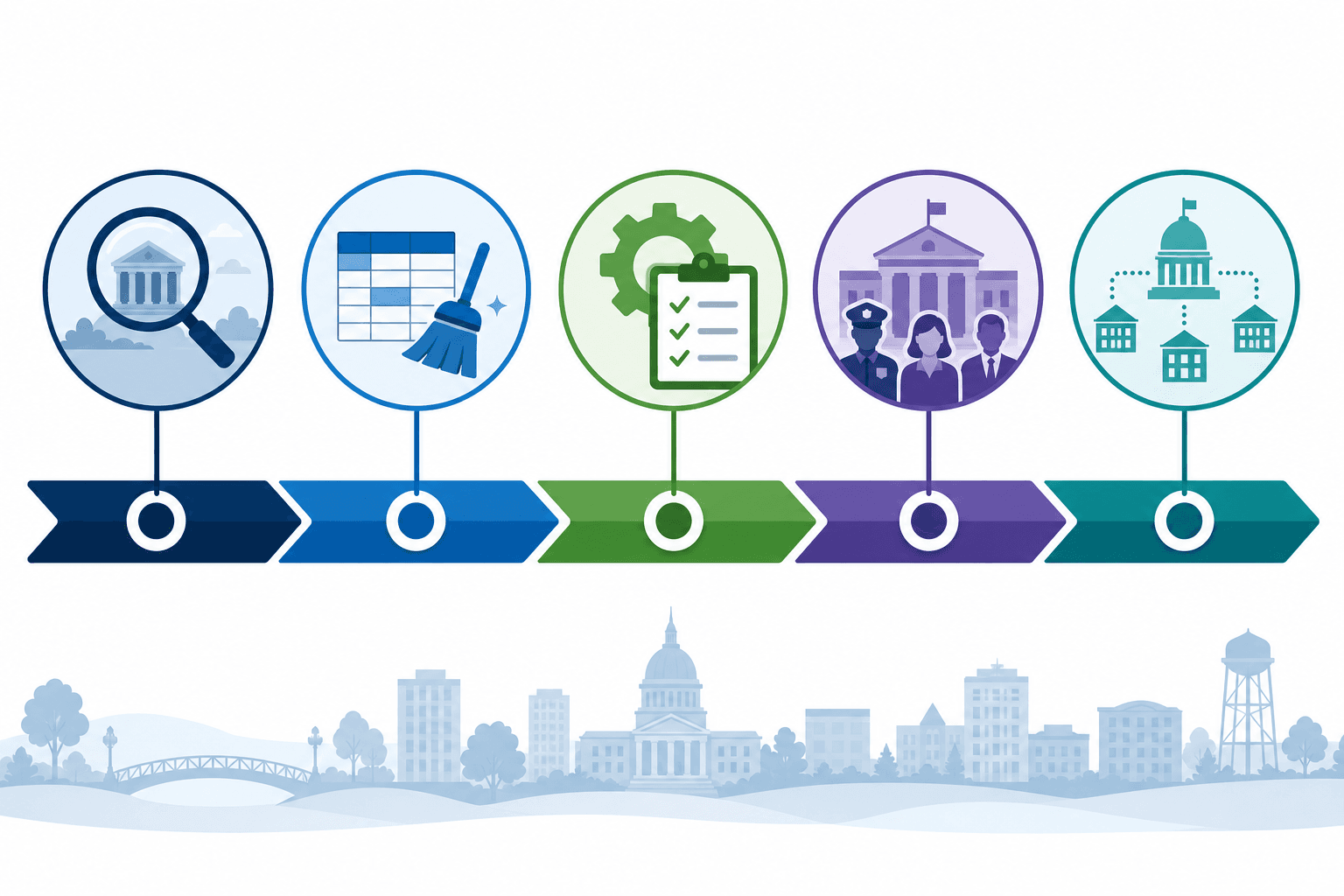
A workable sequence:
- Inventory before you buy. List every active award, the department holding it, the federal award identification number, the period of performance, and the reporting dates.
- Pick a source of truth per field. Finance owns amounts and expenditures. The program department owns scope and outcomes. Settle it before migration.
- Migrate active awards only. Closed awards belong in the archive with their retention date attached.
- Start with one department. A pilot in public works or the school business office proves the field structure before everyone depends on it.
- Set the retention clock on import. Under 2 CFR 200.334 the three-year period runs from submission of the final financial report, and property records run three years from final disposition. Record those dates while somebody still remembers them.
- Train the backup as well as the owner. The person who leaves is rarely the one you trained.
Allow six to twelve weeks for a small jurisdiction on a self-serve platform, and a fiscal quarter or more for an enterprise suite. Then hold the vendor to a dated go-live milestone written into the contract.
What GrantCue Does and Does Not Do for Public-Sector Teams
GrantCue is grantee-side software. It tracks money your agency receives. It does not issue subawards, and it is not audit software.
What it does for a public-sector team:
- Grant discovery across Grants.gov plus 31 live state and state-agency sources covering 28 states, with AI enrichment on the catalog records.
- One pipeline across departments, so finance and the department holding the award see the same record.
- Deadline and reporting-date tracking with assigned owners, reminder emails, and a calendar feed.
- Tasks, threaded comments, document version history, and an activity log, so the record survives a change in administration.
- Internal portfolio reporting with agency and program breakdowns, exportable to CSV and Excel.
What it does not do:
- No subrecipient or pass-through entity model, no risk assessment, and no subrecipient monitoring. If you subgrant, you need a grantor-side product for that work.
- No FFATA or subaward reporting to SAM.gov.
- No SEFA, no audit finding tracking, and no Single Audit support. It will not tell you when you are approaching the $1,000,000 threshold in 2 CFR 200.501, and it should not be used for that determination.
- No general ledger, payroll, bank, or ERP integration. Spend, match, and disbursement figures are entered by hand.
- Reporting means internal reports for your team and your council, not reports filed with a funder.
- County, regional, and council-of-government sources are not systematically ingested.
An agency that needs subrecipient monitoring should buy a platform that has it. Read the grant tracking feature list with one question in mind: is the grantee-side half of the job the half your agency actually has? For the charitable-sector version of the same comparison, see grant management software for nonprofits.
FAQ
What is grant compliance?
Grant compliance is meeting the statutory, regulatory, and award-specific requirements attached to funding you accepted. For federal and federal pass-through awards the rulebook is 2 CFR Part 200, which sets the rules on allowable costs, procurement, records, reporting, and audit.
What is the difference between a subrecipient and a contractor?
A subrecipient carries out part of the federal program, makes programmatic decisions, and is subject to the program's compliance requirements. A contractor supplies goods or services within its normal business operations to many buyers and is not. 2 CFR 200.331 says the substance of the relationship decides it.
How long does a government agency have to keep grant records?
Three years from the date the final financial report is submitted, under 2 CFR 200.334. Property and equipment records run three years from final disposition, and records tied to open litigation or audit findings are kept until final action is taken.
Does a small city need grant management software?
Not always. Under roughly ten active awards with one owner and no subgranting, a spreadsheet works. The trigger points are a second department touching the data, an approaching Single Audit, or the first subaward.
Is grant management software the same as Single Audit software?
No. Grant management software tracks awards, deadlines, spend, and reporting. Single Audit support means preparing a Schedule of Expenditures of Federal Awards, tracking findings, and managing corrective action plans, which is a separate category.
Do we have to run an RFP to buy grant management software?
That depends on your own purchasing law rather than federal law. 2 CFR 200.318(a) requires documented procurement procedures consistent with state, local, and tribal law, and 2 CFR 200.320(a) permits informal methods when the transaction does not exceed the simplified acquisition threshold, which the FAR set at $350,000 for acquisitions on or after October 1, 2025. A recipient may adopt a lower threshold, and many purchasing ordinances do.
Next Step
Pick your side of the money before you pick a vendor. Write down whether your agency only receives grants or also issues subawards, then use the requirements table as page one of your specification. If you subgrant, price the grantor-side module first.
For the compliance groundwork behind that table, start with Uniform Guidance (2 CFR 200) and work through the federal grant compliance checklist. If grants are half of somebody's job in your jurisdiction, the grant management software for local government breakdown lists the fit and the boundaries in one place.