Job Costing Payroll for Nonprofit Grants: How Salary Reaches Awards
Job costing payroll for nonprofit grants explained in plain terms: what job costing means for grants, how salary and fringe reach each award, and what payroll records to keep.

In this article (9)
- Quick Answer: What Is Job Costing Payroll for Nonprofit Grants?
- What Job Costing Payroll Means for Nonprofit Grants
- How Direct Grant Payroll Meets Federal Cost Rules
- How Fringe Benefits Follow Salary Charges to Grants
- Sample Grant Proposal for Nonprofit Job Staffing Costs
- How Accounting Systems Record Job Costing Payroll for Grants
- How to Keep a Payroll Documentation Trail That Holds Up
- FAQ
- What to Do Before the Next Payroll Run
Job costing payroll for nonprofit grants is the work of splitting one paycheck across the awards that received the work. A program director works Tuesday on one grant and Thursday on another. Payroll pays the person once, and job costing divides that cost across the awards that benefited.
That division has to hold up twice: once in the accounting system that posts it, and again in the record that shows the person did that work. Both tests come from the federal cost principles in 2 CFR part 200 (eCFR, current as of September 2026); the uniform guidance overview covers the wider rule set.
Quick Answer: What Is Job Costing Payroll for Nonprofit Grants?
Job costing payroll for nonprofit grants tracks each employee's work by award and charges salary plus fringe to each award in proportion to the benefit it received. Under 2 CFR 200.430(g), the payroll records must reflect work performed, cover no more than 100 percent of compensated activity, and support every split among awards.
What Job Costing Payroll Means for Nonprofit Grants
Job costing payroll for nonprofit grants is a method that assigns salary and wage costs to the awards that received the work. A cost objective is a program, function, activity, award, organizational subdivision, contract, or work unit for which cost data are desired and for which provision is made to accumulate and measure the cost of processes, products, jobs, and capital projects (eCFR 2 CFR 200.1, current as of September 2026).
Allocation is the process that divides the cost. "Allocation means the process of assigning a cost, or a group of costs, to one or more cost objective(s), in reasonable proportion to the benefit provided or other equitable relationship" (eCFR 2 CFR 200.1, current as of September 2026).
Award-specific staff time is direct cost. "Direct costs are those costs that can be identified specifically with a particular final cost objective, such as a Federal award, or other internally or externally funded activity, or that can be directly assigned to such activities relatively easily with a high degree of accuracy" (eCFR 2 CFR 200.413(a), current as of September 2026). Staff time counts as direct when it is award specific, because costs charged directly "are typically incurred specifically for that Federal award (including, for example, supplies needed to achieve the award's objectives and the proportion of employee compensation and fringe benefits expended in relation to that specific award)" (eCFR 2 CFR 200.413(b), current as of September 2026).
That definition draws the line against indirect cost. "Indirect cost means those costs incurred for a common or joint purpose benefitting more than one cost objective and not readily assignable to the cost objectives specifically benefitted, without effort disproportionate to the results achieved" (eCFR 2 CFR 200.1, current as of September 2026). The same cost cannot sit in both places, because 2 CFR 200.403(d) requires consistent treatment: "a cost must not be assigned to a Federal award as a direct cost if any other cost incurred for the same purpose in like circumstances has been allocated to the Federal award as an indirect cost" (eCFR 2 CFR 200.403(d), current as of September 2026).

How Direct Grant Payroll Meets Federal Cost Rules
Direct grant payroll meets federal cost rules when each charge is allowable, allocable, reasonable, and documented. Allowability starts with eight tests, beginning with the requirement that a cost "(a) Be necessary and reasonable for the performance of the Federal award and be allocable thereto under these principles" (eCFR 2 CFR 200.403, current as of September 2026).
2 CFR 200.404 defines a reasonable cost as one that "does not exceed an amount that a prudent person would incur under the circumstances prevailing when the decision was made to incur the cost" (eCFR 2 CFR 200.404, current as of September 2026).
2 CFR 200.405(a) states that "A cost is allocable to a Federal award or other cost objective if the cost is assignable to that Federal award or other cost objective in accordance with the relative benefits received" (eCFR 2 CFR 200.405(a), current as of September 2026). Where shares can be measured without undue effort, 2 CFR 200.405(d) states that "If a cost benefits two or more projects or activities in proportions that can be determined without undue effort or cost, the cost must be allocated to the projects based on the proportional benefit" (eCFR 2 CFR 200.405(d), current as of September 2026).
A salary charge cannot be moved between awards to cover a shortfall, because 2 CFR 200.405(c) states: "A cost allocable to a particular Federal award may not be charged to other Federal awards (for example, to overcome fund deficiencies or to avoid restrictions imposed by Federal statutes, regulations, or the terms and conditions of the Federal awards)" (eCFR 2 CFR 200.405(c), current as of September 2026). The same salary cannot support two federal claims, because 2 CFR 200.403(f) bars a cost from being "included as a cost or used to meet cost sharing requirements of any other federally-financed program in either the current or a prior period" (eCFR 2 CFR 200.403(f), current as of September 2026).
2 CFR 200.413(c) states that "Administrative and clerical staff salaries should normally be treated as indirect costs," and allows direct charging only if the services are "integral to a Federal award," the individuals "can be specifically identified with a Federal award," and "The costs are not also recovered as indirect costs" (eCFR 2 CFR 200.413(c), current as of September 2026).
Our indirect cost rate primer covers the indirect side of the same split.
How Fringe Benefits Follow Salary Charges to Grants
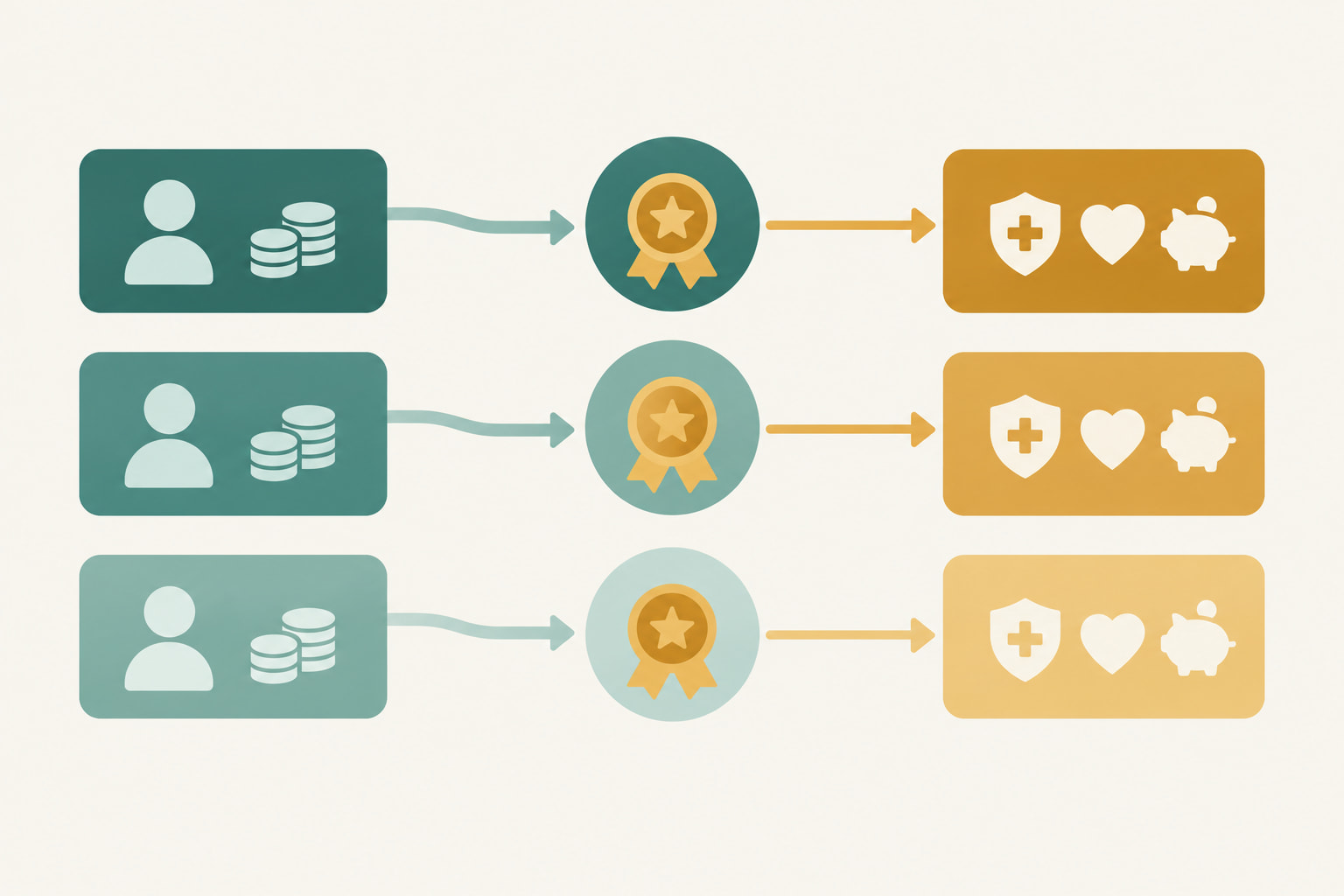
Fringe benefits follow salary charges to grants in the same pattern as the salaries they attach to. "Fringe benefits are allowances and services employers provide to their employees as compensation in addition to regular salaries and wages," and they "include, but are not limited to, the costs of leave, employee insurance, pensions, and unemployment benefits" (eCFR 2 CFR 200.431(a), current as of September 2026).
The allocation rule is explicit. 2 CFR 200.431(c) requires a recipient to "allocate fringe benefits to Federal awards and all other activities in a manner consistent with the pattern of benefits attributable to the individuals or group(s) of employees whose salaries and wages are chargeable to such Federal awards and other activities" (eCFR 2 CFR 200.431(c), current as of September 2026).
2 CFR 200.431(d) gives two permitted fringe methods: assigning benefits "by identifying specific benefits to specific individual employees or by allocating them based on entity-wide salaries and wages of the employees receiving the benefits" (eCFR 2 CFR 200.431(d), current as of September 2026). When the allocation method is used, 2 CFR 200.431(d) adds that "separate allocations must be made to selective groupings of employees unless the recipient or subrecipient demonstrates that costs in relationship to salaries and wages do not differ significantly for different groups of employees" (eCFR 2 CFR 200.431(d), current as of September 2026).
Leave has its own three part test. 2 CFR 200.431(b) allows leave costs only where "They are provided under established written leave policies," "The costs are equitably allocated to all related activities, including Federal awards," and the cash-or-accrual basis chosen "is consistently followed" (eCFR 2 CFR 200.431(b), current as of September 2026).
Sample Grant Proposal for Nonprofit Job Staffing Costs
A sample grant proposal for nonprofit job staffing costs shows job costing before the award starts, in the proposed budget. Funders read the personnel section for which roles the project needs, what share of each role the grant will pay, and how the organization will prove the split.
The percentage on the page becomes the interim charge in payroll. 2 CFR 200.430(g)(1)(vii) states that "Budget estimates (meaning, estimates determined before the services are performed) alone do not qualify as support for charges to Federal awards, but may be used for interim accounting purposes" under three stated conditions (eCFR 2 CFR 200.430(g)(1)(vii), current as of September 2026). Proposal percentages can seed the first payroll postings, and actual time records must then confirm or correct them.
2 CFR 200.430(g)(1)(vii)(C) requires that internal controls "include processes to perform periodic after-the-fact reviews of interim charges made to a Federal award based on budget estimates," with "All necessary adjustments … made so that the final amount charged to the Federal award is accurate, allowable, and properly allocated" (eCFR 2 CFR 200.430(g)(1)(vii)(C), current as of September 2026).
A composite staffing table shows the translation from proposal to payroll.
Illustrative figures, not data from a real organization.
One commenter on Reddit named the control that keeps those splits honest: "one dated input table with employee ID, grant, percentage, effective start/end date, and who approved the change" (Reddit thread 1vmiey8, read September 2026). For laying out the personnel lines at proposal stage, see the grant budget template spreadsheet.
How Accounting Systems Record Job Costing Payroll for Grants
Accounting systems record job costing payroll by carrying award codes from the timesheet through payroll into the general ledger without retyping. The chain runs from time entry by award through approval and payroll posting to the ledger.
System design starts with the chart of accounts. The system must support award level detail, because 2 CFR 200.302(b)(3) requires "Maintaining records that sufficiently identify the amount, source, and expenditure of Federal funds for Federal awards," and "All records must be supported by source documentation" (eCFR 2 CFR 200.302(b)(3), current as of September 2026). It must also identify each award fully, since 2 CFR 200.302(b)(1) requires "Identification of all Federal awards received and expended and the Federal programs under which they were received," including the Assistance Listings title and number and the Federal award identification number (eCFR 2 CFR 200.302(b)(1), current as of September 2026).
Budget comparison is a separate system requirement. 2 CFR 200.302(b)(5) requires every recipient's and subrecipient's financial management system to provide for "Comparison of expenditures with budget amounts for each Federal award" (eCFR 2 CFR 200.302(b)(5), current as of September 2026). Practice must stay consistent, because 2 CFR 200.400(d) requires that "The accounting practices of the recipient and subrecipient must be consistent with these cost principles and support the accumulation of costs as required by these cost principles, including maintaining adequate documentation to support costs charged to the Federal award" (eCFR 2 CFR 200.400(d), current as of September 2026).
Indirect costs then follow Appendix IV, which describes three approaches for nonprofits: the Simplified Allocation Method, the Multiple Allocation Base Method and the Direct Allocation Method (eCFR 2 CFR part 200, Appendix IV, current as of September 2026).
Payroll job costing supplies the effort base the rest of the system reuses. The indirect cost rate guide written for the Funders for Real Cost, Real Change collaborative names two default bases: "Staff level of effort (measured by staff FTEs or full-time equivalents) allocation methodology for costs that are generally driven by staff utilization, such as telephone/internet expenses, office supplies" and "Space/square-footage allocation methodology for occupancy-related costs (e.g., rent)" (BDO FMA Indirect Cost Rate Guide 2022 for Funders for Real Cost, Real Change, dated February 11, 2022).

How to Keep a Payroll Documentation Trail That Holds Up
A payroll documentation trail holds up when each charge traces back to a record of work performed, approved after the fact. 2 CFR 200.430(g)(1) requires that "Charges to Federal awards for salaries and wages must be based on records that accurately reflect the work performed" (eCFR 2 CFR 200.430(g)(1), current as of September 2026).
Payroll records must "Reasonably reflect the total activity for which the employee is compensated by the recipient or subrecipient, not exceeding 100 percent of compensated activities" (eCFR 2 CFR 200.430(g)(1)(iii), current as of September 2026). Splits across awards must "Support the distribution of the employee's salary or wages among specific activities or cost objectives if the employee works on more than one Federal award; a Federal award and non-Federal award; an indirect cost activity and a direct cost activity; two or more indirect activities allocated using different allocation bases; or an unallowable activity and a direct or indirect cost activity" (eCFR 2 CFR 200.430(g)(1)(vi), current as of September 2026). Percentage records are permitted: 2 CFR 200.430(g)(1)(viii) states that "records may reflect categories of activities expressed as a percentage distribution of total activities" (eCFR 2 CFR 200.430(g)(1)(viii), current as of September 2026). Hourly staff need one more element, because 2 CFR 200.430(g)(3) requires that under the Fair Labor Standards Act, "charges for the salaries and wages of nonexempt employees … must also be supported by records indicating the total number of hours worked each day" (eCFR 2 CFR 200.430(g)(3), current as of September 2026).
A workable file for each pay period has five items: the approved time record by award, the allocation table with effective dates and approver, the payroll register showing the same split, the fringe calculation tied to the same percentages, and the review note where estimates were trued to actuals.
Report dates and budget figures can sit beside that file without replacing it. GrantCue tracks awards and their deadlines in a kanban-style pipeline on every plan, and its Team plan, at $109 a month, adds post-award budget versus actuals and payment schedules (grantcue.com, September 2026). The payroll trail itself stays in the payroll and accounting systems, and the same workspace offers open grant search for the next award.
The post-award management checklist covers the wider award file this payroll trail feeds.
FAQ
What is job costing payroll for nonprofit grants?
Job costing payroll for nonprofit grants is the method that divides each paycheck across the grant awards an employee served, in proportion to the benefit each award received. Salary that is identifiable with a specific award is charged direct, and fringe follows the same pattern as the salary it attaches to.
How do you charge staff time to a federal grant?
Charge staff time to the award that received the work, in proportion to benefit, using records that reflect work performed after the fact. Payroll splits must stay within total compensated activity and support each distribution among awards, and budget estimates alone do not qualify as support without periodic review and adjustment.
Can admin staff time be charged to a nonprofit grant?
Admin and clerical salaries are normally indirect, and direct charging is allowed only when the services are integral to the award, the person is specifically identified with it, and the costs are not also recovered as indirect. A full time project assistant named in the budget with time records can meet all three tests.
How are fringe benefits allocated to grants?
Fringe benefits are allocated in a manner consistent with the pattern of the salaries they attach to, either by identifying specific benefits to specific employees or by allocating on entity wide salaries and wages. Separate groupings are needed where benefit costs differ significantly between employee groups.
Do budget estimates support payroll charges to grants?
Budget estimates alone do not support payroll charges. They may be used for interim postings only under three stated conditions, one of which is internal controls with periodic after-the-fact review. All necessary adjustments must be posted so the final charge to the award is accurate, allowable, and properly allocated.
What to Do Before the Next Payroll Run
Pull the current allocation table and check three things: every employee on grant time has an effective dated split, the percentages total to the full compensated effort, and the approver signed the current version. Post payroll by that table, compare the personnel lines against budget by award, and file the time record with the register before the next cycle starts.