Indirect Cost Rate for Federal Grants: De Minimis, MTDC, and NICRA Explained
How the indirect cost rate works on federal grants: the 15 percent de minimis rate under 2 CFR 200.414(f), the MTDC base, a worked calculation, and NICRA basics.
In this article (13)
- Quick Answer: What Is the Indirect Cost Rate for Federal Grants?
- What Is an Indirect Cost Rate? Meaning and Definition
- Direct vs Indirect Costs: What Goes on Each Side
- The De Minimis Indirect Cost Rate Under 2 CFR 200.414(f)
- De Minimis or a Negotiated Rate: Which Pays More?
- The Base the Rate Applies To: MTDC in Brief
- Indirect Cost Rate Calculation: Formula and Worked Example
- Indirect Cost Rate Agreement (NICRA): What It Is and How to Get One
- How the Rate Appears in Your Budget and Budget Narrative
- When a Funder Caps or Refuses Indirect Costs
- Foundation vs Federal Indirect Cost Practice
- FAQ
- Next Step
An indirect cost rate is the percentage a grant recipient applies to a defined base of direct costs to recover overhead that no one can trace to the project line by line. Rent, accounting, insurance, and executive time sit in that pool. The number many grant writers memorized is out of date: the de minimis rate moved from 10 to 15 percent in the 2024 Uniform Guidance revision.
Quick Answer: What Is the Indirect Cost Rate for Federal Grants?
An indirect cost rate is a percentage applied to a direct cost base to recover shared overhead on a grant. Federal recipients without a negotiated rate may elect a de minimis rate of up to 15 percent of modified total direct costs under 2 CFR 200.414(f). Organizations wanting a higher rate negotiate a NICRA with their cognizant federal agency.
Every regulatory figure here was read from eCFR on October 23, 2026, against Title 2 content current as of October 21, 2026.
What Is an Indirect Cost Rate? Meaning and Definition
An indirect cost rate is a ratio that converts an organization's pooled overhead into a percentage chargeable against individual awards. It exists because tracing one electricity bill to every grant it benefits is impractical. 2 CFR 200.1 defines indirect cost as "those costs incurred for a common or joint purpose benefitting more than one cost objective and not readily assignable to the cost objectives specifically benefitted, without effort disproportionate to the results achieved." Universities call these facilities and administrative (F&A) costs. 2 CFR 200.414(a) requires major institutions of higher education and major nonprofit organizations, the latter defined as those receiving more than $10 million in direct federal funding, to classify the pool as Facilities and Administration.
The base matters as much as the percentage: 15 percent of modified total direct costs recovers less than 15 percent of total direct costs. For the wider set of rules these figures sit inside, see the guide to Uniform Guidance 2 CFR 200 grant management.
Direct vs Indirect Costs: What Goes on Each Side
A direct cost can be identified specifically with one project. An indirect cost supports several projects at once and gets allocated rather than assigned. 2 CFR 200.413(a) states the test: direct costs are those "that can be identified specifically with a particular final cost objective."
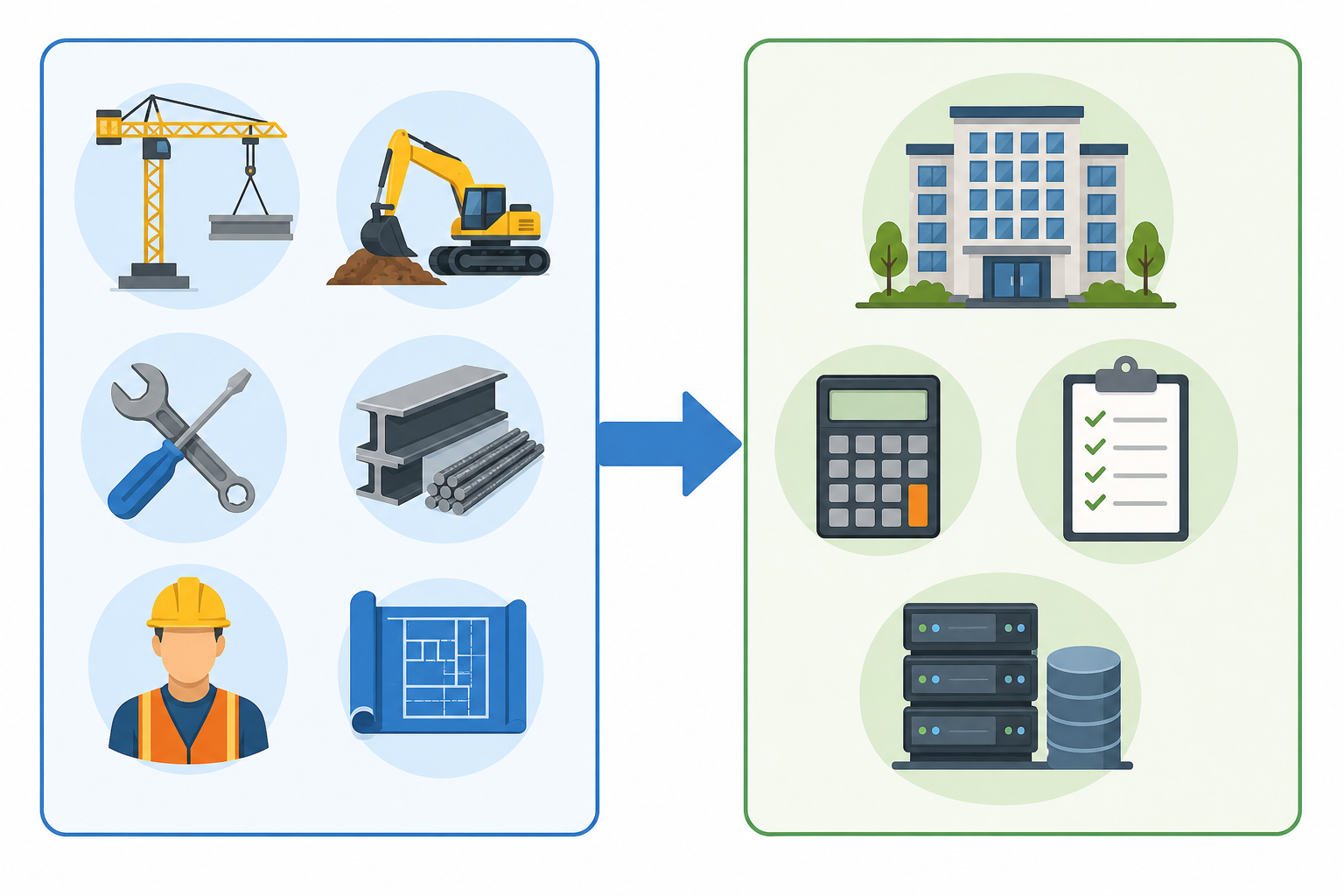
2 CFR 200.413(c) says administrative and clerical salaries "should normally be treated as indirect costs," and permits direct charging only when the service is integral to the award, the individual is specifically identified with it, and the cost is not also recovered indirectly. A project coordinator dedicated to the award can be charged direct. A share of the front-desk receptionist cannot. Salary charged direct, to one award or split across several, also needs records of the work performed, and effort reporting and effort certification covers what those records must show.
2 CFR 200.413(b) allows several categories as direct costs when directly related to a specific award: cybersecurity, integrated data systems, asset management systems, performance management, and program evaluation. Consistency still applies: a cost incurred for the same purpose in like circumstances must be treated the same way every time.
The De Minimis Indirect Cost Rate Under 2 CFR 200.414(f)
The de minimis indirect cost rate is a flat allowance that any recipient or subrecipient without a current federal negotiated rate may elect without documentation. The ceiling is 15 percent of modified total direct costs.
2 CFR 200.414(f) reads: "Recipients and subrecipients that do not have a current Federal negotiated indirect cost rate (including provisional rate) may elect to charge a de minimis rate of up to 15 percent of modified total direct costs (MTDC)." That is the first of the paragraph's eight sentences. Each one, quoted below from the current text, changes something in a budget:
What changed in the 2024 Uniform Guidance revision
OMB published "Guidance for Federal Financial Assistance" at 89 FR 30046 on April 22, 2024, effective October 1, 2024. Four things moved.
Because 15 percent is a ceiling, an organization can elect 12 percent if that matches its overhead.
Agency practice is not uniform. NIH recognized the 15 percent rate for non-SBIR and non-STTR awards in notice NOT-OD-25-059 on January 13, 2025, then rescinded that recognition, with the revised MTDC definition, in notice NOT-OD-26-072 on April 20, 2026. NIH cites the Consolidated Appropriations Act for FY 2026, under which the indirect cost provisions of 45 CFR 75 still apply to NIH awards, although eCFR shows 45 CFR 75.414 as removed on October 1, 2025. Section 7.4 of the NIH Grants Policy Statement, revised March 2026, accordingly sets the de minimis rate for NIH awards at 10 percent of modified total direct costs, and the statement's definitions count only the first $25,000 of each subaward in that base. Budget an NIH application on those figures, and check any other agency's current policy before electing a rate.
OMB proposed a further revision of the guidance on May 29, 2026 at 91 FR 32198, with comments closing July 13, 2026. Until a final rule issues, the current text controls. Section 157 of the Continuing Appropriations Act, 2027, signed September 2, 2026, provides that the rule, or a substantially similar one, shall not be issued or finalized through December 11, 2026, and the Federal Register showed no final rule on October 6, 2026.
De Minimis or a Negotiated Rate: Which Pays More?
The choice comes down to one number: your organization's own indirect cost rate, measured from its books. Divide last fiscal year's indirect costs by the same year's MTDC base, which is a rough version of the simplified allocation method in Appendix IV to Part 200. If the result is near or below 15 percent, the de minimis election recovers about what a negotiation would, with no proposal to prepare. If it runs well above 15 percent, every federal award recovers less than the overhead it actually uses until you negotiate.
A composite organization shows the arithmetic, using the $313,200 MTDC base from the worked example further down this page.
Illustrative figures, not data from a real organization.
Four things decide whether that gap is worth closing:
- How many federal awards you hold. The difference repeats on every award. Three awards of that size would leave $65,772 unrecovered at the de minimis rate.
- The work a rate takes. A first negotiated rate means an indirect cost proposal due within three months of the award's effective date, then a new one within six months of each fiscal year end. The de minimis rate needs none.
- Who you would negotiate with. That is your cognizant agency for indirect costs, or the pass-through entity when you hold no direct federal awards. The NICRA section below covers both.
- Which agency funds you. Some agencies set their own figures. NIH, as described above, applies a 10 percent de minimis rate to its awards.
The Base the Rate Applies To: MTDC in Brief
Modified total direct costs is a trimmed version of total direct costs, and applying a rate to the wrong base overstates or understates recovery. 2 CFR 200.1 defines MTDC as "all direct salaries and wages, applicable fringe benefits, materials and supplies, services, travel, and up to the first $50,000 of each subaward." It excludes equipment, capital expenditures, charges for patient care, rental costs, tuition remission, scholarships and fellowships, participant support costs, and the portion of each subaward above $50,000. Other items can be excluded only with cognizant agency approval, to avoid a serious inequity in the distribution of indirect costs. Equipment under 2 CFR 200.1 means property with a useful life over one year and a per-unit cost at or above the lesser of your own capitalization threshold or $10,000, a ceiling the 2024 revision raised from $5,000. Your capitalization policy decides what leaves the base.
The base gets its own guide: modified total direct costs and your indirect rate builds it in four passes on one composite budget, applying each exclusion and the subaward cap in turn. Payroll allocation software can post the indirect line for you, but check the base it uses: the Cost Allocation Pro review found that tool applies one organization-wide rate to direct salaries rather than to MTDC.
Indirect Cost Rate Calculation: Formula and Worked Example
The indirect cost rate calculation is two steps: build the base by removing excluded lines from total direct costs, then multiply the base by the rate. The formula for a de minimis election:
Indirect costs = (Total direct costs - MTDC exclusions) x elected rate
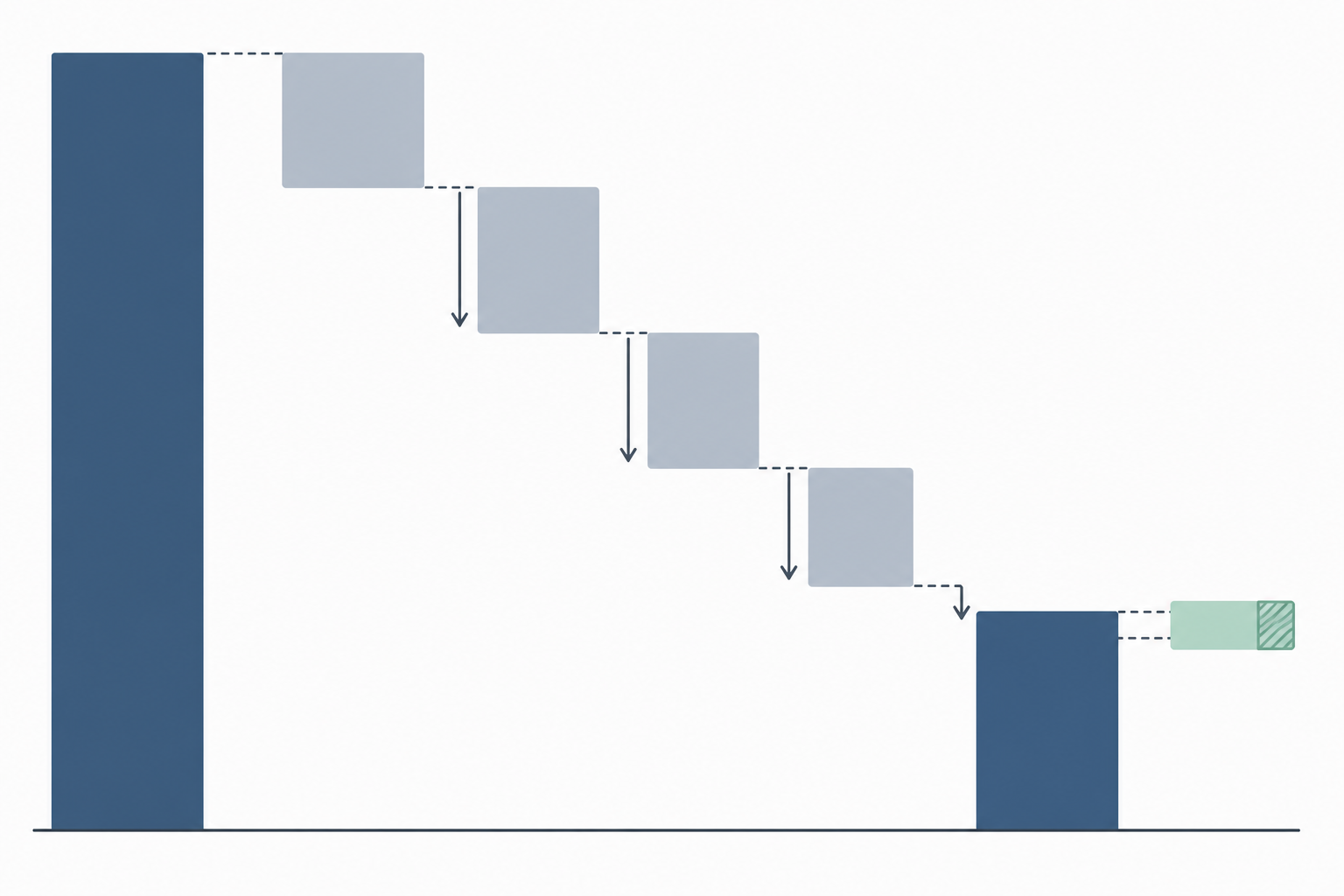
A composite example: a literacy nonprofit with no negotiated rate applies for a federal award and elects the full 15 percent de minimis rate.
Now strip the exclusions: equipment $14,000, participant stipends $25,000, and the $20,000 of the subaward above the $50,000 ceiling. Exclusions total $59,000.
- MTDC base: $372,200 minus $59,000 = $313,200
- Indirect costs at 15 percent: $313,200 x 0.15 = $46,980
- Total project cost: $372,200 plus $46,980 = $419,180
Compare the shortcut many applicants take, 15 percent of total direct costs. That produces $55,830, an overstatement of $8,850. A reviewer who catches it sends the budget back. If nobody catches it, an auditor eventually will.
The same base works with a negotiated rate: at 22 percent, $313,200 x 0.22 = $68,904.
A negotiated rate like that one is built from how shared costs are spread across programs, and allocating indirect costs to programs by FTE shows when headcount is a fair base for the split.
Indirect Cost Rate Agreement (NICRA): What It Is and How to Get One
A negotiated indirect cost rate agreement, or NICRA, is a signed document between an organization and its cognizant federal agency that fixes the rate, the base, and the period it covers. 2 CFR 200.414(c)(1) states that negotiated rates "must be accepted by all Federal agencies." 2 CFR 200.414(d) extends that duty to pass-through entities.
You do not pick the cognizant agency. Under Appendix IV to Part 200, paragraph C.2.a, the federal agency with the largest dollar value of awards funded directly to your organization is designated cognizant for indirect costs. Two offices handle much of this work: Cost Allocation Services in the HHS Program Support Center, and Indirect Cost Services at the Interior Business Center, cognizant for tribal and insular area governments and organizations funded mainly by the Interior Department. With no direct federal funding, you negotiate with the pass-through entity.

Appendix IV also sets the filing clock. An organization that has never established a rate has until three months after the award's effective date to file its initial indirect cost proposal, under paragraph C.2.b. Existing rate holders file again within six months of each fiscal year close, per paragraph C.2.c. One reprieve: 2 CFR 200.414(g) allows a one-time extension of a current rate for up to four years with cognizant agency approval.
A NICRA earns its keep when overhead runs well above 15 percent of MTDC and the federal portfolio is large enough that the difference funds real positions. Below that, the de minimis election costs nothing to defend. Either rate has to survive an audit, which is where the Uniform Guidance cost principles come in. An organization that spends $1,000,000 or more in federal awards in a fiscal year faces that test in its Single Audit, and single audit requirements covers who needs one and what it examines.
How the Rate Appears in Your Budget and Budget Narrative
The number goes on the form. The base, the rate, and the authority go in the narrative.
On the SF-424A, Section B, lines 6a through 6h carry the object class categories from Personnel through Other. Line 6i totals direct charges, line 6j carries indirect charges, and line 6k sums both. One warning: the Grants.gov instruction package for SF424A-V1.0, retrieved October 6, 2026, still describes the de minimis rate as 10 percent and the equipment threshold as $5,000, the pre-2024 figures. The regulation controls, not the form instructions.
The narrative paragraph needs the rate, the base, the dollar result, and the authority. Here it is for the example budget, written with a placeholder organization name:
"Sunrise Literacy Collective, an illustrative applicant, has no current federally negotiated indirect cost rate and elects the de minimis rate of 15 percent of modified total direct costs under 2 CFR 200.414(f). Total direct costs are $372,200. Excluding equipment ($14,000), participant support costs ($25,000), and the portion of the partner subaward above $50,000 ($20,000) produces an MTDC base of $313,200. Indirect costs are $46,980."
If you hold a NICRA, swap the first sentence for the agreement date, the issuing agency, and the approved rate, then attach it. For the surrounding structure, see this grant budget narrative example and template, and for the line items themselves, this grant proposal budget template with nonprofit examples.
When a Funder Caps or Refuses Indirect Costs
Federal programs can cap indirect recovery, but only through a specific route. Under 2 CFR 200.414(c)(1) an agency may use a rate different from your negotiated rate only when federal statute or regulation requires it, or when the awarding agency approves a deviation under its published criteria. So check the authority behind it:
- Read the notice of funding opportunity. 2 CFR 200.414(c)(4) requires the agency to state its indirect cost reimbursement and cost share policies in the NOFO.
- Ask which authority applies. 2 CFR 200.414(c)(3) requires each agency to publish the criteria it uses to justify deviations.
- Escalate if it is wrong. 2 CFR 200.414(c)(2) lets a recipient notify OMB of disputes over the application of a federally negotiated rate.
Genuine caps exist. Section 7.4 of the NIH Grants Policy Statement sets indirect costs on Kirschstein-NRSA institutional research training grants, educational awards, and K awards at 8 percent of modified total direct costs, exclusive of tuition and fees, equipment, and consortiums above $25,000. The same section sets a default small business rate: a Phase II SBIR or STTR applicant proposing 40 percent of total direct costs or less needs no further justification at award, a threshold NIH raised from 25 percent in notice NOT-OD-09-038 on January 21, 2009. For the award sizes and timelines on each side of the Phase I to Phase II step, see SBIR Phase 1 vs Phase 2.
When a cap is real, you have two moves. Rebudget the shortfall into legitimate direct lines where 2 CFR 200.413(b) allows it. Or absorb the gap and record it, so the board sees the true cost. Keep the working papers either way: auditors want the base, the rate, and the authority, a recurring item on any federal grant compliance checklist.
Foundation vs Federal Indirect Cost Practice
Private foundations are not bound by 2 CFR Part 200, so each one sets its own indirect cost policy. Pass-through funding is where that matters most: a subaward carrying federal dollars through a state agency or a university is still a federal award. 2 CFR 200.332(b)(4) requires the pass-through entity to include an indirect cost rate in the subaward, negotiated with the subrecipient or de minimis, and it "must not require the use of the de minimis indirect cost rate if the subrecipient has an approved indirect cost rate negotiated with the Federal Government."
The Ford Foundation states in its grantmaking FAQ that it raised the minimum indirect cost rate on eligible project grants from 20 to 25 percent effective January 1, 2023, and that an accepted rate stays valid for five years or until the grantee submits a new one. Expedited grants and general operating support fall outside it, and many funders publish nothing.
Ask every private funder what rate they allow and what base they apply it to before you build the budget. The gap between the two funder types goes past overhead, as this comparison of federal grant proposal vs foundation grant differences shows.
FAQ
What are indirect costs?
Indirect costs are expenses incurred for a common purpose benefitting more than one project, which cannot be assigned to any single project without disproportionate effort, per 2 CFR 200.1. Examples include rent, utilities, accounting, insurance, human resources, and general administration.
What is the de minimis indirect cost rate?
Up to 15 percent of modified total direct costs, under 2 CFR 200.414(f). It rose from a fixed 10 percent when the 2024 revision took effect on October 1, 2024. Any recipient or subrecipient without a current federal negotiated rate may elect it, with no documentation. Individual agencies can still differ: NIH rescinded its recognition of the 15 percent rate in April 2026 and applies the 10 percent rate in 45 CFR 75.
Do I need a NICRA to charge indirect costs on a federal grant?
No. An organization without a negotiated agreement may elect the de minimis rate instead. A NICRA pays off when your own rate, last year's indirect costs divided by the same year's MTDC base, runs well above 15 percent and you hold enough federal awards for the difference to cover the work of an indirect cost proposal.
What does 2 CFR 200.414(f) say?
It lets any recipient or subrecipient without a current federal negotiated rate, provisional rates included, elect a de minimis rate of up to 15 percent of modified total direct costs. The recipient picks the figure up to that limit, needs no documentation, and may use it indefinitely, but once elected it applies to all federal awards until a rate is negotiated. Agencies and pass-through entities may not require a lower rate unless a statute or regulation does.
What does MTDC exclude?
Equipment, capital expenditures, charges for patient care, rental costs, tuition remission, scholarships and fellowships, participant support costs, and the portion of each subaward above $50,000, per 2 CFR 200.1.
Can a funder force us to use a lower indirect cost rate?
Not unless federal statute or regulation requires it, per 2 CFR 200.414(f). Statutory and agency caps do exist, and 2 CFR 200.414(c)(4) requires the notice of funding opportunity to disclose the agency's policy.
Next Step
Pull your last three federal budgets and recompute the MTDC base on each. Check whether equipment, participant support, and subaward amounts above $50,000 came out before the rate went on. On a $313,200 MTDC base, the gap between 10 and 15 percent is $15,660 on a single award.
Then record the elected rate, the base, the authority, and the date somewhere durable. The surrounding rules sit in the guide to Uniform Guidance grant management under 2 CFR 200. Keeping awards and their budgets in one place makes that record easy to produce when an auditor asks. GrantCue's free plan tracks each award's deadlines, tasks and notes for one user, and every new workspace starts with 14 days of Team with no card (grantcue.com, October 2026). Counties, school districts and other public agencies can see that setup on the page about tracking federal awards for local government.