Budget Narrative Template for a Grant: Justification Wording and Cost Categories
A copy-ready budget narrative template for a grant, with justification wording for personnel, fringe, equipment and every other cost category, and a worked example.
In this article (11)
- Quick Answer: What Is a Budget Narrative Template for a Grant?
- What Is a Budget Narrative in a Grant Proposal?
- Budget Narrative vs Budget Justification: Are They the Same Thing?
- Grant Budget Categories: Personnel, Fringe, Equipment and the Other Federal Cost Lines
- A Complete Grant Budget Narrative Example: $150,000 Over Two Years
- How to Justify Personnel Percentages and Fringe Rates Without Overclaiming
- How Indirect Costs Appear in the Budget Narrative
- Common Reviewer Objections and How to Preempt Them
- Grant Budget Narrative Template
- FAQ
- Rewrite the Largest Line First
A grant budget narrative is the written explanation that sits beside your budget table and tells a reviewer where each number came from, and a budget narrative template makes that explanation repeatable. Your spreadsheet says $23,000. The narrative says that figure is 0.50 FTE of a training coordinator earning $46,000, and it names the activity that person delivers. Reviewers rarely argue with arithmetic they can follow; they argue with numbers that turn up unexplained. Build the figures first with a grant proposal budget template for nonprofits, then write the justification against them.
Quick Answer: What Is a Budget Narrative Template for a Grant?
A grant budget narrative template is a fill-in structure that repeats one justification sentence for every cost category: rate or unit cost, times quantity or effort, equals amount, then the activity the cost supports and the source of the rate. The SF-424A orders the categories personnel, fringe benefits, travel, equipment, supplies, contractual, construction, other and indirect charges.
A budget narrative explains numbers the rest of the proposal has to justify. See how to write a grant proposal for the sections around it. The matching budget table, with live formulas, is in the free grant budget spreadsheet.
What Is a Budget Narrative in a Grant Proposal?
A budget narrative is the proposal document that explains the assumptions behind each budget line and ties every cost to a project activity. It turns totals into claims a reviewer can check against your statement of need and your goals and objectives. Read beside the work plan, it should answer the question a scorer keeps in the back of their mind: does this organization know what its own project costs?
Budget Narrative vs Budget Justification: Are They the Same Thing?
Budget narrative and budget justification describe the same document. The term you see depends on the agency and the form.
Sources: NIH Develop Your Budget (updated December 3, 2025) and NIH Grants Policy Statement 13.3.1 (revised March 2026); OJP Grant Application Resource Guide (page modified September 22, 2026) and Budget Detail Worksheet page; one federal agency's budget narrative guidance posted on Grants.gov (read October 2026); NSF PAPPG 24-1, Chapter II.D.2.f (read October 2026); SAMHSA Detailed Budget and Narrative Template User Guide, template version 6.1 (read October 2026).
What changes between agencies is how much detail they want. The job of the document stays the same. For a modular budget NIH asks for justification "for all personnel by position, role, and level of effort (measured in person months)," and "No individual salary information should be provided" (NIH Grants Policy Statement 13.3.1, revised March 2026).
Grant Budget Categories: Personnel, Fringe, Equipment and the Other Federal Cost Lines
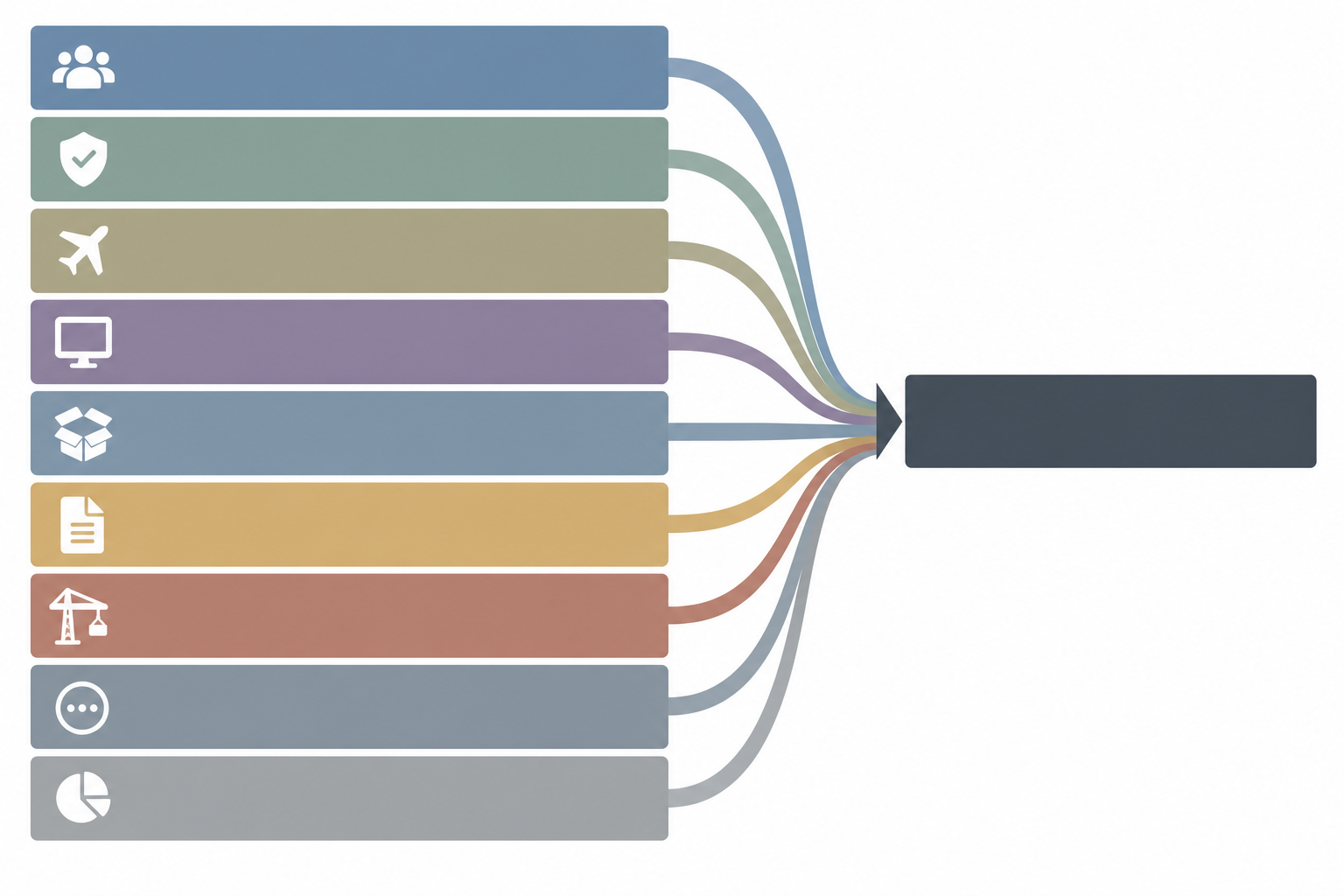
Federal non-construction budgets run on eleven lines in Section B of the SF-424A, "Budget Information for Non-Construction Programs" (OMB Number 4040-0006): nine carry costs and two are totals, and the form asks for "the total requirements for funds (both federal and nonfederal) by object class categories" (Grants.gov, SF-424A form and instructions, read October 2026). The narrative carries the detail the form leaves out.
Illustrative figures, not data from a real organization.
Personnel (6-a)
This line is for your own employees. The Grants.gov SF-424A instructions say "Do not include the personnel costs of consultants, contractors and subrecipients under this category" (Grants.gov, SF-424A instructions, read October 2026). Show the base salary and the effort, because an FTE figure on its own gives a reviewer nothing to verify.
Fringe benefits (6-b)
Fringe benefits are "allowances and services employers provide to their employees as compensation in addition to regular salaries and wages," including leave, insurance, pensions and unemployment benefits (eCFR 2 CFR 200.431(a), current as of September 2026). A contractor's fringe is not yours to budget here. It belongs in Contractual.
Travel (6-c)
Only employees in travel status belong on this line: the SF-424A instructions send travel by non-employees to Contractual and local travel for employees not in travel status to Other (Grants.gov, SF-424A instructions, read October 2026). Under 2 CFR 200.475, travel may be charged on actual costs, per diem or mileage, "provided the method used is applied to an entire trip and not to selected days of the trip," and the costs must be "consistent with the recipient's or subrecipient's established written policy" (eCFR 2 CFR 200.475, text in effect October 1, 2024). The GSA automobile mileage rate is $0.76 per mile for travel on or after July 1, 2026 (GSA, page updated September 21, 2026).
Equipment (6-d)
Equipment is tangible personal property with a useful life of more than one year and a per-unit acquisition cost at or above "the lesser of the capitalization level established by the recipient or subrecipient for financial statement purposes, or $10,000" (eCFR 2 CFR 200.1, read October 2026). OMB's 2024 revision "increased the threshold for determining items that are considered to be equipment from $5,000 to $10,000" (Federal Register, 89 FR 30046, April 22, 2024), so if an older form instruction prints a lower threshold, follow the current regulation. General purpose equipment needs prior written approval at any cost, and special purpose equipment at a unit cost of $10,000 or more (eCFR 2 CFR 200.439(b), read October 2026).
Supplies (6-e)
A supply is "all tangible personal property other than those described in the equipment definition," and a computing device counts as a supply when it costs less than the lesser of your capitalization level or $10,000, "regardless of the length of its useful life" (eCFR 2 CFR 200.1, read October 2026). Give each one a unit price and a quantity.
Contractual (6-f)
Procurement contracts, evaluation contracts and subawards sit here. Individual consultants do not: the SF-424A instructions list "individual consultant costs" under Other (Grants.gov, SF-424A instructions, read October 2026). Only "up to the first $50,000 of each subaward" enters the modified total direct cost base (eCFR 2 CFR 200.1, current as of September 2026).
Construction (6-g)
The SF-424A instructions state that "Construction and major renovation are unallowable in the absence of specific statutory authority" (Grants.gov, SF-424A instructions, read October 2026). On a non-construction award, write "Not applicable" on this line; a blank reads as an oversight.
Other (6-h)
Other is where vague lines tend to hide. The SF-424A instructions list individual consultant costs, local travel, insurance, printing and publications, training costs (tuition and stipends), staff development costs and professional service costs (Grants.gov, SF-424A instructions, read October 2026). Itemize each one with its own calculation, or a reviewer will read the line as padding.
Indirect charges (6-j)
You have three options: a negotiated rate, the de minimis rate, or no recovery at all. Whichever you pick, show the base, the exclusions, and the arithmetic that produced the amount.
A Complete Grant Budget Narrative Example: $150,000 Over Two Years
This narrative belongs to Example Workforce Partners (composite), a two-year training project requesting $150,000 (illustrative figures). The organization, the partner and the figures are invented; the sentence patterns are the ones worth copying.
Illustrative figures, not data from a real organization.
A. Personnel.
Project Director, 0.15 FTE, 1.8 person-months per year. Year 1: $80,000 x 0.15 = $12,000. Year 2: $81,600 x 0.15 = $12,240. The Director supervises staff and prepares the semiannual reports.
Training Coordinator, 0.50 FTE, 6.0 person-months per year. Year 1: $46,000 x 0.50 = $23,000. Year 2: $46,920 x 0.50 = $23,460. The Coordinator recruits participants, delivers the four cohorts, and runs the assessments. Year 2 includes a 2.0 percent organization-wide increase.
B. Fringe Benefits.
Charged at the organization's 25.00 percent rate on requested salaries: $35,000 x 0.2500 = $8,750 in Year 1, $35,700 x 0.2500 = $8,925 in Year 2. The rate is FICA 7.65 percent, health and dental 11.00 percent, retirement 4.00 percent, unemployment and workers' compensation 2.35 percent. Paid time off runs through the rate, not salaries.
C. Travel.
Two staff attend the required grantee meeting: 2 x ($410 airfare + 2 nights x $150 lodging + 3 days x $70 meals and incidentals) = $1,840 per year. Airfare reflects a written quote; lodging and per diem follow the organization's written travel policy.
D. Equipment.
None requested. The two laptops under Supplies cost $1,075 each, below the $5,000 capitalization level and the $10,000 threshold in 2 CFR 200.1.
E. Supplies.
Year 1: two laptops at $1,075 = $2,150; workbooks and assessment materials, 75 x $23 = $1,725; consumables $525. Year 2: workbooks and materials, 75 x $23 = $1,725; consumables $750, covering the lab module added in Cohorts 3 and 4. Unit prices come from the current vendor catalog.
F. Contractual.
A $10,000 annual subaward to a regional workforce partner funds recruitment in two rural counties and 90-day placement follow-up, covering 0.10 FTE of its employment specialist plus home-visit mileage. Scope of work, the partner's budget, and a commitment letter are attached. Each subaward is below $50,000, so the full amount enters the modified total direct cost base.
G. Construction.
Not applicable. No construction or major renovation is proposed.
H. Other.
Curriculum consultant: Year 1, 30 hours x $95 = $2,850 to adapt the four modules before Cohort 1; Year 2, 20 hours x $95 = $1,900 to revise them after Year 1 results. The rate reflects written quotes.
Local staff mileage: 2,000 miles x $0.76 = $1,520 per year between the training site and the partner counties.
Participant transit stipends: 35 x $40 = $1,400 per year, treated as participant support and excluded from the indirect base.
Printing and postage: $640 per year for flyers, handbooks, and assessment reminders.
I. Total Direct Charges.
$66,400 in Year 1, $64,400 in Year 2, $130,800 total.
J. Indirect Charges.
The applicant holds no federally negotiated rate and elects the 15 percent de minimis rate at 2 CFR 200.414(f) on modified total direct cost. Year 1: $66,400 less $1,400 in participant support = $65,000 x 0.15 = $9,750. Year 2: $64,400 less $1,400 = $63,000 x 0.15 = $9,450. No equipment, capital, patient care, rental, or tuition costs are budgeted, and the subaward does not exceed $50,000 in either year.
Total request: $76,150 in Year 1 plus $73,850 in Year 2 equals $150,000 (illustrative figures).
How to Justify Personnel Percentages and Fringe Rates Without Overclaiming
State the base, the effort, and the resulting charge in one sentence, then promise only the effort your time records can actually prove. Personnel is often the largest line in the budget.

- Never write a percentage without its base. "0.15 FTE" is unverifiable. "$80,000 x 0.15 = $12,000" can be checked in one step.
- Keep total effort at or below 100 percent. Payroll records must "Reasonably reflect the total activity for which the employee is compensated," not exceeding 100 percent (eCFR 2 CFR 200.430(g)(1)(iii), current as of September 2026).
- Treat the narrative as a commitment. "Budget estimates (meaning, estimates determined before the services are performed) alone do not qualify as support for charges to Federal awards" (eCFR 2 CFR 200.430(g)(1)(vii), current as of September 2026), and after-the-fact review compares your records to what you wrote.
- Respect statutory salary limits. NIH Notice NOT-OD-26-034, released January 28, 2026, puts the salary limitation for Executive Level II at $228,000, effective January 11, 2026. Above a cap, request salary on the capped amount and say so.
- Do not recover paid time off twice. Leave costs are allowable only where "They are provided under established written leave policies" and the method chosen "is consistently followed" (eCFR 2 CFR 200.431(b), current as of September 2026), so carry paid time off either in salaries or in the fringe rate, never both. SAMHSA's template guide adds that an organization recovering paid absences as part of salaries and wages "may not use percentages of effort and annual salaries to budget salaries" and must use hourly rates; in its example, an employee with 240 hours of paid absences can be budgeted for no more than 1,840 hours of a 2,080-hour year (SAMHSA, Detailed Budget and Narrative Template User Guide, template version 6.1, read October 2026).
Name the source of your fringe rate as well: a negotiated agreement, a board-approved calculation, or recovery through the indirect rate. If it sits inside the indirect rate, leave line 6-b blank and say why, because an empty box with no explanation looks like a line someone forgot.
After the award, those percentages have to be checked against time records, the routine laid out in our method for allocating salaries across multiple grants.
How Indirect Costs Appear in the Budget Narrative
Indirect costs are the expenses that support an award without being assignable to it directly: accounting, human resources, rent, utilities. In the narrative they need one paragraph naming the rate, the base, the exclusions, and the multiplication. Say which of the three options you chose.
- A federally negotiated rate. Cite the cognizant agency, the agreement date, the rate, and the base, then attach the agreement.
- The 15 percent de minimis rate. Under 2 CFR 200.414(f), a recipient without a current federally negotiated rate may elect a rate "of up to 15 percent of modified total direct costs (MTDC)," and the rate "does not require documentation to justify its use and may be used indefinitely" (eCFR 2 CFR 200.414(f), current as of September 2026).
- No indirect recovery. Say so in a sentence, so the reviewer does not assume you forgot.
The base does more work here than the rate. Modified total direct cost covers salaries and wages, fringe benefits, materials and supplies, services, travel, and the first $50,000 of each subaward. It excludes equipment, capital expenditures, patient care, rental, tuition remission, scholarships and fellowships, participant support, and the portion of each subaward above $50,000 (eCFR 2 CFR 200.1, current as of September 2026). Applying the rate to total direct costs instead of the modified base overstates the request.
Two traps are worth a deliberate check before you submit. An older form instruction can still print a lower de minimis rate than the current regulation's 15 percent, and the regulation wins. Agencies and pass-through entities may not require a rate below your negotiated or elected rate "unless required by Federal statute or regulation" (eCFR 2 CFR 200.414(f), current as of September 2026), so read the funding notice for a statutory cap before you assume your rate travels with you. For the rulebook behind these figures, see the Uniform Guidance at 2 CFR Part 200.
The rate itself, the MTDC base, and the NICRA path are covered in indirect cost rates for federal grants.
Common Reviewer Objections and How to Preempt Them
Eight reviewer objections are worth preempting. Each one closes with a single sentence you can write before you submit, which is cheaper than answering it after the score is in.

Behind all of those objections sit two tests. A reasonable cost "does not exceed an amount that a prudent person would incur under the circumstances prevailing when the decision was made to incur the cost" (eCFR 2 CFR 200.404), and a cost is allocable "if the cost is assignable to that Federal award or other cost objective in accordance with the relative benefits received" (eCFR 2 CFR 200.405(a), current as of September 2026). Run through the common grant proposal mistakes before you finalize.
Grant Budget Narrative Template
A grant budget narrative template is a fill-in structure that repeats one sentence pattern across every federal cost category: rate or unit cost, times quantity or effort, equals amount, followed by the activity the cost supports and the source of the rate. Fill every bracket in the skeleton. A category with nothing requested still gets a line, because a blank box reads as an oversight.
A. PERSONNEL   [title], [base salary] x [effort] = [$]. Duties: [activity].
               Escalation: [percent], per [salary scale].
B. FRINGE      [rate] percent x [$ salaries] = [$]. Source: [agreement or policy].
C. TRAVEL      [trip], [travelers]: [$ airfare] + [nights x $ lodging]
               + [days x $ per diem] = [$]. Rates per [written policy].
D. EQUIPMENT   [item] at [$ unit], or "None requested."
               Capitalization level: [$]. Prior approval: [status].
E. SUPPLIES    [item], [quantity] x [$ unit] = [$], for [activity].
F. CONTRACTUAL [partner], [$]. Scope: [deliverable]. Budget attached.
G. CONSTRUCTION  Not applicable, or [statutory authority].
H. OTHER       [item], [quantity] x [$ unit] = [$], for [activity].
               Mark any participant support here.
I. TOTAL DIRECT  [$ sum of A through H].
J. INDIRECT    [negotiated rate / 15 percent de minimis / none].
               [$ direct] less [$ exclusions] = [$ base] x [rate] = [$].
K. TOTAL       [$ I] + [$ J] = [$], matching line 6-k of the SF-424A.
Budget Justification Template When the Funder Wants Less Detail
Some funders want the calculation behind every line and some want category totals with a sentence each, so keep two versions of the same justification. OJP asks that "The budget detail should provide detailed computation for each budget line item, listing the total cost and how it was calculated" (OJP Grant Application Resource Guide, page modified September 22, 2026). An NIH modular budget asks for personnel justification "by position, role, and level of effort (measured in person months)," with no individual salary information (NIH Grants Policy Statement 13.3.1, revised March 2026). For the shorter format, each line becomes one sentence:
PERSONNEL     [title], [person-months] person-months a year, [role in the project].
OTHER LINES   [category]: [$ total], for [activity]. Basis: [one-line calculation].
One commenter on Reddit found that "a line-by-line budget was too much detail," and a commenter in the same thread noted that "the funding agency usually has a budget justification template they'll want used" (Reddit thread 1p2f7cl, read September 2026). Use the funder's template when there is one, and keep the full line-item version on file: NIH advises modular applicants to consider a detailed budget "for your own institution's use," because those details matter "when calculating your F&A costs base and writing your justification, and for audit purposes" (NIH, Develop Your Budget, updated December 3, 2025). The figures themselves come from a grant budget spreadsheet.
When the draft is done, read the narrative beside the budget table and confirm that every number in one shows up in the other. Check the total against the form, the project period, and any ceiling in the funding notice. Then hand it to your finance lead to verify salary bases, the fringe rate, the indirect base, and any match documentation, since those are the four places an error costs real money.
GrantCue includes a budget narrative tool among the AI writing tools that start on the Essentials plan at $49 a month, on the fast model, and the Team plan at $109 a month adds the standard model and "post-award lite" budget versus actuals (grantcue.com, October 2026). A drafted narrative still needs its calculations and rate sources checked by the finance lead. The features overview shows the writing tools.
FAQ
What Are Indirect Costs?
Indirect costs are "those costs incurred for a common or joint purpose benefitting more than one cost objective and not readily assignable to the cost objectives specifically benefitted" (eCFR 2 CFR 200.1, current as of September 2026), such as accounting, personnel administration and facility operations. Under 2 CFR 200.414, organizations recover them through a negotiated rate or the de minimis rate of up to 15 percent of modified total direct costs.
How Long Should a Grant Budget Narrative Be?
Follow the funder's limit and format. NSF caps the budget justification at five pages per proposal, plus five for each subaward (NSF PAPPG 24-1, Chapter II.D.2.f, read October 2026). OJP asks for "detailed computation for each budget line item" (OJP Grant Application Resource Guide, page modified September 22, 2026). Without a stated limit, show the calculation and the activity for each line, then stop.
Do I Still Need a Budget Narrative If the Funder Provides a Budget Form?
Yes, unless the instructions say otherwise. The SF-424A asks for totals "by object class categories," and one federal agency's budget narrative guidance posted on Grants.gov states "The information in the budget narrative must correspond to Section B of the SF-424A" (Grants.gov, read October 2026). The form holds the totals; the narrative holds the calculation and the purpose.
What Belongs in the "Other" Category of a Federal Grant Budget?
The Grants.gov SF-424A instructions put individual consultant costs, local travel, insurance, printing and publications, training costs such as tuition and stipends, staff development costs and professional service costs on the Other line (Grants.gov, SF-424A instructions, read October 2026). Itemize each with its own calculation, and mark participant support costs, because modified total direct costs exclude them (eCFR 2 CFR 200.1, current as of September 2026).
Can a Budget Narrative Template Work as a Grant Budget Justification Template?
Yes. Budget narrative and budget justification name the same document, so one template serves both: rate or unit cost times quantity equals amount, then the activity and the source of the rate. Where the agency supplies its own budget justification template, move the same sentences into its boxes and keep its order.
What Happens If My Budget Narrative Does Not Match My Budget Form?
A mismatch reads as a math error. Check every category total in the narrative against the same line on the form, then confirm that total direct charges plus indirect charges equal the amount on line 6-k of the SF-424A. When the two disagree, correct whichever figure you cannot defend with a calculation.
Rewrite the Largest Line First
Take the largest line in your budget and rewrite it as rate x quantity = amount, then name the activity it funds and where the rate came from. If you cannot name the source, you have found the line a reviewer will question. Work down through the rest the same way, then compare the finished narrative with the budget proposal examples for format.