Sample Grant Proposal for Education Nonprofit Programs: A Complete K-12 Example
A sample grant proposal for education nonprofit programs, walked through section by section with a worked K-12 example covering need, budget, and evaluation.

Last updated: September 2026
A sample grant proposal for education nonprofit programs has to do something a generic template cannot. It has to convince a reviewer who already knows roughly what a school district spends per student. Education funders read requests for tutoring, after-school programming, and classroom materials constantly. They have seen a district budget. The proposals that get funded name the specific gap public funding leaves, then tie the work to a measure the district already reports. They also say what happens to students when the grant year ends. This page walks through that structure with a worked K-12 example you can adapt.
Quick Answer: What Goes in a Sample Grant Proposal for Education Nonprofit Programs?
An education nonprofit grant proposal includes a cover letter, executive summary, organization background, statement of need built on school-level data, program description, SMART objectives, an evaluation plan tied to district assessments and attendance records, a line-item budget with narrative, a sustainability plan, and attachments such as the district partnership agreement and IRS determination letter.
Free download: Complete sample proposal for a K-12 education program as Word .docx. No email address required.
What Education Funders Check Before They Read Your Narrative
An education proposal has to answer four questions early: whether a school or district is a named partner, whether the request adds to public funding, whether you can report student outcomes, and what carries the program after the grant period.
GrantCue's analysis of IRS Form 990-PF filings, current as of September 10, 2026, records 339,302 education-purpose grant line items totaling $31.8 billion, the largest sector in that corpus. Those figures cover grants paid by private foundations that file Form 990-PF, classified by grant purpose text, so they describe private foundation giving and not all education funding. More money moves through education than through any other purpose category in that corpus, and more organizations are competing for it.
The supplement question is easy to miss. A funder reading a request for reading tutors in a Title I school wants to know what Title I already pays for at that school and why this is different. Answer it in the program description, before a reviewer asks. Name the service the school provides and the gap it leaves. Then show where the boundary sits.
If the format itself is new to you, start with the fundamentals in how to write a grant proposal, then come back for the education-specific detail.

Sample Nonprofit Grant Proposal Structure, Adapted for a K-12 Program
The section order for an education proposal follows the standard nonprofit sequence. What changes is the evidence inside each section: school-level enrollment and assessment data carry the argument.
| Section | What an education reviewer checks | Typical length |
|---|---|---|
| Cover letter | Signed by the executive director, names the school partner | 1 page |
| Executive summary | Students served, grade band, request amount, single outcome claim | 1 page |
| Organization background | Years operating in schools, current district relationships | 1 page |
| Statement of need | School-level data for the named campuses | 2 pages |
| Program description | Weekly schedule, dosage, staffing ratio, curriculum used | 2 to 3 pages |
| Goals and objectives | Measurable, with baseline and target | 1 page |
| Evaluation plan | Named instruments, who collects, when | 1 to 2 pages |
| Budget and narrative | Cost per student, personnel basis of calculation | 2 pages |
| Sustainability | Named year-two funding path | 1 page |
| Attachments | Partnership agreement, data-sharing agreement, IRS letter, board list | Varies |
Three items on that list are specific to education work and are easy to underestimate: the partnership agreement with the district, the data-sharing agreement that lets you see student records, and the dosage figure in the program description.
Statement of Need: Use School-Level Data
An education statement of need describes the students in the specific schools you will serve, using data the district publishes or shares under agreement. National reading statistics tell a funder nothing about whether your program is needed at that campus.
Use the layers in this order. Start with the school. State enrollment, the share of students qualifying for free or reduced-price meals, and the most recent proficiency rate in the subject you are targeting. Then narrow to the student group. If the program serves sixth and seventh graders performing below grade level in math, say how many students in those grades are below benchmark on the district screener. Then explain what the school currently does for them and where it stops. Common stopping points are the end of the school day and the number of intervention slots the master schedule allows.
Here is a composite example, invented for illustration. An education nonprofit serves three middle schools in one district. Across those campuses, 412 students in grades 6 and 7 scored below benchmark on the fall math screener. The schools run intervention blocks that reach roughly 140 of them. The nonprofit proposes to serve 120 additional students in after-school small-group math sessions, four days a week, through the school year.
Every figure in that paragraph comes from a system the district already maintains. For more on building this section, see these grant proposal statement of need examples.
Goals and Objectives a School District Can Verify
An education objective is measurable in practice only when a district staff member can pull the number from a system the district already runs. Say which instrument you will use, what the baseline is, what the target is, and by what date.
Weak objective: improve math achievement for participating students.
Stronger objective: by June 2027, at least 65 percent of students attending 60 or more program sessions will move up at least one performance band on the district math benchmark assessment, from a fall baseline in which all enrolled students scored below benchmark.
The second version gives the funder the measure, the dosage threshold, the target, the baseline, and the deadline. It also protects you. A student who attends four sessions and shows no growth does not count against your outcome, because the objective is written against a dosage threshold you defined up front.
Set two to four objectives. Long lists work against you here. Write objectives that match the program's actual dose. A program running 120 hours of small-group math should not promise a change in graduation rates. Objectives, budget, and evaluation all have to agree with each other, a point the proposal writing walkthrough works through in order.
Budget and Budget Narrative for a K-12 Program
Write the budget so the per-student cost is visible without arithmetic. Show cost per student, and give the basis of calculation for every personnel line.
This one-year budget covers the composite example: 120 students across three middle schools, four sessions a week. The figures illustrate method. No funder made this award.
| Line item | Basis | Amount |
|---|---|---|
| Program director, 0.4 FTE | $65,000 base salary at 40% | $26,000 |
| Site coordinators, 3 at 0.2 FTE | $40,000 base salary at 20% each | $24,000 |
| Payroll taxes and benefits | 22% of $50,000 in salaried wages | $11,000 |
| Tutor stipends | 10 tutors x 100 hours x $22/hour | $22,000 |
| Personnel subtotal | $83,000 | |
| Assessment and progress-monitoring licenses | 120 students x $40 | $4,800 |
| Instructional materials and consumables | 120 students x $25 | $3,000 |
| Late-activity transportation | 3 sites x 30 weeks x 4 days x $27.50 per run | $9,900 |
| Family engagement sessions | 4 sessions x $450 | $1,800 |
| Staff clearances and background checks | 14 staff x $55 | $770 |
| Tutor training and coaching | 24 hours x $95 | $2,280 |
| Non-personnel subtotal | $22,550 | |
| Total direct costs | $105,550 | |
| Indirect costs | 10% cap set by the example funder | $10,555 |
| Total request | $116,105 |
That works out to about $968 per student for the year. State that figure in the narrative.
Three assumptions in that table need checking against your own operation. The clearance line covers 14 people: one program director, three site coordinators, and ten tutors. The payroll line covers the $50,000 in salaried wages only, because the example treats tutors as contracted at an hourly stipend rate; extend it if your tutors sit on payroll. The $27.50 per-run transportation figure is a placeholder, so substitute your district's published activity-bus rate.
The example also applies a 10 percent indirect cap set by the funder, calculated on total direct costs. Federal awards work differently. An organization without a negotiated rate may elect the de minimis rate of up to 15 percent of modified total direct costs under 2 CFR 200.414(f) (eCFR, current as of September 10, 2026), and modified total direct costs is a narrower base than total direct costs.
Four budget lines are specific to school-based work and are easy to forget. Late-activity transportation comes first. An after-school program without a bus home serves whoever lives closest and nobody else. Districts require clearances before an adult works alone with students, so put them in the budget. You cannot report growth on an assessment you do not hold a license for. And the tutor training line is what tells a funder your tutors are more than volunteers with worksheets.
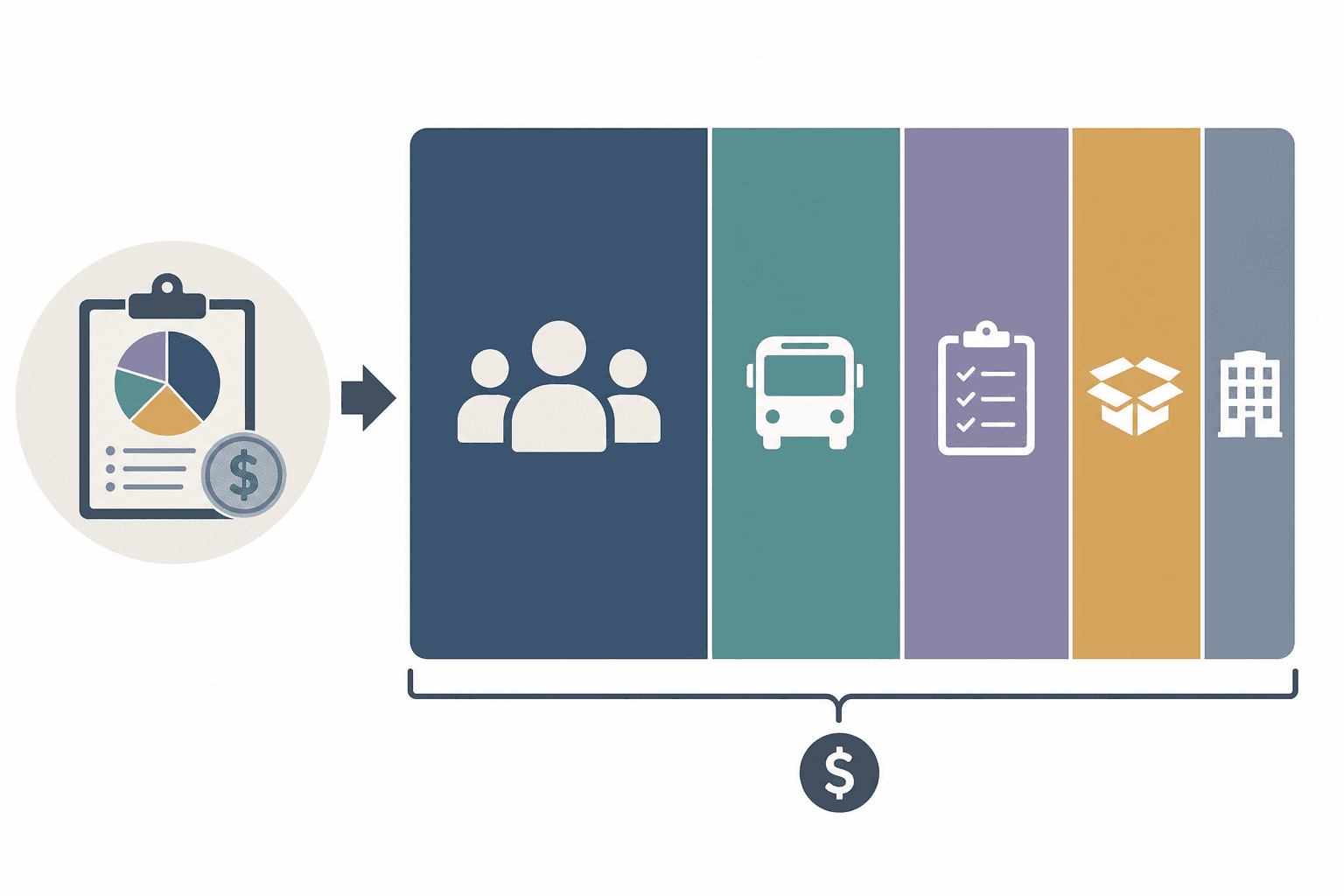
For general formatting and a fuller set of categories, this grant proposal budget template with nonprofit examples covers the mechanics.
Evaluation Plan: Pair Dosage With an Academic Measure
An education evaluation plan works when it pairs a dosage measure with an academic measure drawn from a district system. Attendance alone proves the program ran. It does not prove the program worked.
| Measure | Data source | Collected |
|---|---|---|
| Program dosage: students attending 60+ sessions | Site attendance roster | Weekly, reported quarterly |
| Math benchmark growth, fall to spring | District universal screener | Fall, winter, spring |
| Course pass rate in target subject | District grade records, via data-sharing agreement | Each grading period |
| Chronic absenteeism during program months | District attendance system | Quarterly |
| Student self-efficacy in the target subject | Short pre and post survey | September and May |
Define every threshold in the proposal itself. If you report chronic absenteeism, state the definition you are using, for example missing 10 percent or more of enrolled school days. Use whatever definition your district reports on, so the funder and the district count the same students.
Section 8101(21)(A) of the Elementary and Secondary Education Act defines four levels of evidence for education interventions: strong evidence, moderate evidence, promising evidence, and evidence that demonstrates a rationale (U.S. Department of Education, Non-Regulatory Guidance: Using Evidence to Strengthen Education Investments, revised September 28, 2023, ed.gov). The Department applies the same four levels in its discretionary grant competitions through EDGAR at 34 CFR 77.1, so federal applicants are scored against those definitions. Expect the question in foundation applications too, and answer it the same way. If the curriculum or model you use has been reviewed by the What Works Clearinghouse (ies.ed.gov/ncee/wwc), name the finding. If it has not, the fourth level is an honest answer: present a logic model showing how you expect the intervention to produce the outcome, and commit to studying it.
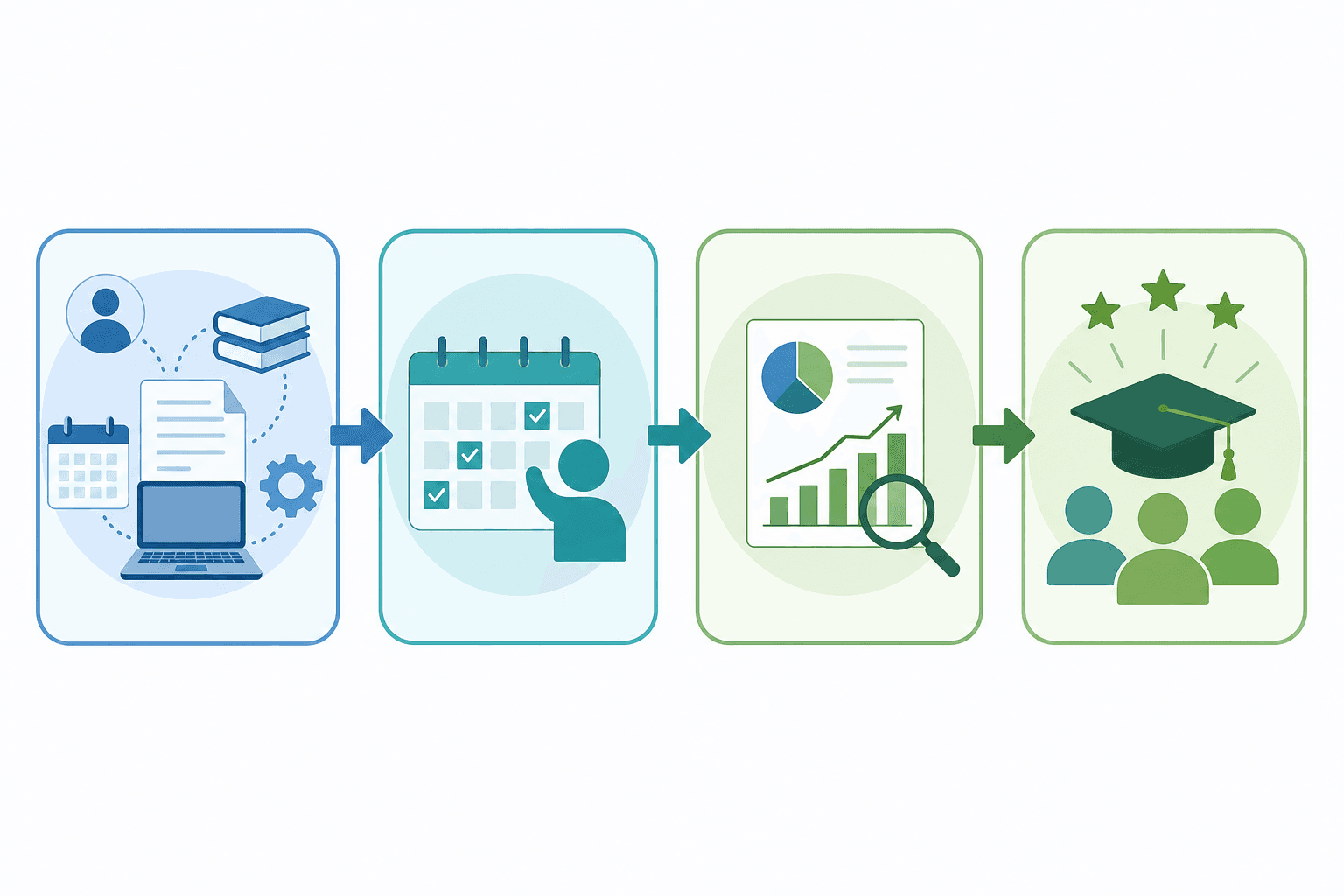
When you get to drafting the section itself, this grant proposal evaluation plan template gives the section-level structure.
Sustainability: What Happens in Year Two
A sustainability section earns its page by naming one funding path and the decision date attached to it. A sentence like "we will continue to seek diversified funding" gives a reviewer nothing to evaluate.
Realistic paths for a school-based program:
- A district line item, once the model has results.
- A school-level set-aside from federal formula funds, where the use is allowable.
- A state after-school or extended-learning program.
- A fee-for-service arrangement, where the district contracts for the program at a per-student rate.
- A local funder taking on part of the cost while the original funder steps down.
Say which one you are pursuing. Identify who at the district you have spoken with, and give the decision date on their budget calendar.
If the honest answer is that year two depends on a second grant, say so and list the programs you will apply to.
Four Objections Education Funders Raise
Write the narrative so it answers four objections in advance: supplanting, the district agreement, dosage versus enrollment, and evidence base.
"Is this replacing something the school already funds?" Answer it in the program description. State what the school provides and what your program adds. Be explicit about where the line falls, then attach the partnership agreement showing the district agrees with that division.
"Do you have the district's agreement in writing?" A signed memorandum of understanding covering facility use, staff access, supervision, and student data sharing answers several reviewer questions at once. Get it before you apply.
"How many students actually attended enough to benefit?" Report both numbers. Students enrolled and students meeting your dosage threshold are different figures.
"What is your evidence base?" Say which curriculum or model you use. Cite the What Works Clearinghouse review if there is one; if there is not, present the logic model.
Adapting This Example to Other K-12 Programs
The structure holds across most K-12 program types. What changes is the dosage figure and the instrument your objective is written against.
| Program type | Dosage measure | Academic measure |
|---|---|---|
| After-school math or reading | Sessions attended against a stated threshold | District universal screener or benchmark growth |
| Summer learning | Days attended out of days offered | Spring-to-fall score change on the same instrument |
| College access | Advising contacts per student | FAFSA completion and application counts from the counseling office |
| STEM enrichment | Contact hours per student | Course enrollment and pass rate in the target sequence |
| Family literacy | Sessions attended per family | Early literacy screener results for the enrolled child |
Change the grade band and subject to match your program, set the dosage your schedule actually delivers, then replace the school data with your own. Keep the chain intact: the need statement names the students, the objective names the instrument, the budget pays for the instrument, and the evaluation plan reports on it. A proposal breaks when one of those links is missing.
Find Education Funders Worth Applying To
Education grant opportunities sit across federal programs, state education agencies, and private foundations, and no single portal lists them together. GrantCue searches federal and state portals and adds foundation data drawn from IRS Form 990-PF filings, so you can browse foundations by state and read each funder's actual grant list, including recipient and grant purpose. Start with education grant opportunities and filter by deadline before you commit writing hours.
Once you have a target list, record each funder's published deadline and required attachments.
FAQ
How to write a nonprofit grant proposal
Work in this order: confirm the school or district partnership, gather the local data your need statement will rest on, define the program's schedule and dosage, set two to four measurable objectives, build the budget from the staffing plan, then write the evaluation and sustainability sections. Draft the executive summary last, once the numbers are settled.
What outcomes should a K-12 education grant proposal measure?
Pair a dosage measure with an academic measure. Dosage means the number of students attending enough sessions to benefit, using a threshold you define. Academic measures should come from systems the district already runs, such as a universal screener, benchmark assessment, course grades, or attendance records, so the results are verifiable.
How much should an education nonprofit ask for in a grant proposal?
Ask for an amount your cost per student justifies and your organization can absorb operationally. Build the budget from the staffing plan first, then check the total against what the funder publishes. If your request exceeds that range, scope the program down or split it across funders and say so in the budget narrative.
Do I need a district MOU before applying for an education grant?
For a program delivered on school property or using student data, yes in practice. A memorandum of understanding covering facility use, supervision, staff clearances, and data sharing answers several reviewer questions at once. Applying without one signals that the partnership may still be informal.
How long should an education grant proposal be?
Follow the funder's stated page limit exactly. Federal notices publish section-level limits in the notice of funding opportunity, and foundation guidelines publish them in the application instructions. If no limit is given, ask the program officer instead of guessing. Cutting to fit a limit is part of the work.
Where can I find grants for education nonprofits?
Search Grants.gov for federal opportunities, your state education agency's grant page, and private foundation filings. A foundation's IRS Form 990-PF lists every grant it paid, with recipient and amount, so you can see what it has already funded in your region.
Next Step
Adapt the statement of need to your schools, then rebuild the budget from your own staffing plan. If you want the wider framework behind each section, the general proposal guide covers the parts that are the same regardless of sector; this page covers the education-specific parts.