Research Grant Proposal Templates and Examples: A PI's Field Guide
Research grant proposal templates and examples for principal investigators and sponsored programs offices, mapped to NIH and NSF component formats.
A research grant proposal is not one document — it's a bundle of components, each with its own format rules set by the sponsor. NIH caps the specific aims page at one page; NSF requires a 15-page project description with mandated sections; every federal sponsor has its own biosketch format, budget forms, and data management requirements.
That's why generic "research grant proposal sample" downloads disappoint: a proposal that worked at one sponsor is formatted wrong for the next one. This guide takes the component view instead — what each piece has to do, which format each major sponsor requires, and where to find a template for each part. It's written for principal investigators doing their own pre-award and for the one-person sponsored programs offices supporting them.
Quick Answer: What Goes in a Research Grant Proposal?
Nearly every federal research application contains these components:
- Project summary / abstract — the one-page public description
- Specific aims or objectives — what you will test or build, and why now
- Research strategy / project description — significance, innovation, approach
- Biosketches — investigator qualifications in the sponsor's mandated format
- Budget and justification — direct costs, F&A (indirect costs), effort in person-months
- Data management and sharing plan — now required by NIH, NSF, and most agencies
- Facilities and resources — what your institution provides
- Letters of support / collaboration — from co-investigators, sites, and partners
The sponsor's solicitation overrides everything. NIH applications follow the NIH application guide; NSF proposals follow the Proposal & Award Policies & Procedures Guide (PAPPG) on nsf.gov; other agencies publish their formats in the notice of funding opportunity on Grants.gov.
Why the Component View Beats a Sample Proposal
Funded proposals from your field are worth studying for their argument — how they frame significance, how they scope aims, how they preempt reviewer objections. They are terrible templates for format, because format is sponsor-specific and changes yearly.
So split the work:
- For argument structure, the general proposal logic is the same one that governs any funder pitch: problem, evidence, plan, measurement, cost. Our section-by-section proposal guide walks that full argument.
- For component formats, work from the current sponsor guide, not from a colleague's five-year-old funded application. Biosketch formats, data-sharing rules, and page limits have all changed in the last few cycles.
The Components, With Templates
The specific aims page (or objectives section)
The single highest-leverage page in a research proposal. Most reviewers form their funding opinion here and spend the rest of the application confirming it. The working structure: an opening paragraph establishing the problem and the gap, a paragraph stating your central hypothesis and approach, then two to four aims, each one sentence of what plus one or two sentences of how and expected outcome.
Aims must be independent — if Aim 2 dies when Aim 1's hypothesis fails, reviewers will say so. The discipline of writing measurable, independent aims is the same one behind SMART goals and objectives in any proposal.
The significance / need argument
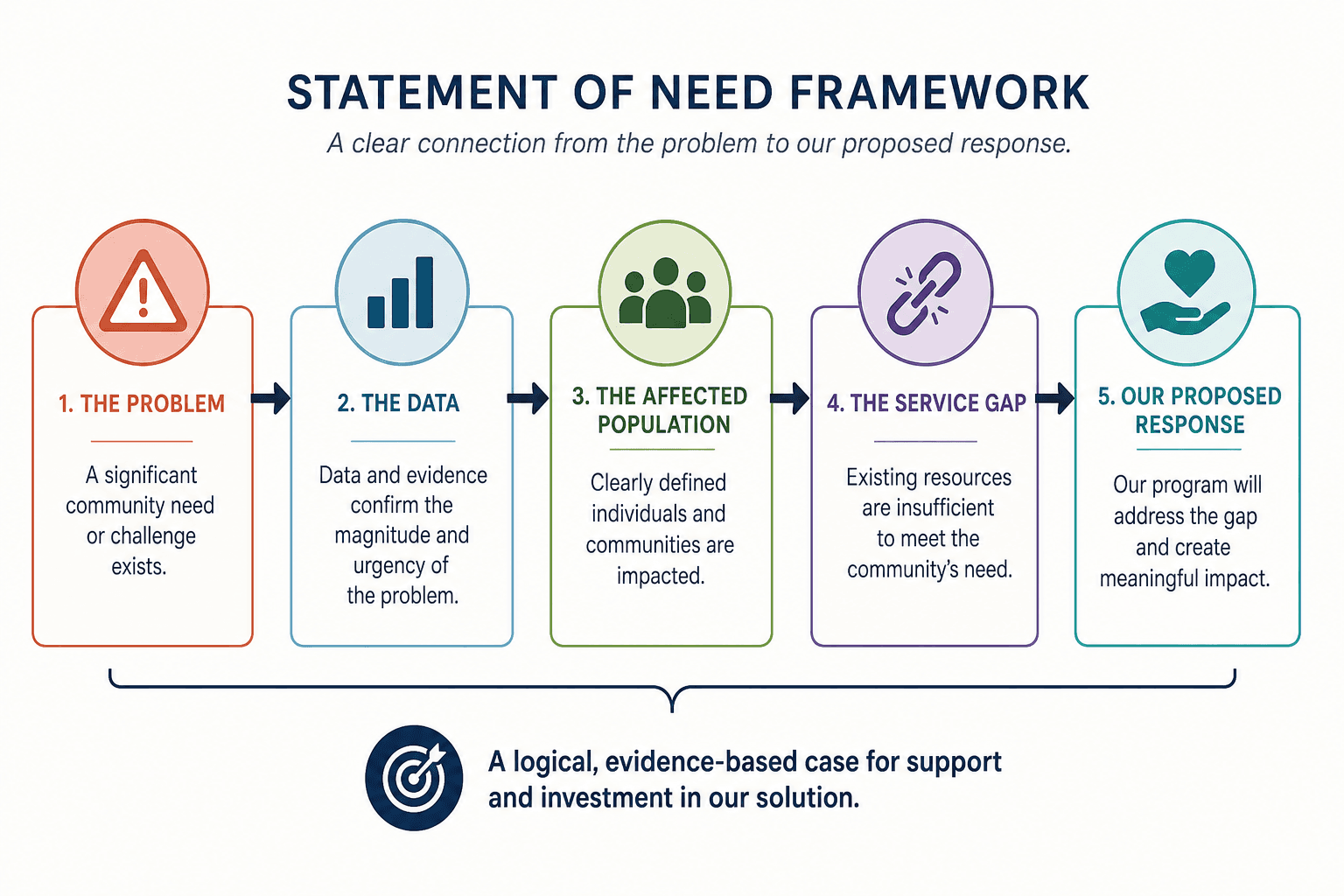
Research proposals prove a gap in knowledge the way nonprofit proposals prove a community need: with citations and data, not adjectives. State what is known, what is not, and why the gap matters — clinically, economically, or scientifically. The evidence-first structure in our statement of need guide transfers directly; swap community statistics for literature and preliminary data.
The budget and justification
Research budgets add three things generic budget templates miss:
- Effort in person-months. Federal sponsors want calendar months of effort per investigator, consistent with institutional commitments.
- F&A (indirect costs) at your negotiated rate. Applied per your institution's rate agreement — and checked by the sponsor, so involve your grants office early.
- Sponsor-specific caps and exclusions — salary caps, equipment thresholds, participant-support rules that vary by agency.
The line-item and justification mechanics are the same as any grant budget; the budget template guide covers the math-shown-per-line format reviewers expect, which you then map onto the sponsor's forms.
The data management and sharing plan
Now a scored or compliance-checked component nearly everywhere: NIH requires a Data Management and Sharing Plan, and NSF requires a data management plan under the PAPPG. Answer four things concretely: what data you'll generate, in what formats and standards, where it will be shared and when, and who oversees compliance. Vague plans draw administrative flags even when the science scores well.
The evaluation logic
Even where no formal "evaluation plan" section exists, reviewers score your approach on the same question: how will you know it worked? Milestones, go/no-go criteria between aims, and pre-registered analysis plans are the research-world versions of the measures in our evaluation plan guide.
The Part Nobody Templates: Deadline and Portfolio Management
Ask anyone who has run pre-award support: proposals rarely fail on writing quality alone. They fail on logistics — the biosketch that arrived in the wrong format the night before deadline, the subaward budget that surfaced at the last minute, the limited-submission opportunity nobody flagged until the internal deadline had passed.
That's a systems problem, and it compounds for the offices the enterprise tools skipped. Kuali, Cayuse, and InfoEd are priced and staffed for R1 research administration; the small college, the independent institute, and the department managing its own submissions typically run on spreadsheets and inbox memory instead. The predictable results:
- Internal deadlines don't exist. The sponsor deadline is the only date anyone tracks, so institutional review gets compressed into the final 48 hours.
- Limited submissions slip through. Opportunities that allow one application per institution need coordination weeks ahead; a spreadsheet doesn't warn anyone.
- Just-in-time and post-award dates blindside the team. JIT requests, progress reports (RPPRs), and no-cost-extension windows all arrive on schedules nobody wrote down.
- Each PI's pipeline is invisible. Nobody can see which proposals are in development, submitted, or awarded across the department — so effort commitments and cost-share promises collide at award time.
This is the tier GrantCue's research institutions solution is built for: a shared pipeline of opportunities and submissions, deadline and task tracking with owners, and AI fit scoring that reads a solicitation against your research profile — at a price a department can approve without a procurement committee. It complements (rather than replaces) your institution's official system of record for award accounting.
A Realistic Timeline for a Federal Research Proposal
| Weeks before deadline | What should be happening |
|---|---|
| 12+ | Opportunity identified and fit-checked; internal/limited-submission clearance confirmed |
| 10 | Specific aims drafted and circulated to collaborators |
| 8 | Research strategy in full draft; subawards and letters requested |
| 6 | Budget built with grants office; biosketches requested in current format |
| 4 | Data management plan, facilities, and supplementary docs complete |
| 2 | Full internal review against the sponsor's review criteria |
| 1 | Institutional sign-off; submission to the sponsor portal |
| Post-deadline | Log outcomes; on award, calendar every report date immediately |
Compressing this into three weeks is possible and common — and it's where formatting errors, budget mismatches, and missed attachments come from. Working backwards from every deadline with named owners is exactly the discipline our full proposal guide recommends for any funder, applied at research-office scale.
FAQ
Where can I find real funded research proposal examples?
NIH's institutes periodically publish funded sample applications (NIAID maintains the best-known collection), and many university research-development offices share funded proposals internally. Use them for argument and scope; always format from the current sponsor guide.
What's the difference between an NIH and an NSF proposal?
Structure and review culture. NIH scores significance, innovation, and approach with a one-page specific aims convention; NSF's PAPPG mandates a project description addressing intellectual merit and broader impacts — and broader impacts is a scored criterion, not boilerplate. Budgets, biosketch formats, and data-plan requirements also differ. The underlying argument — gap, hypothesis, approach, measurement, cost — is the same.
Does GrantCue replace our sponsored programs system?
No. GrantCue handles the layer before and around submission — finding opportunities, scoring fit, tracking deadlines, coordinating tasks across a team — for institutions and departments that don't have (or can't justify) an enterprise eRA system. Award accounting and compliance of record stay with your institution's official systems. See what's included on the research institutions page.