Free Foundation Directory: 127,983 Grantmakers, Built From IRS 990-PF Filings
GrantCue's free foundation directory profiles 127,983 private foundations from IRS 990-PF e-filings: $165.3 billion in paid grants across 2.32 million line items, with giving totals, median grant size, and top recipient states for each funder.

In this article (6)
Every private foundation in the United States files a Form 990-PF with the IRS, and every one of those filings lists the grants the foundation actually paid. The data is public. It has also been genuinely hard to use: the fields sit inside millions of individual XML files, and the commercial databases built on top of them charge four figures a year for access.
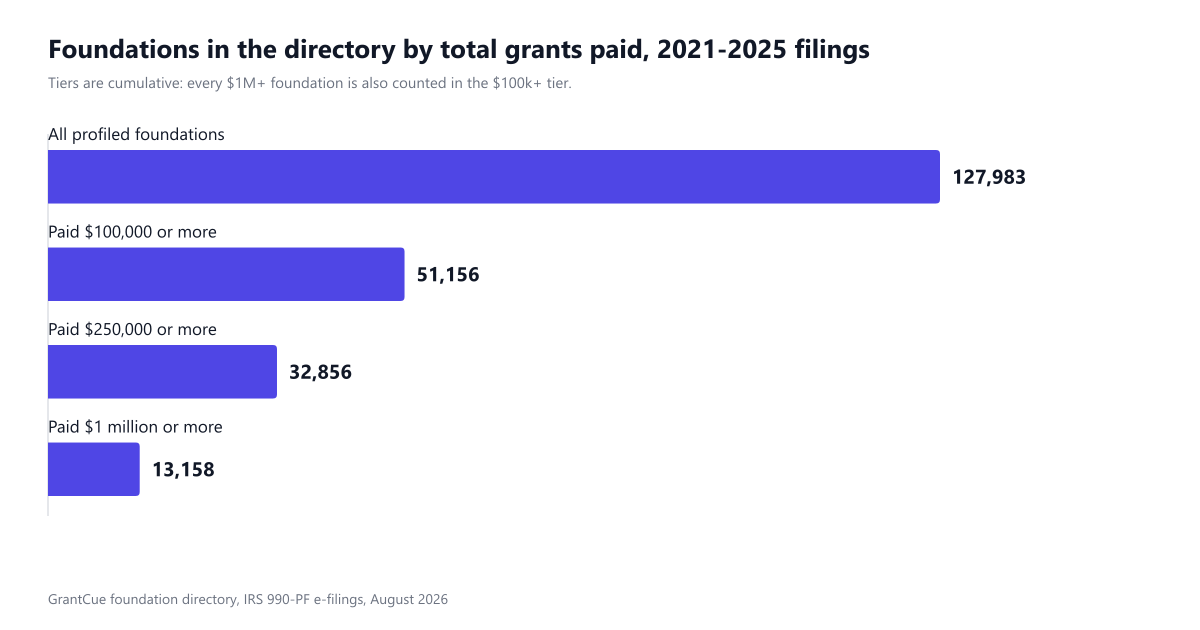
We processed the IRS 990-PF e-filing corpus into a free foundation directory of 127,983 grantmakers. It draws on 2,319,883 individual grant line items from filings covering tax years 2021 through 2025, totaling $165.3 billion in paid grants. Each profile shows what a foundation paid out, how many grants that covered, its median grant size, its giving by year, the states its recipients are in, and its largest individual grants. There is no paywall and no account requirement for browsing.
Quick Answer: What Is in the Directory?
- 127,983 private foundation profiles, searchable by name and sortable by total giving, grant count, or median grant size.
- $165.3 billion in paid grants across 2,319,883 individual grant line items, from IRS 990-PF e-filings for tax years 2021 to 2025.
- 13,158 foundations paid out $1 million or more in the filing window; 51,156 paid at least $100,000.
- Each profile shows giving by year, median grant size, top recipient states, and the foundation's largest individual grants.
- The typical foundation's median grant is $7,500, which says a lot about who this data actually serves. More on that below.
Select to enlarge (opens in a new tab).
What a Profile Tells You
Take a mid-size example: The Wollenberg Foundation (EIN 94-6072264) paid $2,479,100 across 80 grants in its filing window, with a median grant of $10,000. That one line answers the three questions a prospect researcher starts with. Is this funder active? Yes, 80 paid grants. Is my request in their range? Their median is $10,000, so a $250,000 ask is probably the wrong first conversation. Where do they give? The profile lists recipient states, so you can see whether your geography has ever appeared.
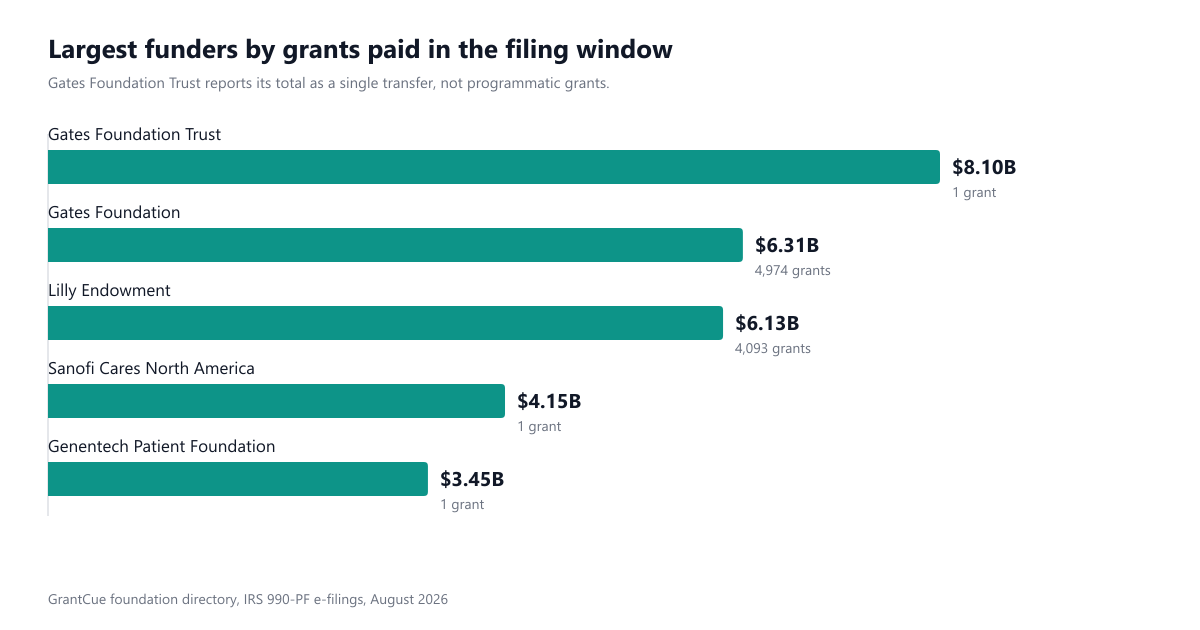
At the other end of the scale, the largest funders in the corpus are familiar names. Gates Foundation Trust shows $8.10 billion, though as a single transfer rather than programmatic grants. The Gates Foundation itself shows $6.31 billion across 4,974 grants. Lilly Endowment shows $6.13 billion across 4,093. The directory does not editorialize about any of them; it shows what the filings report.
Select to enlarge (opens in a new tab).
The corpus also captures money that has been approved but not yet paid: $26.2 billion in future grant commitments across 3,073 foundations. When a foundation reports large future commitments, its near-term discretionary budget may be smaller than its asset size suggests. That is worth knowing before you write the letter of inquiry.
Why Median Grant Size Is the Most Useful Number
Averages lie in this dataset. A foundation that made 79 grants of $5,000 and one of $2 million has an average grant of about $30,000, which describes none of its actual grants. The median cuts through that. Across all profiled foundations the median grant is $7,500.
That number is the honest picture of American private philanthropy below the famous names: tens of thousands of family foundations writing four and five figure checks, mostly to organizations in their own state. If you run a small nonprofit, these funders are more realistic first targets than the household names, and they are the ones no commercial database makes it affordable to find.
Where the Data Comes From, and What It Does Not Cover
The source is the IRS 990-PF e-file corpus, the same public data the commercial platforms build on. We ingest the filings, extract the grants-paid schedules, and aggregate them per EIN. A few honest limitations:
- It covers private foundations only. Community foundations and other public charities file Form 990, not 990-PF, so their grantmaking is not in this directory.
- It reflects filings, not this morning. Foundations file annually and often on extension. The window currently spans tax years 2021 through 2025, and the most recent year is always incomplete.
- Paid grants, not intentions. The totals are what foundations reported actually paying, plus separately reported future commitments. The directory contains no open applications or deadlines, because most private foundations have neither.
- Names are as filed. Foundations occasionally change names or file under variants. We aggregate by EIN, which is stable even when the name is not.
We refresh the directory weekly as new filings enter the corpus.
Also New This Week: Federal Award History and Minnesota Coverage
The directory is one of three data releases this week, and the other two answer the same underlying question, which is "who actually gets the money?"
Past award data on federal grants. Grant listings on GrantCue that carry a federal assistance listing number now show what the program actually awarded since October 2022, sourced from USAspending.gov: award count, total obligated, average award, and the top recipients. Across the 242 active programs with award history in our catalog, that is $315.3 billion in obligations over 353,747 awards. The spread between programs is enormous. The Child Care and Development Block Grant obligated $33.2 billion at an average of $11.0 million per award, while NIH's Allergy and Infectious Diseases Research program made 16,271 awards averaging $951,199. Knowing which of those distributions you are walking into changes how you write.
Minnesota state grants. Our catalog now syncs Minnesota DEED's competitive grants page, which adds business and workforce programs like the Minnesota Job Skills Partnership (closing September 14, 2026) and the rolling State Trade and Export Promotion program. Minnesota joins the states we track directly at the source, and the closed programs stay in the catalog as history rather than vanishing.
How to Use This for Prospect Research
A workflow we have watched real grant teams use with the underlying data:
- Search the directory for foundations whose top recipient states include yours.
- Filter your shortlist by median grant size against your ask. A funder with a $10,000 median is a $10,000 conversation.
- Read the largest-grants list on each profile. It names actual recipient organizations, which tells you the funder's real interests faster than any mission statement.
- Check giving by year. Flat or growing is a good sign; a funder whose payouts fell by half may be spending down or retrenching.
Then the work leaves the data and becomes relationship building, which no database does for you.
The directory is live at grantcue.com/foundations. If you want the same data joined to deadline tracking, team pipelines, and the federal and state opportunity catalog, that is what GrantCue is for, and the starter tier is free.
Charts and statistics from this page may be republished with credit and a link back to this report.