Your Complete Guide to Federal Grants: Navigating Grants.gov and Beyond in 2026
A comprehensive guide to federal grants, Grants.gov navigation, small business grants, and nonprofit funding opportunities. Learn proven strategies for finding, applying, and winning government grants in 2025, including SBIR/STTR programs, foundation grants, and corporate funding sources.
In this article (10)
- Understanding the Federal Grants Ecosystem
- What Is Grants.gov and How Does It Work?
- Small Business Grants: Opportunities Beyond Traditional Lending
- Nonprofit Grants: Navigating Specialized Funding Streams
- The Grant Application Process: From Registration to Award
- Maximizing Your Chances of Success
- Building a Diversified Funding Strategy
- Managing the Grant Lifecycle
- Looking Ahead: The Future of Federal Grant Funding
- Taking Action
Securing funding through government grants has become both more accessible and more competitive than ever. Whether you're running a small business pursuing innovation funding or leading a nonprofit organization seeking support for community programs, understanding the federal grants landscape is essential for organizational success. This comprehensive guide breaks down everything you need to know about finding, applying for, and winning federal grants through Grants.gov and other funding channels.
Understanding the Federal Grants Ecosystem
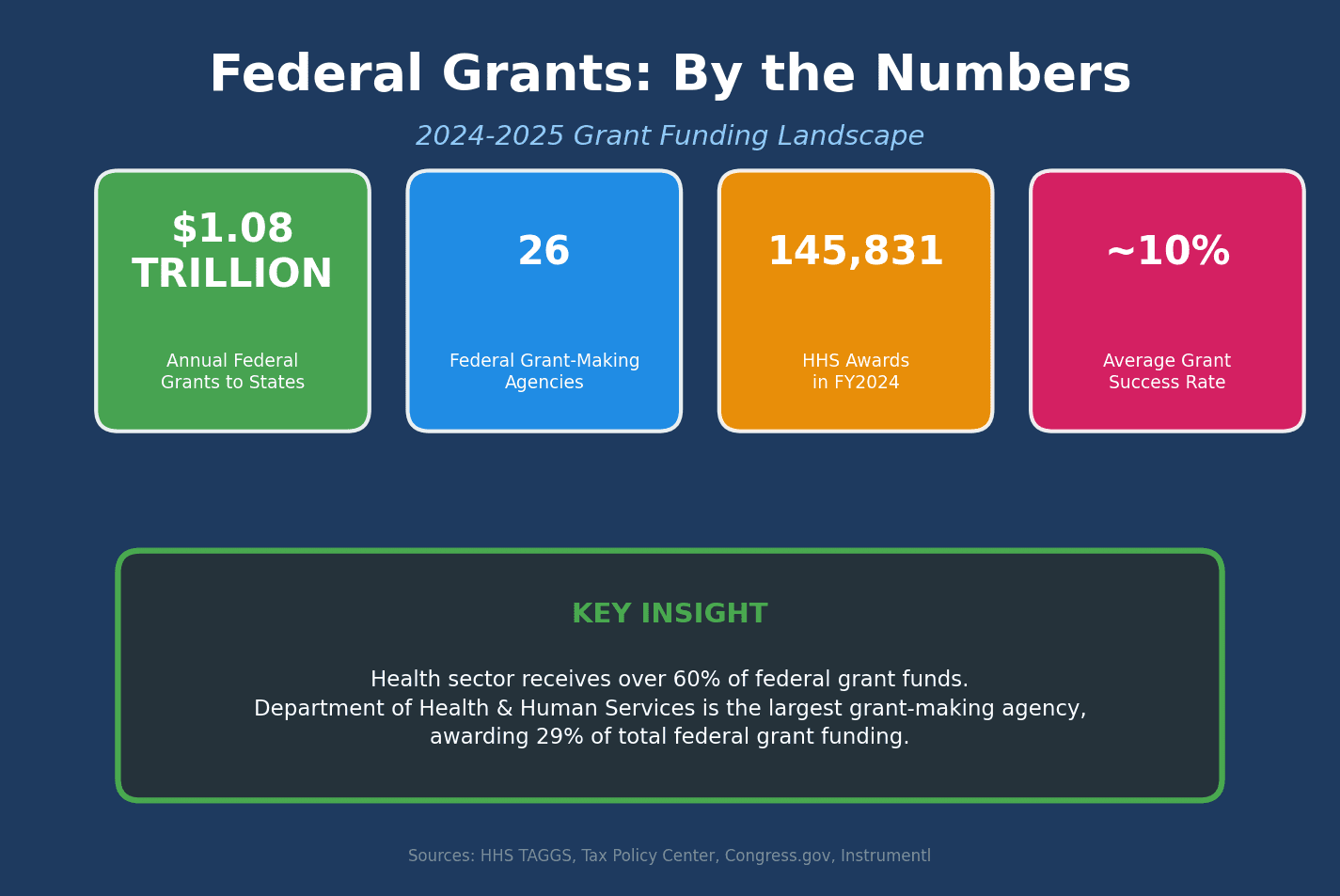
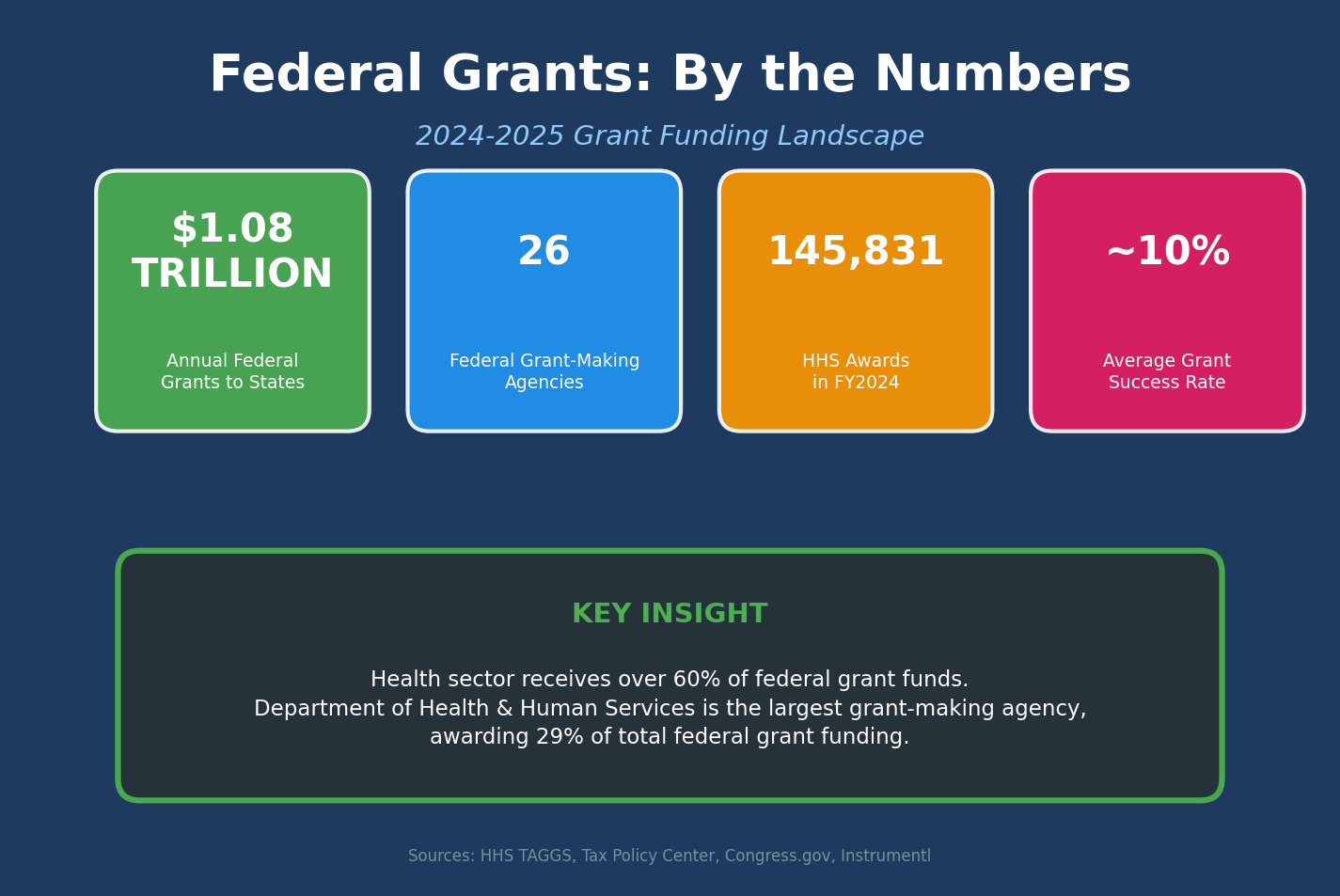
The federal government distributes over $1 trillion annually to state and local governments, organizations, and eligible entities through grant programs. According to data from the HHS Tracking Accountability in Government Grants System (TAGGS), fiscal year 2024 saw 145,831 awards issued to nearly 16,000 recipients—demonstrating both the scale of opportunity and the breadth of competition facing today's grant seekers.
What makes federal grants particularly valuable is their non-dilutive nature. Unlike loans or equity investments, grants don't require repayment or ownership stakes in your organization. For small businesses and nonprofits operating on tight margins, this distinction can mean the difference between sustainable growth and financial strain.
Twenty-six federal agencies actively issue grants, with the Department of Health and Human Services leading as the most significant grantmaker, distributing approximately 29% of total federal grant funding. The health sector alone receives over 60% of all federal grants to state and local governments, though opportunities span every conceivable sector from education and housing to scientific research and community development.
Public-sector applicants have their own tooling questions; see grant management software for government.
What Is Grants.gov and How Does It Work?
Grants.gov serves as the central clearinghouse for federal funding opportunities. Operated by the U.S. Office of Management and Budget, this platform aggregates grant announcements from all 26 grant-making federal agencies into a single searchable database. Think of it as the front door to federal funding—virtually every competitive federal grant opportunity passes through this portal.
However, one critical distinction often trips up first-time applicants: Grants.gov does not publish personal financial assistance opportunities. The funding opportunities listed on the platform target organizations and entities supporting government-funded programs and projects, not individuals seeking personal financial aid. For personal benefits, the government directs citizens to USA.gov instead.
The platform allows grant seekers to search opportunities by keyword, eligibility type, agency, and funding category. You can set up email alerts for specific criteria, ensuring you never miss a relevant funding announcement in your focus area.
As of August 2026, Grants.gov carried 1,709 active opportunities; the grant funding snapshot tracks the monthly numbers.
Small Business Grants: Opportunities Beyond Traditional Lending
For small business owners, government grants represent an attractive alternative to debt financing. The Small Business Administration (SBA) doesn't offer grants for general business operations—that's a common misconception—but several specialized federal programs do provide funding for qualifying small businesses.
The Small Business Innovation Research (SBIR) and Small Business Technology Transfer (STTR) programs have historically been the crown jewels of small business grant funding. Known collectively as "America's Seed Fund," these programs have funded thousands of research and development projects, with Phase I awards reaching approximately $150,000 for feasibility studies and Phase II awards ranging from $1.5 million to $3 million for prototype development.
However, it's worth noting that congressional authority for the SBIR and STTR programs expired on September 30, 2025. At the time of writing, federal agencies are unable to release new solicitations or fund new awards under these programs until Congress acts to reauthorize them. Active awardees should contact their program officers for guidance, and prospective applicants should monitor SBIR.gov for updates on program status.
Beyond SBIR/STTR, the Federal and State Technology (FAST) Program provides funding to organizations that support small businesses applying for federal innovation grants. Additionally, the 2025 Made in America Manufacturing Initiative introduced new grant opportunities for small manufacturing businesses in strategic industries including steel, timber, aluminum, and energy, with awards up to $1.1 million for technical assistance and workforce development.
For organizations seeking to streamline their grant discovery and management process, purpose-built tools can help filter opportunities based on eligibility criteria and track application deadlines—a significant advantage given that the average federal grant application requires over 100 hours of preparation time.
Nonprofit Grants: Navigating Specialized Funding Streams

Nonprofit organizations enjoy access to one of the most diverse funding landscapes in the grants ecosystem. Beyond federal government grants, nonprofits can pursue foundation grants, corporate giving programs, and community-based funding initiatives—often simultaneously.
Federal grants for nonprofits span virtually every mission area. The Nonprofit Security Grant Program (NSGP), administered by FEMA, provides funding for physical security enhancements to organizations at high risk of terrorist or extremist attacks. For fiscal year 2025, the Department of Homeland Security allocated $274.5 million to this program alone.
Foundation grants represent another substantial funding category. The United States is home to over 86,000 grantmaking entities, predominantly independent foundations. Major foundations like the Bill & Melinda Gates Foundation, Ford Foundation, and Lilly Endowment collectively manage billions in assets dedicated to philanthropic purposes.
A growing trend in nonprofit funding is the shift toward trust-based philanthropy—a movement emphasizing stronger relationships between funders and grantees, community expertise, and meaningful collaboration. This approach is transforming how many foundations evaluate applications, placing greater weight on organizational mission alignment and demonstrated community impact rather than purely quantitative metrics.
For nonprofits managing multiple funding streams, grant lifecycle management tools can help track requirements, deadlines, and reporting obligations across diverse funding sources. The complexity of managing government grants alongside foundation and corporate funding often necessitates dedicated systems for organizations serious about scaling their grant revenue.
The Grant Application Process: From Registration to Award

Applying for federal grants through Grants.gov follows a structured process that demands careful attention to detail and advance planning. Understanding each phase helps organizations avoid common pitfalls that derail otherwise competitive applications.
Step 1: SAM.gov Registration
Before you can apply for any federal grant, your organization must register with the System for Award Management (SAM). This mandatory step can take four weeks or longer to complete, making it crucial to begin the registration process well before any application deadline. Through SAM registration, you'll obtain a Unique Entity ID (UEI)—the identifier required for all federal grant applications.
Step 2: Grants.gov Account Creation
With your SAM registration complete, create an organizational account on Grants.gov. The platform distinguishes between organizational and individual registrations, with most grant opportunities requiring organizational accounts. Ensure the information matches your SAM.gov registration exactly to avoid processing delays.
Step 3: Opportunity Research
Use Grants.gov's search functionality to identify funding opportunities aligned with your organization's mission and capabilities. Pay close attention to eligibility requirements—many grants restrict applicants by organization type, geographic location, or specific qualifying criteria. The Notice of Funding Opportunity (NOFO) document contains all essential details about program requirements, evaluation criteria, and submission instructions.
Step 4: Application Preparation
Federal grant applications are comprehensive undertakings. According to industry research, foundation grants typically require 15-20 hours of preparation time, while federal grants often demand 100+ hours. Your application package must address every requirement specified in the NOFO, typically including organizational information, project narrative, budget justification, and supporting documentation.
Step 5: Submission and Tracking
Submit your completed application through Grants.gov before the deadline—late submissions are not accepted. Upon submission, you'll receive a tracking number to monitor your application's status. Be prepared for a lengthy review process; federal grant applications typically take 6-12 months from submission to funding decision.
Timing shapes strategy: the federal grant deadlines calendar shows how closings cluster before September 30.
Maximizing Your Chances of Success
Grant success rates hover around 10% nationally, meaning competition for federal funding is fierce. Organizations that consistently win grants typically share several characteristics that distinguish them from unsuccessful applicants.
Alignment with Funder Priorities
Successful applications demonstrate clear alignment between the proposed project and the funding agency's mission. Before investing significant time in an application, verify that your project genuinely fits within the grant program's objectives. Attempting to force-fit a project into an unsuitable funding category almost never succeeds.
Compelling Narrative with Measurable Outcomes
Grant reviewers evaluate thousands of applications. Those that stand out articulate a clear problem statement, propose a logical solution, and specify measurable outcomes. Use concrete data points and specific examples rather than vague generalizations. If your literacy program served 500 students last year and improved reading scores by 15%, say exactly that.
Strong Organizational Capacity
Funders want assurance that awarded funds will be used effectively. Demonstrate your organization's track record of managing similar projects, highlight relevant staff expertise, and show established systems for financial management and program evaluation. Previous grant awards often serve as credibility markers that strengthen subsequent applications.
Budget Precision
Reviewers scrutinize budgets carefully. Ensure every line item connects logically to proposed activities, costs reflect realistic market rates, and the total request aligns with the grant program's typical award range. Unexplained budget items or costs that seem inflated relative to proposed activities raise red flags.
For organizations looking to professionalize their grant-seeking operations, moving beyond spreadsheet-based tracking to dedicated grant management platforms can significantly improve application quality and success rates by ensuring no deadline is missed and all requirements are systematically addressed.
Building a Diversified Funding Strategy
Relying exclusively on any single funding source creates organizational vulnerability. The most resilient nonprofits and small businesses build diversified funding portfolios that combine multiple grant sources with other revenue streams.
Government grants provide substantial funding but come with extensive compliance requirements and reporting obligations. Foundation grants often offer more flexibility but may be smaller in scale and require cultivation of funder relationships over time. Corporate grants and sponsorships can provide both funding and partnership opportunities, though they typically represent a smaller slice of available grant dollars—approximately 3% of total grant funding, according to Foundation Center data.
Geographic factors also influence grant accessibility. Federal grants to states vary significantly on a per-capita basis, ranging from over $6,800 per capita in Washington, D.C. and Alaska to under $1,900 per capita in states like Florida and Georgia. Local and regional grant opportunities may offer less competition than national programs, making them valuable components of a comprehensive funding strategy.
The wider search playbook, state portals and 990-PF research included, is in how to find grants for nonprofits.
Managing the Grant Lifecycle
Winning a grant marks the beginning rather than the end of your funding journey. Federal grants require ongoing compliance monitoring, regular progress reporting, and meticulous financial tracking throughout the award period.
Most federal grants include specific conditions governing fund usage, project modifications, and reporting requirements. Failure to comply with these conditions can result in award termination, required fund repayment, or disqualification from future federal funding.
Establishing robust systems for grant pipeline and management before you receive significant funding prevents compliance headaches later. Many organizations find that implementing visual pipeline management approaches helps teams track multiple grants at different lifecycle stages—from prospecting through application, award management, and closeout.
Looking Ahead: The Future of Federal Grant Funding
The federal grants landscape continues to evolve. Recent years have seen increased emphasis on data transparency, with systems like USAspending.gov making detailed award information publicly accessible. The modernization of Grants.gov through the Simpler.Grants.gov initiative aims to streamline the application experience, though significant complexity remains inherent in federal grant programs.
Policy changes, budgetary shifts, and program reauthorizations will continue shaping available opportunities. The current uncertainty surrounding SBIR/STTR program authorization illustrates how quickly the funding landscape can change. Organizations that stay informed about policy developments and maintain flexible funding strategies position themselves to adapt as opportunities emerge or contract.
For grant seekers committed to long-term success, building institutional knowledge about the grants ecosystem, investing in application preparation capabilities, and implementing systematic grant management practices creates sustainable competitive advantage in an increasingly crowded field.
Taking Action
The path to grant funding success starts with informed action. Begin by assessing your organization's grant readiness: Is your SAM registration current? Do you have systems in place for tracking opportunities and managing applications? Can you demonstrate the organizational capacity funders expect?
Explore available tools and resources designed to help organizations navigate the grants landscape more effectively. Whether you're pursuing your first federal grant or looking to scale an established grants program, systematic approaches to grant discovery and lifecycle management can transform grant-seeking from an ad hoc activity into a sustainable organizational capability.
The trillion-dollar federal grants ecosystem offers genuine opportunities for organizations with compelling missions and the capacity to execute funded projects effectively. Your next grant might be one well-prepared application away.