Sample Grant Proposal for Health Clinic Programs: A Complete Example
A sample grant proposal for health clinic programs, section by section, with a worked clinic budget, staffing math, and the outcome measures health reviewers recognize.
Last updated: September 2026
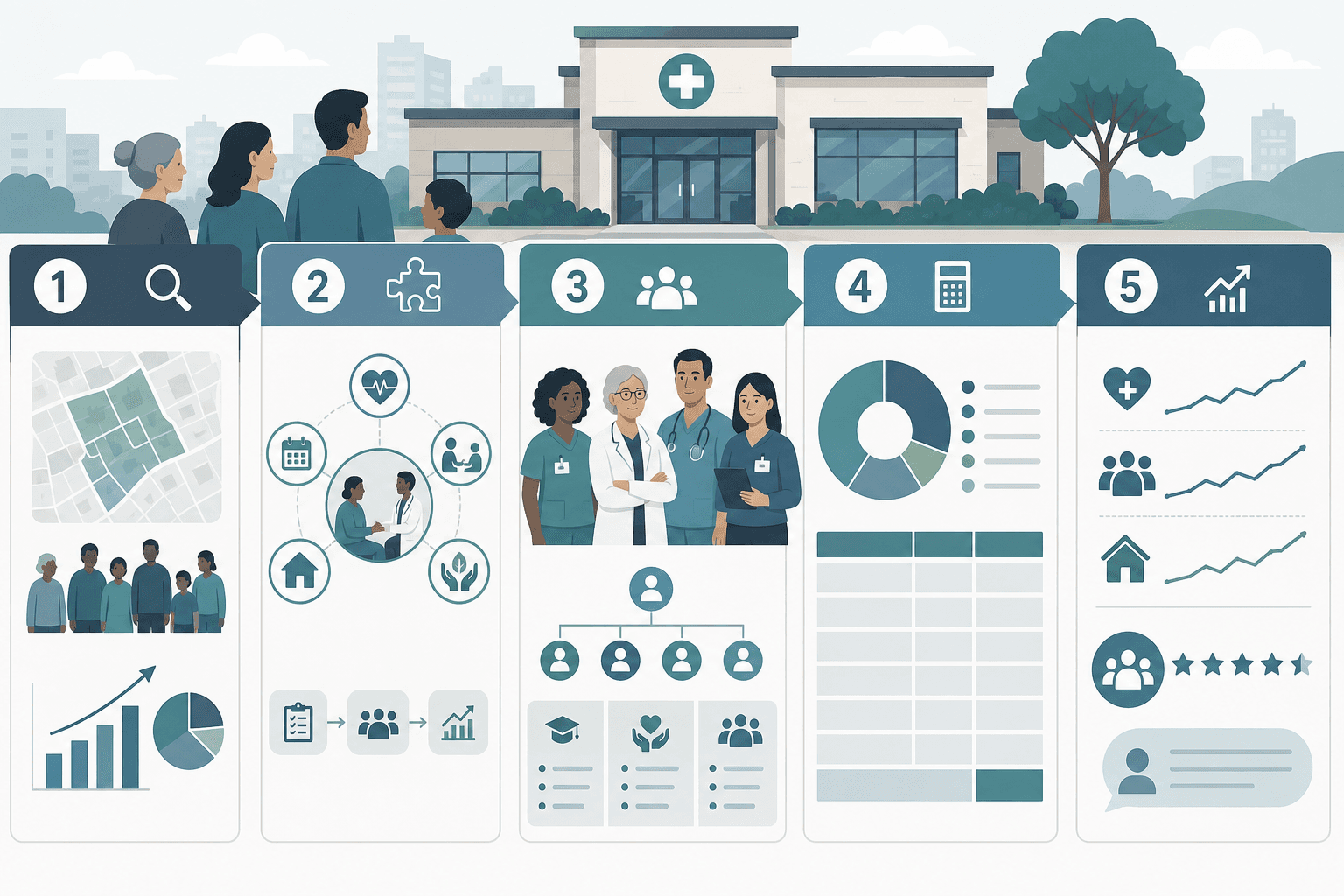
A sample grant proposal for health clinic funding reads differently from a general nonprofit proposal, because reviewers evaluate it as a clinical plan with a budget attached. They want to know which patients get which service, and how the change gets measured. The sequence follows normal grants lifecycle management, applied to a clinic setting.
Quick Answer: What Goes in a Grant Proposal for a Health Clinic?
A health clinic grant proposal contains a cover letter, an executive summary, a statement of need built on service-area health data, a program description naming the clinical service and staffing, clinical outcome measures with an evaluation plan, a line-item budget with narrative, a sustainability plan showing billable revenue, and clinical attachments such as licensure and provider credentials.
Free download: Complete sample proposal for a community health clinic as Word .docx. No email address required.
Sample Grant Proposal for Health Clinic Programs, Section by Section
Each section of a health clinic proposal answers a different reviewer question. The page counts in this table describe the composite two-site clinic used as the worked example throughout, not a funder requirement; funders that impose page limits state them in the application instructions.
| Section | Length in this example | What a health reviewer checks |
|---|---|---|
| Cover letter | 1 page | Signed by the board chair or CEO, names the exact amount and period |
| Executive summary | 1 page | The service, the patient count, the cost, the measure |
| Statement of need | 2 pages | Service-area data, not national data |
| Program description | 3 pages | Named service, staffing FTE, visit workflow, patient volume math |
| Outcomes and evaluation | 2 pages | Baseline, target, data source, reporting cadence |
| Organizational capacity | 1 page | Licensure, credentialing, prior clinical grant performance |
| Budget and narrative | 2 pages | Cost per visit, payer mix, what grant funds do not cover |
| Sustainability plan | 1 page | Revenue path once the grant closes |
| Attachments | Varies | Determination letter, audit, licenses, letters, service-area map |
The executive summary and the budget are the two pieces a reviewer can check in a few minutes, so they get read first and are worth writing last, after the numbers settle.
The Statement of Need for a Clinic Is a Service-Area Argument
A clinic statement of need proves that specific patients inside a defined service area cannot get a specific service today. National statistics about health disparities will not carry it.
Build the section from four data layers. Start with the service area: list the ZIP codes or census tracts your patients come from, and say how you know, since an electronic health record can produce a patient count by ZIP in an afternoon. Add population characteristics next, meaning uninsured share, primary language, age distribution, and payer mix. The Census Bureau's American Community Survey covers the demographics and your practice management system covers the payer mix.
Then quantify the access gap: distance to the nearest provider offering the service, wait time for a new patient appointment, referral completion rate, and no-show rate. Those four numbers do more work than any prevalence figure. Finally, name any federal designation your area carries. HRSA publishes Medically Underserved Area and Health Professional Shortage Area designations, and a designation is confirmation a funder can check without taking your word for it.
One paragraph of your own screening data beats a page of secondary research. A sentence such as "of 412 adults screened for depression last year, 96 had a positive screen and 31 had a documented follow-up plan within 30 days" tells a reviewer the gap is real and that you can already measure it.
Program Description: Name the Service, the Staffing, and the Visit
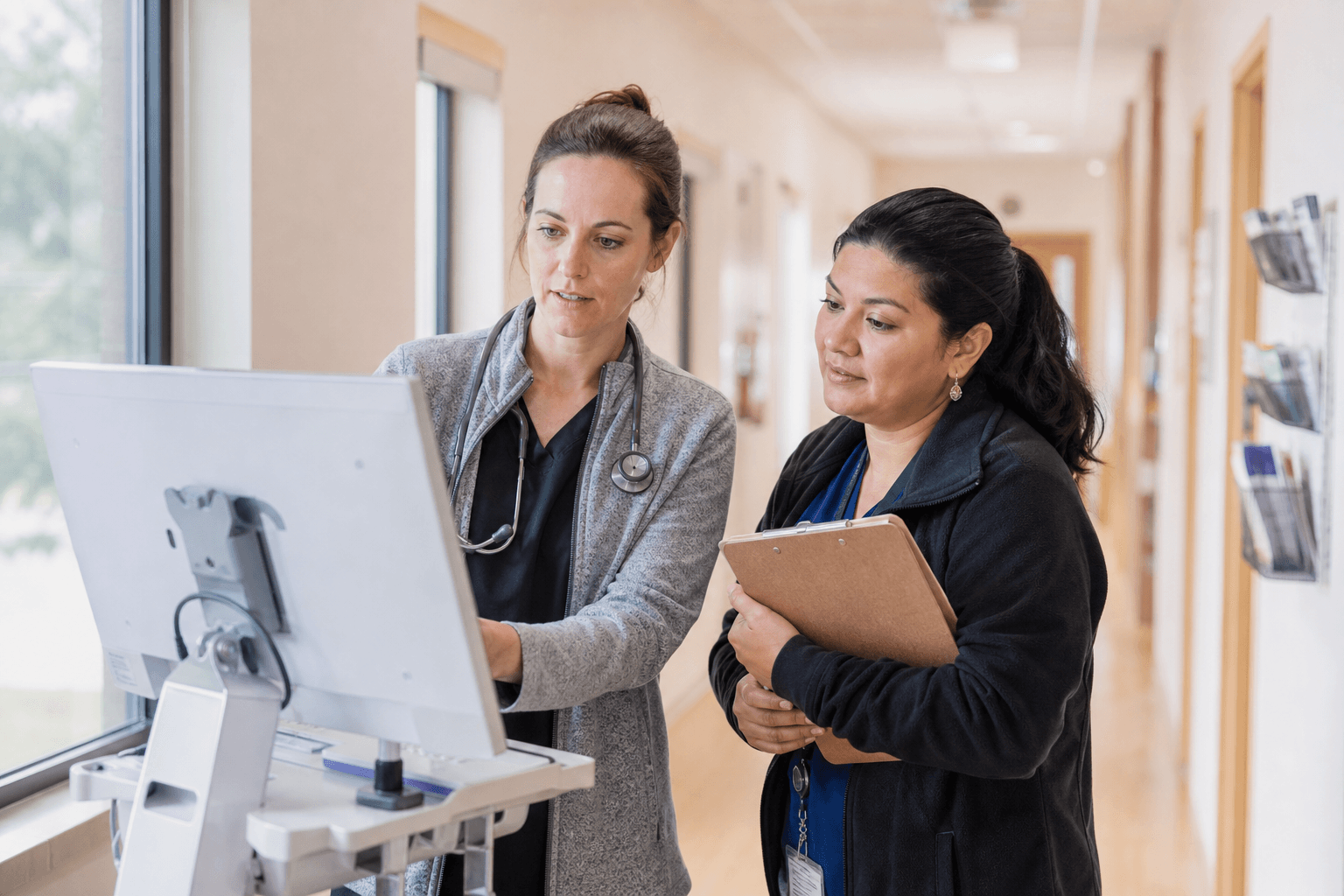
Vague language about improving community health loses points in a clinic program description. Name one clinical service, say who delivers it, and describe the visit that produces the outcome.
The illustrative applicant here is a two-site community clinic in a rural county, requesting $190,865 for the first year of an integrated behavioral health program. It is a worked example, not a real organization, and every figure in it is illustrative.
That clinic's program description would state:
- The service. Universal depression and anxiety screening at every adult primary care visit, a same-day warm handoff to a licensed clinician, and up to six brief-intervention sessions.
- The staffing. One licensed clinical social worker at 1.0 FTE, three days at the larger site and two at the smaller site, supported by an existing medical assistant who runs the screening.
- The volume math. Show the arithmetic. The composite clinic projects 6,000 adult primary care visits a year, an 85 percent screening rate (5,100 screens), a 12 percent positive rate (612 positive screens), a 55 percent handoff acceptance rate (337 patients), and an average of 3.5 sessions each, which comes to roughly 1,180 clinician encounters. Divide that by 220 clinical days and one clinician carries five to six behavioral health visits a day. A funder can run that caseload test in a single line of arithmetic.
- The timeline. Hiring, licensure verification, payer enrollment, EHR template build, staff training, and first patient served. Payer enrollment for a new clinician often takes several months, and a proposal that ignores it looks inexperienced.
- The fee policy. State how you handle patients who cannot pay. Health Center Program awardees run a sliding fee discount schedule under Section 330(k)(3)(G) of the Public Health Service Act, which requires a full discount, or a nominal charge set below the fee in the first discount pay class, for patients at or below 100 percent of the Federal Poverty Guidelines, then at least three discount pay classes between 101 and 200 percent, and no discount above 200 percent, per HRSA's Health Center Program Compliance Manual, Chapter 9, last reviewed November 2025. Free and charitable clinics are not bound by that rule, and many adopt the same structure because funders recognize it.
Clinic Outcome Measures Funders Already Recognize
Health funders prefer outcome measures that already exist in national specifications, because a specified measure arrives with a published denominator and comparison data. Inventing a measure forces the reviewer to trust your definition.
The Uniform Data System is the annual reporting set that every HRSA-funded health center submits, filed by February 15 each year for the prior calendar year, per HRSA's UDS reporting guidance. Its clinical quality measures work as a ready-made menu for any clinic proposal, HRSA-funded or not. Electronic measure version numbers change with each reporting year, so confirm the current specification in the UDS manual for the year you will report.
| Measure | UDS reference, 2025 reporting cycle | What the proposal states |
|---|---|---|
| Depression screening and follow-up plan | UDS Table 6B, CMS2v14 | Baseline screening rate, target rate, EHR report as source |
| Colorectal cancer screening | UDS Table 6B, CMS130v13 | Eligible panel size, current rate, quarterly target |
| Childhood immunization status | UDS Table 6B, CMS117v13 | Cohort definition and registry data source |
| Cervical cancer screening | UDS Table 6B, CMS124v13 | Panel denominator and outreach method |
| Tobacco screening and cessation intervention | UDS Table 6B, CMS138v13 | Screening rate plus intervention rate |
| Early entry into prenatal care | UDS Table 6B, Section B | First-trimester entry count and referral pathway |
Every outcome row in a proposal needs four fields: baseline, target, data source, and who pulls the report. Leave one out and the evaluation section reads as aspiration. Name the staff member who pulls the report and the report they pull. The same four-field structure appears in this evaluation plan template.
Sample Health Clinic Grant Budget
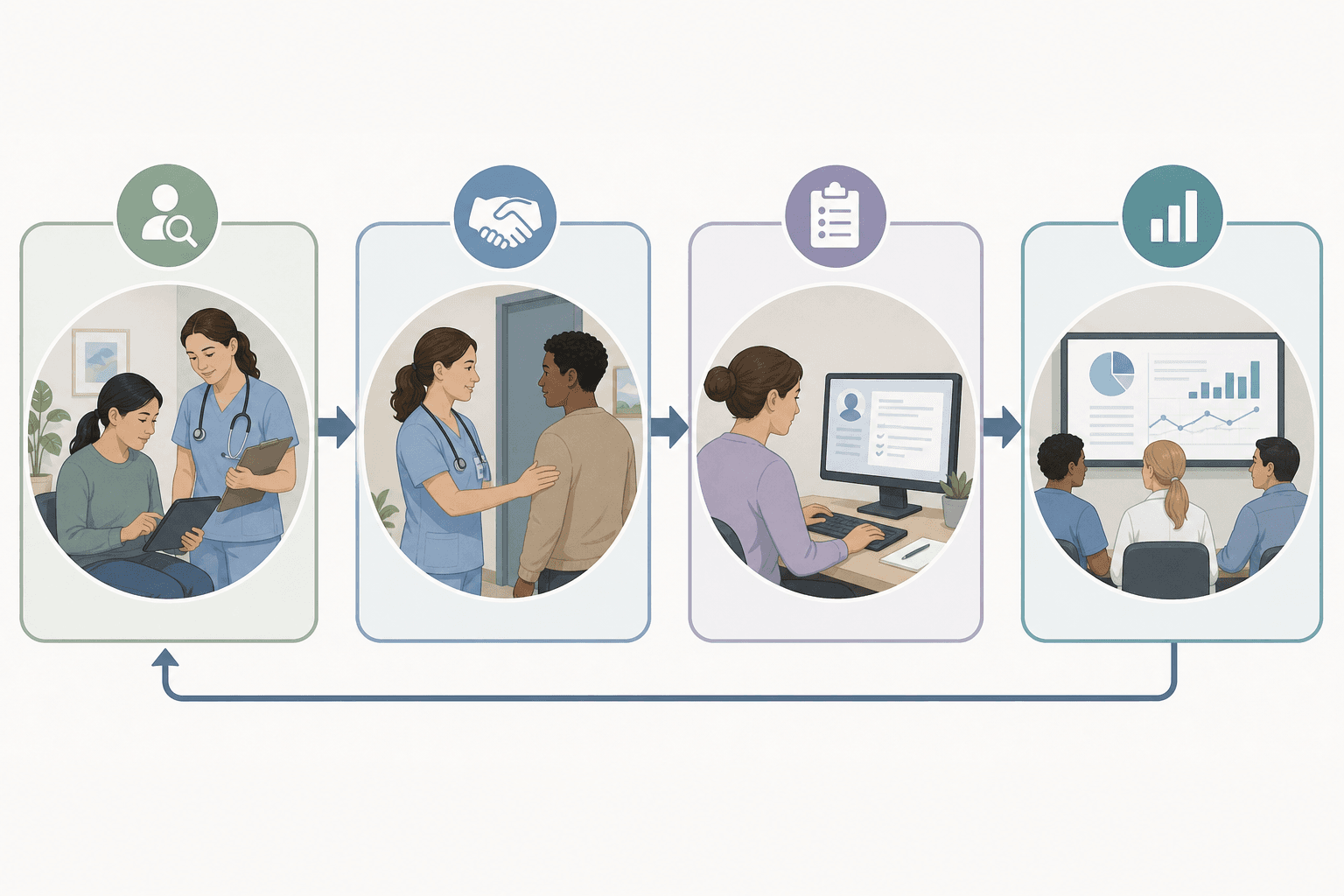
A clinic budget is mostly people, so the first thing a funder tests is whether the salary lines can deliver the visit volume the narrative projects. This first-year budget belongs to the composite two-site rural clinic adding integrated behavioral health, and every figure in it is illustrative.
| Line item | Year 1 | Basis stated in the narrative |
|---|---|---|
| Licensed clinical social worker, 1.0 FTE | $78,000 | Regional salary survey midpoint for the position |
| Community health worker, 0.5 FTE | $19,500 | Half of a $39,000 full-time salary |
| Medical assistant, 0.25 FTE | $9,400 | One quarter of an existing $37,600 position, screening time only |
| Fringe benefits, 26 percent | $27,794 | 26 percent of the $106,900 salary subtotal, organization-wide rate from the most recent audit |
| EHR screening template build and reporting setup | $6,500 | Vendor quote, 50 hours at $130, one time |
| Interpreter services | $4,800 | 160 contracted hours at $30 |
| Point-of-care and screening supplies | $3,060 | 5,100 projected screens at $0.60 each |
| Patient transportation support | $4,000 | 400 round-trip vouchers at $10 |
| Clinician professional liability coverage | $3,600 | Quoted annual premium for the added position |
| Staff training and licensure fees | $2,700 | Three staff at $900 for evidence-based intervention training |
| Uninsured visit subsidy | $14,160 | 354 encounters, 30 percent of the projected caseload, at $40 unreimbursed after the sliding fee discount |
| Total direct costs | $173,514 | |
| Indirect costs | $17,351 | 10 percent of total direct costs, per the organization's negotiated indirect cost rate agreement |
| Total request | $190,865 |
Two lines decide the score. The first is the productivity assumption behind the clinician salary: $78,000 plus its $20,280 share of fringe, divided by 1,180 projected encounters, is $83 per visit, and a reviewer will run that division. The second is the uninsured visit subsidy, because it shows the grant paying for care no payer will reimburse instead of covering billable work.
A clinic with no negotiated rate agreement can elect the de minimis rate, up to 15 percent of modified total direct costs, under 2 CFR 200.414(f). Either way, name the rate and the base in the narrative. Indirect is the easiest line in a budget to check, and a figure with no stated basis reads as a plug. Format conventions carry over from any grant proposal budget template.
Sustainability: What Happens to the Service When the Grant Ends
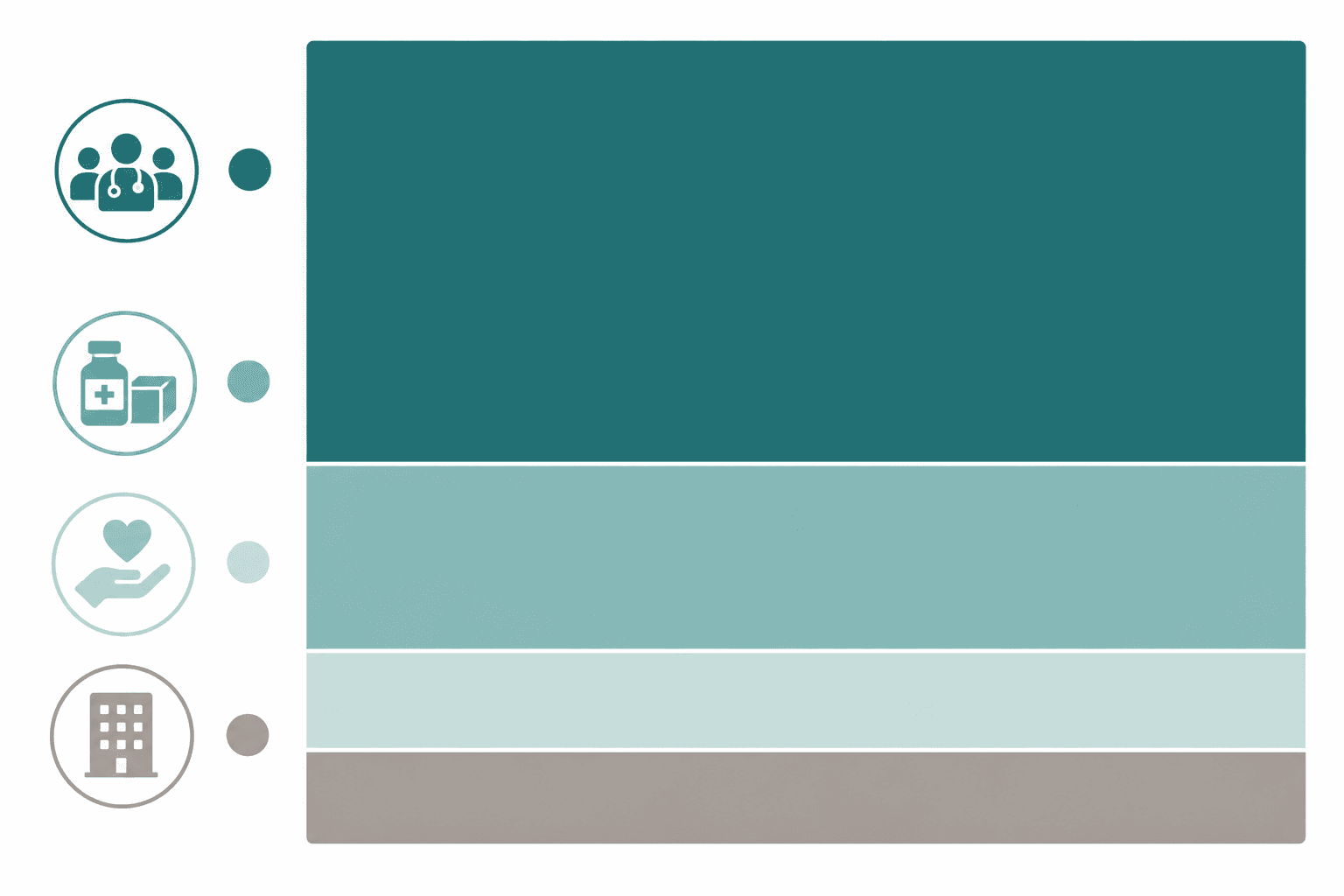
A clinic sustainability plan shows the revenue that replaces the grant, service line by service line. Reviewers look for a revenue path here, not a promise to seek more grants.
Split the program into three funding categories:
- Billable encounters, once credentialing and payer enrollment finish. Give the month you expect first billing and the share of the caseload you expect to be reimbursable.
- Partly billable work such as care coordination and follow-up contacts, which some payers cover under specific arrangements. Say which payers you have confirmed and which you have not.
- Non-billable work: community health worker outreach, interpretation, transportation, and no-show recovery. Name the local candidates to carry it, such as hospital community benefit programs, county health department allocations, and renewing foundation support.
A credible sustainability plan names the year the grant share drops and what replaces it. The composite clinic's plan says the grant covers 100 percent of the program in year one, 60 percent in year two, and 25 percent in year three as billing ramps, which tells a reviewer exactly what takes over and when. That schedule is also a reporting commitment, since each year of the grant lifecycle asks you to show what the previous year's revenue actually did.
How a Health Clinic Proposal Differs From a Sample Grant Proposal for a Non Profit Organization
A health clinic proposal carries clinical obligations that a general nonprofit proposal does not, and funders score those obligations on their own lines. The narrative arc is the same. Five elements change.
| Element | General nonprofit proposal | Health clinic proposal |
|---|---|---|
| Outcomes | Participants served, satisfaction, self-reported change | Specified clinical quality measures with denominators |
| Staffing | Role titles and FTE | Licensure, credentialing status, payer enrollment timeline |
| Budget scrutiny | Cost per participant | Cost per visit plus payer mix and what is billable |
| Data handling | Program records | Protected health information, reported only in aggregate |
| Attachments | Determination letter, audit, board list | Those three plus facility license, provider rosters, quality plan |
The general sequence in a sample grant proposal for a non profit organization still applies to a clinic. Add the clinical layer on top of it.
Four Questions to Answer Before a Reviewer Asks
Four questions recur in health funder review criteria. Answer each one inside the narrative, before a site visit raises it.
Are you duplicating a service already available nearby? Answer with a service-area map, the travel time to the nearest alternative, and a letter from the referring provider confirming the gap. If a federally qualified health center or hospital clinic operates nearby, name it and explain the difference in eligibility, hours, or wait time.
Is grant money paying for work you could bill? Show the payer mix and mark which budget lines are non-billable by nature. Funders are comfortable subsidizing uninsured care and non-clinical roles. They resist covering encounters that Medicaid would pay for.
Can you actually hire this person? Staffing credibility is a common weak point for rural and small clinics, where a single vacancy stalls the whole program. Include the recruitment plan, the salary benchmark source, any candidate already identified, and a contingency such as a contracted telehealth clinician during the vacancy.
Will patients show up? Quote your current no-show rate and the specific tactics you will use, such as same-day warm handoff, evening hours, reminder calls from a community health worker, or transportation vouchers. A projected caseload needs an attendance strategy attached to it.
Where Health Clinic Grants Come From
Clinic funding arrives from four channels, and it is easy to watch only the first. Federal opportunities post on Grants.gov, including HRSA programs. State primary care offices, offices of rural health, and Medicaid agencies run their own portals, which do not appear in federal search. County health departments and hospital community benefit programs fund local access work directly. Private foundations fund clinics heavily, and their giving history is visible in IRS Form 990-PF filings.
GrantCue searches federal and state portals in one place and carries 990-PF foundation data, so you can see which funders have supported clinics before. Deadlines and tasks stay with the team. Browse health grants across federal and state portals to see what is open in your state now.
FAQ
How do you write a grant proposal for a health clinic?
Start with the service-area need shown in your own patient data, then define one clinical service with named staffing. Attach recognized outcome measures with baselines and targets, build a line-item budget that supports the projected visit volume, and close with a sustainability plan that separates billable from non-billable costs.
What is a statement of need in a grant proposal?
A statement of need is the section that proves a specific population cannot get a specific service today. For a health clinic it is a service-area argument: the ZIP codes or tracts you serve, payer mix and uninsured share, distance and wait time for the nearest alternative provider, your own screening or referral data showing the gap, and any Medically Underserved Area or Health Professional Shortage Area designation covering your service area.
How long should a health clinic grant proposal be?
Follow the funder's stated page limit exactly, because reviewers score against it. When the funder sets no limit, size the narrative to the sections the funder asks for. The composite example in this article runs thirteen pages of narrative plus attachments. Federal applications frequently run longer and specify a project narrative limit in the notice of funding opportunity.
What outcome measures do health funders want to see?
Funders prefer measures with published specifications, such as the clinical quality measures in HRSA's Uniform Data System: depression screening and follow-up, colorectal and cervical cancer screening, childhood immunization status, tobacco screening with cessation intervention, and early entry into prenatal care.
Can a free clinic apply for the same grants as a federally qualified health center?
For most of them, yes. Free and charitable clinics can apply for state, county, hospital, and foundation funding, and for many federal programs. Ongoing Section 330 operating support flows to organizations that already hold a Health Center Program award or look-alike designation. New organizations enter through competitions such as New Access Points, which accept applicants that are not current Health Center Program recipients and that will meet program requirements after award.
How much should a health clinic ask for in its first grant?
Ask for an amount that matches a single defined service and that your budget can defend line by line. A first request funding one clinical position plus its supporting costs is easier to justify than a large request spread across several programs with no owner.
Next Step
A clinic proposal is one stage of a longer cycle that runs through award and reporting into next year's renewal, so file the version you submit where your team can find it. The full lifecycle guide covers what happens after the decision arrives.