Sample Grant Proposal for Arts Organization: Full Example and Budget
See a complete sample grant proposal for an arts organization, including artistic rationale, an arts budget with access line items, and audience metrics.

Last updated: September 2026
A sample grant proposal for arts organization applicants carries sections a service agency proposal never needs: an artistic rationale, artist fees separated from staff salaries, access services costed as their own line, and audience measures in place of clients served. Work samples are reviewed against the same criteria as the narrative, so a strong story attached to a weak recording still loses. Below is each section with language you can adapt, an arts budget that balances, and the metrics funders ask you to report. Start with how to write a grant proposal for the mechanics.
Quick Answer: What Goes in a Grant Proposal for an Arts Organization?
An arts organization grant proposal contains a summary, a community need statement, an artistic rationale naming the work and the artists, a project description with a season or production timeline, measurable audience and participation outcomes, an evaluation plan, a budget with artist fees and access services, organizational background, and curated work samples that show artistic quality.
Free download: Complete sample proposal for an arts organization as Word .docx. No email address required.
What an Arts Grant Proposal Has to Prove That Other Proposals Do Not
An arts proposal answers two review questions at once: is the work artistically strong, and does the public get something real from it. Most social service proposals answer only the second.
That double burden shows up in the application structure. The National Endowment for the Arts requires work samples in every Grants for Arts Projects application and judges them against the same two published criteria as the narrative, artistic excellence and artistic merit, with equal weight on each. Panelists spend up to 20 minutes per application on work samples, within a 250MB upload allowance (National Endowment for the Arts, FY27 GAP Program Guidelines and FY27 discipline application instructions, arts.gov, retrieved September 2026). A polished narrative attached to a badly lit rehearsal video loses to a plainer narrative with a curated sample.
The second difference is the money structure. Grants for Arts Projects awards run from $10,000 to $100,000 for most disciplines, while designated local arts agencies eligible to subgrant may request $30,000 to $150,000 and Challenge America applicants request a fixed $10,000. Every award requires a nonfederal cost share of at least 1 to 1, so NEA funds cannot exceed half of total project cost (National Endowment for the Arts, FY27 GAP Program Guidelines, arts.gov, retrieved September 2026). An arts budget therefore has to show that half the project is already funded by someone other than the funder you are asking.
Private foundations fund this sector heavily. GrantCue's IRS 990-PF corpus contains 100,818 arts and culture grant records totaling $5.3 billion across filings for tax years 2021 through 2025, measured on September 10, 2026. That total is what funders reported on their own returns, a floor for arts giving rather than a census. Private foundations rarely publish a scoring rubric, which makes the federal structure a safe template.
Sample Grant Proposal for Arts Organization: Section by Section
An arts grant proposal runs nine sections: summary, statement of need, artistic rationale, project description and timeline, goals and outcomes, evaluation plan, organizational background, budget, and work samples. The worked example below follows a community theater company requesting project support for a new production paired with school residencies. The company is an illustrative composite, and bracketed slots mark where your own verified facts go.
Summary paragraph
Open with the ask, the work, and the public benefit in one paragraph. Sample language:
[Your Organization] requests $30,000 toward a $60,000 project to produce [title of work] across [number] public performances and to deliver [number] teaching artist residencies in [number] Title I elementary schools. The project pays [number] local artists at [rate] and includes ASL-interpreted, open-captioned, audio-described, and sensory-friendly performances. Free and pay-what-you-wish admission covers [number] of the [number] performances.
Statement of need
Describe the community's gap in arts access and keep your own budget shortfall out of it. The common failure here is a need statement describing the organization's deficit rather than the community's.
Weak: "Ticket revenue no longer covers production costs."
Stronger: "The [district] eliminated its elementary music and theater positions in [year], leaving [number] students with no in-school arts instruction. The nearest professional venue is [distance] from [neighborhood], and [number]% of households there report no vehicle access, per [named local source]."
Cite the school district's own staffing report or a municipal cultural plan rather than a national statistic about arts participation. Use a standard statement of need structure and swap in arts access data.
Artistic rationale
An artistic rationale is the section of an arts proposal that explains what work will be made, who will make it, how those artists were chosen, and why this work belongs in this community now. A general nonprofit template has no equivalent, and skipping it leaves an application that is a program plan with no art in it.
Name the work, the artists, and the selection process. Sample language:
[Title] was selected through [process: open call, curatorial committee, artistic director with advisory input]. The play addresses [theme] and connects directly to [community context]. The director, [role description], has previously staged [type of work] with [type of partner]. Casting will prioritize artists who live in [region], and all performers are paid at [rate or scale].
Two details are the ones a reviewer can verify: how artists get paid, and whether selection followed a process. NEA's published review criteria list evidence of direct compensation to artists, makers, art collectives, and art workers among the artistic merit factors (National Endowment for the Arts, FY27 GAP Program Guidelines, arts.gov, retrieved September 2026).
Project description and timeline
Give the season shape. Arts projects have hard public dates, which is an advantage if you show them.
| Phase | Months | Key activities |
|---|---|---|
| Pre-production | 1 to 2 | Rights and licensing secured, design meetings, casting |
| School residencies | 2 to 5 | Teaching artist sessions in partner classrooms |
| Rehearsal | 5 to 7 | Company rehearsals, technical build, access services booked |
| Performances | 7 to 8 | Public run, including interpreted and captioned dates |
| Evaluation and reporting | 8 to 9 | Survey analysis, artist debrief, funder report |
Book access services in the rehearsal phase, not the performance phase. Interpreters and audio describers need the script and a run-through in advance.
Goals and measurable outcomes
Separate what you will produce from what will change. The output is the number of performances delivered. The outcome is the share of surveyed attendees who report it was their first live theater experience. The same split applies to writing a grant proposal in any sector.
Sample outcome statements:
By [end date], [number] students across [number] classrooms will complete [number] contact hours of teaching artist instruction, with [number]% completing a final presentation.
At least [number]% of survey respondents at free and pay-what-you-wish performances will report attending live theater fewer than once in the prior year.
All [number] participating artists will be paid at or above [named rate standard], documented in payroll and contractor records.
The third statement, artist compensation written as an outcome, maps onto a criterion NEA already publishes.
Evaluation plan
Say who collects the data, when, and with what instrument. An arts evaluation plan usually combines a short post-performance audience survey, teaching artist session logs, and box office data from the ticketing system.
Keep the instrument short. A four-question exit survey that people finish beats a twenty-question survey they abandon. Name the role responsible for each instrument, give the collection window, and say where the data lands.
Organizational background and work samples
Establish that you can deliver, then curate the samples. NEA guidance asks applicants to include creative credits, the title of the work, the date it was created and performed, the medium and dimensions for visual art, and sample length for audio and video (National Endowment for the Arts, FY27 GAP discipline application instructions, arts.gov, retrieved September 2026). Links must stay active for at least six months after the funding notification date.
Check eligibility before you invest the roughly 24 hours NEA estimates for drafting and submitting an application once registrations are complete. GAP applicants must have completed at least five years of arts programming before the deadline and must have had at least $20,000 in organization operating expenses in the most recently completed fiscal year (National Endowment for the Arts, FY27 GAP Program Guidelines, arts.gov, retrieved September 2026).
Sample Arts Organization Grant Proposal Budget
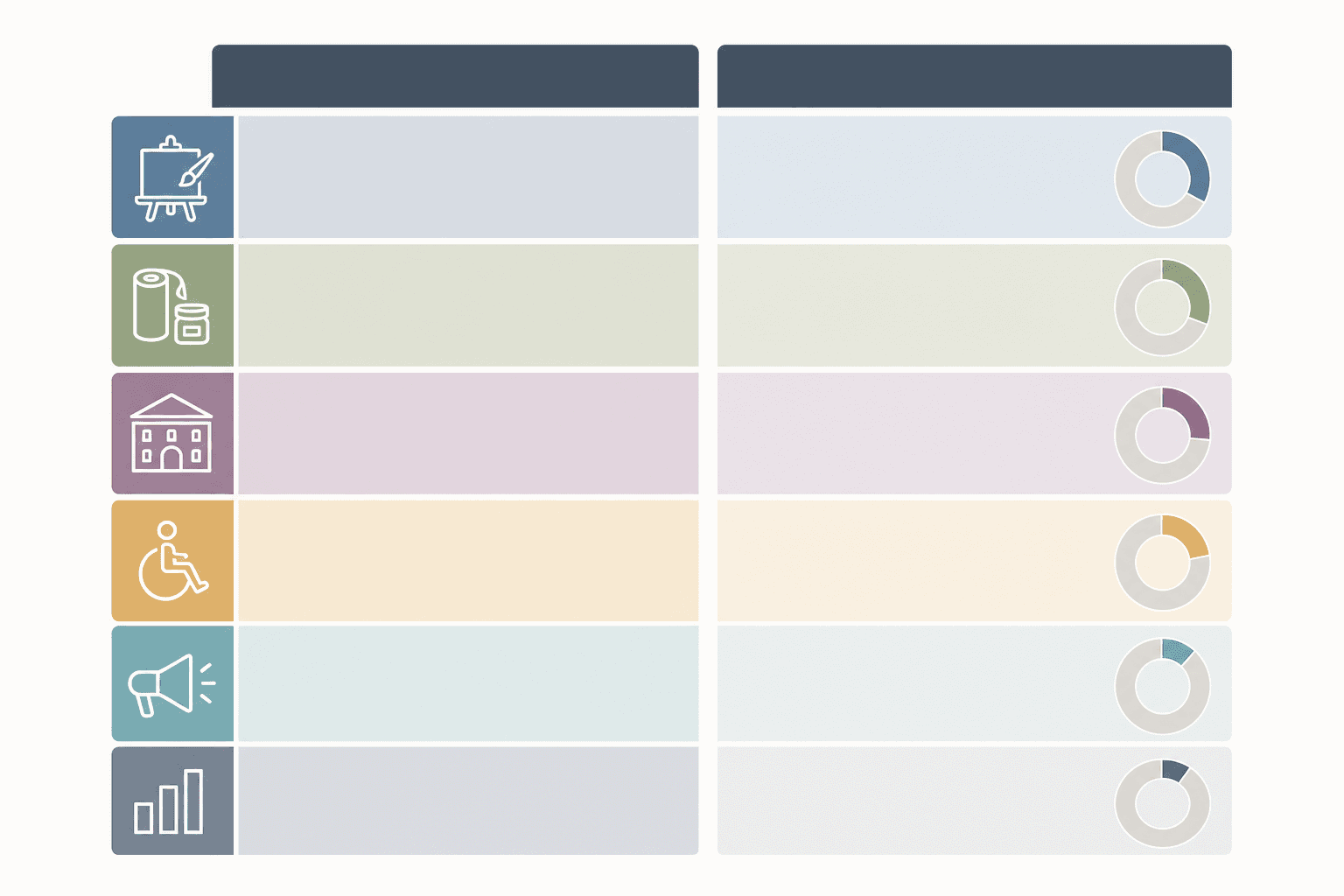
An arts project budget has line items no other sector needs: rights and royalties, artist fees separate from staff salaries, production materials, and access services. The composite example below totals $60,000 against a $30,000 request, which satisfies a 1:1 cost share.
| Line item | Amount | Notes |
|---|---|---|
| Artist fees and honoraria | $19,000 | Performers, designers, composer; paid at a stated rate |
| Teaching artist fees | $7,500 | School residency sessions, billed per contact hour |
| Production personnel | $6,000 | Stage manager, technical director |
| Venue and rehearsal space | $5,500 | Includes $4,000 donated space counted as in-kind |
| Rights, royalties, licensing | $2,500 | Script or score license for the performance run |
| Sets, costumes, props, lighting | $4,000 | Materials and rentals |
| Access services | $4,000 | ASL interpretation, open captioning, audio description, large-print programs |
| Marketing and audience development | $3,500 | Outreach to first-time attendee audiences |
| Archival documentation | $1,500 | Photography and video for future work samples |
| Evaluation | $1,500 | Survey administration and analysis |
| Project coordination | $5,000 | 0.15 FTE over 9 months, $45,000 annualized salary basis |
| Total project expenses | $60,000 | |
| Funder request | $30,000 | 50% of total project cost |
| Cost share | $30,000 | Ticket revenue, individual gifts, in-kind venue, local arts agency funds only where they are not federal pass-through |
In-kind contributions counted in the cost share also appear as direct costs, which keeps the budget balanced. No federal funds appear in the cost share. NEA's Project Budget Form states that federal funds subgranted from a state arts agency, regional arts organization, or local arts agency cannot be used as match, so a local arts agency award counts only if its funds are nonfederal (National Endowment for the Arts, Project Budget Form, arts.gov, retrieved September 2026). The table omits indirect costs. Applicants without a federally negotiated rate may claim a de minimis rate of up to 15 percent of modified total direct costs, a cap raised from 10 percent in the 2024 Uniform Guidance revision (2 CFR 200.414(f), ecfr.gov, retrieved September 2026; NEA FY27 GAP project budget instructions). Claiming the rate raises total project cost and the required match with it.
Cost share funds do not have to be secured when you apply. Mark the committed sources and label the rest as pending. The grant proposal budget template walk-through covers the line-item format.
How an Arts Grant Proposal Differs From a Sample Grant Proposal for a Non Profit Organization
An arts proposal keeps every section a general nonprofit proposal has and adds four: artistic rationale, work samples, access services, and artist compensation.
| Section | General nonprofit proposal | Arts organization proposal |
|---|---|---|
| Need statement | Service gap, population data | Arts access gap, local cultural data |
| Rationale | Program model and evidence base | Artistic merit, artist selection, why this work now |
| Personnel | Staff salaries and FTE | Artist fees and honoraria, separate from staff |
| Materials | Program supplies | Production materials, rights and royalties |
| Access | ADA compliance statement | Budgeted interpretation, captioning, audio description |
| Outcomes | Participants served, behavior change | Attendance, unique participants, first-time attendees, contact hours |
| Attachments | Financials, board list | Financials, board list, curated work samples |
If you are adapting a general template, keep your need statement and financial attachments and rebuild the middle. A sample grant proposal for a nonprofit organization gives you the outer structure.
Audience and Access Metrics Worth Reporting
Attendance alone is a weak outcome because it counts tickets rather than any change in the audience. Pair every count with a definition and a collection method, and the same table is also your reporting plan.

| Metric | How to define it | Where the data comes from |
|---|---|---|
| Total attendance | Seats filled across all performances | Box office or ticketing system |
| Unique participants | Distinct individuals, not repeat visits | De-duplicated ticket records or sign-in sheets |
| First-time attendees | Share reporting no live attendance in prior 12 months | Post-performance exit survey |
| Free and reduced admissions | Count and share of total admissions | Ticketing system by price tier |
| Teaching artist contact hours | Students by sessions by session length | Teaching artist session logs |
| Accessible performances offered | Interpreted, captioned, audio-described, sensory-friendly dates | Production calendar |
| Accommodations used | Requests received and fulfilled | Box office accommodation log |
| Artists paid | Headcount and total compensation | Payroll and contractor records |
| Geographic reach | Distinct ZIP codes in ticket buyer records | Ticketing system |
Report accommodations offered and accommodations used as two separate numbers. Interpreted performances counted beside fulfilled interpretation requests give a funder something checkable, where "accessible programming" gives a panel nothing.
Four Objections Arts Funders Raise, and How to Answer Them
"This is entertainment, not a public benefit." Answer with participation structure. Show free and pay-what-you-wish counts, residency contact hours, and the accessible performance schedule as budgeted line items. A budgeted benefit is one a panel can verify against the expense side.
"You are asking us to subsidize a season you would run anyway." Draw a hard boundary around the project and name what is new: a commission, a residency partnership, an added interpreted run, or a venue in a neighborhood you do not usually serve. If the project is your core season, look for a funder that offers general operating support. The NEA does not, and its GAP guidelines rule out funding a full season of programming.
"Your earned revenue assumptions are optimistic." Project from the capacity you actually sold in a comparable prior production, not from house capacity. If that run sold [percentage] of the house, budget from that figure and cite the box office report.
"Attendance is a count, not an outcome." Pair each count with a change measure from the metrics table, and name the instrument that captures it. An exit survey with a named administrator carries more weight than a promise to evaluate.
None of these answers require new programming. Write each objection into the margin of your draft and check that the narrative answers it.
What a Complete Arts Grant Proposal Contains at Submission Length
A complete arts proposal runs every section above at full length rather than as an outline, and carries the attachments a funder checks separately.
At submission length the summary is one paragraph and the statement of need runs two or three, built on named local sources. Goals and outcomes appear as numbered statements with a target figure attached to each. The budget appears as a table with in-kind contributions on both sides, and work samples come last, curated rather than exhaustive.
Adapt that structure for a theater company, gallery, music ensemble, dance company, folk and traditional arts program, or museum education department. The artistic rationale is the part that changes most between applications.
FAQ
What should a sample grant proposal for an arts organization include?
An arts organization proposal includes a summary, a need statement built on local arts access data, an artistic rationale, a project description with a production timeline, audience and participation outcomes, an evaluation plan, a budget with artist fees and access services, organizational background, and curated work samples.
How do you write an artistic rationale in a grant proposal?
An artistic rationale is the section of an arts proposal that explains what work will be made, who will make it, how those artists were chosen, and why this work fits this community now. Name the selection process, describe the artists by role and experience rather than reputation, and connect the work's subject to a local context.
What is a good budget for an arts grant proposal?
A good arts budget separates artist fees from staff salaries, includes rights and licensing costs, budgets access services as their own line, and shows a cost share. NEA's Grants for Arts Projects requires a nonfederal match of at least 1 to 1, so total project expenses are at least double the request (National Endowment for the Arts, FY27 GAP Program Guidelines, arts.gov, retrieved September 2026).
How do arts organizations measure grant outcomes?
Arts organizations measure outcomes with attendance and unique participant counts, first-time attendee share from exit surveys, teaching artist contact hours from session logs, free and reduced admission counts from the ticketing system, accessible performances offered against accommodations used, and artists paid with total compensation.
Where can arts organizations find grants to apply for?
Arts funding comes from federal programs, state and local arts agencies, and private foundations, and each publishes in a different place. You can search grants across federal and state portals in one place, then use foundation records to find private funders that already give to arts organizations.
Next Step
Write the proposal once, then keep the pieces. The artistic rationale and the balanced budget become reusable material for the next application, and the archival documentation line pays for next year's work samples. The how to write a grant proposal guide covers the full sequence.