Sample Grant Proposal for Community Development: A Full Neighborhood Project Example
See a sample grant proposal for community development, section by section, built on a composite corridor project with budget lines, outcomes, and reviewer objections.
Last updated: September 2026
Community development proposals get judged on things most grant proposals never touch: site control, displacement risk, who maintains the improvement in year three, and whether residents asked for the project. A sample grant proposal for community development has to carry all of that on top of a clear need and a tidy budget.
Quick Answer: What Goes in a Community Development Grant Proposal?
A community development grant proposal contains a cover letter, a needs statement tied to a defined geography, a project description with site control evidence, a resident engagement plan, measurable neighborhood outcomes, a budget showing committed leverage, a maintenance and sustainability plan, and organizational documents. Public funders also require a stated national objective.
Free download: Complete sample proposal for a community development project as Word .docx. No email address required.
What Community Development Funders Actually Fund
Community development money arrives through two doors, and the proposal looks different at each one. Public funds usually flow through a city or county, while private funds come from foundations that give directly to the organization doing the work.
The federal Community Development Block Grant program is allocated to entitlement cities, urban counties, and states rather than directly to nonprofits. Neighborhood nonprofits and community development corporations normally receive it as subrecipients through a local application round.
That round has its own rules. Every funded activity must meet one of the three CDBG national objectives: benefit to low- and moderate-income persons, prevention or elimination of slums or blight, or meeting an urgent community development need. The criteria are set out at 24 CFR 570.208 for entitlement cities and urban counties, and at 24 CFR 570.483 for state-administered programs (eCFR, accessed September 10, 2026).
For area benefit activities, the general rule is that at least 51 percent of residents in the service area must be low- and moderate-income, at 570.208(a)(1)(i) for entitlement jurisdictions and 570.483(b)(1)(i) for state programs. Metropolitan cities and urban counties get an exception at 570.208(a)(1)(ii) for an area below that line that ranks in the jurisdiction's highest quartile.
In GrantCue's corpus of IRS Form 990-PF grant records, community development purposes account for 29,910 grants totaling roughly $3.3 billion, measured on September 10, 2026 across 2.4 million grant items and classified from the purpose text funders report on their filings. The corpus covers the private foundation filings GrantCue tracks, not every foundation grant made in the United States.
Place-based private funders ask different questions. A city wants to know the activity is eligible and the service area clears an income test. A community foundation wants to know who decided this was the priority and what happens to the improvement after the grant period closes.
| Funding door | Who applies | What the proposal must prove |
|---|---|---|
| CDBG through a city or county | Nonprofit as subrecipient | Stated national objective, service area income data, eligible activity, procurement readiness |
| State community development or Main Street program | Nonprofit or municipality | Local match, alignment with a state plan, project readiness |
| Community foundation, place-based fund | Nonprofit directly | Resident leadership, neighborhood fit, plausible maintenance plan |
| Bank or utility corporate fund | Nonprofit directly | Service area map, jobs or business counts, community reinvestment relevance |
Before drafting, read the guide to community development grants so you know which door you are knocking on. The worked example that follows assumes the community foundation door, because that is the version most organizations write first.
Sample Grant Proposal for Community Development: Section by Section
A sample grant proposal for community development follows the standard proposal skeleton, and four sections are where the sector's real requirements show up: geography, site control, resident engagement, and long-term stewardship.
| Section | Length in the example | What makes it a community development section |
|---|---|---|
| Cover letter | 1 page | Names the corridor, the ward, and the local partner at the table |
| Executive summary | 250 words | Leads with the physical change, then the people it serves |
| Statement of need | 700 words | Defined boundary, tract-level data, resident survey behind the priorities |
| Project description | 900 words | Activity list, site control status per parcel, permits, construction sequence |
| Community engagement plan | 400 words | Steering committee composition, meeting cadence, translation, decision rights |
| Goals and outcomes | 500 words | Neighborhood-level indicators with a baseline for each |
| Evaluation plan | 400 words | Baseline counts, data owner, reporting rhythm |
| Budget and narrative | 2 pages | Hard costs, soft costs, subgrants, and committed leverage |
| Sustainability and maintenance | 350 words | Who owns, insures, and maintains the improvement afterward |
| Organizational capacity | 400 words | Prior construction or subgrant experience, audit status, board composition |
The statement of need in a community development proposal must be geographic before it is demographic. Draw a boundary, name the streets, and report data for that boundary. A citywide poverty rate proves nothing about six blocks.
Sustainability is the second trap. Program grants end and the program stops. A rebuilt streetscape sits there long after the grant period closes, so a reviewer wants a named party responsible for snow, litter, lighting repairs, and insurance in year three. Name that party in the proposal and attach the agreement.
Worked Example: A Composite Corridor Revitalization Request
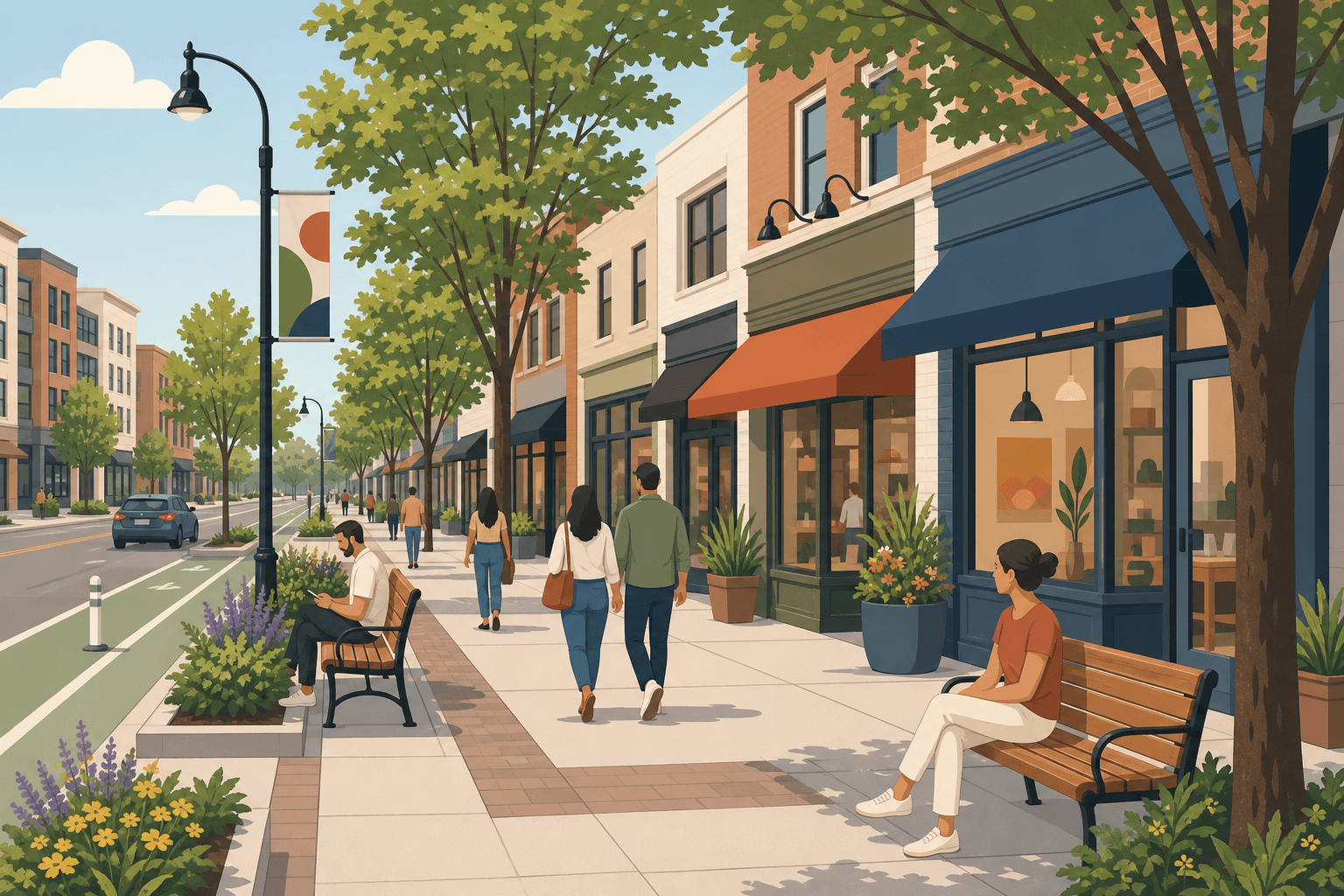
A community development corporation in a mid-sized city requests $175,000 over 18 months to restore a six-block commercial corridor where ground-floor vacancy has climbed and three storefronts are boarded. This corridor project is a composite built for illustration, not a real organization, grant, or neighborhood.
The CDC has operated for eleven years and owns two parcels on the corridor outright.
The project has four activities. First, facade improvement subgrants to six storefront businesses, capped per business, with the owner contributing a share. Second, streetscape work: planters, pedestrian lighting, and benches installed with the city's permission in the public right of way. Third, 200 hours of contracted technical assistance covering licensing, bookkeeping, and lease review. Fourth, a resident steering committee of twelve neighbors and four business owners that sets the facade priority order and approves designs.
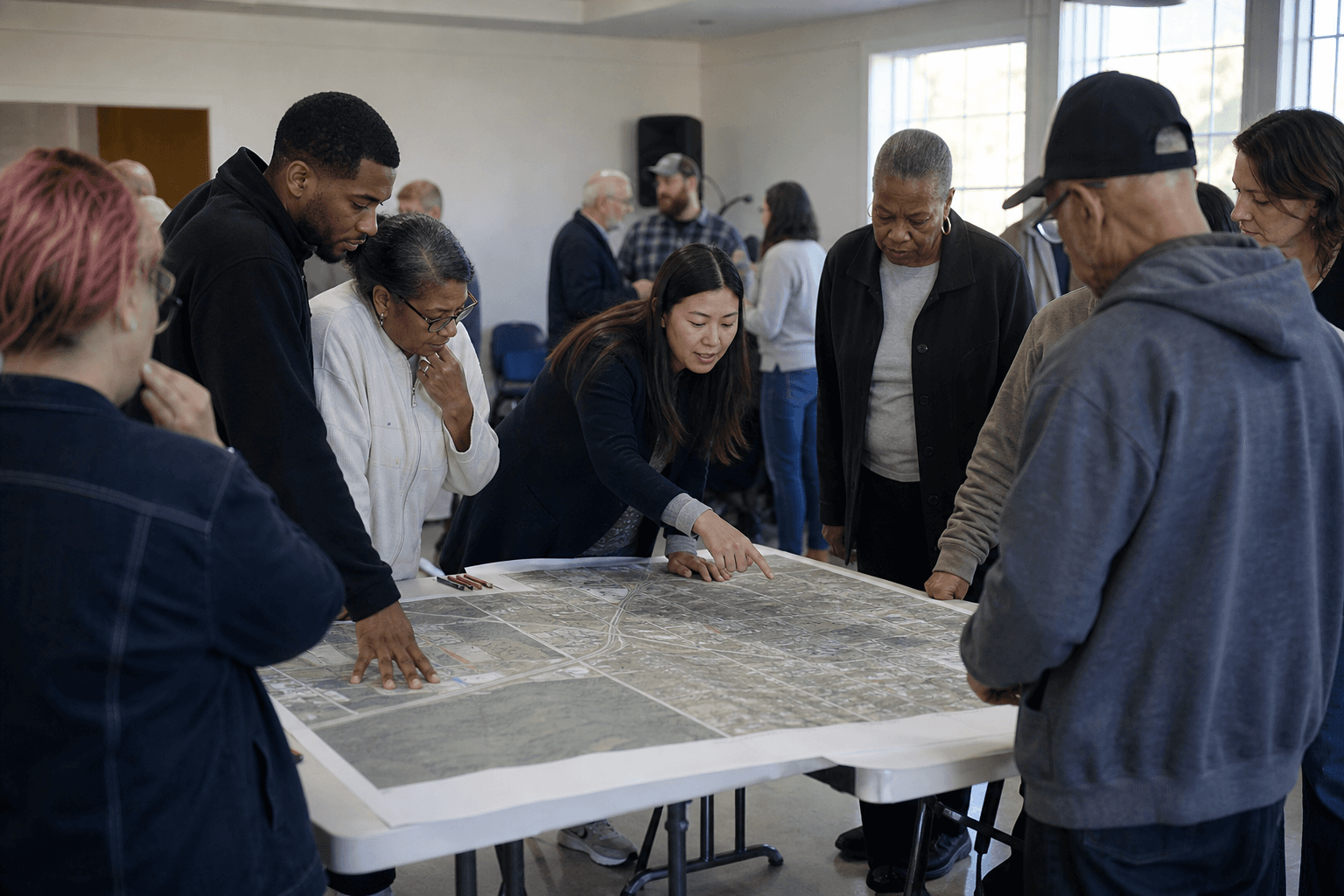
The needs section opens with the boundary, then reports ground-floor vacancy counted by walking the corridor twice in one quarter, then household income for the two census tracts the corridor sits in, then the top three priorities from a door-knock survey the CDC ran. Reviewers can verify all four of those things themselves.
The project description assigns site control status parcel by parcel: two owned, four under signed facade agreements with property owners, and the right of way covered by a letter from the city's public works department. The proposal lists anything without site control as out of scope, which is more persuasive than pretending otherwise.
The corridor business association takes planter maintenance and litter under a signed two-year commitment, attached to the proposal. The city takes the lighting once it is installed. The CDC insures the benches.
The schedule carries as much weight as the activity list. The example runs eighteen months in three stages: predevelopment in months one through four, construction in months five through fourteen, and closeout in months fifteen through eighteen. Reviewers read that sequence to see whether the site assessment, the boundary survey, and the signed facade agreements clear before construction money moves. A proposal that puts the environmental assessment in month nine and facade work in month three tells a reviewer that nobody on the team has built anything before.
Community Development Grant Proposal Budget Example
A community development budget separates hard costs, soft costs, and subgrants, and it shows leverage next to the request. Reviewers read the leverage column first.
| Line item | Request | Committed leverage |
|---|---|---|
| Project manager, 0.5 FTE, 18 months | $52,000 | CDC operating support covers supervision |
| Facade subgrants to 6 storefronts | $42,000 | Property owner match per agreement |
| Streetscape materials and installation | $21,000 | City waives permit fees, provides installation labor |
| Environmental site assessment and survey | $18,000 | None |
| Resident steering committee stipends | $14,400 | In-kind meeting space from a partner congregation |
| Contracted business technical assistance, 200 hours | $12,000 | Volunteer hours from a local accounting firm |
| Translation and interpretation for meetings | $4,200 | None |
| Insurance and permits | $3,400 | None |
| Indirect costs | $8,000 | At the rate stated in the funder's policy |
| Total | $175,000 |
Budget the resident stipends. An unpaid advisory committee skews toward people who can afford to attend. Translation is a real cost in most corridors and gets cut first when it should not. Environmental assessment sits in the budget even when nobody wants it there, because a lender or a public funder will ask for it later.
Build the arithmetic in a spreadsheet before it goes into the narrative. The grant proposal budget template walks through the structure and the narrative that explains each line, and the guide to neighborhood funding programs covers what each funding door expects.
Outcome Measures Community Development Funders Look For
Community development funders measure outcomes at the neighborhood level. A program grant counts people served. A corridor grant counts what changed on the corridor.
| Measure | How the example CDC counts it | Baseline needed |
|---|---|---|
| Ground-floor vacancy rate | Walk-and-count of the six blocks, twice a year | Yes, before work starts |
| Storefronts improved | Completed facade projects with final inspection | No |
| Businesses receiving technical assistance | Signed engagement logs, hours delivered | No |
| Jobs created or retained | Employer-reported headcount at 6 and 18 months | Yes |
| Steering committee members living in the two tracts | Address verification at intake | No |
| Business association membership | Paid membership roster | Yes |
| Reported sense of safety on the corridor | Short intercept survey, same two blocks, same season | Yes |
Pick fewer measures than you think you need, and collect the baseline before the first invoice. Funders accept a modest target. What they cannot accept is an outcome with no baseline, because nothing can be compared to it. The vacancy count in the example takes one person two hours with a clipboard, and it has to happen before the first facade contract. Structure all of it in an evaluation plan that names who collects each number and when.
Five Objections a Community Development Reviewer Will Raise
Community development reviewers raise five recurring objections: site control, displacement, year-three maintenance, conflict with the adopted city plan, and whether leverage is committed. Answer them inside the proposal, before anyone schedules a site visit.
Do you control the sites? Answer parcel by parcel, with the document type for each: deed, lease, signed owner agreement, or municipal letter. Vagueness here reads as risk.
Will this displace the people it is supposed to help? Say what happens if rents rise. In the corridor example the CDC owns two parcels outright, which takes those storefronts off the table, and the four facade agreements bar rent increases for three years after the work is finished. That leaves the rest of the corridor exposed, and the proposal says so. It names a commercial lease assistance fund as the next thing the CDC intends to raise, without claiming the money exists. Proposals that say nothing about displacement invite the question at the site visit anyway.
Who maintains it in year three? Name the maintenance owner and attach the commitment, and put the insurance in the budget rather than in a promise.
Does this duplicate the city's plan or contradict it? Cite the adopted plan by name and say which of its objectives the project advances. If the project departs from the plan, explain why, because a reviewer who finds the conflict will otherwise read it as carelessness.
Is your leverage committed or hoped for? Mark each leverage line as committed, applied, or planned, and say which document proves the committed ones. A funder who finds that a committed match was really an aspiration will discount every other number in the file.
How a Community Development Proposal Differs From a Sample Grant Proposal for a Non Profit Organization
A generic sample grant proposal for a non profit organization is organized around a population and a service. A community development proposal is organized around a place and a physical or economic change to it.
The need statement is drawn as a boundary on a map, with the streets named. Budgets carry hard costs, subgrants to third parties, and predevelopment expenses a service budget never sees. Outcomes are neighborhood indicators, each with a baseline attached. Instead of enrollment and retention, the risk section has to cover site control, environmental condition, and displacement.
Everything else transfers. The cover letter, executive summary, organizational capacity section, and attachments work the same way they do in any proposal, and the sector work concentrates in those four areas.
How to Adapt a Community Development Proposal to Your Own Project
Adapting a community development proposal means replacing the geography, the activity list, and the site control evidence while keeping the section order intact, because that order is what reviewers recognize.
Start with the boundary. The tract data you pull, the count you run, and the outcome measures you can claim all depend on it, so pick a boundary you can walk in an afternoon and defend in a sentence.
Then swap the activity list. A corridor request, a vacant lot program, a housing rehab pipeline, and a small business fund all use the same skeleton, and only the middle of the project description changes. The site control table changes with it: a rehab pipeline lists purchase agreements, and a business fund lists underwriting criteria instead of parcels.
Rebuild the budget from the activity list rather than from the request amount, then rewrite the sustainability section for the specific improvement. A streetscape needs a maintenance owner; a rehabbed building needs an operator and a reserve. The question stays the same in every version: who is responsible for this in year three, and what have they signed?
Track Community Development Grant Deadlines After You Submit the Proposal
Community development funding opens in rounds, scattered across a city budget calendar, a state program cycle, and foundation deadlines that share no schedule.
GrantCue searches federal and state portals in one place, so you can find open community development grant opportunities without checking a dozen sites by hand. Deadlines and pipeline status live alongside the search, and the 990-PF foundation profiles show each funder's grant history, median grant size, and top recipient states, so you can judge fit before you apply. The community development grants guide is the next read once this proposal is out the door.
FAQ
What is a community development grant proposal?
A community development grant proposal is a funding request that seeks money for a physical, economic, or social change in a defined geographic area, such as a commercial corridor, a housing block, or a neighborhood park. It differs from a program proposal by centering a place rather than a service population.
How do you write a statement of need for a community development grant?
To write a statement of need for a community development grant, start with the boundary and then attach data to it. American Community Survey tract tables give household income, housing tenure, and vacancy status for the census tracts your boundary sits in. Your own walk-and-count gives ground-floor vacancy and boarded storefronts block by block, at a finer grain than tract data reaches. A resident survey or a public meeting record gives the priority order. Date every figure, because a reviewer cannot tell whether a vacancy count is current unless you say when it was taken.
Can a nonprofit apply for CDBG funds directly?
Generally no. HUD allocates Community Development Block Grant funds to entitlement cities and urban counties under 24 CFR Part 570 Subpart D, and to states, which administer their own program under 24 CFR Part 570 Subpart I (eCFR, accessed September 10, 2026). Each jurisdiction then runs its own application round and sets the deadline, forms, and reporting rules. Most nonprofits receive CDBG as subrecipients through that local round.
How long should a community development grant proposal be?
Length is set by the funder rather than by convention. Public rounds are usually form-driven with strict character limits per field, so the answer there is whatever the portal allows. A private foundation application that states no limit still has to carry the full section set, from the need statement through the sustainability plan. Write the long version first, then cut it to fit whatever form you are given.
What do community development funders want to see in the budget?
Hard costs, soft costs, and subgrants separated clearly, plus a leverage column marking each match as committed, applied, or planned. Reviewers also look for line items that inexperienced applicants omit: environmental assessment, permits, insurance, resident stipends, and translation.
Where can I find community development grants?
Check your city or county community development department for the local CDBG round, your state's community development or Main Street office, and community foundations serving your county. IRS Form 990-PF filings list each private foundation's grants with recipient names and amounts, so you can see who has funded comparable work.