How Detailed Should a Grant Budget Be? Line Items, Rounding and Funder Forms
How much detail a grant budget needs by situation: funder forms, federal budget pages, NIH modular budgets, when line items are too much, rounding, and narrative match.

In this article (9)
- Quick Answer: How Detailed Should a Grant Budget Be?
- How Detailed Should a Grant Budget Be? Start With the Funder's Form
- Grant Budget Detail by Situation
- What Federal Budget Pages Ask You to Show
- When a Line-by-Line Budget Is Too Much
- How to Round Numbers in a Grant Budget
- Keeping the Budget and the Narrative Aligned
- FAQ
- Build the Detailed Version, Submit the Funder's Version
How detailed should a grant budget be? As detailed as the funder's form and the size of the request require, and no more. A federal agency may want every line computed, a research funder may want only round modules, and a foundation may want two totals on an online form.
Getting the level wrong costs time either way. The person who started one Reddit thread first planned a line-by-line budget, then decided that was too much detail for a grant application, and a commenter replied that "the funding agency usually has a budget justification template they'll want used" (Reddit thread 1p2f7cl, read September 2026). The form is where the answer starts.
Quick Answer: How Detailed Should a Grant Budget Be?
A grant budget should be as detailed as the funder's form and the size of the request require. When a funder supplies a form, complete every line it asks for, in the detail its instructions request. Federal itemized budget details want each cost computed, while NIH modular budgets ask for $25,000 modules (NIH Grants Policy Statement, March 2026).
How Detailed Should a Grant Budget Be? Start With the Funder's Form
The funder's form sets the level of detail, and it comes in three broad shapes: category totals, computed line items, or round modules. Read which one you have before you build anything, because each asks a different question of the same numbers.
Category totals are what the standard federal form holds. The SF-424A, "Budget Information for Non-Construction Programs," lists object classes from "a. Personnel" through "h. Other," then "i. Total Direct Charges," "j. Indirect Charges" and "k. TOTALS" (Grants.gov, SF-424A, OMB expiration June 30, 2028). Its instructions ask for "the total requirements for funds (both federal and non federal) by object class categories" (Grants.gov, SF-424A instructions), so the form itself holds totals, and the detail moves to a separate budget narrative or justification.
Computed line items are what an itemized budget detail asks for. The Department of Justice's Office of Justice Programs says "The budget detail should provide detailed computation for each budget line item, listing the total cost and how it was calculated" (OJP Grant Application Resource Guide, August 24, 2026). It is the most detailed of the three shapes.
Round modules are the least detailed. NIH modular applications "request direct cost funding in modules of $25,000, for up to $250,000 each year for covered activity codes," and the personnel justification gives position, role and effort while "No individual salary information should be provided" (NIH Grants Policy Statement, 13.3.1, revised March 2026).
When no form exists, a foundation's guidelines, its online application fields or a conversation with staff tell you what it expects. At the earlier decide-whether-to-apply stage, a few numbers are enough, as the go/no-go framework explains. After a yes, the budget is built for submission, and the form's shape decides the detail.
Grant Budget Detail by Situation
The right level of detail changes with the funder type and the form, and published instructions range from two totals to a full itemization. Find your situation, then follow that funder's own words.
Two patterns run through the table. The shorter forms ask for totals, while federal itemized formats ask for the arithmetic behind every number. And each instruction describes its own form, so a budget built for one funder may not fit another without trimming or expanding.
The size of the request moves the level of detail as well. NIH uses its modular format "to request up to a total of $250,000 of direct costs per year" for some applications, "rather than requiring a full detailed budget" (NIH, Develop Your Budget, December 3, 2025), so the same project asking for more than that moves to the detailed R&R budget form. At the other end, a short foundation form may hold only two budget totals.
Size matters after award as well. Under 2 CFR 200.308, an agency may restrict transfers among direct cost categories once the Federal share exceeds the simplified acquisition threshold and cumulative transfers exceed "10 percent of the total budget, including cost share, as last approved by the Federal agency" (eCFR, current as of September 2026). On a larger award, the category totals you submit become lines you may need permission to move money between.

What Federal Budget Pages Ask You to Show
A federal budget can ask you to show three things: the total by category on the form, the computation behind each total, and a narrative that matches both. The notice sets how much computation to show, and OJP's instructions show a full version.
OJP's instructions spell out the standard. "For example, costs for personnel should show the salary rate and the amount of time devoted to the project for each employee paid with grant funds," and "it should be clear how the applicant estimated and calculated all costs and how those costs are necessary to completion of the proposed project" (OJP Grant Application Resource Guide, August 24, 2026). OJP's Grants 101 page adds that a budget should be "in outline form, listing line items under major headings and subheadings," with each major component "subtotaled with a grand total at the end" (OJP, Grants 101, October 2026).
The same page states the general principle plainly: "the degree of specificity of any budget will vary depending on the nature of the project and OJP agency requirements" (OJP, Grants 101, October 2026). Detail follows the requirement, not a house style.
Federal detail also binds you after award. Every recipient's financial system must provide for "Comparison of expenditures with budget amounts for each Federal award" (2 CFR 200.302(b)(5), eCFR, current as of September 2026), so the budget you submit becomes the baseline for every spending report. Cost principles apply to each line: a cost must be "necessary and reasonable for the performance of the Federal award" (2 CFR 200.403(a), eCFR, current as of September 2026).
Extra commitments carry weight too. OJP warns that "If a successful application proposes a voluntary match amount and OJP approves the budget, then the total match amount incorporated into the approved budget becomes mandatory and subject to audit" (OJP Grant Application Resource Guide, August 24, 2026). Show the cost share the notice requires, and think twice before volunteering more.
For the category-by-category wording that goes under these numbers, the budget narrative example walks through each federal line.
When a Line-by-Line Budget Is Too Much
A line-by-line budget is too much when the funder's form does not ask for it: a modular federal application, a foundation form with summary fields, or a short letter of inquiry. In those cases the extra lines have nowhere to go.
NIH is the clearest case. Its applications "will include either the R&R Budget Form or the PHS 398 Modular Budget Form, but not both," and for a modular justification NIH says "Do not include salary and fringe benefit rate in the justification" (NIH, Develop Your Budget, page last updated December 3, 2025). Sending itemized salaries into a format that asks for none departs from the instructions.
Foundation forms set the same limit in a different way. A form with two total fields has no place for forty lines, and the CCHD instructions ask for "your budgeted project expenses, not the entire organization's" (Catholic Campaign for Human Development, 2024-2025 instructions). When a foundation also wants an organization budget, look for that request in its guidelines; the difference between the two is covered in program budget vs project budget.
Too little detail is the opposite failure. NIH notes that reviewers "will judge whether your request is justified by your aims and methods" and that "Significant over- or under-estimating suggests you may not understand the scope of the work" (NIH, Develop Your Budget, December 3, 2025). The Missouri Arts Council's FY25 instructions put the test well: "Make certain the information answers questions but doesn't raise any" (Missouri Arts Council, December 20, 2023).
The working rule is to build the detailed version for yourself and submit the version the form asks for. NIH says so directly for modular budgets: "Consider creating a detailed budget for your own institution's use," because "While the NIH will not ask for these details, they are important for you to have on hand when calculating your F&A costs base and writing your justification, and for audit purposes" (NIH, Develop Your Budget, December 3, 2025). The same logic applies to any short-form foundation budget.

How to Round Numbers in a Grant Budget
Round every figure to whole dollars unless the funder says otherwise, round each line before you total, and make sure the totals add exactly. Every published instruction quoted in this section asks for whole dollars, and they differ on the details.
Four instructions show the pattern. NIH says "round to whole dollars and use only U.S. dollars" (NIH, Develop Your Budget, December 3, 2025). A U.S. Department of State application guide says "All figures must be in U.S. Dollars and rounded to the nearest dollar" (U.S. Department of State, MEPI application guidance, June 2025). The Missouri Arts Council's form states "All figures will automatically be rounded to the nearest dollar" (FY25 instructions, December 20, 2023), and Michigan's 2026 budget form says "Totals and subtotals on the form will round to the nearest dollar" (Michigan EGLE, 2026 instructions).
Some formats round further. NIH modules are found by subtracting consortium F&A from total direct costs "and then round to the nearest $25,000 increment," and consortium totals are "rounded to the nearest $1,000" (NIH, Develop Your Budget, December 3, 2025). Use those larger units only where the funder names them.
The trap is a total that no longer matches its lines. Compute in cents in your working sheet, round each line to the dollar, and then sum the rounded lines; never round the exact total separately.
Illustrative figures, not data from a real organization.
Rounding the exact total gives $16,035, one dollar more than the sum of the rounded lines. A form that totals the lines for you will show $16,034, and the narrative must use the same figure. The CCHD instructions put the rule plainly: "columns must add down and rows add across" (Catholic Campaign for Human Development, 2024-2025 instructions).
Keeping the Budget and the Narrative Aligned
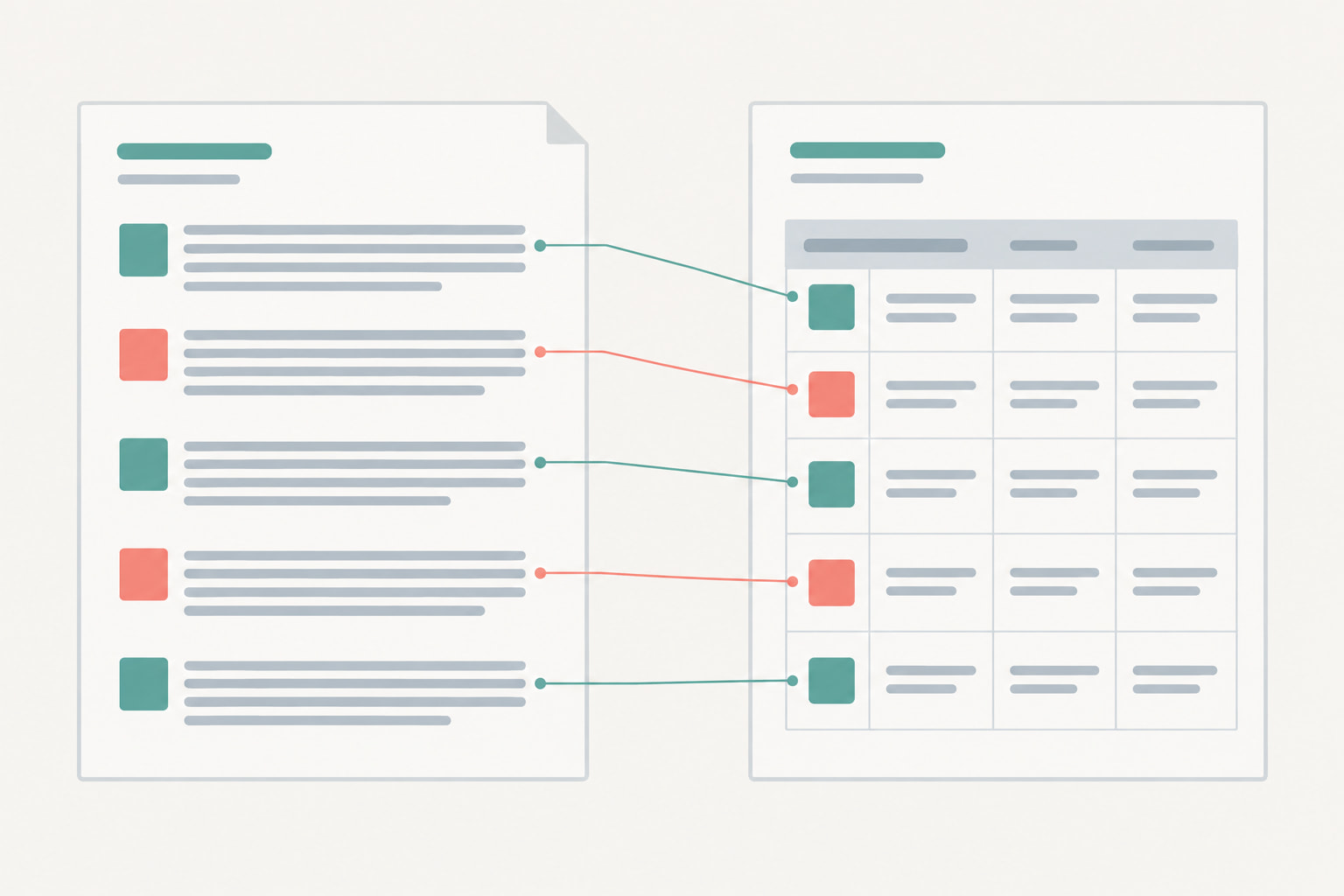
The budget and the narrative must tell one story: every activity in the narrative has a cost line, every cost line traces to an activity, and every total appears the same way everywhere. Several funders state this rule outright, and some forms enforce it.
One federal agency's guidance is explicit. Its budget narrative guidance posted on Grants.gov states "The information in the budget narrative must correspond to Section B of the SF-424A" (Grants.gov opportunity attachment, Budget Narrative Guidance). OJP requires that the Consolidated Category Summary "should match the amounts entered into the Standard Applicant Information with regard to the total, federal, and match amounts" (OJP, August 24, 2026). Michigan's form requires that "The Project Total from the budget page must be the same as the Project Total on the cover sheet" (Michigan EGLE, 2026 instructions), and the Irwin Foundation warns "If the numbers do not match, we may not be able to process your application" (2024 application overview).
A crosswalk catches mismatches before a reviewer does. Make a three-column list: each activity named in the narrative, the budget line that pays for it, and the narrative paragraph that justifies the amount. Any activity with no line, or any line with no activity, needs a fix. Then search the narrative for every dollar figure and confirm each one against the final rounded budget, since a late edit in one place can leave a stray number in another. The structure of a whole budget workbook is covered in the grant budget template guide.
Once a grant is awarded, the submitted budget becomes the spending baseline, and the detail you chose is the detail you will report against. GrantCue's Team plan includes "post-award lite" budget versus actuals and payment schedules, the Organization plan adds full budget planning templates and spenddown tracking, and AI writing tools on the fast model start on Essentials (grantcue.com, October 2026). The feature overview describes these tools.
FAQ
Should a Grant Budget Include Every Line Item?
Only when the funder's format asks for it. Federal itemized budget details ask for every line computed for the full period of performance (OJP, August 24, 2026), while NIH modular applications ask for $25,000 modules without individual salaries (NIH Grants Policy Statement, March 2026). Some foundation forms ask only for totals. Keep a detailed working budget either way, and submit the level the form requests.
Should Grant Budget Figures Include Cents?
Not unless the funder asks for them. NIH tells applicants to "round to whole dollars" (NIH, Develop Your Budget, December 3, 2025), and several application forms round automatically or ask for no decimals. Compute in cents in your own sheet, round each line to the dollar, and sum the rounded lines so the totals match the form exactly.
How Much Detail Does a Foundation Budget Need?
As much as the foundation's own form or guidelines show. Some online forms ask only for organization and project budget totals in whole dollars, while others supply a table with columns for the funder's share and other sources. When guidelines are silent, give each major cost with a one-line explanation, and confirm the request amount matches everywhere it appears.
What Is a Modular Budget?
A modular budget is an NIH research grant budget format that requests direct costs in fixed blocks instead of itemized categories. NIH modular applications request direct costs "in modules of $25,000, for up to $250,000 each year for covered activity codes" (NIH Grants Policy Statement, revised March 2026), with personnel justified by position, role and effort. The format does not apply to SBIR and STTR Phase I grants or to foreign organizations.
Can a Grant Budget Be Too Detailed?
Yes, when the detail goes beyond what the format asks for. A modular NIH justification should not include salary and fringe benefit rates (NIH, Develop Your Budget, December 3, 2025), and a two-field foundation form has no room for an itemized table. Extra commitments can also bind you: OJP makes an approved voluntary match mandatory and subject to audit (OJP, August 24, 2026).
Does the Budget Have to Match the Narrative Exactly?
Treat it as required. One federal agency's guidance requires the budget narrative to correspond to Section B of the SF-424A (agency guidance posted on Grants.gov), and some funders state they may not process an application whose numbers do not match (William G. Irwin Charity Foundation, 2024 application overview). Check every dollar figure in the narrative against the final rounded budget before submitting.
Build the Detailed Version, Submit the Funder's Version
Every budget starts as the full working version: each cost computed in cents, with its basis written next to it. That file answers reviewer questions, sets up post-award reporting and supports an audit.
Before the next application, open the funder's form first and note whether it asks for category totals, computed line items or round modules. Then cut the working file down to that shape, round each line, sum the rounded lines, and check that the narrative uses the same numbers. For budget layouts by proposal type, the grant proposal budget examples show complete sample tables.