Fringe Benefit Allocation Across Grants
How fringe follows salary across grants, when to use rates or actuals, and the federal sections that govern each fringe charge, with tables you can copy.

In this article (9)
- Quick Answer: How Do You Allocate Fringe Benefits Across Grants?
- How Fringe Benefit Allocation Across Grants Works
- Fringe Benefit Rates Versus Actual Fringe Costs Across Grants
- What The Uniform Guidance Requires For Fringe Charges
- Leave, Insurance, Pensions And Other Fringe Components Across Grants
- Records That Support Fringe Benefit Allocation Across Grants
- Keeping Fringe Benefit Allocation Audit Ready
- FAQ
- Next Steps For Clean Fringe Charges On Every Grant
Fringe benefit allocation across grants decides which award pays for leave, insurance, pensions, and related employment costs when staff work on several awards. Salary points to the answer in most cases. The share of salary charged to an award sets the starting point for the share of fringe charged there.
Two things complicate it. Benefits do not bill on the same rhythm as payroll, so a flat monthly premium and a leave day earned last spring both have to land somewhere. And the method you choose, a rate or specific identification, changes what records you have to keep for the rest of the award.
Quick Answer: How Do You Allocate Fringe Benefits Across Grants?
Fringe benefit allocation across grants charges each award the leave, insurance, pension and related costs that go with the salary charged there. 2 CFR 200.431(d) permits two methods: identify specific benefits to specific employees, or allocate by a salary-based rate, set separately for employee groups whose benefit costs differ.
How Fringe Benefit Allocation Across Grants Works
Fringe benefit allocation across grants works by tying each fringe dollar to the salary dollar it supports. The award that carries the salary carries the related fringe.
Federal rules state the principle in direct terms. A cost is allocable to an award when the cost is assignable to that award in accordance with the relative benefits received (eCFR 2 CFR 200.405(a), current as of September 2026). For fringe, the benefit follows the work.
The definition matters here. Fringe benefits are allowances and services employers provide to their employees as compensation in addition to regular salaries and wages, and they include, but are not limited to, the costs of leave, employee insurance, pensions, and unemployment benefits (eCFR 2 CFR 200.431(a), current as of September 2026). Allocation means the process of assigning a cost, or a group of costs, to one or more cost objectives, in reasonable proportion to the benefit provided or other equitable relationship (eCFR 2 CFR 200.1, current as of September 2026).
Staff time charged directly to an award brings its fringe with it. Federal text confirms that costs charged directly are typically incurred specifically for that award, including for example the proportion of employee compensation and fringe benefits expended in relation to that specific award (eCFR 2 CFR 200.413(b), current as of September 2026). In practice, that means charging fringe in the same proportion as the salary it rides on, unless a documented reason supports a different split.
Two guardrails shape every allocation decision. A cost allocable to one award may not be charged to other awards, for example to overcome fund deficiencies or to avoid restrictions imposed by statutes, regulations, or award terms (eCFR 2 CFR 200.405(c), current as of September 2026). When a cost benefits two or more projects in proportions that can be determined without undue effort or cost, it must be allocated on the proportional benefit, and when proportions cannot be determined because of the interrelationship of the work involved, costs may be allocated on any reasonable documented basis (eCFR 2 CFR 200.405(d), current as of September 2026).
Award dates, salary splits and fringe adjustments belong in one award file, set up with the rest of our award setup checklist.
Fringe Benefit Rates Versus Actual Fringe Costs Across Grants
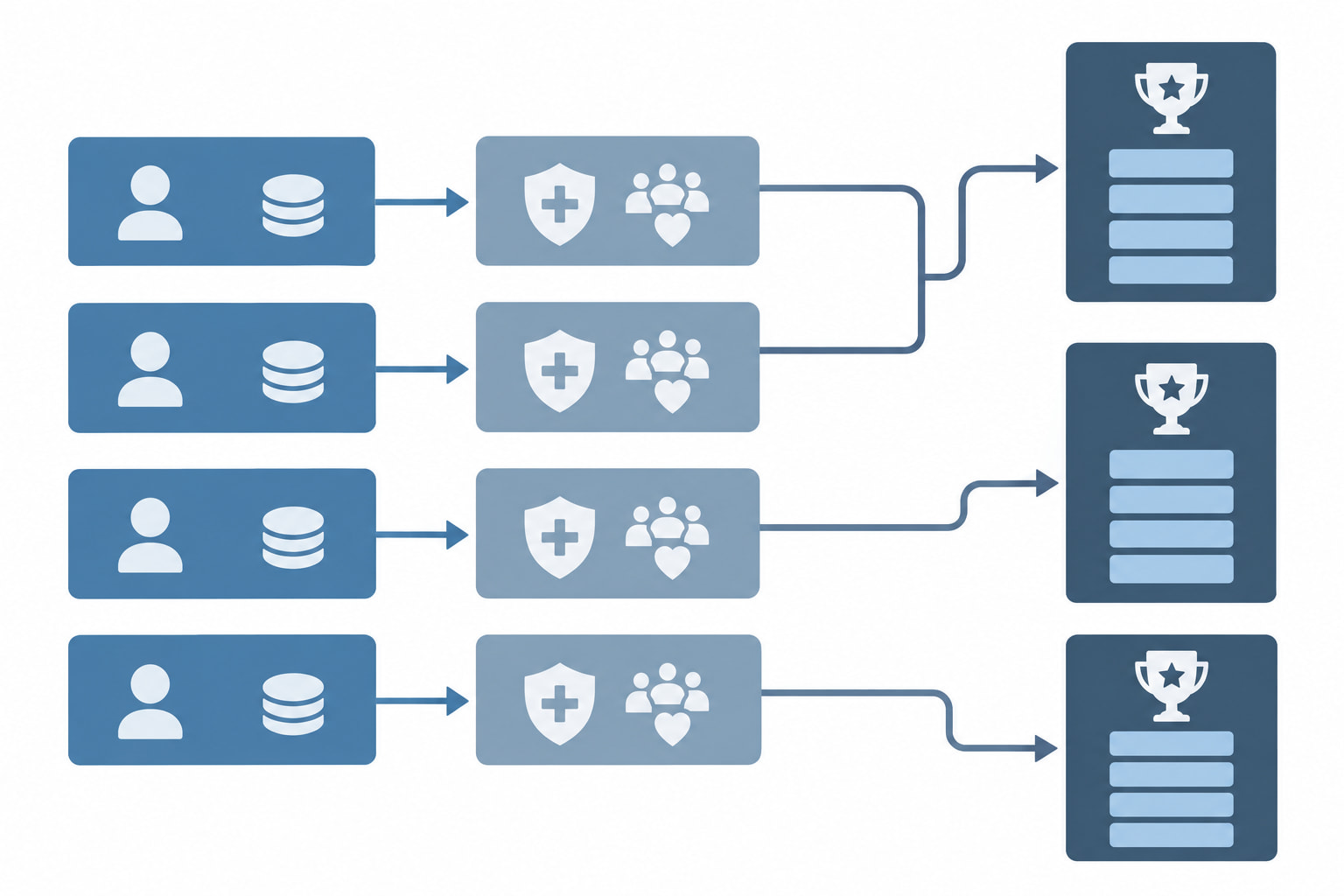
Fringe benefit rates versus actual fringe costs is the central choice in this area. A rate applies a percentage to salary. Actuals trace each cost to the person who incurred it. Both can comply when the records support them.
Federal rules permit two approaches. Fringe may be assigned by identifying specific benefits to specific individual employees or by allocating them based on entity-wide salaries and wages of the employees receiving the benefits (eCFR 2 CFR 200.431(d), current as of September 2026). The first path is specific identification. The second path is a rate. The same section adds that when the allocation method is used, separate allocations must be made to selective groupings of employees unless the recipient demonstrates that costs in relationship to salaries and wages do not differ significantly for different groups of employees (eCFR 2 CFR 200.431(d), current as of September 2026).
That grouping rule is easy to miss. One blended rate for all staff looks simple and fails once benefit costs differ significantly across groups.
Specific identification fits small teams with stable assignments, where you charge the actual premium share, retirement contribution and leave for the person whose salary sits on the award. A salary-based rate fits larger payrolls with frequent movement between awards: build the rate from actual cost pools, apply it each pay period, and reconcile at set intervals.
Rates need a written policy that names the groups, the pools, and the reconciliation cycle. A cost must meet the eight allowability criteria that begin with being necessary and reasonable for the performance of the award and allocable thereto under the cost principles (eCFR 2 CFR 200.403, current as of September 2026).
The two paths usually land close together and then diverge at the reconciliation. Take one employee whose salary for the month splits 60 percent to Award A and 40 percent to Award B (illustrative figures).
Illustrative figures, not data from a real organization.
Under specific identification the $1,300 is the employer health premium, the retirement match and the payroll taxes actually incurred for that person, traced and then split on the same 60/40 salary shares. Under the rate method the group rate produced $1,400 for this person. A rate is an average, so one person's gap is expected; the scheduled reconciliation compares what the rate recovered across the whole group with the pool's actual cost and adjusts the charges when the group total is off. Both methods split on the same salary shares and differ only in how the fringe amount is measured, which is why the rate path needs a scheduled true-up and the actuals path needs per-person invoices on file.
Consistent treatment closes the loop. A cost must not be assigned to an award as a direct cost when any other cost incurred for the same purpose in like circumstances has been allocated to the award as an indirect cost (eCFR 2 CFR 200.403(d), current as of September 2026). A year-round check on direct and indirect treatment belongs on our year-round federal compliance checklist as well.
What The Uniform Guidance Requires For Fringe Charges
The Uniform Guidance requires fringe charges to follow the salary pattern and to rest on records that show the work. Two sections carry most of the weight: 2 CFR 200.431 for the fringe itself and 2 CFR 200.430(g) for the payroll records underneath it.
The allocation rule for fringe is explicit. A recipient must allocate fringe benefits to awards and all other activities in a manner consistent with the pattern of benefits attributable to the individuals or group of employees whose salaries and wages are chargeable to such awards and other activities (eCFR 2 CFR 200.431(c), current as of September 2026).
Payroll records carry the proof. Charges for salaries and wages must be based on records that accurately reflect the work performed (eCFR 2 CFR 200.430(g)(1), current as of September 2026). Those records must reasonably reflect the total activity for which the employee is compensated, not exceeding 100 percent of compensated activities (eCFR 2 CFR 200.430(g)(1)(iii), current as of September 2026). They must support the distribution of salary among specific activities when the employee works on more than one federal award, on a federal award and a non-federal award, or on direct and indirect work (eCFR 2 CFR 200.430(g)(1)(vi), current as of September 2026). Fringe inherits that support. A fringe charge without a salary record behind it has no base.
Budget estimates alone do not qualify as support for charges to awards, but may be used for interim accounting purposes under three stated conditions (eCFR 2 CFR 200.430(g)(1)(vii), current as of September 2026). Internal controls must include processes to perform periodic after-the-fact reviews of interim charges made to an award based on budget estimates, with all necessary adjustments made so that the final amount charged is accurate, allowable, and properly allocated (eCFR 2 CFR 200.430(g)(1)(vii)(C), current as of September 2026).
One category is flatly unallowable. The personal-use share of an employer-furnished automobile, including transportation to and from work, is unallowable as a fringe benefit or indirect cost regardless of whether the cost is reported as taxable income to the employees (eCFR 2 CFR 200.431(f), current as of September 2026). Car benefits tied to commuting stay out of the fringe pool entirely.

Leave, Insurance, Pensions And Other Fringe Components Across Grants
Leave, insurance, pensions, and related items behave differently in the payroll file. Each needs its own handling even when all of them follow salary in the end.
Leave accrues and pays out on a different cycle from salary. Staff earn leave while working across awards, then use it in a later period when their award mix may have changed. The rule sets three conditions: leave costs are allowable where they are provided under established written leave policies, where the costs are equitably allocated to all related activities including federal awards, and where the cash or accrual basis chosen is consistently followed (eCFR 2 CFR 200.431(b), current as of September 2026). Equitable allocation is the condition that does the work, and in practice it means following the awards the person was working on while the leave was earned. Charging a week of vacation entirely to whichever award the employee happens to sit on that week creates spikes a reviewer will question.
Health and other insurance usually bills as a flat monthly premium per enrolled employee, and the premium does not move when award percentages shift mid-month. Split the employer share by the salary percentages in force for that pay period. Retirement and pension contributions track salary by formula, so the employer match already posts as a percentage of eligible wages and maps onto awards on the same salary shares.
Keep each component traceable to its source document, and schedule the payroll tie-out alongside the other monthly grant management process steps.
Records That Support Fringe Benefit Allocation Across Grants
Records that support fringe benefit allocation are payroll records plus the fringe source documents behind them. Reviewers follow the chain from award charge to salary record to fringe pool to invoice.
Start with the salary base. The financial system must identify each award received and expended and the program under which it was received, including the Assistance Listings title and number and the award identification number (eCFR 2 CFR 200.302(b)(1), current as of September 2026). It must maintain records that sufficiently identify the amount, source, and expenditure of funds for each award, supported by source documentation (eCFR 2 CFR 200.302(b)(3), current as of September 2026). It must provide for comparison of expenditures with budget amounts for each award (eCFR 2 CFR 200.302(b)(5), current as of September 2026).
Payroll entries should show employee, award, percentage or hours, effective dates, and approver. Dated splits matter because award mixes change mid-period, and the fringe follows whichever split was in force.
Fringe source files sit beside payroll. Keep carrier invoices for insurance, plan statements for retirement, leave ledgers for paid time off, and tax filings for payroll taxes. Accounting practices must be consistent with the cost principles and support the accumulation of costs, including maintaining adequate documentation to support costs charged to the award (eCFR 2 CFR 200.400(d), current as of September 2026).
Timing discipline keeps salary and fringe from drifting apart. Post salary and fringe in the same period, approve splits before payroll runs where you can, file the approval with the payroll, and post adjustments to interim budget-based charges promptly (eCFR 2 CFR 200.430(g)(1)(vii)(C), current as of September 2026).
Keeping Fringe Benefit Allocation Audit Ready
Keeping fringe benefit allocation audit ready means the file explains itself without the preparer in the room. Policy states the method. Payroll shows the split. Fringe math follows the split. Reconciliation ties the math to actual costs.
Write the policy in plain terms. Name the fringe elements included. State whether each element uses specific identification or a grouped rate. Define the employee groups used for rates, consistent with the requirement for separate allocations to selective groupings unless costs do not differ significantly across groups (eCFR 2 CFR 200.431(d), current as of September 2026). State the reconciliation cycle and the owner. State how leave is treated under the written leave policy, including which basis, cash or accrual, the policy follows and how the costs are equitably allocated to all related activities (eCFR 2 CFR 200.431(b), current as of September 2026).
Test the file each quarter. Pull one pay period. Trace salary to awards. Trace fringe to salary. Compare charged fringe to source invoices and plan statements. Confirm totals stay within the full workload limit that payroll records must observe (eCFR 2 CFR 200.430(g)(1)(iii), current as of September 2026). Confirm no award absorbed costs that belong elsewhere, since a cost allocable to one award may not be charged to others to cover shortfalls (eCFR 2 CFR 200.405(c), current as of September 2026).
The quarterly test needs a budget line to compare against. GrantCue's Team plan, at $109 a month, adds post-award budget versus actuals and payment schedules to its kanban-style award pipeline, and full spenddown tracking starts on Organization at $229 a month (grantcue.com, September 2026). With each award's budget there, the fringe test compares charges to plan in the same workspace that lists grants open for your next application.

FAQ
What is fringe benefit allocation across grants?
Fringe benefit allocation across grants is the process of assigning leave, insurance, pension, and related employment costs to each award that benefited from the work. It follows the salary pattern in most cases. The award that carries the salary carries the related fringe share, supported by payroll records that show the work performed.
How do fringe benefit rates differ from actual fringe costs?
A fringe rate applies a calculated percentage to salary each pay period, usually by employee group. Actual costing traces each benefit to the person and then to the award. Rates need scheduled reconciliation to real pool costs. Actuals need detailed per-person records.
Which federal rule governs fringe benefit allocation?
Two sections govern most decisions. The allocation standard requires fringe to follow the pattern of benefits attributable to the employees whose salary is charged to the awards (eCFR 2 CFR 200.431(c), current as of September 2026). The methods section permits specific identification or allocation based on salaries and wages, with separate groupings where benefit costs differ significantly (eCFR 2 CFR 200.431(d), current as of September 2026).
How should leave costs be charged across grants?
Leave costs are allowable where they are provided under an established written leave policy, where the costs are equitably allocated to all related activities including federal awards, and where the cash or accrual basis chosen is consistently followed (eCFR 2 CFR 200.431(b), current as of September 2026). In practice that points at the awards the person worked on while earning the leave, because charging it all to whichever award is active during the vacation week misstates the benefit each one received.
What records support fringe charges to federal grants?
Payroll records that accurately reflect work performed support the salary base (eCFR 2 CFR 200.430(g)(1), current as of September 2026). Dated award splits, carrier invoices, retirement plan statements, leave ledgers, rate calculations, approvals, and reconciliations support the fringe layer for each pay period.
Can one fringe rate cover all employees?
One rate works only when benefit costs in relation to salaries and wages do not differ significantly across groups of employees (eCFR 2 CFR 200.431(d), current as of September 2026). A workforce that mixes full-time insured staff with part-time uninsured staff is unlikely to pass that test, and separate rates by group are the answer the rule points to.
Next Steps For Clean Fringe Charges On Every Grant
Confirm the method for each fringe element. Confirm the employee groups behind any rate. Post salary and fringe together each payroll. Reconcile to invoices and plan statements on a set date. Costs incurred for a common purpose and not readily assignable to one award are indirect costs, which our guide to federal indirect cost rates covers.