The Grant Management Process: 8 Steps From Finding a Grant to Closeout
The grant management process in eight steps, with the trigger, the owner, and the output for each one, plus a RACI grid showing who is accountable at every stage.
Last updated: September 2026
The grant management process is the full sequence of work an organization runs for every grant, starting before an application exists and ending after the last dollar is spent. Writing the proposal is the visible part. The rest of the sequence, from deciding what to chase through to a final report filed years later, is where deadlines slip and closeout happens in a panic.
This guide splits the work into eight steps and names an owner and an output for each. The RACI grid further down assigns all eight to roles, so a new hire can see who does what on their first morning.
Quick Answer: What Is the Grant Management Process?
The grant management process is the end-to-end cycle an organization uses to win and administer funding. It runs in eight steps: find opportunities, decide go or no-go, plan the application, write the proposal, review and submit, track the decision, manage the active award, then report and close out. Each step has one owner, one output, and one date.
Free download: Grant management process map and RACI workbook as Excel .xlsx. No email address required.
What the Grant Management Process Covers
The grant management process covers every activity between spotting a funding opportunity and closing the award, including the non-writing work that has no obvious owner. Grant writing is one step inside it, not a synonym for it.
People use three terms interchangeably, and they should not. Grant writing is the drafting work that produces a narrative, a budget, and the attachments a funder asks for. Grant administration is the post-award work of spending, documenting, and reporting against the award terms. Grant management is the wider practice that holds both, plus the decisions about which opportunities to chase and which to skip.
The distinction matters because of workload. A single award generates months of obligations after the check clears, and they arrive while the team is already writing the next application. Our grants lifecycle management guide covers that overlap in more depth.
The 8 Grant Management Process Steps
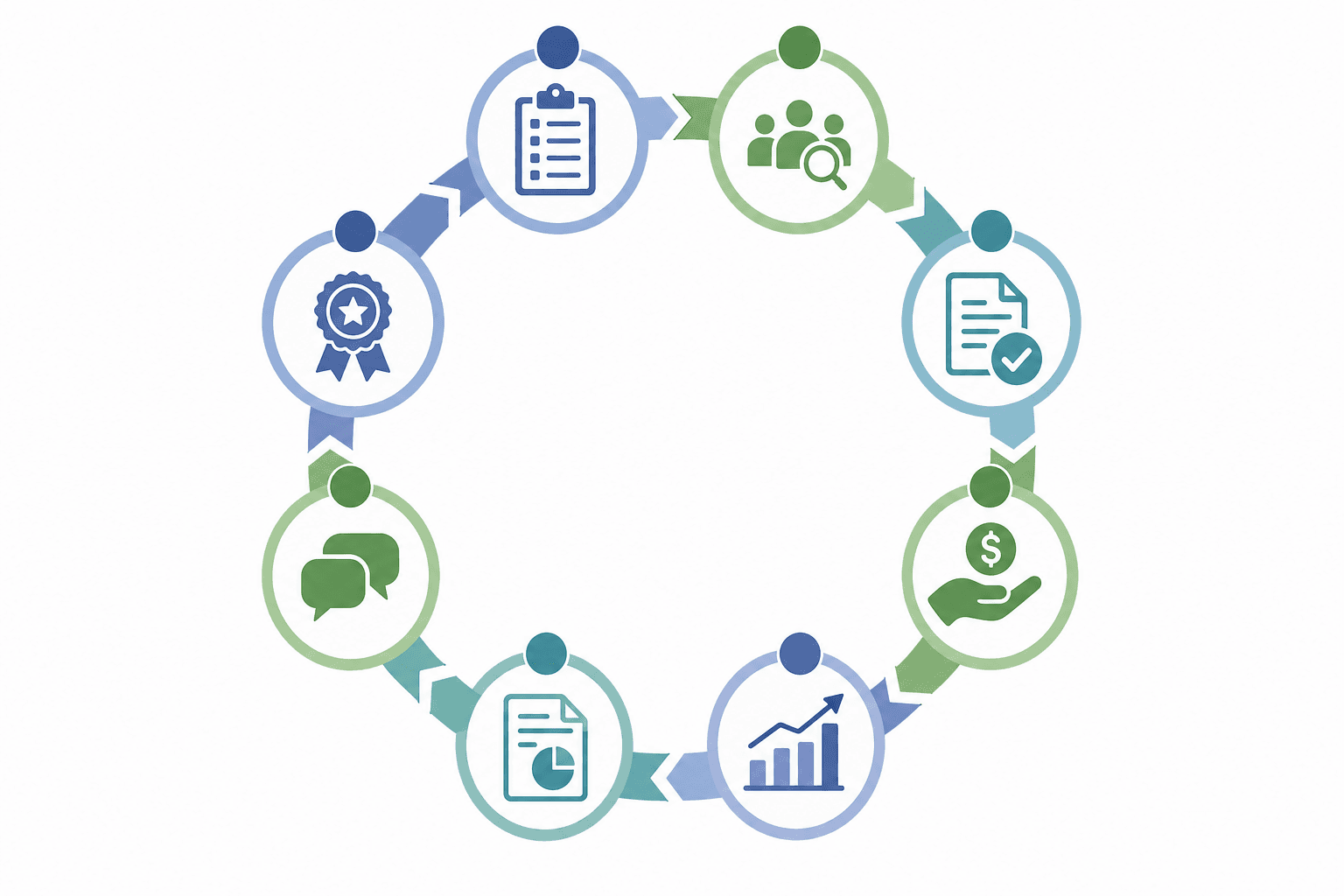
The eight grant management process steps are: screen opportunities, decide go or no-go, plan the application, write the proposal, review and submit, track the decision, manage the active award, and report and close out. Every step ends with a named output that becomes the input for the next one.
| Step | What happens | Primary owner | Output |
|---|---|---|---|
| 1. Screen | Search portals and funder databases, filter by fit | Grant lead | Shortlist of opportunities |
| 2. Decide | Score fit, capacity, and cost of applying | Executive director | Go or no-go decision |
| 3. Plan | Build the task list and the internal calendar | Grant lead | Application timeline |
| 4. Write | Draft the narrative, budget, and attachments | Writer plus program lead | Complete draft |
| 5. Review | Check math, compliance, and required forms | Reviewer plus finance | Submission-ready package |
| 6. Track | Log the submission, follow the decision | Grant lead | Award, declination, or resubmission plan |
| 7. Manage | Spend, document, and monitor against the budget | Program lead plus finance | Spending and activity record |
| 8. Close | File final reports, archive, decide on renewal | Grant lead | Closeout file and renewal decision |

Step 1. Screen Opportunities
Screen on eligibility first, then on fit, then on award size. Anything that fails eligibility is finished, however well it matches the mission.
Screening is the search and filter work that turns the open funding universe into a short list your organization could plausibly win, and it runs all year. Most federal programs post a notice to Grants.gov, though several agencies also run their own application systems. State agencies post to their own portals, and the portal software varies by state, so one search does not cover them. Many private foundations never post an opportunity to a public database, so their past giving is documented in IRS Form 990-PF filings rather than in a searchable feed. Check all three source types on a schedule, or your shortlist ends up reflecting whichever portal someone happened to remember.
Step 2. Decide Go or No-Go
The go or no-go decision is a documented judgment about whether an opportunity is worth the staff hours it will cost. Making it explicit is what stops a team from applying to everything.
Score each opportunity on four things: eligibility, mission fit, the organization's capacity to deliver the work if funded, and the hours the application itself will consume. Take a composite example: a $25,000 request from a small literacy nonprofit is worth writing if the application takes two days. The same $25,000 behind a long federal submission usually is not.
Record the decision and the reason, including the noes, so that six months later the record explains why nobody applied.
Step 3. Plan the Application
Work backwards from the funder deadline. Planning converts that deadline into a set of tasks with owners and internal due dates that all fall before the funder's date, and it is the easiest step to skip. Skipping it is why submissions happen at midnight.
Set the internal submission target several days early to absorb portal problems and signature delays. Assign each attachment to a named person so none goes missing: audited financials, board lists, letters of support, IRS determination letters, and organizational charts. Confirm who holds portal credentials before the week of the deadline.
Step 4. Write the Proposal
Writing produces the application package in the funder's required format. It is the visible part of the process.
Draft the budget and the narrative together. Written separately, the budget table ends up contradicting figures quoted in the text. Pull reusable material from previous submissions, then rewrite the sections that address this funder's priorities. Our guide on how to write a grant proposal walks through the section-by-section structure.
Step 5. Review and Submit
Hand the assembled package to someone who did not write it, and have them check it against the funder's own instructions. An author cannot see the gaps in their own draft.
Check three categories in order: compliance, arithmetic, and clarity. Compliance means every required form is present and the formatting rules are followed. Arithmetic means budget lines total correctly and match every figure quoted in the narrative. Clarity comes last because a well-written proposal that misses a required form still gets screened out. Submit early enough that a portal outage costs you an afternoon.
Step 6. Track the Decision
Log every submission with its amount, its funder, its decision date if one is published, and its status. Tracking is the record of what was submitted, when, to whom, and what came back, and without it an organization cannot answer basic questions about its own pipeline.
Log the declinations too. The pattern across them tells you which funders to stop chasing. When a funder gives feedback, capture it against the record so the next attempt starts from something better than memory.
Step 7. Manage the Active Award
Set up the grant in your accounting system with its own code before the first expense. Award management is the ongoing work of spending against the approved budget, documenting activities, and meeting interim reporting terms, and it runs for the full life of the award.
Reconcile spending against budget lines every month. Federal awards carry additional obligations under 2 CFR Part 200, the Uniform Administrative Requirements, Cost Principles, and Audit Requirements for Federal Awards (eCFR, Title 2 current as of September 8, 2026). Confirm the terms in your own award notice, because they do not always carry over from the last award. Log interim report deadlines the day the award is signed. A post-award grant management checklist covers the setup in detail.
Step 8. Report and Close Out
Closeout is the final set of deliverables that formally ends the award: final financial report, final narrative, outstanding documentation, and a record retention decision. It also decides whether the relationship continues.
Reconcile final spending before writing the final narrative, because the numbers shape what you can claim. Archive the complete file in one place. Make the renewal decision while the results are still fresh; waiting until the next cycle opens means rebuilding the case from scratch. Our grant closeout checklist lists the standard deliverables.
Grant Process Flow: How Work Moves Between the Steps
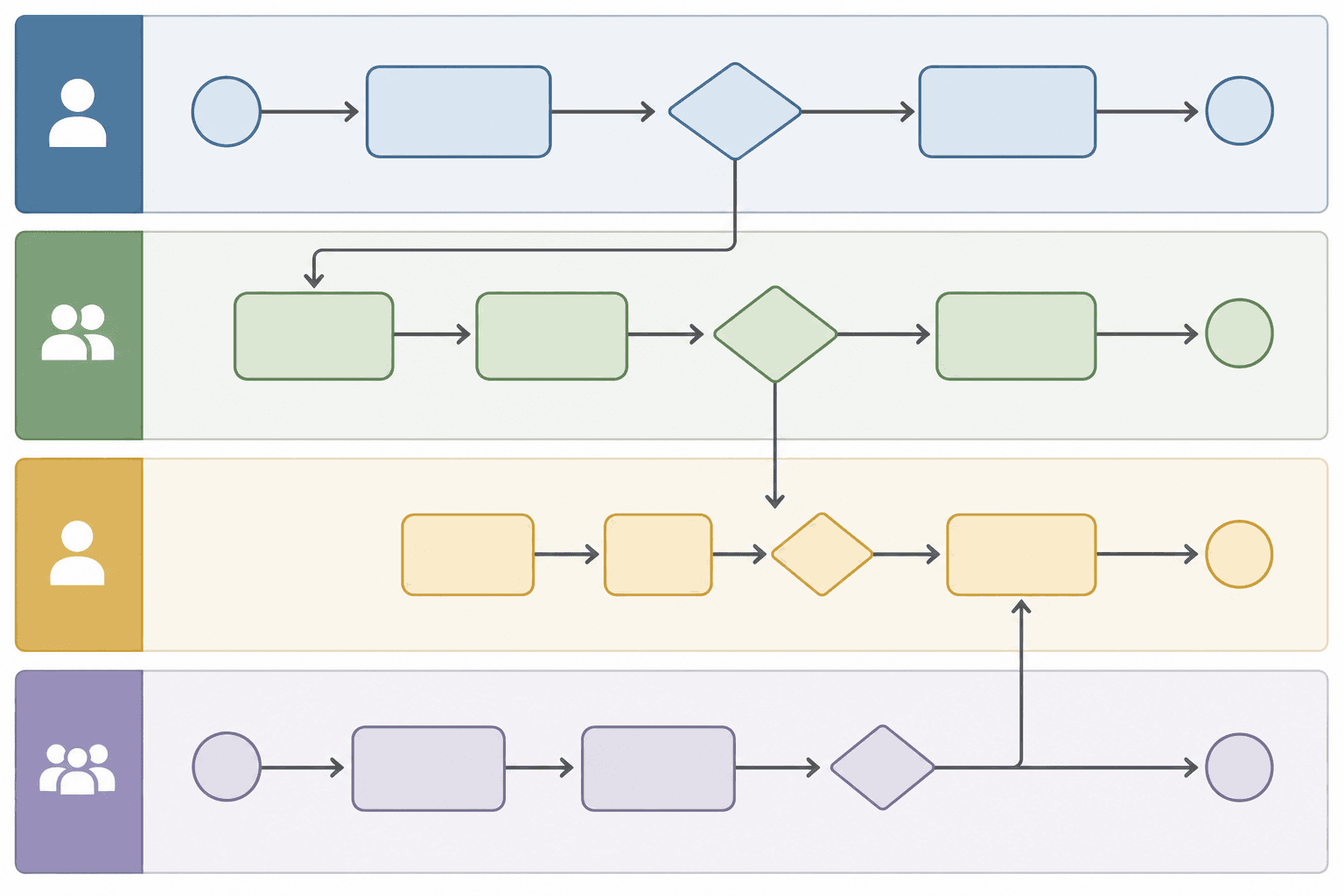
The grant process flow is the set of handoffs between steps, and each handoff is a place where a grant can go quiet. A step is finished when the person who owns the next step accepts its output, not when the previous owner stops working on it.
Four handoffs are worth naming:
- Screen to decide. The shortlist sits with nobody empowered to say no, so opportunities age out.
- Plan to write. Someone assigns the tasks but nobody agrees the internal dates, so everything compresses into the final week.
- Submitting to managing the award. The award arrives and nobody formally hands the file from the writer to the program lead, so spending starts before anyone owns the budget.
- Closing out. Reporting deadlines land after the project ends and after attention has moved elsewhere.
The submit-to-manage handoff is the expensive one. A grant written by one person and delivered by another with no formal transfer produces mismatched spending and reports that contradict the proposal. Treat the award notice as a trigger for a kickoff.
How the Grants Process Changes With Team Size
The grants process has the same eight steps at every organization size, but the number of people holding them changes, and small teams are where roles collapse onto one person. Collapsed roles work as long as each one carries a named compensating control. Read the table below as a working model to adapt, not as a measurement of what organizations do.
| Team size | Common staffing pattern | Risk to watch | Compensating control |
|---|---|---|---|
| One person | Executive director does everything | No independent review before submit | Board member or peer reviews the package |
| Two to four | Grant lead plus finance | Post-award handoff is informal | Written kickoff at award notice |
| Five or more | Dedicated writer, program, finance | Steps run in parallel and drift apart | Shared pipeline with one status per grant |
A one-person shop still needs step 5. The reviewer does not have to be staff, but it cannot be the author.
Who Owns Each Step: The RACI View
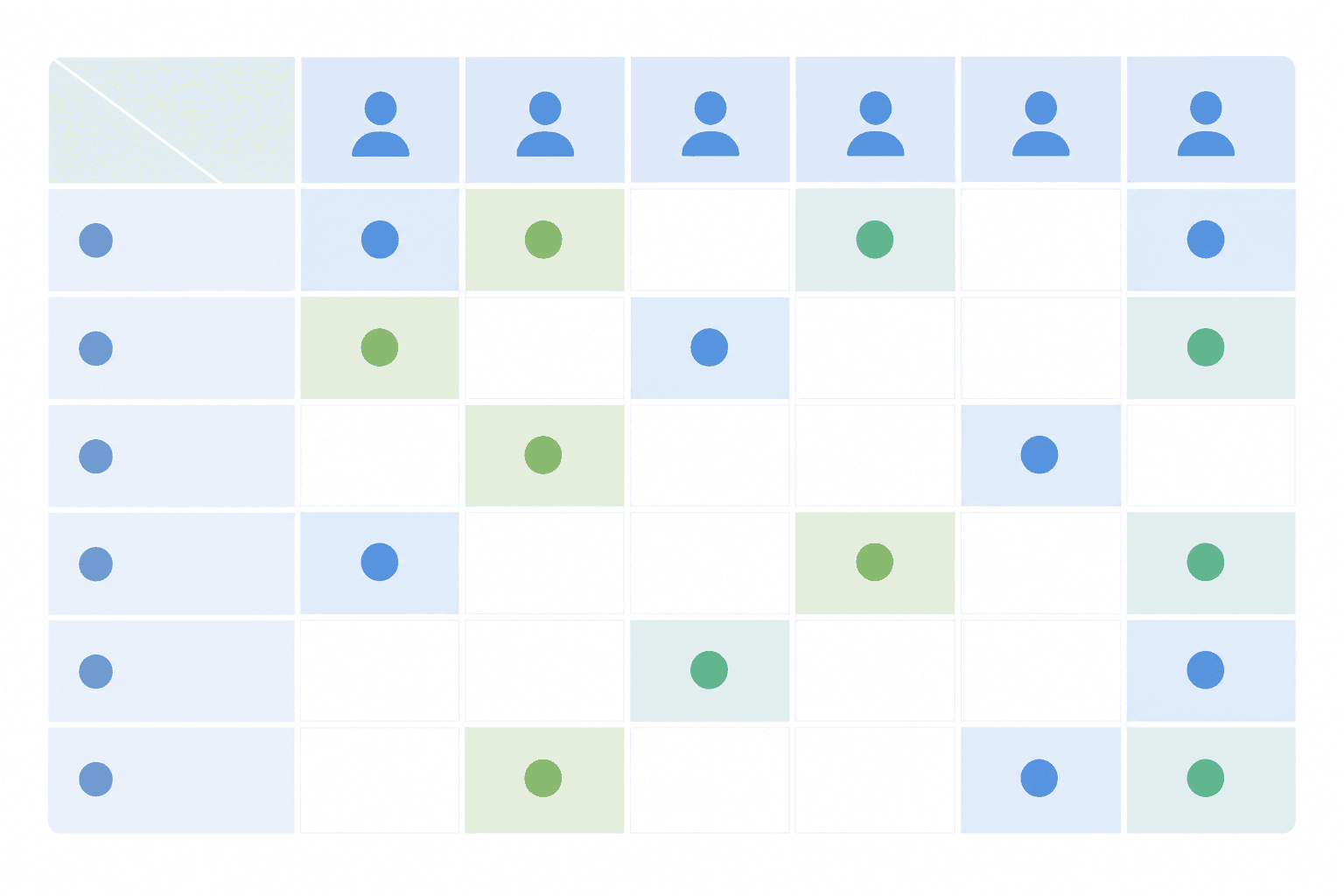
A RACI grid assigns four roles to every step: Responsible for doing the work, Accountable for the outcome, Consulted before decisions, and Informed after them. One person is Accountable per step, and more than one means nobody is.
| Step | Executive director | Grant lead | Program lead | Finance |
|---|---|---|---|---|
| 1. Screen | I | R, A | C | I |
| 2. Decide | A | R | C | C |
| 3. Plan | I | R, A | C | C |
| 4. Write | C | R, A | R | R |
| 5. Review | A | R | C | R |
| 6. Track | I | R, A | I | I |
| 7. Manage | I | C | R, A | R |
| 8. Close | A | R | C | R |
Two changes turn that grid into your grid. Rename the four role headings to job titles that exist at your organization, collapsing them where one person holds several. Then add a duration column to the eight-step table above and record the real elapsed time for each step as you go, so that after one cycle you are working from your own timings.
Print the grid and put it where the team can see it. When ownership of a step is disputed, a visible grid gives everyone something to point at, which is the practical half of lifecycle management.
Where the Grant Management Process Breaks Down
The grant management process breaks in predictable places, and the fixes are administrative work. Five failures show up again and again:
- Deadlines live in one person's head, so when that person is on leave the deadline is invisible.
- Nobody recorded the go or no-go calls, so the team cannot explain its own pattern of applications six months later.
- The writer and the finance lead build the budget and the narrative separately, so figures quoted in the text do not match the budget table.
- Award notices land in an inbox with no deadline attached to them, so someone reads the reporting terms once and forgets them.
- The team treats closeout as optional, and a late final report damages a relationship with a funder who was already inclined to renew.
You fix each of these by writing something down where other people can see it.
Running the Grants Process in One System
A grant management system holds the process in one place so that deadlines and owners survive staff turnover. Spreadsheets work until two people need to edit them at once.
GrantCue holds these eight steps in one place. It searches federal and state portals together so screening does not mean visiting every portal separately, and it includes IRS 990-PF foundation data for private funder research. Opportunities you find in grant search move into a pipeline with a status per grant. Deadlines, tasks, and owners sit against each record, so step 3 stops depending on memory. Reporting pulls from the records the team already updates.
If you are formalizing the process for the first time, run one cycle against the eight steps and the RACI grid above before deciding what needs a system. The grants lifecycle management guide is the natural next read once the eight steps are assigned.
FAQ
What is the grant management process?
The grant management process is the end-to-end cycle for winning and administering funding: screening opportunities, deciding whether to apply, planning the application, writing it, reviewing and submitting, tracking the decision, managing the active award, and reporting and closing out. Grant writing is one step within it.
What are the stages of a grant?
A grant has three broad stages. Pre-award covers screening, the go or no-go decision, planning, writing, review, and submission. Award covers the funder's decision and the acceptance of terms. Post-award covers spending, documentation, interim reporting, and closeout.
What is the difference between grant management and grant writing?
Grant writing produces the narrative, budget, and attachments for one application. Grant management covers the whole cycle around that writing, including which opportunities to pursue, who owns each task, how the money is spent and documented, and how the award is closed.
How long does the grant management process take?
It depends on the funder and the length of the award, so measure your own. Record the real elapsed time for each of the eight steps through one full cycle, from the day an opportunity is screened to the day the final report is filed. After one cycle you will have your organization's own number.
What is grant compliance?
Grant compliance is meeting the terms written into an award: allowable costs, documentation standards, reporting deadlines, and record retention. For federal awards those rules sit in 2 CFR Part 200, which covers cost principles in Subpart E, financial and performance reporting in sections 200.328 and 200.329, and record retention in section 200.334 (eCFR, Title 2 current as of September 8, 2026). The requirements that apply to your specific award appear in the award notice itself.
Who is responsible for grant management in a small nonprofit?
In a small nonprofit one person usually holds several process roles, often the executive director or a part-time grant lead. That works as long as one control is preserved: the person who writes the proposal should not be the only person who reviews it before submission. A board member or an outside peer can fill the reviewer role.
Put the Eight Steps in Front of Your Team
The grant management process does not get better because people try harder. It gets better when each step has one owner, one output, and one date, and when those assignments are visible instead of living in the head of whoever wrote the last proposal.
Copy the RACI grid above, replace the role headings with the names of the people who actually hold them, and run one full grant cycle against it. That cycle will tell you which of the eight steps needs more support, and whether the step that keeps stalling is a staffing problem or a tooling one.