Foundation Proposal Template: What Private Funders Expect in Each Section
A foundation proposal template built for private funders: the eight sections in the order a program officer reads them, and what each one has to answer.
In this article (26)
- Quick Answer: What Goes in a Foundation Proposal Template?
- What a Foundation Proposal Template Should Contain
- How a Foundation Grant Proposal Differs From a Federal Application
- The Private Foundation Grant Application Process, Step by Step
- How to Write Each Section of a Foundation Grant Proposal
- Cover letter
- Summary of the request
- Statement of need
- Project description
- Goals and objectives
- Evaluation plan
- Budget and budget narrative
- Organizational background
- Foundation Proposal Example: A $25,000 Request Filled In
- How to Build Your Own Foundation Proposal Template
- What to Do When the Foundation Uses an Online Application Form
- How to Find Private Foundations Worth Applying To
- Common Mistakes in a Private Foundation Grant Application
- FAQ
- What is a foundation grant proposal?
- How long should a foundation grant proposal be?
- Do private foundations accept unsolicited proposals?
- What is the difference between a letter of inquiry and a full proposal?
- Can I use the same foundation proposal template for every funder?
- What attachments do private foundations usually request?
- Where to Go Next
A foundation proposal template saves you from rebuilding the same document for every funder. What it cannot do is turn a federal application into a foundation request. Private foundations read shorter documents, the reader is a named program officer instead of an anonymous scoring panel, and many publish guidelines that ask for a letter of inquiry before a full proposal. The craft of how to write a grant proposal carries over from any other funder. The structure below is what changes when the reader is a foundation.
Quick Answer: What Goes in a Foundation Proposal Template?
A foundation proposal template contains a cover letter, a summary of the request, a statement of need, a project description, goals and objectives, an evaluation plan, a project budget with a short narrative, and an organizational background section. Foundation proposals run shorter than federal applications, and the funder's published guidelines set the page limit.
Free download: Foundation grant proposal template as Word .docx. No email address required.
What a Foundation Proposal Template Should Contain
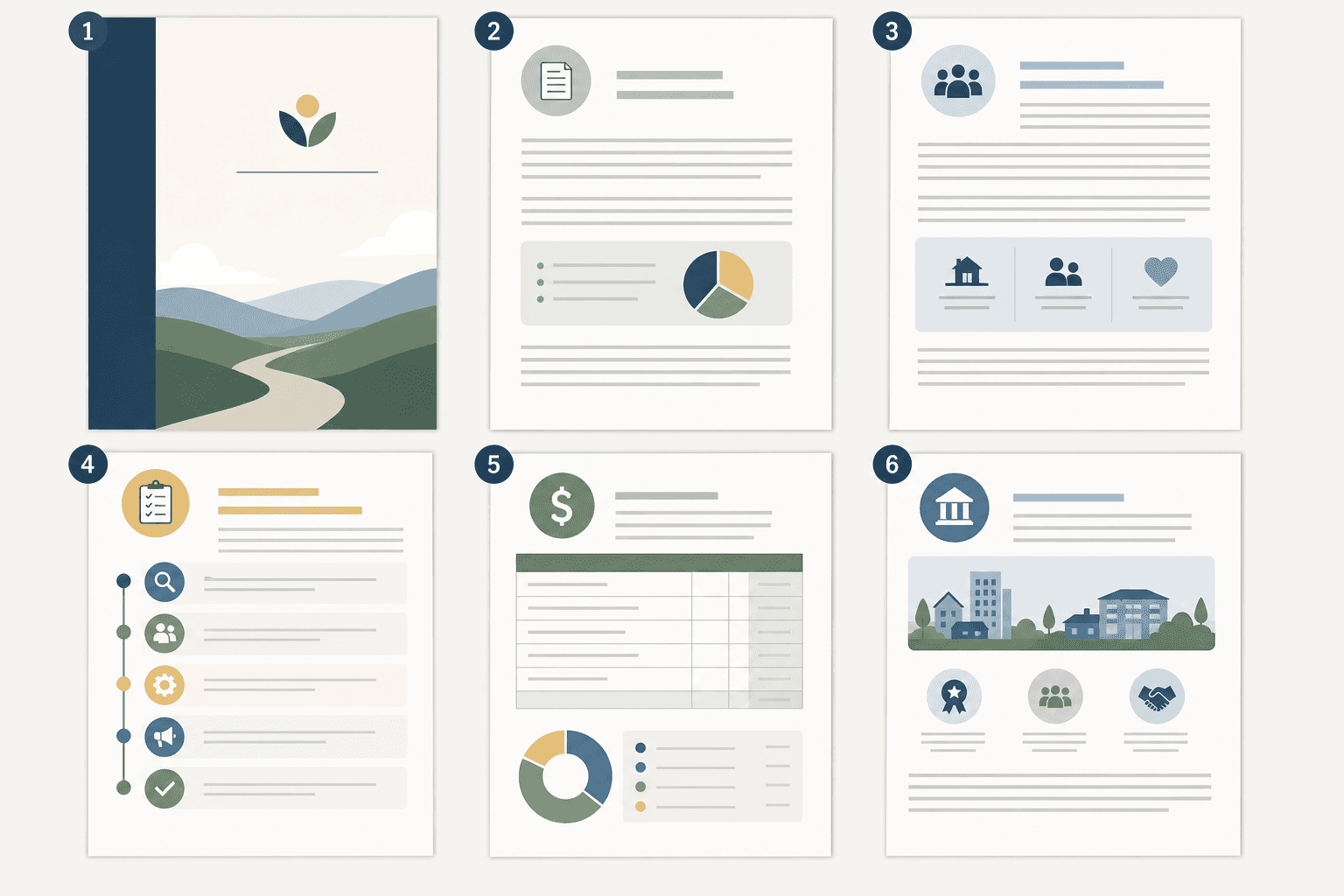
A foundation proposal template should contain eight parts, and each part answers one question a program officer will have to answer out loud when the board meets. The lengths below are a starting point for your own master document. When a funder publishes a page limit or names its own sections, their guidelines override anything here.
Scroll horizontally to see all columns when needed.
| Section | The question it answers | Suggested length |
|---|---|---|
| Cover letter | Why are you writing to us specifically? | 1 page |
| Summary of the request | What do you want, how much, and for what? | 1 paragraph |
| Statement of need | Who is affected, and how do you know? | 2 to 4 paragraphs |
| Project description | What exactly will you do, and by when? | 1 to 2 pages |
| Goals and objectives | What changes if this works? | Half a page |
| Evaluation plan | How will you and the funder know? | Half a page |
| Budget and narrative | Where does every dollar go? | 1 page plus a short narrative |
| Organizational background | Why should they trust you to do it? | 2 to 3 paragraphs |
For a small request, the need and the budget carry most of the weight. A $25,000 ask needs a handful of numbers the organization can collect without hiring anyone, plus a budget whose line items match the activities described a page earlier.
How a Foundation Grant Proposal Differs From a Federal Application
A foundation grant proposal is a short funding request written for a named program officer at a private or family foundation, while a federal application is a long, form-driven submission scored by anonymous reviewers against published criteria.
Scroll horizontally to see all columns when needed.
| Federal application | Foundation grant proposal | |
|---|---|---|
| Length | Set by the notice, often with a hard page limit and required attachments | A few pages |
| Entry point | Public notice with a fixed deadline | Letter of inquiry, or an invitation |
| Reader | Panel of reviewers scoring to a rubric | Program officer, then trustees |
| Format | Prescribed forms and portal fields | Funder guidelines, often a PDF by email |
| Tone | Technical and impersonal | Direct and specific to that funder |
| Deadlines | Fixed and published in advance | Rolling, or tied to board meeting dates |
| Compliance load | Set by the federal award terms | Set by the grant agreement |
| Decision timeline | Set by the agency's published review schedule | Set by the board calendar |
You cannot shrink a federal application into a foundation proposal. The federal version leads with compliance language and methodology. The foundation version leads with fit: why this funder, and why now. Federal and foundation grant proposals diverge well before the formatting does.

Select to enlarge (opens in a new tab).
The Private Foundation Grant Application Process, Step by Step
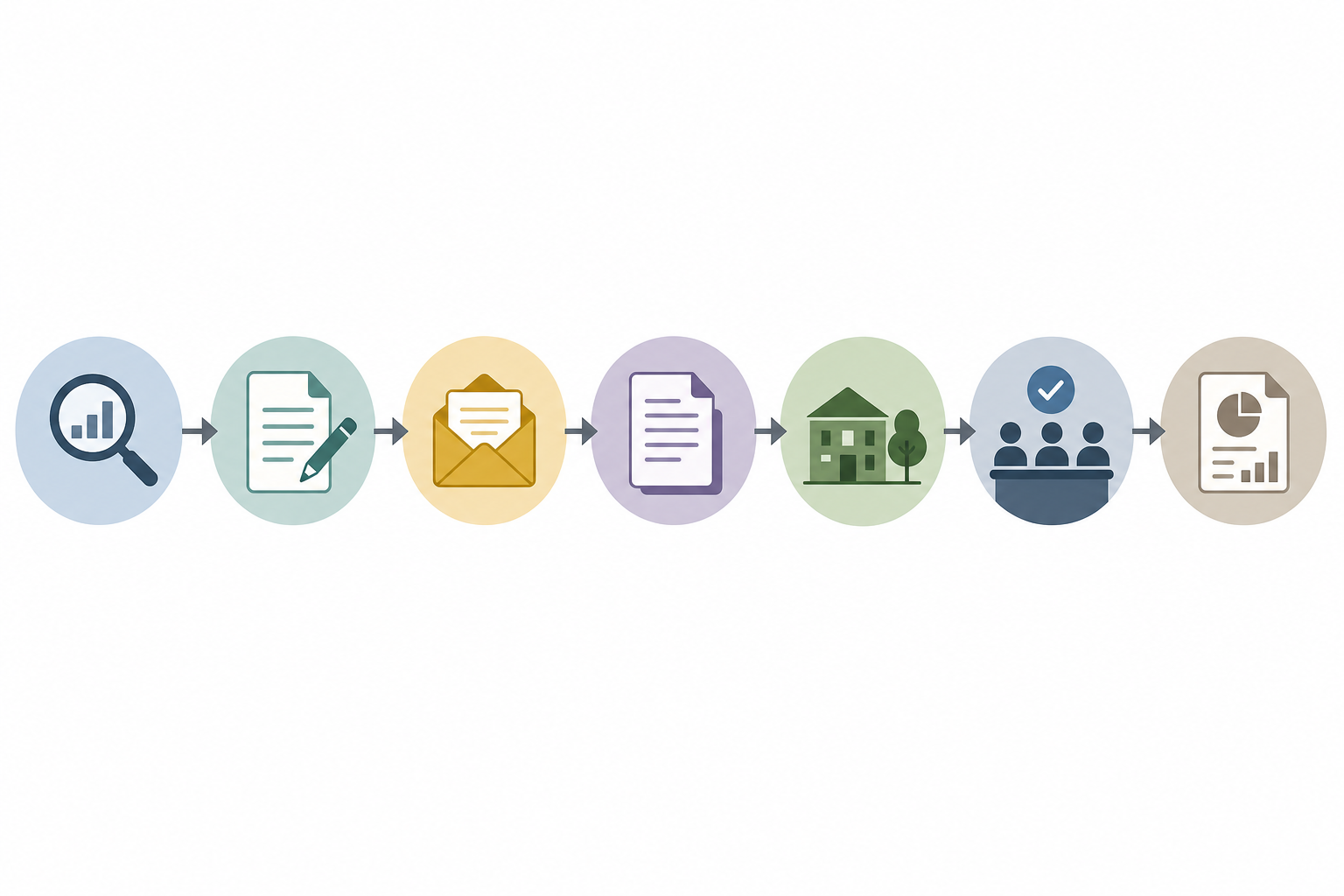
A private foundation grant application moves through six stages: research the funder, send a letter of inquiry, wait for an invitation, submit the full proposal, answer follow-up questions, and wait for a board decision. The first two stages shape the outcome more than the drafting does.
- Research the funder before you write anything. Read the guidelines, the recent grants, and the stated geographic and program focus, then check whether the foundation accepts requests it did not solicit. Some private foundations give only to organizations they approach, and their guidelines say so in a sentence near the top. A foundation that funds one county will not make an exception for a strong proposal.
- Send a letter of inquiry first, sometimes called a letter of intent. Many funders publish a page limit for the inquiry. Use theirs, and when none is published, one to two pages is a safe default. A letter of intent states what you want to do, what it will cost, and asks whether a full proposal is welcome.
- Wait for the invitation. It often arrives with instructions that override the published guidelines, so read it twice.
- Submit the full proposal in their format. If the funder names sections and a page limit, use their names and their limit. If you reorder their sections to match your template, the reviewer notices.
- Expect a question or a site visit. If a program officer asks something before the board packet closes, answer quickly.
- Board decision, then the grant agreement. The trustees' meeting calendar sets the decision date, not the date you submitted. A proposal that arrives the week after a quarterly meeting waits for the next one, so ask when the board meets before you promise a project start date to a school, a landlord, or a new hire.
Select to enlarge (opens in a new tab).
How to Write Each Section of a Foundation Grant Proposal
A foundation grant proposal has eight sections: cover letter, summary of the request, statement of need, project description, goals and objectives, evaluation plan, budget with narrative, and organizational background. Each answers a different question, and none of them has to be long. The general craft of writing a grant proposal applies here; the length and the order are what change.
Cover letter
The cover letter names the amount you are requesting, the project it funds, and the reason you are writing to this foundation. Sign it from the executive director. Keep it to one page. Open with the request, and save the founding date for later.
Summary of the request
The summary is a single paragraph short enough for a trustee to read aloud and repeat accurately to another trustee. Include the population served, the activity, the amount, the period, and the outcome you expect. Write it last, after the rest of the proposal has settled.
Statement of need
The need section names the problem, who it affects, and where, using data the reader can check. A place name, a population, and a number will do more work than a paragraph of adjectives. Name the source and the year for every figure. Do not describe your organization's lack of funding as the need; describe the problem in the community. Worked examples of a statement of need show how much evidence a short foundation request actually carries.
Project description
The project description explains what you will do, who will do it, where, and on what schedule. Name the staff roles, the number of people served, the sequence of activities, and the start date. If the project runs longer than a year, say what happens in year one.
Goals and objectives
Goals state the change you are working toward. Objectives state the measurable steps toward it, each with a number and a date. One goal with three or four objectives is usually enough for a foundation request.
Evaluation plan
The evaluation plan says what you will measure, how you will collect it, who is responsible, and when the funder will hear about it. Match the design to the size of the request. A funder wants to know that you will notice if the project is not working.
Budget and budget narrative
The budget lists every line item for the project period and shows the total request against the total project cost. The narrative explains any line a reader might question, such as personnel allocations and indirect costs. Check that each activity in the project description has a budget line, and that no line is left over.
Organizational background
The organizational background section establishes that you can execute. Cover your mission, the year you were founded, your current programs, your annual operating size, and one or two results from comparable work. Two or three paragraphs is plenty.
Foundation Proposal Example: A $25,000 Request Filled In
A filled in foundation proposal is short: one paragraph of summary, a page of project description, a budget that adds up to the request, and an evaluation plan of three sentences. The example below is composite and hypothetical. No organization, funder, or figure in it is real.
A literacy nonprofit runs after school tutoring and wants to add the two elementary schools in its county that have no reading program. It is approaching a family foundation that gives in that county and asks for a two page letter of inquiry first. The request is $25,000 for one year.
The summary paragraph. "We request $25,000 over twelve months to bring after school reading tutoring to 60 third and fourth graders at the two elementary schools in the county without a reading program. A part time coordinator will recruit and train six volunteer tutors, who will meet with students twice a week from October through May. We expect 40 of the 60 students to gain at least one reading level by the spring assessment." Population, activity, amount, period, outcome, in three sentences a trustee can repeat.
One objective, written so someone can check it. "By the end of the tutoring year, 40 of the 60 enrolled students will gain at least one reading level, measured by the assessment the district already gives in the fall and again in the spring." A number, a deadline, and an instrument the organization does not have to build.
The budget. Every line traces back to an activity named in the project description.
Scroll horizontally to see all columns when needed.
| Line item | Basis | Request |
|---|---|---|
| Program coordinator, 0.4 FTE | 12 months | $18,000 |
| Tutor stipends | 6 tutors, 30 weeks | $4,200 |
| Books and assessment materials | 60 students | $1,800 |
| Mileage between the two schools | 30 weeks | $600 |
| Background checks | 6 tutors | $400 |
| Total request | $25,000 |
The program costs more than $25,000 to run, so the narrative says what covers the rest: the district contributes the space, and an existing operating grant pays for supervision. Showing the request against the full project cost tells the funder who else is already in.
The evaluation plan, in three sentences. Name who pulls the reading scores, when the two assessments happen, and when the funder gets a one page report. That is the entire design for a request this size. A control group would cost more than the tutoring.
The fit sentence in the cover letter. Say what you read in their most recent 990-PF and what it told you: the county they pay into, the range their grants fall in, the kind of work they buy. One or two sentences. Do not recite their giving history back to them.
How to Build Your Own Foundation Proposal Template
Build the template once as a master document, then copy the master for each funder and rewrite only the parts that speak to that funder. Assemble it in the order a foundation reads, cover letter first and organizational background last. Put a one page letter of inquiry at the front of the file, because that is the document you will send first and send most often.
The value of a master is knowing which parts survive the copy and which get rewritten every time.
Scroll horizontally to see all columns when needed.
| Part of the master | What happens per funder |
|---|---|
| Mission, founding year, organizational background | Reuse as written |
| Statement of need | Light edit, swap in local data for a regional funder |
| Project description, goals, objectives | Light edit to match the funder's program language |
| Evaluation plan | Scale to the size of the request |
| Budget and narrative | Rebuild the request column for the amount you are asking |
| Cover letter and fit paragraph | Rewrite every time |
| Section names and order | Replace with the funder's names and order |
Keep an attachment checklist in the same file. It should name the IRS determination letter, a current board list with affiliations, the organizational budget for the current year, recent financial statements or an audit, and the project budget. Funders vary, and a few ask for nothing beyond the proposal itself. Build the checklist once and you stop rediscovering at five o'clock on a Friday that the audit lives in someone else's inbox.

Select to enlarge (opens in a new tab).
What to Do When the Foundation Uses an Online Application Form
When a foundation collects requests through an online portal, your template stops being the submission and becomes the drafting file. You write each answer in your own document, paste it into the field, and cut it to the character limit.
Copy the field labels and their limits into your draft before you write a word. Limits are usually counted in characters including spaces, so a 1,500 character box holds roughly 250 words. Portals also time out, and a form that logs you out partway through an answer rarely keeps what you had typed.
Scroll horizontally to see all columns when needed.
| Portal field | Section of your template that feeds it | What usually has to go |
|---|---|---|
| Project summary, short limit | Summary of the request | The founding date and the mission sentence |
| Statement of need | Statement of need | The second and third data points, keep the strongest |
| Project description | Project description | Staff biographies and background on the model |
| Amount requested and period | Cover letter and budget | Nothing, these are numeric fields |
| Budget upload | Budget and narrative | Nothing, but check the accepted file type |
| Attachments | Attachment checklist | Nothing, check the file size cap |
Two habits protect the submission. Save the confirmation screen or the confirmation email, because most portals will not show you what you sent after you send it. Then paste your final answers back into your master file, since the next funder's form will ask four of the same six questions.
How to Find Private Foundations Worth Applying To
Every private foundation exempt under section 501(a) files Form 990-PF each year, and Part XIV of that return carries the grants and contributions it paid, with each recipient's name and address, the purpose of the grant, and the amount (Instructions for Form 990-PF, IRS, 2025). A funder's recent 990-PF shows the grant range and the geography it actually funds. Compare that against the published guidelines before you decide what to ask for.
Before you write, check the 990-PF for three things:
Scroll horizontally to see all columns when needed.
| Check | What you are looking for | Where to find it |
|---|---|---|
| Grant range | The size of the grants they actually pay | Part XIV, line 3a, paid during year |
| Geography | Where the recipients are located | Recipient addresses in the same list |
| Focus | Whether they fund your kind of work | Grant purposes in that list, read against the guidelines |
If last year's grants cluster well below your request, ask for less or pick a different funder. GrantCue indexes federal and state portals for opportunities that carry published deadlines, and 990-PF data for private funders that do not publish notices. Grant search covers the open opportunities, and deadline tracking and pipeline views keep the letters of inquiry and the invited proposals in one view.
Common Mistakes in a Private Foundation Grant Application
Check fit and sequence before you polish prose. A request that reaches the wrong funder, or reaches the right funder at the wrong stage, does not get a close read.
- Sending a full proposal when the funder asked for a letter of inquiry. It reads as not having read the guidelines.
- Applying to a foundation that gives only to organizations it approaches. One line in the guidelines usually settles it.
- Requesting an amount outside their range. If the grants a foundation paid last year cluster in the low thousands, a six-figure ask signals that nobody opened the 990-PF, and the program officer is left wondering whether the rest of the proposal was researched with the same care.
- Using your section names instead of theirs.
- Recycling a federal narrative. The methodology-heavy voice that scores well with a federal panel reads as evasive to a program officer who wanted three pages about one project.
- Leaving the budget and the narrative out of sync. Make the line items match the activities. A mismatch raises a question you will not be in the room to answer.
- Treating a decline as the end. Ask once, briefly, why it did not fit.
FAQ
What is a foundation grant proposal?
A foundation grant proposal asks a private or family foundation to fund a specific project. It states the need, the amount requested, and how you will measure results. A program officer reads it before the trustees do. It runs shorter than a federal application and is less form driven.
How long should a foundation grant proposal be?
Follow the funder's stated page limit. When no limit is published, a few pages plus attachments is a reasonable default, and the letter of inquiry that precedes the proposal runs one to two pages. A longer proposal will not read as a more rigorous one here.
Do private foundations accept unsolicited proposals?
Some do. Foundations that give only to pre-selected organizations say so in their guidelines, often in a single sentence near the top. Check that sentence before you invest time, because a funder that gives only to organizations it approaches will not review a request it did not invite.
What is the difference between a letter of inquiry and a full proposal?
A letter of inquiry is a one to two page summary that states what you want to do, what it will cost, and why this funder. A full proposal is the complete document with budget, evaluation plan, and attachments, and the funder normally invites it before you send it.
Can I use the same foundation proposal template for every funder?
Use the same template for structure and rewrite the parts that speak to the funder. The statement of need, project description, evaluation plan, and organizational background carry over with light editing. The cover letter, the fit paragraph, the amount, and the section order change for every foundation.
What attachments do private foundations usually request?
Common attachments include the IRS determination letter, a current board list with affiliations, an organizational budget for the current year, recent financial statements or an audit, and the project budget. The funder's guidelines are the authority, and some ask for nothing beyond the proposal itself.
Where to Go Next
Fill in your organization's standing sections once and save that file as the master you copy from. Then pick one funder, read their guidelines line by line, and write the letter of inquiry before anything else. For the underlying craft, the full walkthrough on how to write a grant proposal covers each section in depth and applies to foundation and government requests alike.