Are Form 990s Public Record? What the IRS Requires
Are Form 990s public record? Yes. The IRS public inspection rules, what each return discloses and withholds, and how to request a copy from a nonprofit or the IRS.

In this article (9)
- Quick Answer: Are Form 990s Public Record?
- Are Form 990s Public Record for Anyone Who Asks?
- How the Public Inspection Rules Work
- What Is Disclosed and What Is Withheld
- How to Request a Form 990 from the Organization
- How to Get a Copy from the IRS
- Timing and Penalties When Access Is Refused
- FAQ
- Make the Request Inside the Three-Year Window
Are Form 990 returns public record? Yes. Any person may inspect an exempt organization's annual return (IRS, Public disclosure and availability of exempt organizations returns and applications, June 28, 2026), and the Form 990-PF itself carries the legend "Open to Public Inspection" on page 1 (IRS, 2025 Form 990-PF). What differs between a private foundation and a public charity is whether contributor names and addresses are disclosed.
That matters for anyone researching funders or checking a partner's finances. A private foundation's return has three access routes, contributor names are withheld on every return except a private foundation's, and the duty to keep a return available runs for three years (IRS, Public disclosure and availability of exempt organizations returns and applications, June 28, 2026; IRS, Instructions for Form 990-PF (2025), section Q).
Quick Answer: Are Form 990s Public Record?
Yes. Forms 990, 990-EZ and 990-PF are public records. Anyone may inspect a return at the organization's office, ask for a copy, or view it free on IRS Tax Exempt Organization Search. Each return must stay available for three years from its due date, with extensions, or its filing date, whichever is later (IRS public disclosure rules, June 28, 2026).
Are Form 990s Public Record for Anyone Who Asks?
Yes. Every exempt organization must make its annual return available for public inspection (IRS, Public disclosure and availability of exempt organizations returns and applications, June 28, 2026), and a private foundation must make "its annual returns and exemption application available for public inspection" (IRS, Instructions for Form 990-PF (2025), section Q).
A public record is a document that a person outside the organization has a legal right to inspect and copy. For exempt organizations that document is the annual information return, whatever its form. ProPublica, which republishes these filings, puts the point plainly: "Tax returns filed by nonprofit organizations are public records" (ProPublica Nonprofit Explorer, "Full Filing" view, read September 2026).
Private foundations file Form 990-PF, whose full title is "Form 990-PF, Return of Private Foundation or Section 4947(a)(1) Trust Treated as Private Foundation" (IRS, 2025 Form 990-PF). All private foundations, including nonexempt trusts treated as private foundations, must annually file Form 990-PF (IRS, Private foundations, June 28, 2026).
Not every grantmaker files Form 990-PF. Community foundations file Form 990 instead (Grantmakers.io, The IRS 990 dataset, read September 2026), and the public inspection duty attaches to those returns as well (IRS, Public disclosure and availability of exempt organizations returns and applications, June 28, 2026). Either way, the return is open to anyone who asks.
How the Public Inspection Rules Work
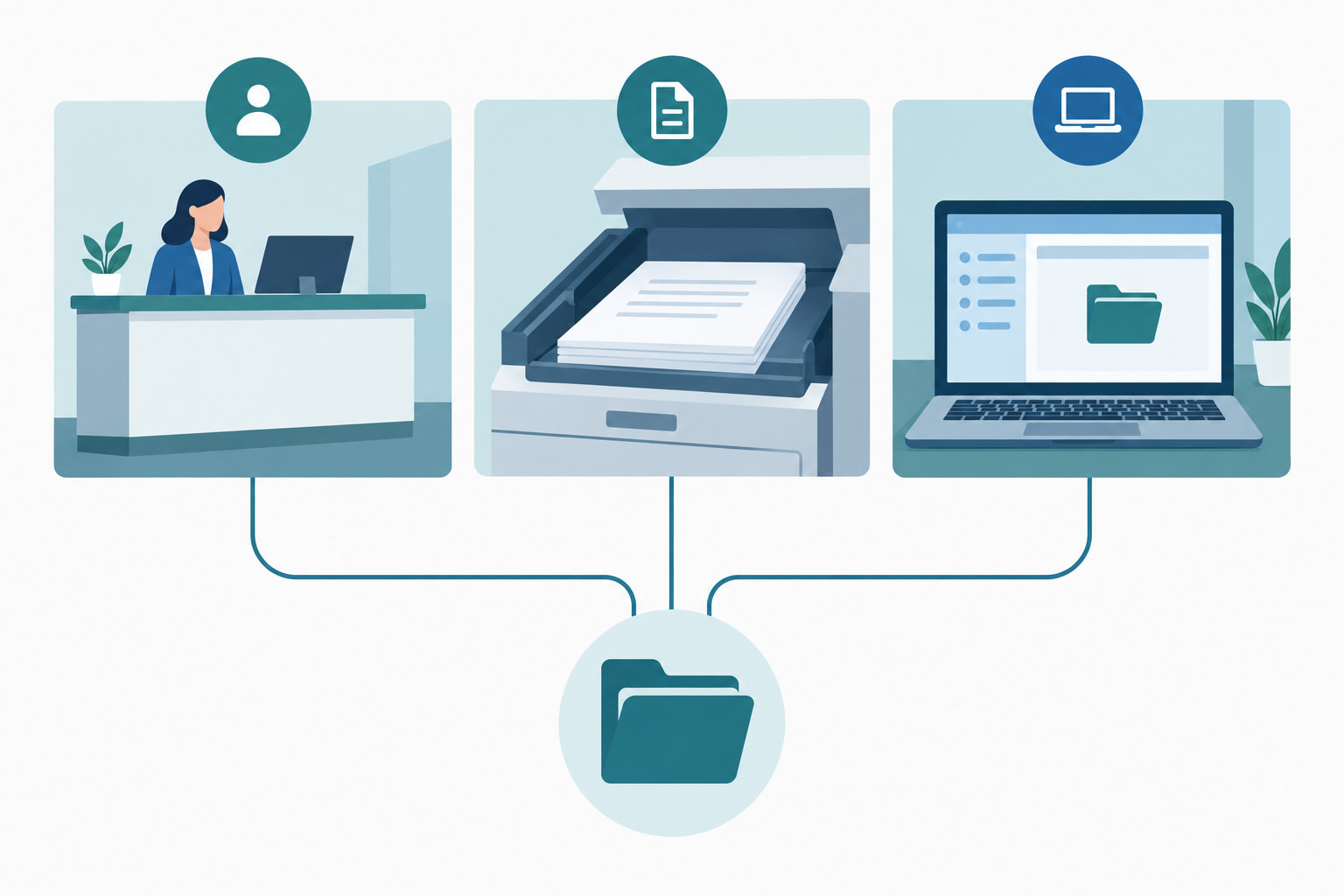
A private foundation must make its annual returns and exemption application available in three ways: by office visitation, by providing copies, and by Internet posting (IRS, Instructions for Form 990-PF (2025), section Q).
Office visitation means the documents can be read at the organization's premises. Providing copies means duplicates are handed over when asked. Internet posting means the filing is online.
There is one large exception to the copy duty. "A private foundation doesn't have to provide copies of its annual returns and/or its exemption application if it makes these documents widely available," and the instructions treat a posting "as part of a database of like documents of other tax-exempt organizations on a website established and maintained by another entity" as one way to meet that standard (IRS, Instructions for Form 990-PF (2025), section Q).
Source: IRS, Instructions for Form 990-PF (2025), section Q.
If an office visit is awkward, ask for a copy or look for a posting. If a posting already exists, you may not need to ask for anything, because a wide posting releases a private foundation from the duty to provide copies (IRS, Instructions for Form 990-PF (2025), section Q).
What Is Disclosed and What Is Withheld
Most of the return is public, and one class of names is not: with the exception of private foundations, an exempt organization is not required to disclose the name and address of any contributor to the organization (IRS, Public disclosure and availability of exempt organizations returns and applications, June 28, 2026).
On a private foundation return, contributor names and addresses do appear. The IRS also makes available a private foundation's Form 990-PF, Form 990-T, and approved exemption application (IRS, Instructions for Form 990-PF (2025), section Q), so the exemption file travels with the annual return.
The depth of what you can inspect varies by form. Form 990-N carries only "eight items of basic information," including its Employer Identification Number (EIN), legal name and mailing address, principal officer, website address and a confirmation that gross receipts are $50,000 or less (IRS, Annual electronic filing requirement for small exempt organizations, read September 2026).
Some organizations file nothing at all. Churches, "an interchurch organization of local units of a church, a convention or association of churches" and an "integrated auxiliary of a church" are among the organizations that do not have to file an annual information return (IRS, Annual exempt organization return: who must file, May 31, 2026). With no return on file there is no public record to inspect. Organizations that do not file for three consecutive years automatically lose their tax-exempt status under Section 6033(j) of the Internal Revenue Code (IRS, Automatic revocation of exemption, read September 2026), so a long gap in filings is itself a signal. For research that starts from a geography, a state listing of private foundations narrows whose returns are worth requesting.
Source: IRS, Public disclosure and availability of exempt organizations returns and applications (June 28, 2026); IRS, Annual electronic filing requirement for small exempt organizations (read September 2026); IRS, Annual exempt organization return: who must file (May 31, 2026); IRS, Automatic revocation of exemption (read September 2026).

How to Request a Form 990 from the Organization
A private foundation must provide copies to any individual who makes a request in person at the private foundation's principal, regional, or district offices during regular business hours on the same day that the individual makes the request (IRS, Instructions for Form 990-PF (2025), section Q).
The duty to keep the document available is finite. "Returns must be available for a three-year period beginning with the due date of the return (including any extension of time for filing) or is actually filed, whichever is later" (IRS, Public disclosure and availability of exempt organizations returns and applications, June 28, 2026). Outside that window the organization can decline.
A written request is worth sending even when an office visit is possible. Name the organization and the return year, and add its Employer Identification Number if you have it. An EIN is an Employer Identification Number, also known as a Taxpayer Identification Number (TIN), and it is the field the IRS and every 990 database keys on (IRS, Annual electronic filing requirement for small exempt organizations, read September 2026). Ask for a copy of the annual return and the exemption application.
If the foundation says its documents are widely available online, that can satisfy the copy duty (IRS, Instructions for Form 990-PF (2025), section Q). Take the link, confirm the filing year printed on the document, and save the file. A refusal is not free for the foundation: the rules attach a daily penalty to it (IRS, Instructions for Form 990-PF (2025), section Q).
How to Get a Copy from the IRS
The IRS is the other copy source, and the viewing route is free. "The IRS makes available a private foundation's Form 990-PF, Form 990-T, and approved exemption application," and "You may view exempt organization returns free of charge on Tax Exempt Organization Search (TEOS) at IRS.gov/TEOS" (IRS, Instructions for Form 990-PF (2025), section Q).
Tax Exempt Organization Search is the IRS's own free tool, and it searches five separate data sets: "Pub. 78 data," "Automatic revocation of exemption list," "Determination letters," "Form 990 series returns," and "Form 990-N (e-Postcard)" (IRS, Search for tax exempt organizations (TEOS FAQ), read September 2026). Returns are one of the five sets, so the copy you want is inside the tool.
Most recent filings reach the IRS as electronic submissions. "Effective for tax years beginning after July 1, 2019, the Taxpayer First Act, Pub. L. No. 116-25 Section 2301, requires organizations exempt from taxation under section 501(a) to file their annual Form 990 and Form 990-PF returns electronically, unless covered by one of the exceptions listed in the form instructions" (IRS, Exempt organizations annual reporting requirements, June 28, 2026).
Electronic filing is why machine-readable releases exist at all. The IRS "started publishing foundation tax returns in 'machine-readable format' for the first time in 2016," and raw data is "Only available for electronically filed documents" (Grantmakers.io, The IRS 990 dataset, read September 2026; ProPublica Nonprofit Explorer, August 20, 2026). The IRS bulk data files "are updated monthly" (IRS, Tax Exempt Organization Search bulk data downloads, read September 2026).
A rebuilt page on a third-party site is a reconstruction of IRS data, so check the filing year on the source before you rely on a figure. ProPublica says so about its own pages: "The pages below are a reconstruction of a tax document using raw data from the IRS" (ProPublica Nonprofit Explorer, "Full Filing" view, read September 2026). A late return for an old year reaches the IRS on paper, because "Electronic filing is only available for the current tax year and 2 prior tax periods," and the IRS "will no longer accept electronically filed returns for years 2020 and older" (IRS, Instructions for Form 990-PF (2025), section J). A paper return has page images but no XML.
Timing and Penalties When Access Is Refused
When access is refused, the rules set a price on the refusal. For a private foundation, the penalty runs "according to the section 6104(d) rules," at "$25 for each day during which a failure occurs," with a maximum of "$13,000" for any one annual return and an additional "$6,500" for a willful failure (IRS, Instructions for Form 990-PF (2025), section Q).
A missing filing costs money too. Late or incomplete Form 990-PF filing costs "$25 for each day the failure continues ($130 a day if it is a large organization)," capped at "the lesser of $13,000 ($65,000 for a large organization) or 5% of the gross receipts of the organization for the year" (IRS, Instructions for Form 990-PF (2025), section M). For the 2025 form, "A large organization is one that has gross receipts exceeding $1,309,500 for the tax year" (IRS, Instructions for Form 990-PF (2025), section M).
Source: IRS, Instructions for Form 990-PF (2025), sections M and Q.
Timing sets a second limit, and it works against a researcher. "Form 990, 990-EZ, or 990-PF must be filed by the 15th day of the 5th month after the end of your organization's accounting period," so a calendar-year filer is due May 15 of the following year (IRS, Annual exempt organization return: due date, June 28, 2026). "Use Form 8868 ... to request an automatic 6-month extension of time to file Form 990, 990-EZ, or 990-PF" (IRS, Annual exempt organization return: due date, June 28, 2026).
By the time a return is public, the year it covers is well closed. A filing is evidence about a past year, not a statement of what the organization is doing now.
Because these returns are public, anyone can build on them. GrantCue turns IRS 990-PF public filings into profile pages for more than 10,000 private foundations, each keyed by name and EIN (grantcue.com, September 2026). Every one of those profiles built from public returns points back to a filing you can request or pull yourself, so check the tax year on the return before you quote a figure.
FAQ
Can a Nonprofit Refuse to Share Its Form 990?
Only in narrow cases. A return must stay available for three years from its due date, including extensions, or its filing date, whichever is later, so an older return can be declined (IRS, Public disclosure and availability of exempt organizations returns and applications, June 28, 2026). A private foundation that makes its documents widely available online need not provide copies. Otherwise a private foundation's refusal costs "$25 for each day during which a failure occurs," up to "$13,000" per return (IRS, Instructions for Form 990-PF (2025), section Q).
Can Anyone Request a Copy of a Form 990?
Yes. The rules cover any individual who asks. A private foundation must provide copies to any individual who makes a request in person at its principal, regional, or district offices during regular business hours on the same day that the individual makes the request (IRS, Instructions for Form 990-PF (2025), section Q).
How Long Does an Organization Have to Make Form 990 Available?
"Returns must be available for a three-year period beginning with the due date of the return (including any extension of time for filing) or is actually filed, whichever is later" (IRS, Public disclosure and availability of exempt organizations returns and applications, June 28, 2026). After that period ends, the organization is free to decline a copy request.
Is Donor Information on a Form 990 Public Record?
Not on every return. With the exception of private foundations, an exempt organization is not required to disclose the name and address of any contributor to the organization (IRS, Public disclosure and availability of exempt organizations returns and applications, June 28, 2026). Private foundation returns do carry contributor names and addresses.
Are Private Foundation Returns Public Record?
Yes. All private foundations, including nonexempt trusts treated as private foundations, must annually file Form 990-PF (IRS, Private foundations, June 28, 2026). The form is printed with the legend "Open to Public Inspection" on page 1 (IRS, 2025 Form 990-PF), and the IRS makes available a private foundation's Form 990-PF, Form 990-T, and approved exemption application (IRS, Instructions for Form 990-PF (2025), section Q).
How Do I Get a Copy of a Form 990 From the IRS?
You may view exempt organization returns free of charge on Tax Exempt Organization Search (IRS, Instructions for Form 990-PF (2025), section Q). The IRS also publishes raw filings for download in XML formats, organized by year and month with an index file for each year (IRS, Form 990 series downloads, read September 2026). XML exists only for electronically filed returns (Grantmakers.io, The IRS 990 dataset, read September 2026).
Make the Request Inside the Three-Year Window
You can inspect the return at the office, request a copy, or read the organization's own posting (IRS, Instructions for Form 990-PF (2025), section Q), and the IRS shows returns free on Tax Exempt Organization Search. The window is the three-year period counted from the due date or the actual filing date, whichever is later (IRS, Public disclosure and availability of exempt organizations returns and applications, June 28, 2026).
Write the request before that window closes. Name the organization and the return year, add the EIN if you have it, ask for the annual return and the exemption application, and cite the public inspection rule. If the answer is a link to a public posting, save the file and check the year printed on it.
The grant search method for nonprofits covers the search side, and the live grant search lists are where a qualified prospect becomes an application.