Evaluation Plan for a Grant Proposal: What Funders Expect and How to Build One
How to build an evaluation plan for a grant proposal funders trust: the seven parts reviewers expect, method choices, a worked sample, and a pre-submission check.
Last updated: September 2026
A reviewer can accept the idea, agree the budget is reasonable, and still decline the proposal because nothing in it shows how anyone would know the money worked. The evaluation plan for a grant proposal is the section that answers that. Written badly, it becomes a paragraph promising to track outcomes and report annually, which tells a reader nothing. Written well, it names what will change, what gets counted, who counts it, and when. Funders read for seven specific parts. Leave one out and the section becomes a placeholder.
Quick Answer: What Is an Evaluation Plan for a Grant Proposal?
An evaluation plan for a grant proposal is the section that explains how you will measure whether the funded project worked. It names the outcomes you expect, the indicators that show progress, the data sources and collection schedule, the person responsible, and how results will be reported back to the funder and used to improve the program.
Free download: Evaluation plan builder as Word .docx. No email address required.
What an Evaluation Plan for a Grant Proposal Includes
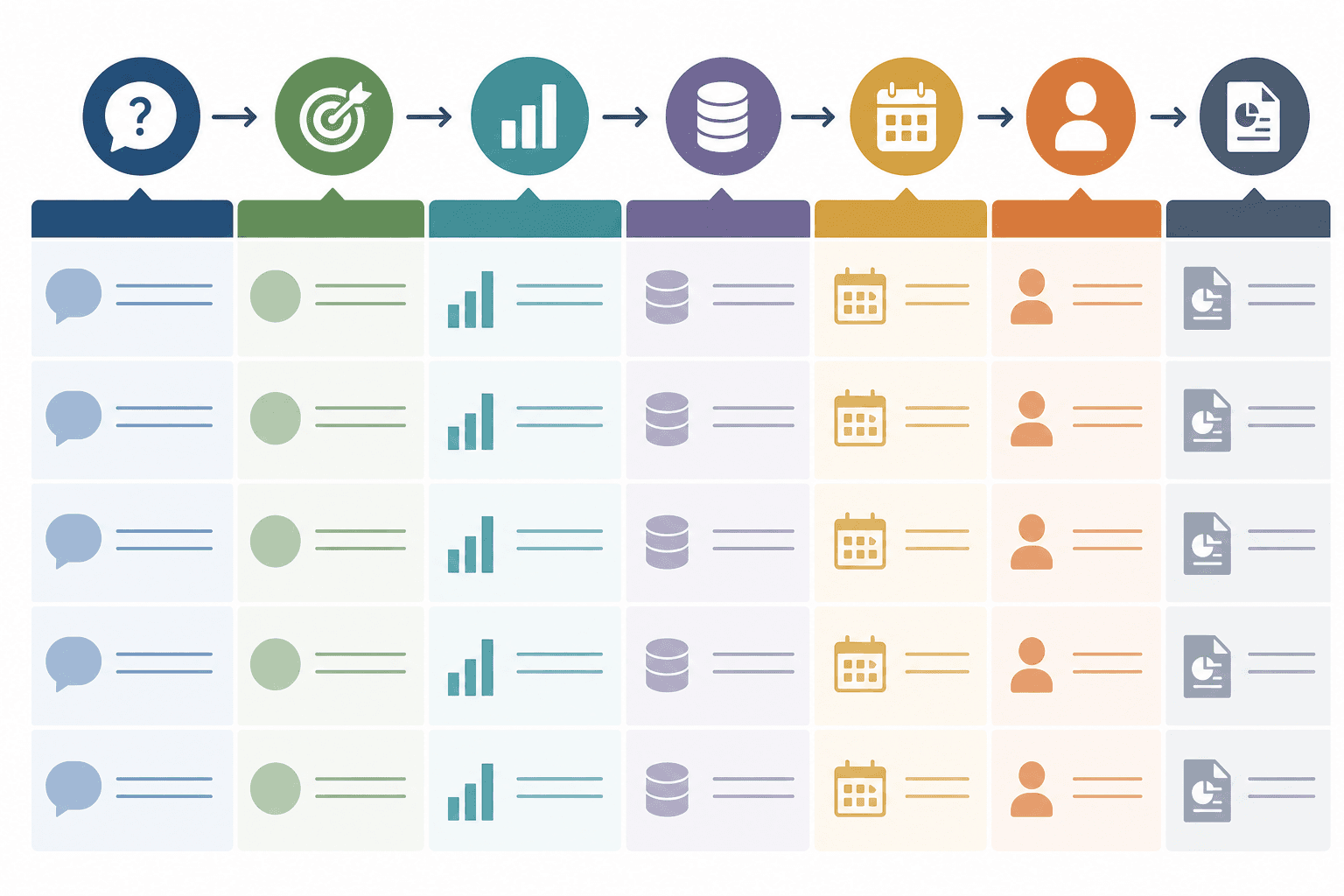
A complete evaluation plan answers seven questions. An application form may prompt for only two or three of them, so write the rest in without waiting to be asked.
| Part | Question it answers | What reviewers want to see |
|---|---|---|
| Evaluation questions | What are we trying to learn? | Two to four questions tied directly to the objectives |
| Outcomes and indicators | What changes, and how would we see it? | One measurable indicator per stated outcome |
| Data sources | Where do the numbers come from? | Named instruments, records, or systems |
| Collection schedule | When is each measure taken? | Baseline, midpoint, and end of period |
| Analysis approach | How do raw data become findings? | A comparison method stated in plain language |
| Responsibility | Who does the work? | A named role with time reflected in the budget |
| Reporting and use | Who sees the results, and what changes? | Funder reporting plus an internal review point |
The seven parts depend on your objectives, so write them after the objectives are final. Vague objectives produce a vague evaluation plan. Fix the upstream section first using SMART goals and objectives, then come back. For a fill-in structure with side-by-side wording, the grant proposal evaluation plan template covers each part with example language.

How to Write a Grant Proposal Evaluation Plan
Work through the section in seven passes, from the objectives down to the reporting schedule, because every later choice depends on an earlier one.
- Restate the objective as a question. An objective says what will change; the matching question asks whether it did. "Did participants improve reading fluency over the program year?" works. "Was the program successful?" does not.
- Separate outputs from outcomes. Outputs count what you delivered. Outcomes describe what changed for the people who received it. A tutoring program that held 30 sessions for 40 students has two outputs and no outcome yet; the outcome is the reading gain those 40 students made. This is the step worth slowing down on. Output data already sits in the sign-in binder, while outcome data has to be collected on purpose, which means somebody has to decide to do it before services start. Write past the output. Attendance shows delivery, and a funder is buying the change.
- Attach one indicator to each outcome. An indicator is a countable signal that an outcome occurred. Pick the smallest indicator that would convince a skeptic.
- Name the data source for every indicator. Say which instrument, record, or system produces the number. "Pre and post administration of the program's 20-item skills checklist" beats "participant feedback."
- Set a collection schedule. Give each measure a baseline point and at least one follow-up, so you finish the grant able to show movement rather than a single number.
- Assign a person and pay for the time. Give a role, not a name, and make sure the hours appear in the grant proposal budget. An evaluation plan with no staff time behind it reads as decorative.
- State how results get used. Say when the team reviews findings, what a mid-course adjustment would look like, and when the funder receives a report.
A logic model makes steps two and three faster because it forces activities, outputs, and outcomes into separate columns before you write prose. If your program does not have one yet, build it from a logic model template and lift the outcome column straight into the evaluation plan.
Evaluation Plan for Grant Proposal: Choosing Your Methods
Match the strength of the evidence to the size of the award and the burden on participants. A small community grant does not need a control group, and proposing one you cannot staff hurts more than it helps.
| Method | Best for | Effort | Watch out for |
|---|---|---|---|
| Pre and post survey | Knowledge, confidence, self-reported behavior | Low | Response drop-off at the post point |
| Service and attendance records | Dosage, reach, retention | Very low | Counts delivery, says nothing about benefit |
| Standardized assessment | Skills, clinical or academic measures | Medium | Licensing cost and administration time |
| Interviews or focus groups | Why something worked or stalled | Medium | Cannot be summarized as a percentage |
| Administrative data match | Longer-term outcomes such as enrollment | High | Data-sharing agreements take months |
| Observation rubric | Practice change, program fidelity | Medium | Needs two raters to be credible |
Two methods cover most of what a reader needs. One quantitative measure shows the size of the change and one qualitative measure explains it. Name both in the proposal and say which question each one answers.
A notice of funding opportunity may specify the method. Read it before you choose, because a method the notice rules out is not a method you can propose. Deadline tracking and pipeline tools keep those dates in one view instead of a dozen portal tabs.
Grant Proposal Evaluation Sample: A Worked Example
A short sample is easier to adapt than a long abstract description, so this one runs to a table and a paragraph. The example is composite and illustrative, not a real grantee: a $60,000 two-year request from a small literacy nonprofit running after-school tutoring for third graders.
Evaluation questions
- Do participating students improve oral reading fluency over the school year?
- Does regular attendance relate to the size of that improvement?
- Do families report that the program fits their schedule?
Indicator table
| Outcome | Indicator | Data source | Schedule | Target |
|---|---|---|---|---|
| Reading fluency improves | Words correct per minute | Curriculum-based fluency probe | September, January, May | 70% of students gain at least 20 wcpm |
| Students stay engaged | Sessions attended per student | Sign-in log in the program database | Weekly | Median of 24 of 30 sessions |
| Families can use the program | Share of families rating scheduling workable | Two-item family survey | November, May | 80% rate it workable |
The narrative that goes with it
"The site coordinator administers a curriculum-based fluency probe to every enrolled student in the first two weeks of September, again in January, and again in May, and enters the scores in the program database within three days. The program director compares January and May scores against the September baseline and examines gains by attendance band. Staff review the findings each February and adjust the spring session. The program director submits results to the funder in the annual report each June."
That wording is short, and it answers who, what, when, and what happens next. Methodological jargon is not the point. The point is that a reader can picture every step happening and can name the person who does it.
Two details make this sample credible. The targets are specific enough to fail. A reader takes that as honesty, because a target you can miss is a target you did not write to be safe. The February internal review shows the data will change something during the grant, while there is still time to act on it. If you want more variations of this structure across program types, the evaluation plan examples collection has additional worked sections.
What Reviewers Look For in an Evaluation Plan
Two things decide whether an evaluation plan holds up: whether the staff described in the proposal could actually carry it out, and whether it measures the objectives stated earlier in the proposal.
The vocabulary is not a matter of house style. For federal awards, 2 CFR 200.301 says the awarding agency should communicate in the award any expected outcomes, indicators, targets, baseline data, or data collections the recipient is responsible for measuring and reporting (eCFR, Title 2 current as of August 27, 2026; accessed September 10, 2026). Outcome, indicator, target, baseline, data collection: give each of those five a concrete answer and the section is most of the way built.
Write the plan so a reader can confirm each of these without asking you a question:
- Every objective has a matching measure, with no orphans in either direction.
- Indicators are countable, so two people reading the report would arrive at the same number.
- The data collection burden matches the staffing described elsewhere in the proposal.
- A baseline exists, so you can show improvement instead of claiming it.
- The plan says what happens if results come in below target.
That last line is easy to leave out. Write it anyway. A sentence acknowledging that a target may be missed, and describing what the team would do about it, is a sign of professional maturity.

Common Mistakes in a Grant Proposal Evaluation Plan
The mistake that costs the most points is measuring activity instead of change. The others come down to vagueness and to promising work nobody is paid to do.
| Mistake | Why it costs points | Fix |
|---|---|---|
| Counting only outputs | Attendance does not show benefit | Add one outcome indicator per objective |
| No baseline | Change cannot be demonstrated | Add a pre-measure before services start |
| Vague instruments | Reviewer cannot picture the data | Name the survey, probe, or record |
| Targets with no number | Nothing can be judged met or missed | State a threshold you would accept |
| Evaluation with no budget line | Signals it will not happen | Fund the hours, however few |
| Methods too large for the team | Feasibility concern | Drop to a simpler method you can staff |
| Results reported only at the end | No learning during the grant | Add a mid-period internal review |
Overpromising is the quiet version of the same problem. A two-year community grant that proposes a randomized design with a matched comparison group raises an obvious question: who runs it? Propose only the design your budget staffs. If the comparison group has no hours behind it, drop it and say plainly why the simpler method fits the project.
Budgeting and Staffing the Evaluation
Evaluation costs belong in the proposal budget as their own line, because unfunded measurement rarely survives a busy program year.
On a federal award, 2 CFR 200.403 sets the test every cost has to pass. A cost must be necessary and reasonable for performance of the award and allocable to it, conform to any limits set in the cost principles or in the award itself, and follow policies applied uniformly to federally financed and other activities of the organization (eCFR, accessed September 10, 2026; the current cost principles were published at 89 FR 30136 on April 22, 2024). The funding notice and the award terms sit on top of that general test, so read both before you budget an external evaluator.
Common evaluation line items include staff time for data collection and entry, survey or assessment licensing, and an external evaluator contract where the funder expects one. Payments to the people being studied need a second look. 2 CFR 200.456 makes participant support costs allowable and requires the classification to be documented in the recipient's written policies and procedures and treated consistently across every federal award held (eCFR, accessed September 10, 2026). If your organization has no such policy, write one before an incentive line goes into a federal budget.
Keep the line proportional to the award. A modest project can allocate a slice of a program coordinator's time and still produce a defensible plan. Whatever the amount, justify it in the budget narrative using the same terms the evaluation plan uses, so a reader comparing the two sections finds them describing the same work rather than two versions of it.
A Pre-Submission Check for the Evaluation Section
Read the finished section against the proposal it sits in, not on its own. The failures worth catching at this stage are mismatches with another section rather than errors inside the plan itself.
Run these checks in order:
- Count the objectives, then count the indicators. The two numbers should match, and each pair should be obvious without explanation.
- Open the budget and find the evaluation hours. If they are not there, either add them or cut the method that needed them.
- Read the staffing section and ask whether the person named in the evaluation plan has room in the week for the work.
- Check every target for a number and a date. "Improved outcomes" is not a target. "70% of students gain at least 20 words correct per minute by May" is.
- Confirm the reporting dates in the evaluation plan match the reporting schedule the funder asked for.
- Read the section out loud. Anywhere you have to explain what a sentence means, rewrite the sentence.
None of this takes long once the plan is drafted, and check five catches a problem that gets expensive later: an internal review calendar that does not line up with the funder's reporting deadlines, so the team learns something useful in March and cannot report it until the following June.
FAQ
What is an evaluation plan in a grant proposal?
An evaluation plan in a grant proposal is the written section describing how the project's results will be measured. It states the evaluation questions, the outcomes and indicators, and who collects what data on what schedule, then says how the findings get reported and used.
How long should an evaluation plan for a grant proposal be?
Match the funder's page limit first. Where no limit is given, one to two pages covers a community-scale project. For a federal research application, take the full page allowance the notice provides and use it. Length matters less than whether a reader can tell exactly what will be measured and when.
What is the difference between formative and summative evaluation?
Formative evaluation runs during the project and asks whether the work should be adjusted. Summative evaluation happens at or near the end and asks whether the project achieved its outcomes. Include both where the grant period is long enough for a mid-course change to matter, with a formative review partway through and a summative report at closeout.
What is the difference between outputs and outcomes in grant evaluation?
Outputs are what the program produces, such as workshops delivered or meals served. Outcomes are the changes those outputs create for participants, such as improved test scores or stable housing. Write both into the plan. The outputs show the program ran, and the outcomes show it mattered.
Do I need an external evaluator for a grant proposal?
The notice of funding opportunity states whether an independent evaluator is required. Read it before assuming internal evaluation is acceptable. For federal awards, 2 CFR 200.301(c) says the agency should also specify in the award any requirements for the recipient's participation in federally funded evaluations (eCFR, accessed September 10, 2026), so the award document is the second place to look. Where neither one requires an outside evaluator, program staff can run the evaluation if the plan is specific and the hours are budgeted.
How do I write an evaluation plan with almost no budget?
Use data you already collect. Attendance records, intake forms, and a short pre and post survey cost little and produce real indicators. Pick two outcomes rather than six, set honest targets, and assign the work to a named role with a few hours per month.
Next Steps
Lock the objectives before you draft the evaluation plan, because every part of it depends on their wording. Then write the seven parts in order, budget the hours, and keep the wording short enough that a reader can picture the work happening.
When you want finished language to compare against your own, the grant proposal evaluation plan template and examples collection covers each part with example wording alongside a blank structure.