Allocating Indirect Costs to Programs by FTE
How to allocate indirect costs to programs by FTE, when FTE is the right base, a worked composite example, and the cases where a funder will not accept it.
In this article (9)
- Quick Answer: How Do You Allocate Indirect Costs to Programs by FTE?
- What Allocating Indirect Costs to Programs by FTE Means
- FTE Versus Other Allocation Bases
- When FTE Is the Right Base for a Cost Pool
- A Worked Example: Allocating Indirect Costs Across Programs by FTE
- When a Funder Will Not Accept FTE Allocation
- Documenting FTE Allocation for Audit
- FAQ
- Setting Up FTE Allocation Before the Next Budget Cycle
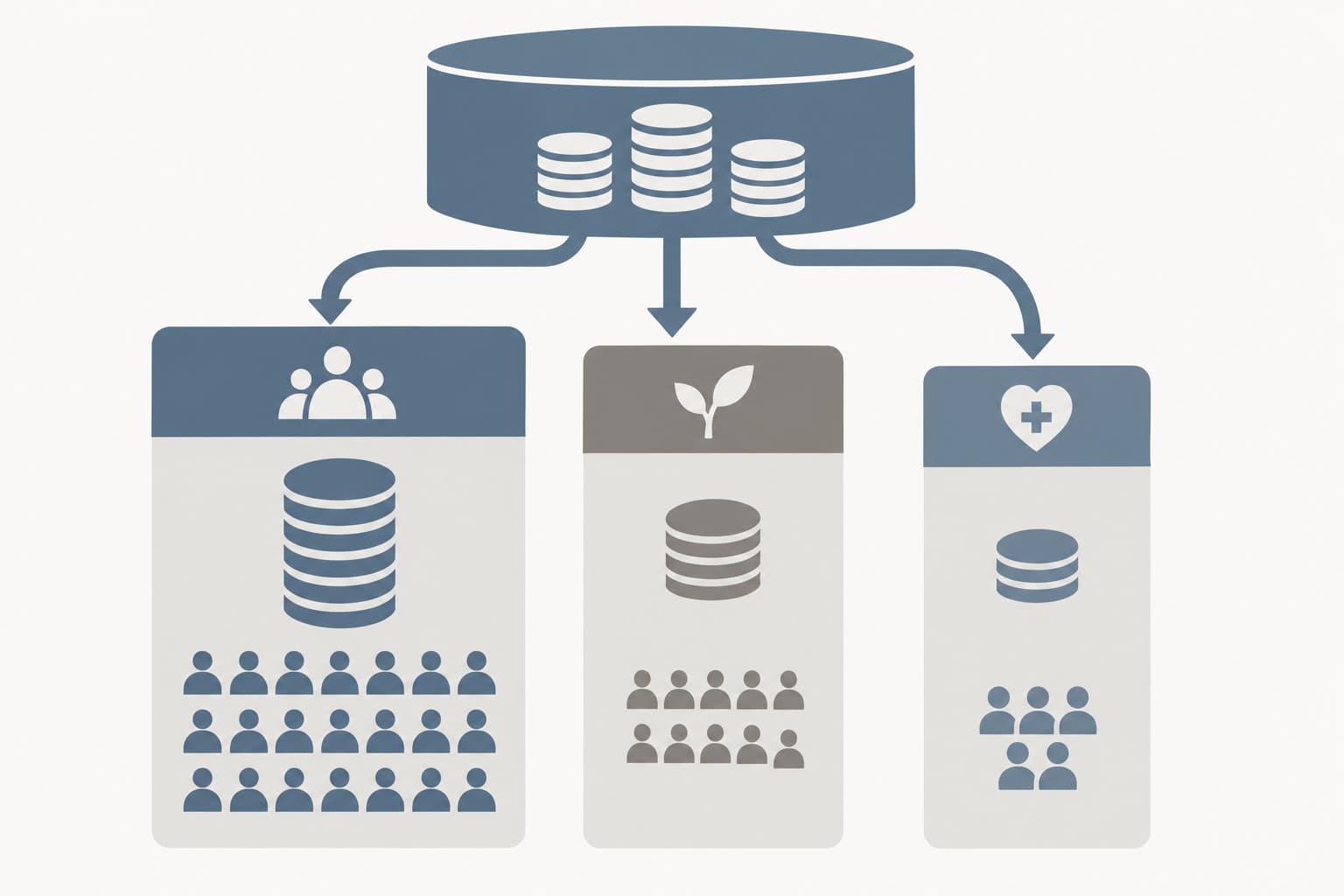
Allocating indirect costs to programs by FTE means dividing a shared cost pool among your programs in proportion to each program's headcount measured in full-time equivalents. An FTE is a staffing measure that expresses a position as a share of one full-time schedule, so part-time and full-time positions become comparable across programs.
The Uniform Guidance does not name FTE as the required base. It requires the base to track the benefit each activity receives and to rest on records you can produce on request. FTE meets that test for some cost pools and fails it for others.
Quick Answer: How Do You Allocate Indirect Costs to Programs by FTE?
Allocating indirect costs to programs by FTE spreads a shared cost pool across cost objectives in proportion to each program's share of full-time equivalent staff. FTE works when the cost being split follows people instead of space or dollars. The method must be documented, applied consistently, and supportable against records that show the actual staffing for the period.
What Allocating Indirect Costs to Programs by FTE Means
FTE allocation means spreading a cost pool in proportion to each program's full-time equivalent headcount, so a program carrying twice the staff absorbs twice the share of a shared cost. Allocation is defined in 2 CFR 200.1 as "the process of assigning a cost, or a group of costs, to one or more cost objective(s), in reasonable proportion to the benefit provided or other equitable relationship" (eCFR 2 CFR 200.1, current as of September 2026).
2 CFR 200.405(a) states the test: "A cost is allocable to a Federal award or other cost objective if the cost is assignable to that Federal award or other cost objective in accordance with the relative benefits received" (eCFR 2 CFR 200.405(a), current as of September 2026).
2 CFR 200.405(d) sets an order of preference (eCFR 2 CFR 200.405(d), current as of September 2026). Where a cost benefits two or more projects in proportions that can be determined without undue effort, it must be allocated on proportional benefit. Where proportions cannot be determined because of the interrelationship of the work involved, costs "may be allocated or transferred to benefitted projects on any reasonable documented basis" (eCFR 2 CFR 200.405(d), current as of September 2026). FTE sits in the second branch when an exact split is unknowable, and in the first when headcount tracks consumption.
2 CFR 200.405(b) requires that all activities which benefit from indirect cost, including unallowable activities and donated services, receive an appropriate allocation (eCFR 2 CFR 200.405(b), current as of September 2026). Fundraising therefore takes a share of the pool, and a base built only from program headcount strands that share on the programs instead.
FTE Versus Other Allocation Bases
FTE is the right base when the cost being divided tracks people, and it is the wrong base when the cost tracks space, contract volume, or equipment.
Appendix IV to 2 CFR part 200 names three distribution bases under the Simplified Allocation Method: total direct costs excluding capital expenditures and other distorting items such as subawards for $50,000 or more, direct salaries and wages, or "other base which results in an equitable distribution" (eCFR 2 CFR part 200, Appendix IV, section B.2.c, current as of September 2026). FTE is not on that list by name, and it does not need to be. The test at section B.3.c is "the one best suited for assigning the pool of costs to cost objectives in accordance with benefits derived; a traceable cause and effect relationship; or logic and reason" (eCFR 2 CFR part 200, Appendix IV, section B.3.c, current as of September 2026).
For jointly used space, Appendix IV allows allocation on the basis of "the employees and other users on a full-time equivalent (FTE) basis or salaries and wages of those individual functions benefitting from the use of that space," while depreciation on shared buildings follows usable square feet excluding common areas (eCFR 2 CFR part 200, Appendix IV, section B.3.c(1), current as of September 2026).
When FTE Is the Right Base for a Cost Pool
FTE is the right base for cost pools whose consumption rises with headcount: shared connectivity, office supplies, shared devices, and space several functions occupy together. The indirect cost rate guide BDO wrote for the Funders for Real Cost, Real Change collaborative names two default bases: "Staff level of effort (measured by staff FTEs or full-time equivalents) allocation methodology for costs that are generally driven by staff utilization, such as telephone/internet expenses, office supplies" and "Space/square-footage allocation methodology for occupancy-related costs (e.g., rent)" (BDO FMA Indirect Cost Rate Guide 2022 for Funders for Real Cost, Real Change, dated February 11, 2022).
The Simplified Allocation Method fits an organization whose major functions benefit from indirect costs to approximately the same degree. It separates total costs into direct and indirect, then divides total allowable indirect costs by an equitable distribution base, which must exclude participant support costs (eCFR 2 CFR part 200, Appendix IV, section B.2, current as of September 2026).
The Multiple Allocation Base Method fits an organization whose indirect costs benefit its major functions in varying degrees. It requires indirect costs to be accumulated into separate cost groupings, each allocated individually to benefitting functions by the base that best measures relative benefits (eCFR 2 CFR part 200, Appendix IV, section B.3.a, current as of September 2026). Appendix IV names four such groupings: Depreciation, Interest, Operation and maintenance expenses, and General administration and general expenses (eCFR 2 CFR part 200, Appendix IV, section B.3.b, current as of September 2026). An FTE base for one pool and a square-foot base for another sit side by side in the same schedule under this method.
The Direct Allocation Method treats all costs as direct except general administration and general expenses, then prorates joint costs such as depreciation, rental, telephone and information technology "using a base most appropriate to [the] particular cost being prorated" (eCFR 2 CFR part 200, Appendix IV, section B.4.a, current as of September 2026).
A Worked Example: Allocating Indirect Costs Across Programs by FTE
To allocate a shared pool by FTE, count the full-time equivalents behind each cost objective for the base period, divide each count by the total, and multiply the pool by each resulting share. Confirm that nothing in the pool is charged direct anywhere else, and tie the result to the general ledger before the period closes.
The composite organization runs three programs plus a fundraising function, with a staff-driven pool covering shared internet, devices and office supplies for one fiscal year.
Illustrative figures, not data from a real organization.
The same organization also runs a $96,000 occupancy pool covering rent and building depreciation, and its floor plan gives Program A 25 percent of usable square feet, Program B 31.25 percent, Program C 18.75 percent and fundraising 25 percent. Folding that pool into the staff pool and splitting the $160,000 total by FTE alone changes every program's total even though nothing about the work changed.
Illustrative figures, not data from a real organization.
In this composite example, an FTE-only split gives fundraising less of the occupancy pool than a space-based split does, so the difference lands on the programs. That is the whole argument for splitting pools before choosing a base.
FTE counts for staff who split their time come from the same effort records that support their salary charges, so they inherit the salary rules. Charges to Federal awards for salaries and wages must be based on records that accurately reflect the work performed, and budget estimates alone do not qualify as support for charges to Federal awards, though they may be used for interim accounting purposes (eCFR 2 CFR 200.430(g)(1) and (g)(1)(vii), current as of September 2026). Interim estimates work only with internal controls that "include processes to perform periodic after-the-fact reviews of interim charges," so the final amount charged is accurate, allowable and properly allocated (eCFR 2 CFR 200.430(g)(1)(vii)(C), current as of September 2026).

When a Funder Will Not Accept FTE Allocation
A funder will set FTE allocation aside in three situations: the funder's own terms fix the rate, the pool does not track staff, or the method contradicts how you treat that same cost everywhere else.
When the Funder's Own Terms Fix the Rate
On Federal awards, negotiated rates are not optional: "Negotiated indirect cost rates must be accepted by all Federal agencies," with deviation only when required by Federal statute or regulation or approved by the awarding Federal agency (eCFR 2 CFR 200.414(c)(1), current as of September 2026). Agencies and pass-through entities may not require you to use a rate lower than your negotiated rate or the rate you elected, unless a statute or regulation compels it (eCFR 2 CFR 200.414(f), current as of September 2026). The guide to indirect cost rates for federal grants explains how a negotiated rate is built and held.
Some foundations fix recovery on a project grant at a published percentage instead of negotiating it. The Ford Foundation states that "As of January 1, 2023, the Ford Foundation will pay a minimum indirect cost rate (IDC) of 25% for eligible project grants" (Ford Foundation FAQs, published November 1, 2022). A published rate settles what you recover on that grant. It says nothing about which program absorbed which shared cost, so the internal FTE split still runs and still has to hold up on its own.
When the Pool Does Not Track Staff
Rent follows floor space. Appendix IV requires depreciation on shared buildings to be allocated on usable square feet, excluding common areas such as hallways, stairwells and restrooms, so an FTE count is the wrong base for that pool (eCFR 2 CFR part 200, Appendix IV, section B.3.c(1)(b), current as of September 2026). The same appendix does allow an FTE base for jointly used space, where the question is who occupies a room and not how large the room is (eCFR 2 CFR part 200, Appendix IV, section B.3.c(1)(c), current as of September 2026). Splitting occupancy into its building depreciation and its shared-space components is what keeps both treatments defensible.
When the Method Conflicts With Your Own Books
2 CFR 200.403(d) requires consistent treatment: "a cost must not be assigned to a Federal award as a direct cost if any other cost incurred for the same purpose in like circumstances has been allocated to the Federal award as an indirect cost" (eCFR 2 CFR 200.403(d), current as of September 2026). 2 CFR 200.405(c) bars using allocation to move money around: a cost allocable to one Federal award "may not be charged to other Federal awards (for example, to overcome fund deficiencies or to avoid restrictions imposed by Federal statutes, regulations, or the terms and conditions of the Federal awards)" (eCFR 2 CFR 200.405(c), current as of September 2026). Adjusting FTE shares after a program runs short breaks that rule, however clean the spreadsheet looks.
Documenting FTE Allocation for Audit
An FTE allocation holds up when the counts come from records that reflect actual work, the method is written down before the period opens, and no line inside the pool is charged direct anywhere else.
The documentation standard starts in 2 CFR 200.400(d): accounting practices must be consistent with the cost principles and must maintain adequate documentation to support costs charged to the Federal award (eCFR 2 CFR 200.400(d), current as of September 2026). Your financial management system must maintain records that "sufficiently identify the amount, source, and expenditure of Federal funds," all "supported by source documentation" (eCFR 2 CFR 200.302(b)(3), current as of September 2026).
A practical file for an FTE method carries five items: the written policy naming the base and pools, the FTE schedule for the base period with effective dates, the calculation showing shares and pool amounts, the reconciliation to the general ledger, and any after-the-fact adjustment.
Your Form 990 filing runs on a different cut of the same costs (IRS, Instructions for Form 990, 2025). Part IX is the "Statement of Functional Expenses," with program services, management and general, and fundraising columns, and its instructions carry a dedicated "Allocating Indirect Expenses" heading (IRS, Instructions for Form 990, 2025). When the grant allocation schedule and the functional split give different answers for the same pool, keep a written reconciliation that explains the difference.
Our award-start checklist lists what to capture from the award document when the award starts.
Each award's approved budget can sit in GrantCue while the allocation schedule stays with the accounting records. Its Team plan, at $109 a month, adds post-award budget versus actuals to the kanban-style award pipeline, and full budget planning templates and spenddown tracking start on Organization at $229 a month (grantcue.com, September 2026). The GrantCue plans that include budget tracking are listed side by side.

FAQ
What does allocating indirect costs to programs by FTE mean?
Allocating indirect costs to programs by FTE means dividing a shared cost pool across cost objectives in proportion to each program's share of full-time equivalent staff. You count the FTEs behind each cost objective for the base period, divide each count by the total, and multiply the pool by each share. It suits a pool only when that pool's consumption rises with staff.
When is FTE a good allocation base for indirect costs?
FTE is a good base when consumption of the pool rises with headcount: shared internet, office supplies, shared devices, and space several functions occupy together. The indirect cost rate guide BDO wrote for the Funders for Real Cost, Real Change collaborative names staff FTE as the default methodology for costs "generally driven by staff utilization" (BDO FMA Indirect Cost Rate Guide 2022 for Funders for Real Cost, Real Change, dated February 11, 2022).
What is the alternative to allocating indirect costs by FTE?
Appendix IV to 2 CFR part 200 names total direct costs (excluding capital expenditures and other distorting items, such as subawards for $50,000 or more), direct salaries and wages, or another base that gives an equitable distribution (section B.2.c), and it requires usable square feet for depreciation on shared buildings (section B.3.c(1)(b)) (eCFR, current as of September 2026).
How do you calculate an FTE allocation for a cost pool?
Count the full-time equivalents behind each cost objective for the base period, total them, divide each program's count by the total to get its share, then multiply the pool by each share. Treat a half-schedule position as half an FTE. Check that the shares reconcile to the full pool and that no employee's recorded distribution exceeds their compensated activities (eCFR 2 CFR 200.430(g)(1)(iii), current as of September 2026).
Do funders accept FTE allocation of indirect costs?
On federal awards, "Negotiated indirect cost rates must be accepted by all Federal agencies" (eCFR 2 CFR 200.414(c)(1), current as of September 2026), and the base behind that rate has to meet Appendix IV's test: benefits derived, a traceable cause and effect relationship, or logic and reason. Some foundations publish a fixed rate for project grants instead, which sets what you recover but leaves the internal split on your documented base.
How do you document FTE allocation for a single audit?
Keep the written policy naming the base and pools, the FTE schedule with effective dates, and the reconciliation to the general ledger. Records must "sufficiently identify the amount, source, and expenditure of Federal funds," supported by source documentation (eCFR 2 CFR 200.302(b)(3), current as of September 2026). A single audit applies once an entity expends $1,000,000 or more in Federal awards in its fiscal year (eCFR 2 CFR 200.501(a), current as of September 2026).
Setting Up FTE Allocation Before the Next Budget Cycle
Write the policy first: which costs sit in the pool, which base applies to each pool, and which fiscal window the FTE counts cover. Appendix IV states the base period normally should coincide with the organization's fiscal year (eCFR 2 CFR part 200, Appendix IV, section B.1.e, current as of September 2026).
Build the FTE schedule once, with employee, cost objective, percent, effective dates and approver, drawn from the payroll records for the period, and recompute the shares each period. The same shares give the next proposal budget you draft a documented basis for each program's portion of shared costs.
The allocation is done when you can hand a reviewer the policy, the counts, the calculation and the ledger tie-out without contradiction.