Modified Total Direct Costs and Your Indirect Rate
What modified total direct costs include and exclude, how the MTDC base sets a federal indirect rate, and how to run a clean calculation for federal awards.

Last updated: October 2026
On a federal grant, an indirect rate charged on modified total direct costs is really two things: a percentage, and the base that percentage multiplies. The base is where the money is won or lost. A rate means little until you know what it multiplies, and federal rules define that base in one place, with a fixed list of what counts and what does not.
The base comes from one paragraph of regulation text, and getting it wrong in either direction costs real money. Overstate it and the indirect charge exceeds what the rule allows. Understate it and the organization absorbs shared costs it was entitled to recover.
Quick Answer: What Is the MTDC Base for an Indirect Rate?
Modified total direct costs is the base for the de minimis rate, which 2 CFR 200.414(f) caps at 15 percent. Under 2 CFR 200.1 it covers direct salaries and wages, fringe benefits, supplies, services, travel and the first $50,000 of each subaward, and excludes equipment, capital expenditures, rent, patient care, tuition remission, scholarships, participant support and subaward amounts over $50,000.
Modified Total Direct Costs and the Indirect Rate in Plain Terms
Modified Total Direct Cost is a base that sets the dollars an indirect rate applies to. The definition lives in the Uniform Guidance definitions section, so the same list applies wherever a federal award uses an MTDC base (eCFR 2 CFR 200.1, current as of September 2026).
The regulation states the included side this way: "Modified Total Direct Cost (MTDC) means all direct salaries and wages, applicable fringe benefits, materials and supplies, services, travel, and up to the first $50,000 of each subaward (regardless of the period of performance of the subawards under the award)" (eCFR 2 CFR 200.1, current as of September 2026). Each element in the quoted definition belongs in the base. Each subaward contributes only its capped slice.
2 CFR 200.1 states the excluded side in one sentence: "MTDC excludes equipment, capital expenditures, charges for patient care, rental costs, tuition remission, scholarships and fellowships, participant support costs, and the portion of each subaward in excess of $50,000" (eCFR 2 CFR 200.1, current as of September 2026).
Two related definitions keep the base honest. The regulation provides that "Indirect cost means those costs incurred for a common or joint purpose benefitting more than one cost objective and not readily assignable to the cost objectives specifically benefitted, without effort disproportionate to the results achieved" (eCFR 2 CFR 200.1, current as of September 2026). Its opposite is the traceable kind: "Direct costs are those costs that can be identified specifically with a particular final cost objective, such as a Federal award, or other internally or externally funded activity, or that can be directly assigned to such activities relatively easily with a high degree of accuracy" (eCFR 2 CFR 200.413(a), current as of September 2026).
| Side of the base | What belongs there |
|---|---|
| Counts in MTDC | Direct salaries and wages, applicable fringe benefits, materials and supplies, services, travel, capped slice of each subaward |
| Stays out of MTDC | Equipment, capital expenditures, patient care charges, rental costs, tuition remission, scholarships and fellowships, participant support costs, subaward sums above the cap |
Source: eCFR 2 CFR 200.1, current as of September 2026.
One more sentence in the definition handles special cases. Items beyond that list "may only be excluded [from MTDC] when necessary to avoid a serious inequity in the distribution of indirect costs and with the approval of the cognizant agency for indirect costs" (eCFR 2 CFR 200.1, current as of September 2026).
Indirect Cost Rate for Federal Grants
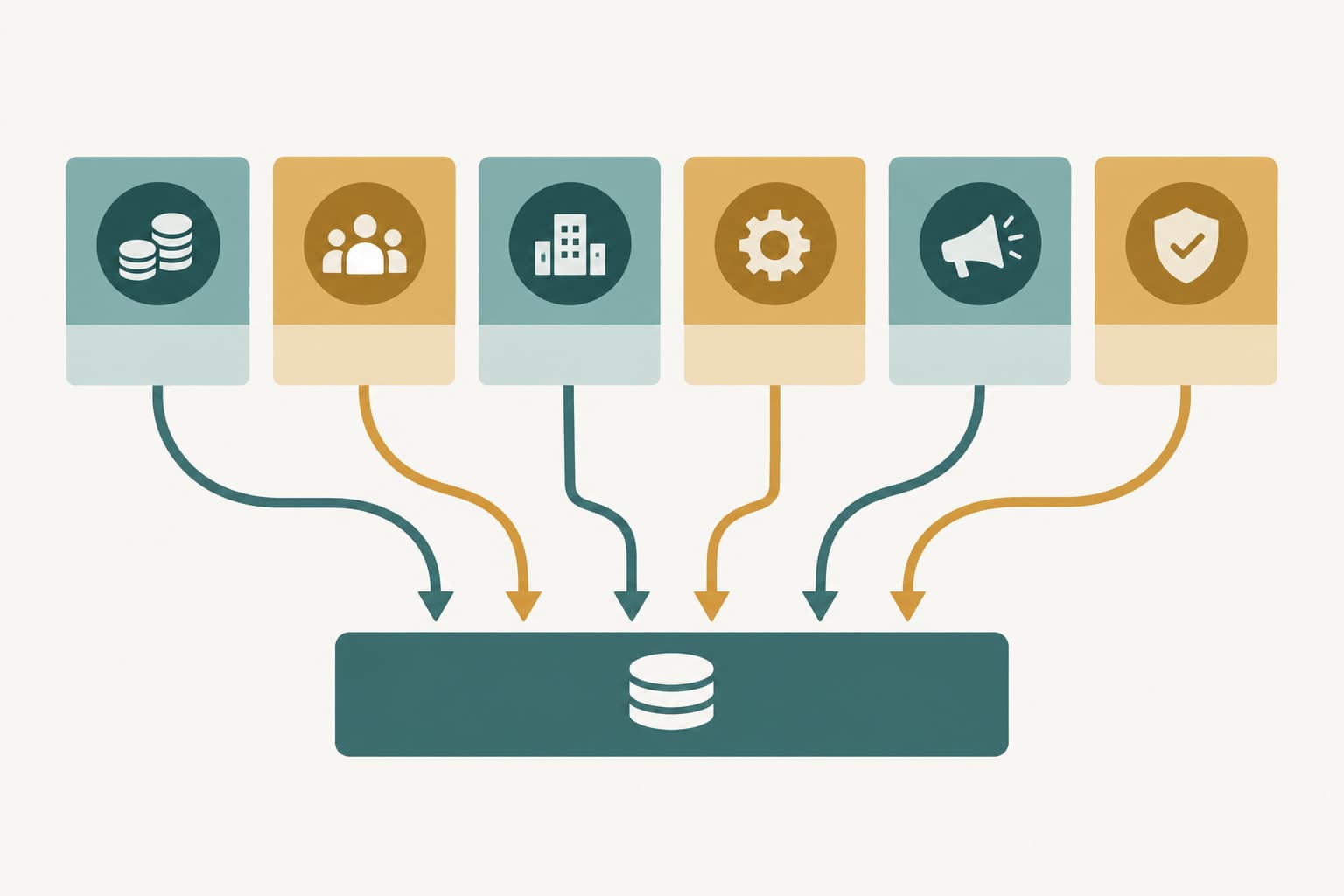
An indirect cost rate for federal grants is a ratio that converts shared costs into award dollars through a base, which for the de minimis rate is MTDC. The total cost rule behind it states that "The total cost of a Federal award is the sum of the allowable direct and allocable indirect costs minus any applicable credits" (eCFR 2 CFR 200.402, current as of September 2026).
Consistent treatment protects that bridge. The cost principles provide that under 2 CFR 200.403(d), "a cost must not be assigned to a Federal award as a direct cost if any other cost incurred for the same purpose in like circumstances has been allocated to the Federal award as an indirect cost" (eCFR 2 CFR 200.403(d), current as of September 2026).
Negotiated rates carry across agencies once set. The regulation at 2 CFR 200.414(c)(1) states that "Negotiated indirect cost rates must be accepted by all Federal agencies," with deviation only "when required by Federal statute or regulation, or when approved by the awarding Federal agency" (eCFR 2 CFR 200.414(c)(1), current as of September 2026). The written agreement that records the negotiation is the NICRA, since "The results of each negotiation must be formalized in a written agreement between the cognizant agency for indirect costs and the nonprofit organization" (eCFR 2 CFR part 200, Appendix IV, section C.2.g, current as of September 2026).
Our companion guide to indirect cost rates explains rate types and negotiation in more depth.
De Minimis Indirect Cost Rate
The de minimis indirect cost rate is a simple federal path that avoids negotiation. Recipients and subrecipients without a current federally negotiated rate "may elect to charge a de minimis rate of up to 15 percent of modified total direct costs (MTDC)" under 2 CFR 200.414(f) (eCFR 2 CFR 200.414(f), current as of September 2026).
Election is voluntary and stable. The same paragraph states that "The de minimis rate does not require documentation to justify its use and may be used indefinitely," and that "Recipients and subrecipients are not required to use the de minimis rate" (eCFR 2 CFR 200.414(f), current as of September 2026).
The rate demands clean books in exchange for that simplicity. The same paragraph requires that "When applying the de minimis rate, costs must be consistently charged as either direct or indirect costs and may not be double charged or inconsistently charged as both" (eCFR 2 CFR 200.414(f), current as of September 2026).
Agencies cannot push the rate down by preference: "Federal agencies and pass-through entities may not require recipients and subrecipients to use a de minimis rate lower than the negotiated indirect cost rate or the rate elected pursuant to this subsection unless required by Federal statute or regulation" (eCFR 2 CFR 200.414(f), current as of September 2026). Our checklist of federal award terms shows where that check fits among the others.

How to Calculate the Indirect Cost Rate for Federal Grants
Calculating an indirect cost rate means dividing a pool of indirect costs by a distribution base, while applying one means multiplying your base by the rate you hold or elect. Under Appendix IV's Simplified Allocation Method, used where an organization's major functions benefit from its indirect costs to approximately the same degree, a nonprofit computes its own rate by "dividing the total allowable indirect costs (net of applicable credits) by an equitable distribution base" (eCFR 2 CFR part 200, Appendix IV, section B.2.a, current as of September 2026), and the rate it negotiates is recorded in a NICRA.
An organization that elects the de minimis rate skips that step and applies up to 15 percent to MTDC under 2 CFR 200.414(f). A clean MTDC calculation follows four passes: list direct lines, remove exclusions, cap subawards, then multiply. Each pass uses the definition in 2 CFR 200.1 (eCFR 2 CFR 200.1, current as of September 2026).
Start by listing every direct line the award will charge. Include project salaries, the fringe tied to those salaries, project materials and supplies, project services, and project travel. These are the categories the MTDC definition names as included (eCFR 2 CFR 200.1, current as of September 2026). Charges for salaries and wages must rest on records that reflect work performed, as 2 CFR 200.430(g)(1) requires that "Charges to Federal awards for salaries and wages must be based on records that accurately reflect the work performed" (eCFR 2 CFR 200.430(g)(1), current as of September 2026).
Remove the excluded categories in full. Strip equipment, capital spending, patient care charges, rent, tuition remission, scholarships and fellowships, and participant support from the base, since MTDC excludes each of them by name (eCFR 2 CFR 200.1, current as of September 2026). Participant support costs are direct costs that aid participants, since "Participant support costs means direct costs that support participants … such as stipends, subsistence allowances, travel allowances, registration fees, temporary dependent care, and per diem paid directly to or on behalf of participants" (eCFR 2 CFR 200.1, current as of September 2026).
Cap each subaward before adding it. Only the capped slice enters the base, because MTDC includes "up to the first $50,000 of each subaward" and excludes "the portion of each subaward in excess of $50,000" (eCFR 2 CFR 200.1, current as of September 2026). A payment to a contractor is not a subaward, since a subaward "does not include payments to a contractor, beneficiary, or participant" (eCFR 2 CFR 200.1, current as of September 2026).
This worked example uses composite figures for a mid-size project year, applying the de minimis ceiling of "up to 15 percent of modified total direct costs (MTDC)" (eCFR 2 CFR 200.414(f), current as of September 2026).
| Budget line | Award total | In MTDC |
|---|---|---|
| Direct salaries and wages | $180,000 | $180,000 |
| Applicable fringe benefits | $45,000 | $45,000 |
| Materials and supplies | $22,000 | $22,000 |
| Services | $30,000 | $30,000 |
| Staff travel | $12,000 | $12,000 |
| Equipment | $40,000 | $0 |
| Rental costs | $24,000 | $0 |
| Participant support costs | $18,000 | $0 |
| Subaward A | $80,000 | $50,000 |
| Subaward B | $30,000 | $30,000 |
| Total direct costs | $481,000 | |
| MTDC base | $369,000 | |
| Indirect at the 15 percent de minimis ceiling | $55,350 |
Illustrative figures, not data from a real organization.
Add the included direct lines plus the capped subaward slices to reach the MTDC base. Multiply that base by the elected rate, up to the de minimis ceiling of 15 percent (eCFR 2 CFR 200.414(f), current as of September 2026). Add the resulting indirect back to total direct costs for the full award cost, $536,350 in this composite, since "The total cost of a Federal award is the sum of the allowable direct and allocable indirect costs minus any applicable credits" (eCFR 2 CFR 200.402, current as of September 2026).
De Minimis Indirect Cost Rate in 2026: What Changed and Where It Applies
The 15 percent ceiling arrived with the 2024 revision of the Uniform Guidance, and OMB set the switchover date itself: "The effective date for the final guidance is October 1, 2024," with agencies permitted to apply it earlier but "no earlier than June 21, 2024" (Federal Register, Guidance for Federal Financial Assistance, 89 FR 30136, published April 22, 2024). A budget template written before that date, or a funder form still printing the pre-2024 figure from 2 CFR 200.414(f), is quoting a rule that no longer exists, and copying it leaves recovery on the table.
Scope is the other thing to hold on to. The de minimis figure is a share of MTDC, never a share of the whole grant, and the gap between the two widens with every excluded line (eCFR 2 CFR 200.1 and 2 CFR 200.414(f), current as of September 2026). In the composite year, 15 percent of all $481,000 in direct costs would claim $72,150, while 15 percent of the $369,000 MTDC base, the amount 2 CFR 200.414(f) allows, is $55,350. An award loaded with equipment recovers far less than its headline size suggests.

Indirect Rate for Federal Grants and Subawards
A pass-through entity must accept a subrecipient's federally negotiated rate. The regulation at 2 CFR 200.414(d) states that pass-through entities "must accept all federally negotiated indirect costs rates for subrecipients" (eCFR 2 CFR 200.414(d), current as of September 2026). The pass-through entity must not substitute the de minimis path, since the subaward rules provide that "The pass-through entity must not require the use of the de minimis indirect cost rate if the subrecipient has an approved indirect cost rate negotiated with the Federal Government" (eCFR 2 CFR 200.332(b)(4)(ii), current as of September 2026).
Where no approved rate exists, the two sides set one together. The subaward rules require that where no approved rate exists, "a pass-through entity must determine the appropriate rate in collaboration with the subrecipient," choosing either a negotiated pass-through rate or "The de minimis indirect cost rate" (eCFR 2 CFR 200.332(b)(4)(i), current as of September 2026). Our list of setup steps after an award covers what follows.
Whatever rate the budget carries, the approved figures have to survive into tracking. GrantCue's Team plan, at $109 a month, holds post-award budget versus actuals and payment schedules beside each award's deadlines in its kanban-style pipeline, with full spenddown tracking on Organization at $229 a month (grantcue.com, September 2026). Tracking the approved budget in GrantCue keeps the indirect line beside the actuals it is measured against.
FAQ
What Is the De Minimis Indirect Cost Rate?
The de minimis indirect cost rate is the federal no-negotiation path for recipients and subrecipients without a current federally negotiated rate. Those organizations may elect up to 15 percent of MTDC, need no documentation to justify the choice, and may keep using it indefinitely (eCFR 2 CFR 200.414(f), current as of September 2026).
Where Is the MTDC Definition in the eCFR?
The definition sits in 2 CFR 200.1, the definitions section of the Uniform Guidance, under the entry "Modified Total Direct Cost (MTDC)" (eCFR, current as of September 2026). The de minimis rate that uses it as a base is in 2 CFR 200.414(f). Both reflect the 2024 revision, which took effect on October 1, 2024 (Federal Register, 89 FR 30136, published April 22, 2024).
What Is the Indirect Cost Rate for Federal Grants?
The indirect cost rate for federal grants is either a federally negotiated rate recorded in a NICRA or the elected de minimis rate of up to 15 percent of MTDC (eCFR 2 CFR 200.414(f), current as of September 2026). Federal agencies must accept current negotiated rates with narrow exceptions (eCFR 2 CFR 200.414(c)(1), current as of September 2026). Organizations without one may elect the de minimis path.
What Does 2 CFR 200.414(f) Say About the De Minimis Rate?
Section 2 CFR 200.414(f) is the paragraph that authorizes the de minimis election of up to 15 percent of MTDC for recipients and subrecipients without a current federally negotiated rate (eCFR 2 CFR 200.414(f), current as of September 2026). It also bars Federal agencies and pass-through entities from requiring a lower rate unless a Federal statute or regulation requires it.
Does MTDC Include Subawards?
Under 2 CFR 200.1, only the first $50,000 of each subaward counts, however long that subaward runs. MTDC includes "up to the first $50,000 of each subaward (regardless of the period of performance of the subawards under the award)" and excludes "the portion of each subaward in excess of $50,000" (eCFR 2 CFR 200.1, current as of September 2026). A payment to a contractor is not a subaward, so the cap does not apply to it.
Does the De Minimis Rate Apply to the Whole Grant?
No. The de minimis rate applies to MTDC only, never to total award spending. Presenting it as a share of the whole grant overstates recovery, because the base excludes equipment, capital items, participant support, tuition, rent, patient care and subaward sums above the cap (eCFR 2 CFR 200.1 and 2 CFR 200.414(f), current as of September 2026).
Check Your Base Before You Sign the Budget
Run the MTDC pass before the budget locks, not after the award starts. List the included lines, strike the excluded lines, cap each subaward at the rule that keeps "up to the first $50,000 of each subaward" in the base (eCFR 2 CFR 200.1, current as of September 2026), and multiply by the elected or negotiated rate. File the NICRA or the de minimis election memo with the signed budget so the next review starts from the same base.