Grant Reporting Requirements: What Funders Expect and a Progress Report Template
What grant reporting requirements cover: financial and performance reports, 2 CFR 200 deadlines, frequency by funder type, and a reusable progress report template.
In this article (14)
- Quick Answer: What Are Grant Reporting Requirements?
- What Is Grant Reporting?
- The Three Types of Grant Reports
- Federal Grant Reporting Requirements Under 2 CFR 200
- Grant Reporting Frequency by Funder Type
- Grant Reporting Template: A Progress Report You Can Fill In
- How to Show Impact When Outcomes Are Still in Progress
- What to Do When You Will Miss a Reporting Deadline
- What to Do When the Numbers Look Bad
- Grant Reporting Mistakes That Cost Renewals
- Grant Reporting Tools and Tracking
- Grant Reporting Best Practices
- FAQ
- Next Step
Grant reporting requirements are the conditions in an award agreement that tell you what to submit, in what format, and by when. Most awards carry at least two. A financial report shows how the money was spent, and a performance report shows what it produced. Federal awards add a layer of rules on top, set out in Uniform Guidance 2 CFR 200 grant management. This guide covers the three report types, federal deadlines with section numbers, frequency by funder, and a progress report template. A longer fill-in version, with a free Word download, is in our grant progress report template.
Quick Answer: What Are Grant Reporting Requirements?
Grant reporting requirements are a funder's rules for documenting spending and results during and after an award. They usually include:
- A financial report that shows spending against the approved budget.
- A performance report that compares accomplishments to the objectives in your proposal.
- A final report for the whole period of performance.
- A submission schedule, plus the official portal or form you have to use.
On federal awards, reports are collected no more often than quarterly and no less than annually, and final reports are due within 120 calendar days after the period of performance ends (2 CFR 200.328, 200.329, 200.344, verified October 6, 2026).
What Is Grant Reporting?
Grant reporting is the set of scheduled submissions a funded organization sends its funder to document how an award was spent and what it produced. It is a condition of the money. The award agreement binds you, not the funder's website.
The funder sets the format and the deadline. On federal awards the financial report also carries a signed certification from someone authorized to legally bind the organization. That certification references penalties for false statements under 18 U.S.C. 1001 and 31 U.S.C. 3729-3730 (2 CFR 200.415(a), verified October 6, 2026). Reporting feeds the next decision too, because renewal reviewers read your last progress report before your new proposal.
The Three Types of Grant Reports
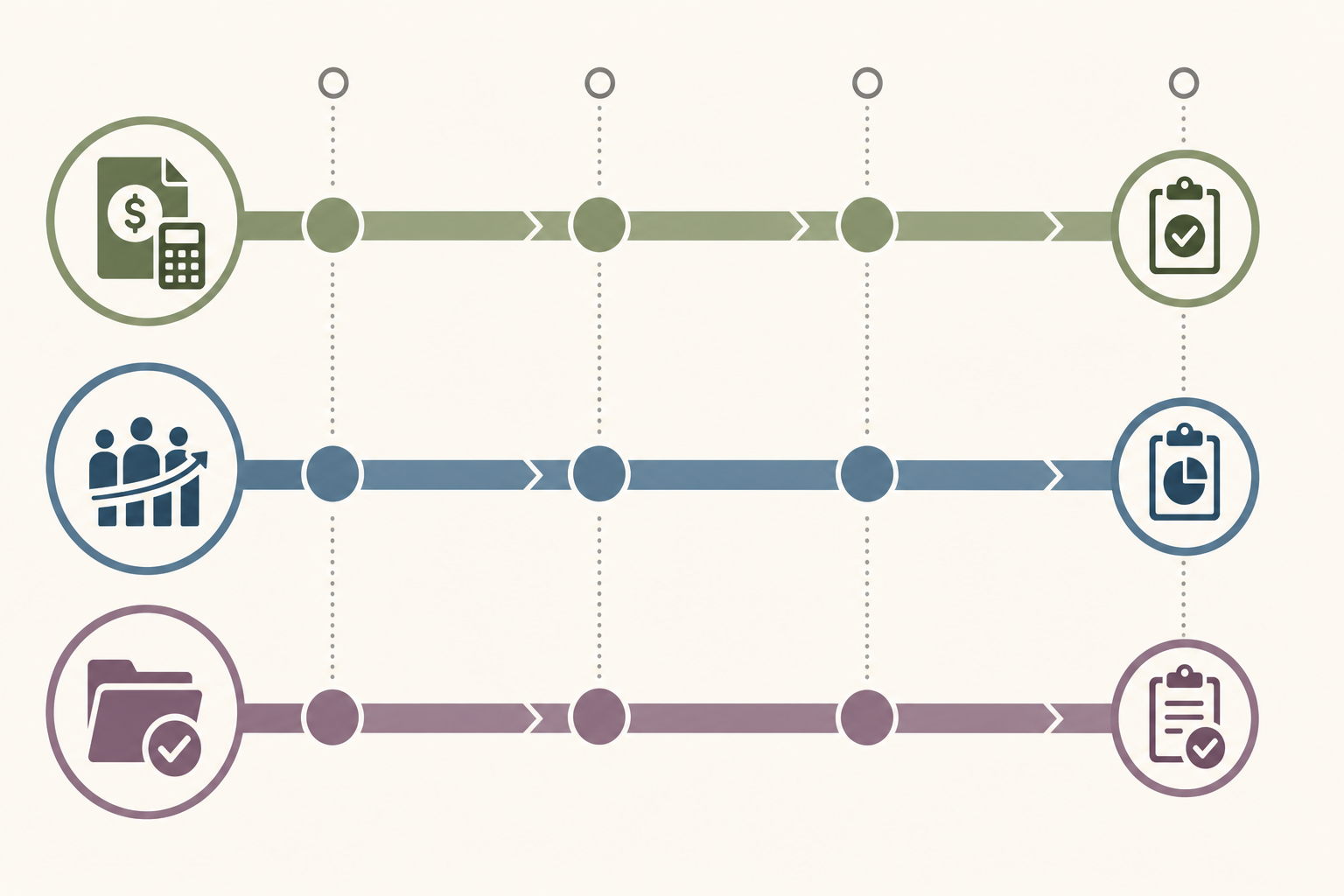
Grant reports fall into three categories. Financial reports cover the money, performance reports cover the results, and the final report covers the whole award. Some funders combine them into one form. Federal agencies keep them separate, though the rules say due dates should be aligned where practicable (2 CFR 200.329(b)).
Two smaller types catch teams out. Reports on real property in which the federal government retains an interest are due at least annually (2 CFR 200.330). First-tier subawards of $30,000 or more must be reported by the end of the month after the month they were issued (2 CFR Part 170, Appendix A, verified October 6, 2026).
Federal Grant Reporting Requirements Under 2 CFR 200
Federal reporting rules sit in Subpart D of 2 CFR Part 200, mainly sections 200.328 and 200.329. Values below were read from eCFR on October 6, 2026.
One row in that table is easy to miss. Section 200.329(e) makes a significant problem a reporting obligation in its own right, not something to hold until the next scheduled report.
An organization that expends $1,000,000 or more in federal awards during its fiscal year must also have a single or program-specific audit (2 CFR 200.501(a)), with the reporting package due within 30 calendar days after receiving the auditor's report or nine months after the audit period ends, whichever is earlier (2 CFR 200.512(a)(1)). That threshold replaced $750,000 under the OMB final rule published April 22, 2024.
Grant Reporting Frequency by Funder Type
Federal agencies work inside the 2 CFR 200 window. Private foundations set their own schedules and are not bound by federal rules.
The NSF annual report deadline runs before the budget period closes, not after. Teams that assume every report is retrospective miss it. NIH's dates are in NIH Grants Policy Statement 8.4.1 and its RPPR instruction guide, and NSF's are on Report Your Progress and Outcomes.
Grant Reporting Template: A Progress Report You Can Fill In
The template below has ten sections. It follows the federal Research Performance Progress Report format, whose only mandatory component is Accomplishments (NSF, Research Performance Progress Reports policy page, verified October 6, 2026), and it maps onto foundation narrative forms too.
Examples are a composite illustration, not a real grantee: a two-year, $120,000 award to a small after-school literacy program, reporting at the end of year one.
1. Identifying information. Award number, project title, recipient, reporting period, contact, date submitted.
2. Period summary. Three to five sentences a reviewer can read without opening anything else. Prompt: if the funder reads only this box, what do they need to know?
Example: "We enrolled 84 students against a target of 90 and delivered 132 of a planned 140 tutoring sessions. Reading assessments were administered in May. Spending is at 46 percent of budget, under plan because a tutor position was filled two months late."
3. Accomplishments against stated objectives. Restate each objective from the proposal verbatim, then report against it. Recipients must relate accomplishments to the goals and objectives of the award (2 CFR 200.329(b)), and the comparison belongs against the objectives set for the reporting period (2 CFR 200.329(c)(2)(i)).
Example: "Objective 2: increase weekly attendance to 70 percent. Result: average weekly attendance was 63 percent across 32 program weeks, drawn from daily sign-in sheets."
4. Activities and outputs. Counts of what you did: sessions delivered, people trained, materials produced, sites opened. Every count should reconcile to a source document.
5. Outcomes and evidence. What changed for participants, and how you know. Name the instrument and the sample size, and report against the measures you proposed. A grant proposal evaluation plan written well at the application stage keeps the outcomes section short.
6. Participants and partners. Who worked on the project, in what role, at what effort level, and which partners contributed. Staffing gaps belong here, because they explain underspending and missed targets.
7. Changes and problems. Deviations from the plan, delays, staffing changes, budget shifts, and anything that required funder approval. Prompt: what would the program officer be annoyed to learn later?
8. Budget and spending status. Spend to date by budget line, percentage drawn, and an explanation of any line more than roughly 10 percent off plan. Federal reporting asks specifically for explanation of cost overruns or higher-than-expected unit costs (2 CFR 200.329(c)(2)(iii)).
9. Plan for the next period. What happens next, including corrective action for missed targets.
10. Attachments. Photos, participant quotes with consent, assessment summaries, partner letters, required certifications.

The template only holds up if the objective wording matches the proposal exactly and the counts and spending figures come from one tracking record.
How to Show Impact When Outcomes Are Still in Progress
Report the leading indicators you have rather than the lagging outcome you do not. A funder reading a year-one report already knows the year-three outcome is not available. Five things count as legitimate mid-grant evidence:
- Outputs delivered. Sessions, enrollments, units distributed, hours of service, each with a source document behind it.
- Reach and retention. Who you reached, how that compares to the population in your proposal, how many stayed.
- Interim measures. Pre-test scores, baseline surveys, attendance trends, waitlist size, referral volume.
- Qualitative signal. Participant and staff observations, quoted with permission and labeled as qualitative.
- Systems built. A trained team, a signed data-sharing agreement, an assessment instrument in use.
If your proposal included a logic model, use it as the reporting spine: inputs and activities in year one, outputs and short-term outcomes in year two, long-term outcomes at closeout. Say plainly when data is not yet available, and give the date it will be.
What to Do When You Will Miss a Reporting Deadline
Ask for an extension in writing before the deadline, with a specific reason and a specific new date. On federal awards the agency or pass-through entity may extend the due date for any financial or performance report with justification from the recipient (2 CFR 200.328(d) and 200.329(c)(1), verified October 6, 2026).
An extension request needs four parts:
- Award number, report type, and current due date.
- The reason, stated concretely. A finance lead on leave, or a subrecipient invoice that has not arrived.
- The new date you are committing to.
- What you can send now, such as the financial section on time with the narrative to follow.
Send it to the program officer and the grants management specialist, and keep the email with the award record.
The consequences of missing a report without notice are written into the rule. A federal agency may withhold payments, disallow costs, suspend or terminate the award, initiate suspension or debarment proceedings, or withhold future funding (2 CFR 200.339). Failure to submit all final reports must be recorded in SAM.gov as a material failure to comply (2 CFR 200.344(i)), where every agency reviewing your next application can see it.
What to Do When the Numbers Look Bad
Report the real number, explain the cause, and state the correction. Federal performance reports should explain why established goals or objectives were not met (2 CFR 200.329(c)(2)(ii)). A shortfall with a documented cause is a compliant report. A padded one is a false statement on a certified document.
Do not wait for the next scheduled report if the problem is material. When a significant development arises between reporting due dates, including problems, delays, or adverse conditions affecting your milestones, you must notify the funder and include a plan for corrective action and any assistance needed (2 CFR 200.329(e)).
A short structure for the disclosure:
- The number. "We served 84 of 90 planned students."
- The variance. "That is 93 percent of target."
- The cause. "One of two tutor positions sat vacant from September to November."
- What you did. "We raised the wage band, filled the role in December, and enrollment recovered by February."
- What it means. "We expect to reach the year-two target of 90 without a budget modification."
Do not restate the target as if it had been lower, and do not swap in a different measure without flagging it. Never sign a financial report you have not reconciled: the certification in 2 CFR 200.415(a) carries penalties.
Underspending needs the same treatment. Unobligated funds have to be refunded at closeout (2 CFR 200.344(e)), so a balance first disclosed at the end is usually money returned. Raise it at six months with a proposed budget revision and you can often still spend it.
Grant Reporting Mistakes That Cost Renewals
Almost none of the reporting mistakes that cost renewals are dramatic. Most are process failures that nobody caught until the report was already due.
Work you defer during the award still has to happen at closeout. The grant closeout checklist covers what a clean finish requires, and most of it is easier when the interim reports were accurate.
Grant Reporting Tools and Tracking
Across a portfolio, the schedule is harder to manage than the writing: what is due in the next 90 days, who owns it, and what is stuck waiting on data nobody has collected.

A reporting system needs to hold five things per award: every due date with its report type and portal, the owner of each section, the status of the underlying data, the objectives and measures copied from the proposal, and submitted copies with portal confirmations. Reporting is one stage of wider grants lifecycle management, which follows each award from application to closeout.
Spreadsheets handle this while the portfolio is small. As it grows the failure mode is predictable: the sheet stops being updated, and the real schedule ends up in one person's head. Grant reporting software keeps deadlines, tasks, documents, and award records in the same place, so the schedule survives a staffing change. GrantCue does that, and shows what is due across the whole portfolio alongside grant discovery on federal and state portals.
Grant Reporting Best Practices
Good reporting is mostly scheduling and record-keeping done early.
- Extract every reporting requirement from the award agreement in the first week and load the dates.
- Set internal due dates two weeks ahead of funder deadlines for narrative reports.
- Keep the proposal open while you draft, and report against what was promised.
- Reconcile the financial report before the narrative is finalized so both cite the same figures.
- Note where each number came from, and save the submission confirmation with the award record.
Reporting is one piece of the wider obligations in 2 CFR 200 grant management, which also covers allowable costs, procurement, property, and records.
Reporting is one slice of a wider obligation; the compliance checklist covers the rest, from procurement to audit readiness.
FAQ
What does grant reporting mean?
Grant reporting means submitting the documentation a funder requires during and after an award, showing how the money was spent and what results it produced. It normally includes a financial report, a progress report, and a final report, on the funder's schedule and in its format.
How often do you have to report on a federal grant?
Federal agencies and pass-through entities must collect financial and performance reports no less than annually and no more frequently than quarterly, unless a specific condition has been imposed under 2 CFR 200.208. Annual reports are due within 90 calendar days after the reporting period, quarterly and semiannual reports within 30 (2 CFR 200.328 and 200.329, verified October 6, 2026).
What is the difference between a financial report and a progress report?
A financial report documents expenditures against the approved budget and is usually filed by finance on a standard form such as the SF-425. A progress report documents activities, outputs, and outcomes against the objectives in the proposal, and is usually drafted by program staff.
What happens if you miss a grant reporting deadline?
The agency may withhold payments, disallow costs, suspend or terminate the award, begin debarment proceedings, or withhold future funding (2 CFR 200.339). Failure to submit all final reports is recorded in SAM.gov as a material failure to comply (2 CFR 200.344(i)).
Is there a standard grant reporting form?
For federal financial reporting, yes: agencies may require only OMB-approved government-wide data elements, currently the SF-425 Federal Financial Report (2 CFR 200.328(a)). For performance reporting on research awards, agencies use OMB-approved collections such as the Research Performance Progress Report. Foundations use their own forms.
Next Step
Pull the award agreements for every active grant and write down the report type, due date, portal, and owner for each. If any of them name a report that is not already on someone's calendar, start there. Then confirm the data behind each report is being collected now, not reconstructed later. Reporting is the part of post-award grant management the funder actually sees, and the obligations behind it are in Uniform Guidance 2 CFR 200.